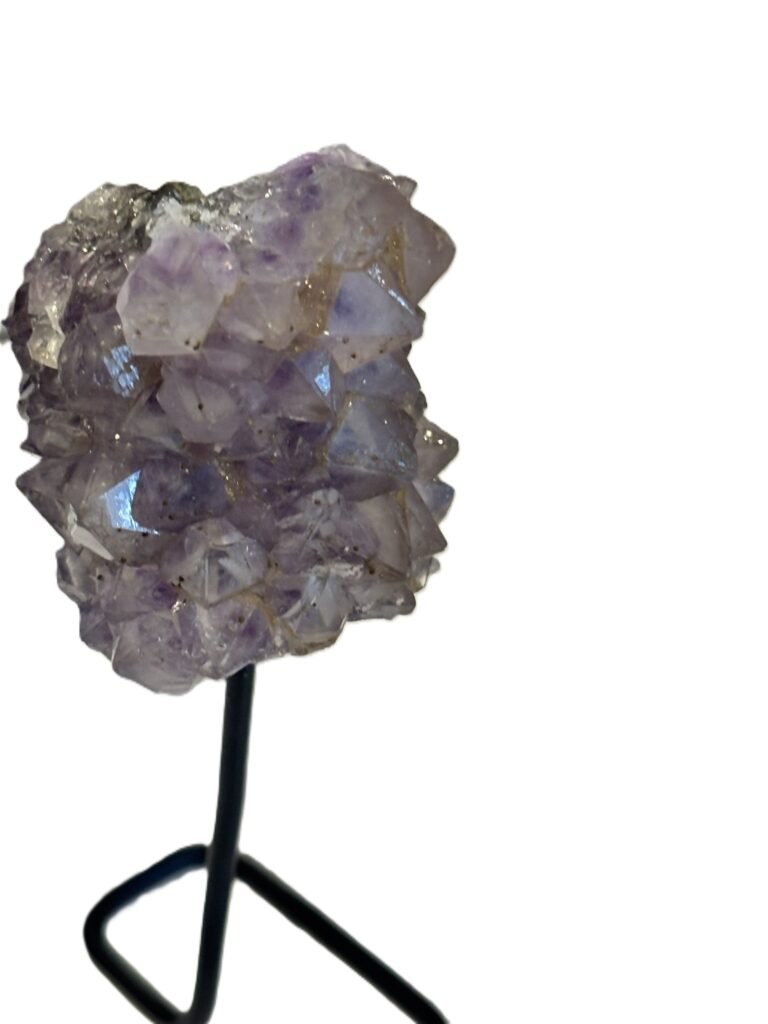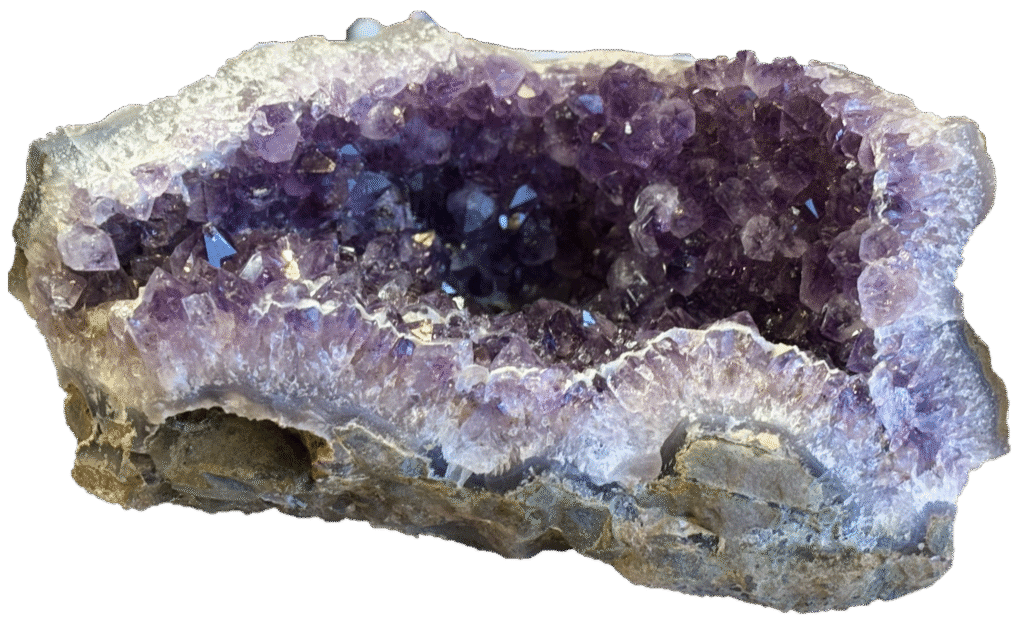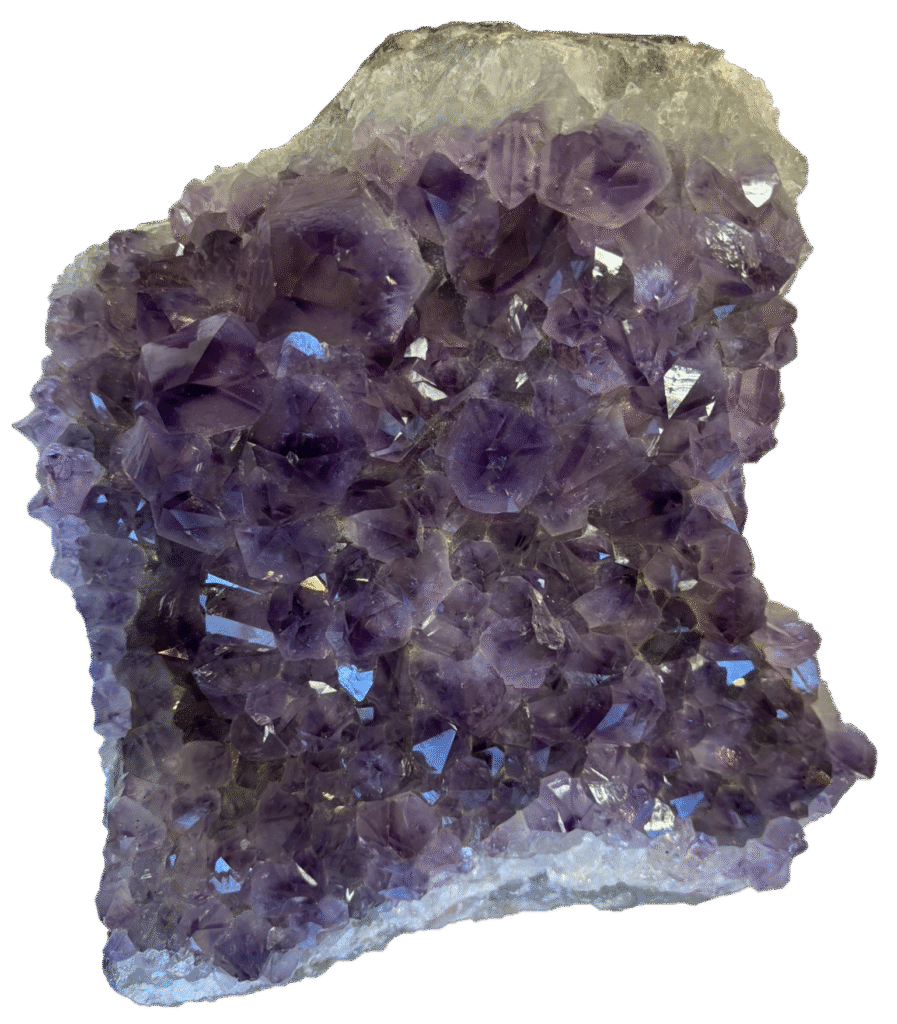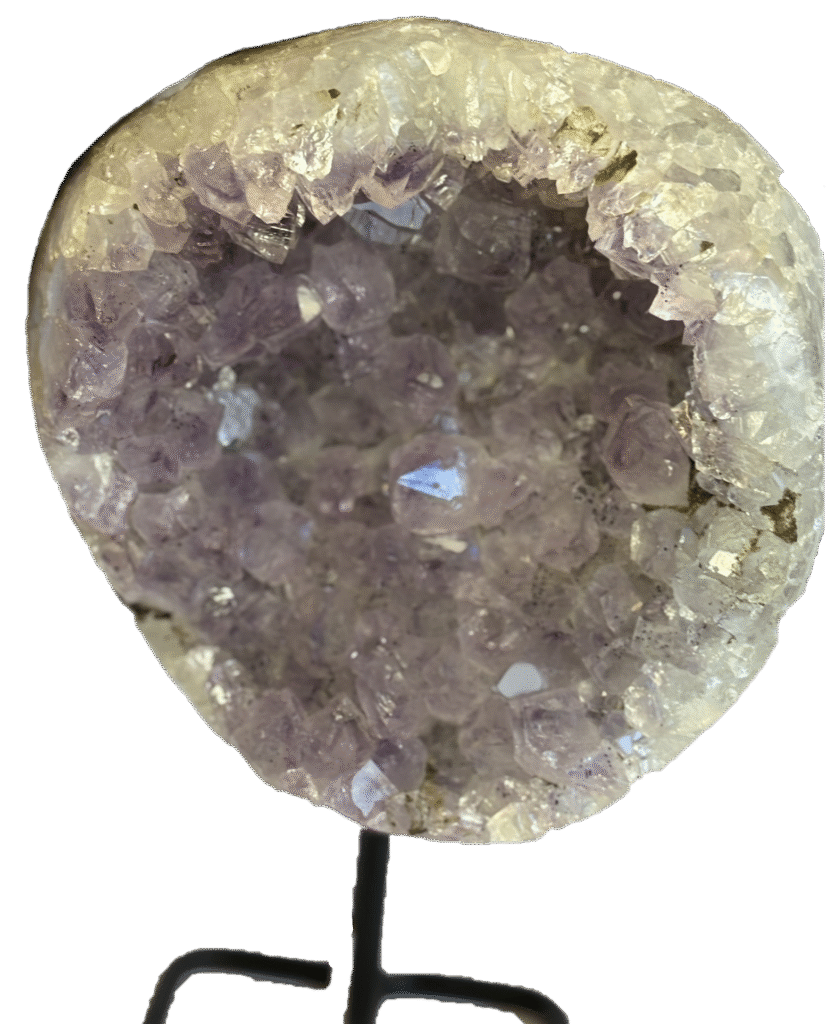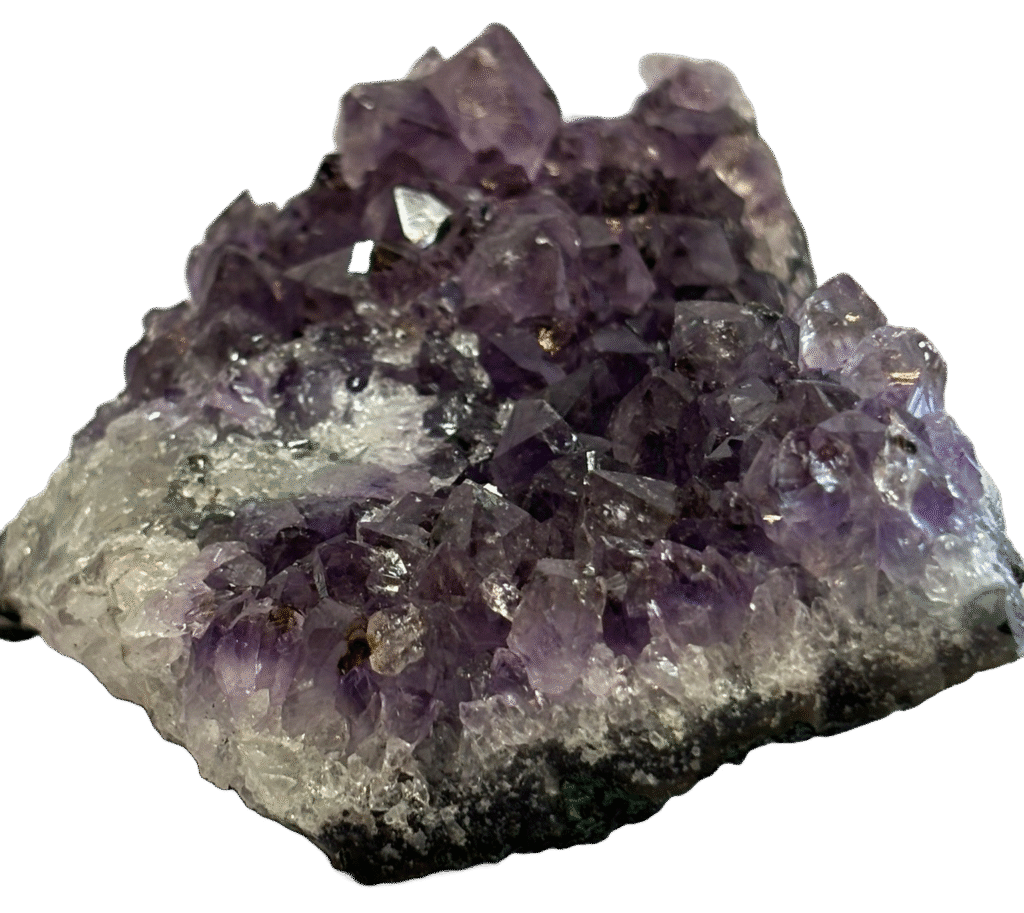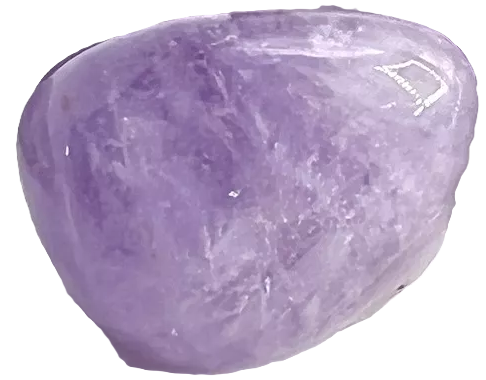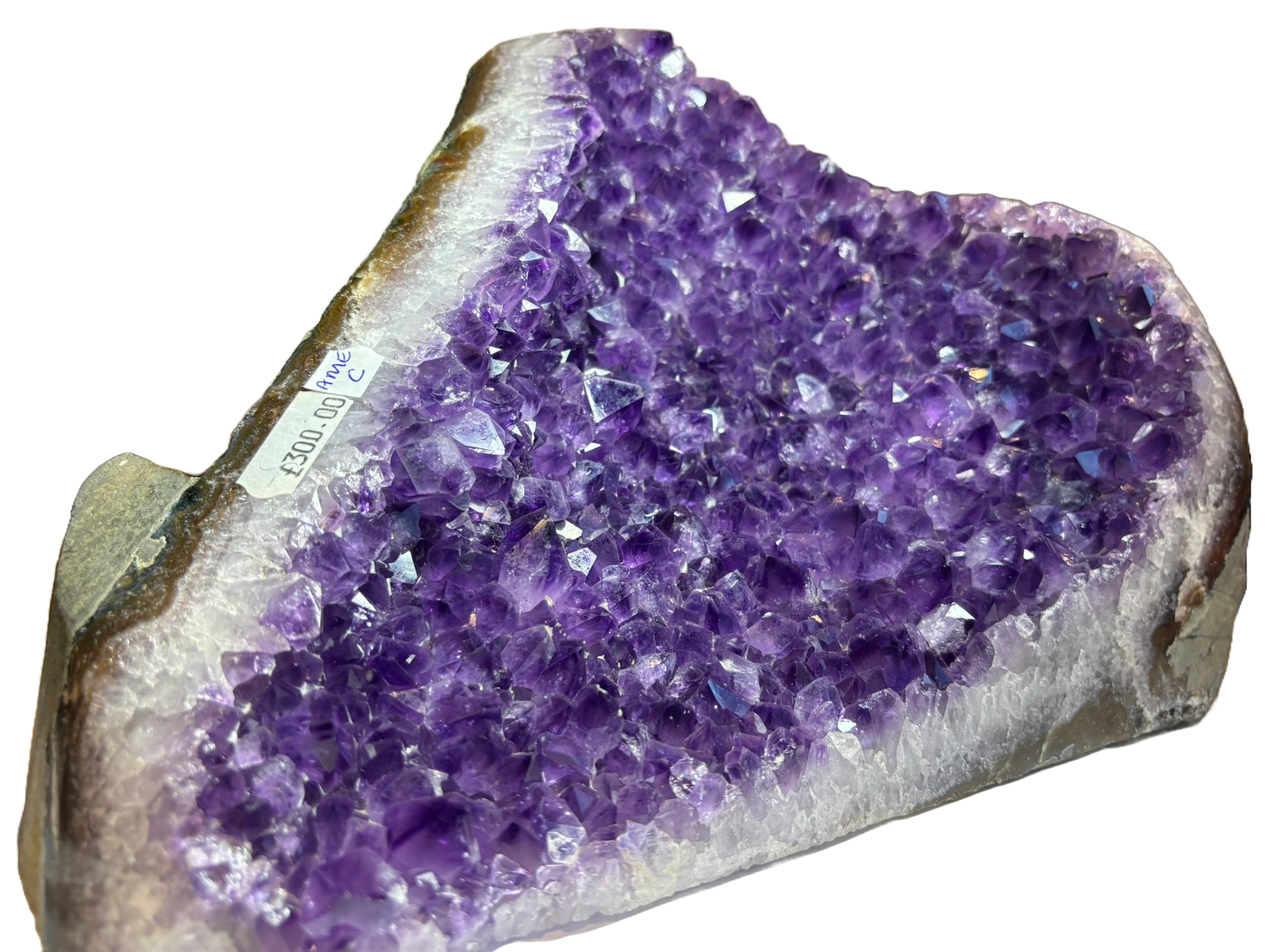
The name “amethyst” originates from the ancient Greek word amethystos, meaning “not intoxicated.” The Greeks believed the stone could prevent drunkenness and ward off overindulgence. In different cultures, amethyst has also been called “bishop’s stone” due to its use in religious regalia and “violet quartz” because of its distinct purple hue.
Composition, Physical Characteristics, and Varieties
Amethyst is a variety of quartz (SiO₂) distinguished by its striking purple colour, which results from iron and aluminium impurities combined with natural radiation. Its colour ranges from pale lavender to deep violet, sometimes exhibiting a colour shift in different lighting conditions. Heat treatment can alter its shade, turning it yellow or green, often sold as Citrine or prasiolite, respectively. Varieties of amethyst include chevron amethyst, which features white quartz banding, and ametrine, a natural blend of amethyst and Citrine.
Geographical Locations
Amethyst is found worldwide, with major deposits in Brazil, Uruguay, Madagascar, Zambia, and Russia. Brazil’s amethyst mines produce large geodes filled with crystals, while Uruguay yields deep, richly coloured specimens. Zambia’s amethyst is known for its deep purple hues, and Siberian amethyst from Russia is prized for its red and blue flashes.
Archaeological and Significant Finds, Historical and Current Usage
Ancient Egypt, Amethyst was known as “Hemag.” It was carved into hearts and worn as amulets by travellers to keep them safe from being taken advantage of or attack and during burial ceremonies with pieces dating as far back as 3000 BCE. An Amethyst Scarab beetle shaped was found in Tutankhamun’s tomb.
The Greeks and Romans crafted goblets to prevent intoxication. In medieval Europe, amethyst symbolised piety and was often set into religious artefacts, including the rings of Catholic bishops. Today, it is used in jewellery, decorative carvings, and meditation tools.
Beads of amethyst were found in Anglo-Saxon graves in England. Medieval European soldiers wore amethyst amulets as protection in battle in the belief that amethysts heal people and keep them cool-headed.
In 1660, upon the restoration of the monarchy by Charles II of England, Amethyst was used as the centrepiece for the recreated crown jewels.
Interesting Facts
- Amethyst was once as valuable as rubies and sapphires until large deposits were discovered in South America.
- Anglican bishops wear an episcopal ring often set with an amethyst. In the Catholic religion, Amethyst was used in prayer beads and rosaries. It was known as the Bishop’s Stone because it symbolised ecclesiastical dignity. Today, Bishops still wear it on the second finger of their right hand as it gives clergymen the power of restraint so that they could uphold their vows.
- Some amethyst exhibits a cat’s eye effect or asterism, though rare.
- The British Crown Jewels include amethyst among their treasures.
- The Hebrews called Amethyst “Ahlamah,” which was derived from the Hebrew word, “halam,” which means “to dream.” Still known as the “Dream Stone” it is believed that it can help deter nightmares while giving more positive, vivid dreams.
- The colour purple has historically been associated with royalty due to the costly process and expensive nature of making purple dye. As a stone of royalty, it was used in crowns, sceptres, and jewellery by the royal house because it helped leaders with decision-making. One of the oldest surviving crowns with amethyst jewels is the “Iron Crown of Lombardy” from Italy and dates to the early Middle Ages. It is alleged that the crown contains a band of iron from the crucifixion nails of Christ. The golden crown is decorated with 22 gemstones, 7 red garnets, 7 blue sapphires, 4 violet amethysts and 4 gems made of glass.
Folklore, Legends, and Tales
Greek mythology attributes amethyst’s origins to Dionysus, the god of wine, who, in a fit of rage, ordered tigers to attack a maiden named Amethystos. The goddess Artemis saved her by turning her into a pure quartz statue. Regretful, Dionysus spilled wine over the statue, giving it its purple hue. In other legends, amethyst is believed to bestow wisdom and foresight upon its wearer.
For the Chinese practitioners of Feng Shui, Amethyst can be used to transform lower vibrations into positive ones.
Buddhists believe amethysts to be a sacred stone to Buddha and use prayer beads of amethysts. In ancient times, Amethyst was known as a “Gem of Fire,” because it was thought to hold the energy of fire, which is passionate, creative, and spiritual in nature. In the Eastern world, Amethyst was used in the tree of life, in the gem cities, and in temples of worship. It was also used in offerings and for spiritual practices and meditation.
The blasted Amethyst
The Cursed Amethyst also known as the “Blasted Amethyst” is legend of a jewel looted from the Temple of Indra in Kanpur during the Rebellion of 1857. Brought to England by cavalryman Colonel W. Ferris. Soon after returning to England Ferris lost his life’s savings and passed away. His son inherited the jewel and began having misfortune. The Colonel’s son gave the jewel to a friend who had admired the gem. Shortly after receiving the jewel this friend committed suicide, willing it back to the previous owner.
In 1890 the Blasted Amethyst fell into the possession of Edward Heron-Allen, a 19th-century author and musician. Yet he soon found himself rattled by a series of disasters. Smitten by the voice of a Lady friend, unaware of its past Edward gave her the jewel. The Lady soon fell ill and lost her voice never to sing again. After learning the gems history, Edward reclaimed the Jewel, vowing to get rid of the Blasted Amethyst for good and tossed the jewel into the Regent’s Canal. However, three months later the stone was returned to him after dredgers found the stone in the canal.
Edward finally decided to lock the jewel away in a bank vault. Encased within seven locked boxes. Instructing the bank to donate the Jewel to the Natural History Museum of London three years after his death and to never let his daughter touch the Blasted Amethyst.
Mystical Healing Properties
Amethyst is considered a powerful stone for calming the mind, relieving stress, and aiding in spiritual awareness. It is associated with sobriety, clarity of thought, and protection from negative energies. It is also believed to aid in insomnia, headaches, and emotional balance.
Astrology and Zodiac Links
Amethyst is linked to the zodiac signs of Pisces, Aquarius, and Sagittarius. It is believed to enhance intuition for Pisces, bring clarity for Aquarius, and promote balance for Sagittarius. In astrology, amethyst is associated with the planet Jupiter and the element of water.
Chakra System
Amethyst is primarily linked to the crown chakra (Sahasrara), which governs spiritual connection and enlightenment. It is also connected to the third eye chakra (Ajna), enhancing intuition and inner wisdom. Meditating with amethyst is thought to open these chakras, promoting higher consciousness and psychic awareness.
Use as a Birthstone and for a Wedding Anniversary
Amethyst is the traditional birthstone for February, symbolising peace, stability, and courage. It is also the gemstone associated with the 6th wedding anniversary, representing harmony and strengthening the bond between partners.
Amethyst Pairing guide
Amethyst is arguably the crown jewel of the crystal world. Renowned for its stunning violet hues and its ability to promote calm, clarity, and spiritual connection, this beautiful quartz variety is a staple in any crystal collection.
However, if you are looking to amplify your intentions, pairing Amethyst with other stones can either elevate your practice or inadvertently clash with your goals. Crystal pairing relies heavily on aligning elemental energies, intentions, and vibrational frequencies.
In this comprehensive guide, we explore the best crystal combinations for Amethyst, the pairings you should avoid, and answers to your most frequently asked questions.
Best Crystal Combinations for Amethyst
When combining crystals, the goal is synergy—choosing stones that harmonise with Amethyst’s soothing, higher-chakra energy. The following pairings work exceptionally well for manifestation, emotional healing, and spiritual growth.
1. Amethyst and Rose Quartz (The Ultimate Self-Care Duo)
If you are seeking emotional balance or healing a heavy heart, this is the perfect pairing. Rose Quartz resonates deeply with the Heart Chakra, promoting unconditional love, compassion, and emotional warmth. When paired with Amethyst’s calming third-eye energy, it creates a gentle, nurturing environment.
- Best for: Stress relief, self-love rituals, and emotional healing.
2. Amethyst and Clear Quartz (The Ultimate Amplifier)
Clear Quartz is known as the ‘Master Healer’ and can amplify the energy of any stone it touches. Pairing it with Amethyst supercharges Amethyst’s natural properties, heightening intuition, deepening meditation, and bringing intense mental clarity.
- Best for: Deep meditation, manifestation, and spiritual awakening.
3. Amethyst and Black Tourmaline (Spiritual Protection)
Amethyst is excellent for clearing negative thoughts but combining it with Black Tourmaline adds an intense layer of energetic protection. Black Tourmaline acts as an anchor, absorbing negative energy and grounding you, while Amethyst raises your spiritual vibration.
- Best for: Empaths, shielding against negative environments and anxiety relief.
4. Amethyst and Citrine (The ‘Ametrine’ Power Couple)
Citrine represents the Solar Plexus—abundance, joy, and manifestation—while Amethyst governs inner wisdom. Together, they create a beautiful balance between spiritual insight and grounded action. In fact, these two naturally grow together to form a rare crystal called Ametrine.
- Best for: Manifesting goals, creative inspiration, and balancing spiritual and material wealth.
Crystals You Should Not Pair With Amethyst
While no crystal combination is inherently ‘dangerous’, pairing stones with opposing elemental properties or vastly different energetic frequencies can leave you feeling restless, scattered, or emotionally drained.
| Crystal | Why It Clashes With Amethyst |
| Carnelian | Carnelian is highly stimulating, fiery, and action-oriented. Its high energy can completely overpower or disrupt Amethyst’s peaceful, sleep-inducing vibes. |
| Tiger’s Eye | An intensely grounding, action-led stone focused on primal survival and worldly success. Combining it with Amethyst’s high-vibrational, spiritual focus can create a confusing energetic tug-of-war. |
| Sunstone | Sunstone carries vibrant, fiery, solar energy designed to invigorate. It actively conflicts with Amethyst’s cool, calm, and receptive lunar energy. |
Tip for Beginners: If you ever feel dizzy, anxious, or unusually restless while holding a crystal combination, separate the stones. Your intuition is your best guide.
Amethyst Frequently Asked Questions (FAQ)
Can Amethyst be in the sun?
It is best to keep Amethyst out of direct sunlight for extended periods. Because it is a variety of quartz coloured by irradiation and iron impurities, prolonged exposure to UV rays will cause its vibrant purple colour to fade to a dull grey or white over time.
Where should I place Amethyst in my home?
- The Bedroom: Place Amethyst on your bedside table or under your pillow to promote restful sleep and ward off nightmares.
- The Living Room: A large Amethyst geode or cluster in common areas helps maintain a peaceful, harmonious household dynamic.
- The Workspace: Keep a piece on your desk to reduce work-related stress and enhance creative focus.
Note: To protect the rich, natural purple colour centres of your stone, avoid leaving it in direct, harsh sunlight for extended periods, as prolonged UV exposure can cause the violet hues to fade.
Can Amethyst go in water?
Yes, Amethyst scores a 7 on the Mohs hardness scale, meaning it is physically durable enough to handle water. You can safely cleanse it under running water or use it to create crystal elixirs (indirect method preferred). However, avoid prolonged soaking in salt water, as this can degrade the stone’s finish over time.
How do I cleanse and charge my Amethyst?
To keep your Amethyst functioning at its highest vibration, cleanse it regularly. You can pass it through smoke (such as sage or incense), place it under the light of a Full Moon, or sit it on a Selenite charging plate overnight. Avoid sunlight charging to prevent colour fading.
Which zodiac sign benefits most from Amethyst?
Amethyst is the traditional birthstone for February and is deeply connected to the sign of Pisces. It helps anchor the naturally dreamy, emotional nature of Pisces, providing them with mental clarity and spiritual grounding. It also resonates beautifully with Aquarius and Capricorn.
What chakra is Amethyst?
Amethyst is deeply connected to both the Third Eye Chakra and the Crown Chakra.
These are my personally selected and curated Amethyst products
Amethyst to buy now