
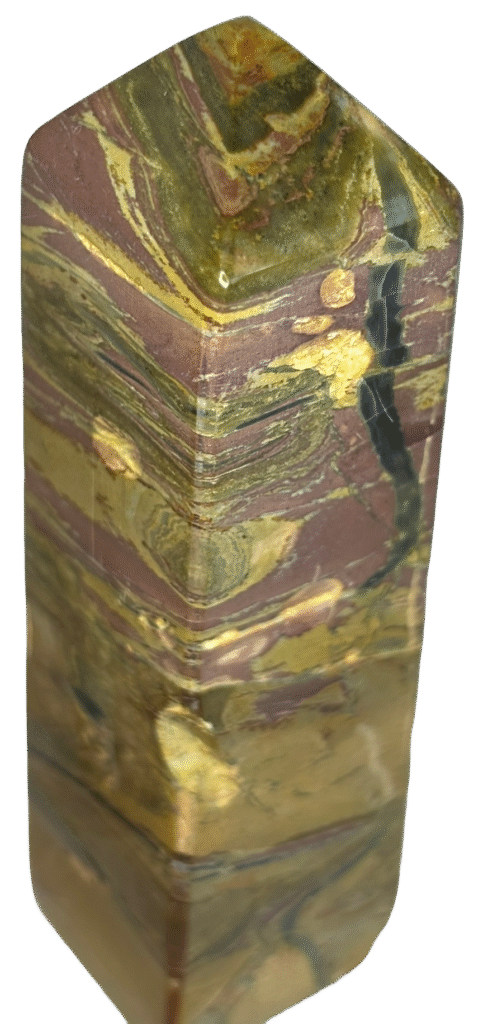
Picture Jasper is an opaque, microcrystalline variety of quartz renowned for its dramatic scenic patterns that resemble miniature landscape paintings, sand dunes, and rolling hills. Formed through volcanic action and hydrothermal silica deposition over millions of years, the stone captures a frozen geological canvas within every cut. It serves as both a high-grade lapidary material and a cornerstone of holistic crystal healing. Revered as the “Stone of Global Awareness,” Picture Jasper is celebrated globally by gemologists, jewellers, and collectors for its distinct, earth-toned dendritic patterning.
Alternate Names
Beyond its primary trade designation, Picture Jasper carries regional and descriptive titles:
- Landscape Jasper: Highlighting wide-angle horizon views.
- Scenic Jasper: Referencing intricate natural tableaus.
- Kalahari Picture Jasper: Trade name for specimens mined in southern Africa.
- Phantom Jasper: Applied to specimens with faint, ghostly interior bands.
- Pictorial Jasper: An early 20th-century gemological synonym.
- Regional Trade Names: Specific variants named by deposit, including Biggs Jasper, Deschutes Jasper, Owyhee Jasper, and Bruneau Jasper.
The Stone’s Science and Composition
Picture Jasper is an impure aggregate of microcrystalline quartz (SiO2) belonging to the chalcedony family. Its geological formation occurs primarily when silica-rich thermal fluids percolate through volcanic ash beds, rhyolitic tuffs, or fine-grained sedimentary rock.
The characteristic “pictures” are petrified dendrites and diffusion rings caused by mineral precipitation during the petrification process. As silica gel slowly solidifies, iron and manganese oxides precipitate outwards along fractures and porosity gradients in concentric or dendritic patterns (Liesegang banding).
- Iron Oxides (Haematite, Goethite): Impart deep rust reds, terracotta, golden ochres, and tan tones.
- Iron Hydroxides: Produce soft creams and buttery beige matrices.
- Manganese Oxides: Form fine, dendritic black and dark brown “trees” or skyline silhouettes.
- Chlorite Inclusions: Occasionally create muted sage-green hills and valleys.
Key Physical Characteristics
| Property | Value / Measurement |
|---|---|
| Chemical Formula | SiO2 (Silicon Dioxide) with metallic oxide inclusions |
| Crystal System | Trigonal (Microcrystalline Aggregate) |
| Mohs Hardness | 6.5 – 7.0 |
| Specific Gravity | 2.58 – 2.91 |
| Refractive Index | 1.540 – 1.553 |
| Lustre | Vitreous to waxy; takes a mirror polish |
| Fracture | Conchoidal to splintery |
| Tenacity | Brittle to tough |
| Transparency | Completely opaque |
Common Geologic Varieties
- Biggs Jasper (Oregon, USA): Discovered in 1964 following a flash flood near Biggs Junction. It features high-contrast chocolate brown, cream, and lavender-tan bands forming tight, fluid landscape contours.
- Deschutes Jasper (Oregon, USA): Sourced near the Deschutes River canyon. Known for fine-grained, red-brown, gold, and tan patterns that mimic desert canyons.
- Bruneau Jasper (Idaho, USA): Mined in the Bruneau River Canyon. It displays distinctive orbicular “egg” patterns alongside cream and reddish-brown layered horizons.
- Owyhee Jasper (Oregon/Idaho Border): Renowned for its blue-sky backgrounds set above rolling brown mudflat patterns.
- African Picture Jasper: Mined in Namibia and South Africa, showcasing bold cream, tan, and dark brown angular cross-bedding.
Global Mining and Volcanic Sources
Picture Jasper deposits require specific volcanic settings: thick layers of volcanic ash or tuff intersected by silica-saturated hydrothermal activity under low temperatures and pressures.
- Pacific Northwest (USA): The Columbia River Basalt Group and associated rhyolitic ash flows in Oregon and Idaho produce the world’s most detailed scenic jaspers.
- Southern Africa (Namibia & South Africa): Ancient Precambrian cratons produce vast sedimentary jasper beds with banded, desert-like colouration.
- Western Australia: Ashburton and Pilbara regions produce banded iron formation (BIF) jaspers, including picture-grade tiger iron and jaspilite.
- Madagascar: Yields dense, silicified ocean and landscape jaspers from weathered volcanic terranes.
- Central Europe: Historic occurrences in Germany and the Czech Republic have produced scenic jasper nodules in Permian volcanic rock.
Crystal Pairings: What to Combine and Avoid
Optimal Crystal Pairings
- Smoky Quartz: Enhances grounding and stress relief. The dark quartz balances the lighter earth vibrations of Picture Jasper without overwhelming its subtle resonance.
- Tiger’s Eye: Complements the solar-plexus and root energies, amplifying physical vitality, confidence, and practical manifestation.
- Petrified Wood: Harmonises ancient geological frequency, making it ideal for ancestral grounding, past-life recall, and nature attunement.
- Black Tourmaline: Provides an energetic shield, anchoring the protective qualities of jasper against ambient negativity.
Crystal Pairings to Avoid
- High-Vibration Celestial Stones (e.g., Moldavite, Phenakite): Moldavite’s intense, rapid upper-chakra energy directly conflicts with Picture Jasper’s deliberate, low-frequency planetary grounding.
- Selenite: Rapidly dissolves denser earth vibrations. Pairing them often leaves Picture Jasper feeling energetically stripped rather than balanced.
- Scolecite or Apophyllite: Highly ethereal stones can produce a disorienting energetic mismatch when forced alongside dense volcanic chalcedony.
Archaeology, Art and Ancient History
Jaspers have held functional and ritualistic value since the Neolithic era. Because Picture Jasper fractures conchoidally with high edge-retention, early hominids fashioned it into durable scrapers, blades, and arrowheads before adopting it for ceremonial art.
- Minoan Civilisation (c. 1800 BCE): Excavations at the Palace of Knossos in Crete recovered finely carved jasper cylinder seals and amulets used to mark royal decrees and storage vaults.
- Ancient Egypt: Egyptian artisans carved tet (Isis knot) amulets and scarabs from ochre-red jasper to guarantee safe passage through the underworld and invoke the protective blood of Isis.
- Mesopotamia: Cylinder seals fashioned from dense, patterned jaspers depicted scenes of deities, pastoral life, and mythological combat, prized for resisting wear in clay impressions.
- Lapidary Renaissance: European cabinets of curiosities (Wunderkammern) in the 16th and 17th centuries routinely catalogued polished slabs of scenic jasper as “natural marvels” where nature had painted its own landscapes.
Folklore, Legends and Sacred Tales
Centuries of folklore position Picture Jasper as a physical manifestation of Mother Earth’s consciousness.
- Native American Traditions: Varied legends describe landscape jaspers as sacred maps left by the Earth Mother. Shamanic practitioners used the stone during vision quests to travel through inner landscapes and commune with nature spirits.
- The Stone of Global Vision: Early Mediterranean traders carried patterned jasper talismans to ensure safe maritime passages, believing the stone’s miniature horizons calmed real horizons at sea.
- Dream Recall and Past Lives: Medieval European lapidaries recorded that sleeping with a polished slice of scenic jasper under one’s pillow invited prophetic dreams of ancient civilisations and past incarnations.
Metaphysical and Mystical Healing Properties
In modern holistic and vibrational therapies, Picture Jasper is known as the supreme nurturer of physical awareness and emotional resilience:
- Emotional Balancing: Absorbs toxic emotional currents, reduces chronic anxieties, and instils a practical calm during structural changes or crises.
- Trauma Integration: Encourages suppressed fears, hidden guilt, and long-standing trauma to rise gently to conscious awareness so they can be processed and released.
- Geopathic Stress Protection: Metaphysical practitioners place large Picture Jasper nodules in homes to neutralise electromagnetic smog and environmental radiation.
- Physical Resonance: Crystal healers traditional associate this stone with immune support, skin tissue repair, and digestive or intestinal equilibrium.
Astrological Connections
Picture Jasper resonates with signs that benefit from structured, stabilising earth energy:
- Capricorn (Primary): Reinforces Capricorn’s innate discipline, grounding ambitious career pursuits in long-term perspective and ethical duty.
- Taurus: Complements the Taurean appreciation for natural beauty, stability, and tangible abundance while encouraging flexibility when routines fracture.
- Leo (Secondary): Balances Leo’s fiery solar plexus energy by grounding pride into quiet authority and creative stamina.
The Chakra System
Picture Jasper aligns primarily with the lower energy centres while bridging subtle links upward:
- Root Chakra (Muladhara): The foundational anchor. Its deep brown, red, and terracotta bands stimulate the base of the spine, stabilising the physical body and grounding spiritual energy.
- Third Eye Chakra (Ajna): The stone’s visual, scenic dendrites facilitate visualisation during meditation, opening intuitive sight while keeping the seeker firmly anchored.
- Solar Plexus (Manipura): The mustard and golden ochre inclusions stimulate self-worth, courage, and practical action.
Interesting Facts
- Accidental Discovery: The famous Biggs Jasper deposit was uncovered by highway crews in Oregon in 1964 while blasting bedrock for Interstate 84.
- Liesegang Wonders: The scenic bands are identical in chemical process to the chemical phenomenon of Liesegang rings discovered by German chemist Raphael E. Liesegang in 1896.
- Mohs Durability: With a hardness of 7, high-grade Picture Jasper will readily scratch ordinary window glass and knife steel.
- Porosity Differences: While most jasper is non-porous, some fine landscape varieties have micro-porous layers that readily accept natural dyes—making authenticity verification critical for collectors.
Modern Milestones: Birthstones and Anniversaries
- Mystical & Alternative Birthstone: An alternative, earth-aligned birthstone for October and November, serving as an earthy counterpart to traditional opals and citrines.
- Zodiacal Stone: Celebrated as a talismanic birthstone for those born under the astrological sign of Capricorn (December 22 – January 19).
- Wedding Anniversaries: A meaningful gift for the 7th and 10th wedding anniversaries, where its layered bands symbolise stability, deep foundations, and shared history over time.
Picture Jasper Frequently Asked Questions
How do I clean and care for my Picture Jasper?
Clean Picture Jasper with warm, soapy water and a soft microfibre cloth. Avoid ultrasonic cleaners and harsh industrial chemicals like bleach or hydrochloric acid, which can degrade or discolour the mineral inclusions.
Is Picture Jasper expensive?
Commercial, mass-market beads and tumbled stones are very affordable (£2–£15). However, museum-grade display slabs or rare historic rough (such as original, mined-out Biggs Jasper or Bruneau Jasper) with sharp scenic horizons fetch hundreds to thousands of pounds among lapidaries.
How can I tell real Picture Jasper from fake or dyed stones?
Genuine Picture Jasper feels cool to the touch, possesses a hefty specific gravity (~2.6), and cannot be scratched by a steel pocket knife (Mohs 5.5). Imitations made of polymer clay or resin feel warm, are light, and scratch easily. Dyed varieties often show unnatural pooling of colour along micro-fractures under a 10x jeweller’s loupe
Can Picture Jasper go into water?
Yes. As a hard, microcrystalline quartz with no water-soluble components, it is safe in plain water for brief cleansing rituals. Avoid prolonged submersion in salt water, as saline solutions can penetrate micro-fractures and weaken the stone over time.
Can Picture Jasper go into water?
Yes. As a hard, microcrystalline quartz with no water-soluble components, it is safe in plain water for brief cleansing rituals. Avoid prolonged submersion in salt water, as saline solutions can penetrate micro-fractures and weaken the stone over time.
Where should I place Picture Jasper in my home for Feng Shui?
Place Picture Jasper in the Northeast (Knowledge & Self-Cultivation) or Southwest (Love, Relationships & Grounding) areas of your home or office. Its strong Earth element stabilises ambient energies and encourages steady, grounded progress.
