Scattered across 6,500 square kilometres the desolate, windswept dunes of the eastern Sahara Great Sand Sea, between the borders of Egypt and Libya, lies one of the most mesmerising geological enigmas on Earth: Libyan Desert Glass. Libyan Desert Glass, the purest natural silica glass known to planetary science. Forged approximately 28.5 to 29 million years ago at temperatures exceeding 1,600°C–2,000°C, For thousands of years, these translucent, pale-yellow shards have captured the human imagination. They are so rare and prized that one was even carved into the centrepiece scarab for King Tutankhamun’s famous pectoral. Yet, the origins of this natural glass have puzzled scientists, explorers, and historians alike, giving rise to the enduring Libyan Desert Glass Mystery.
How did vast stretches of sand instantly melt into gemstone-quality glass in a hyper-arid wilderness? For decades, the scientific community has been locked in a high-stakes debate over the cataclysmic event responsible: Was the Sahara ground zero for a colossal meteor impact, or did it experience the searing, catastrophic thermal wave of a cosmic air burst? Yet for nearly a century after its scientific discovery, geologists faced a glaring anomaly: there is no visible impact crater anywhere in the strewn field. How could an event energetic enough to melt millions of tonnes of quartz sand leave behind no obvious hole in the ground?
Patrick Clayton’s 1932 Expedition: Discovering an Impossible Glass
Although Bedouin nomads and Stone Age toolmakers had encountered the translucent yellow stones for millennia, Libyan Desert Glass formally entered modern science on 29 December 1932.
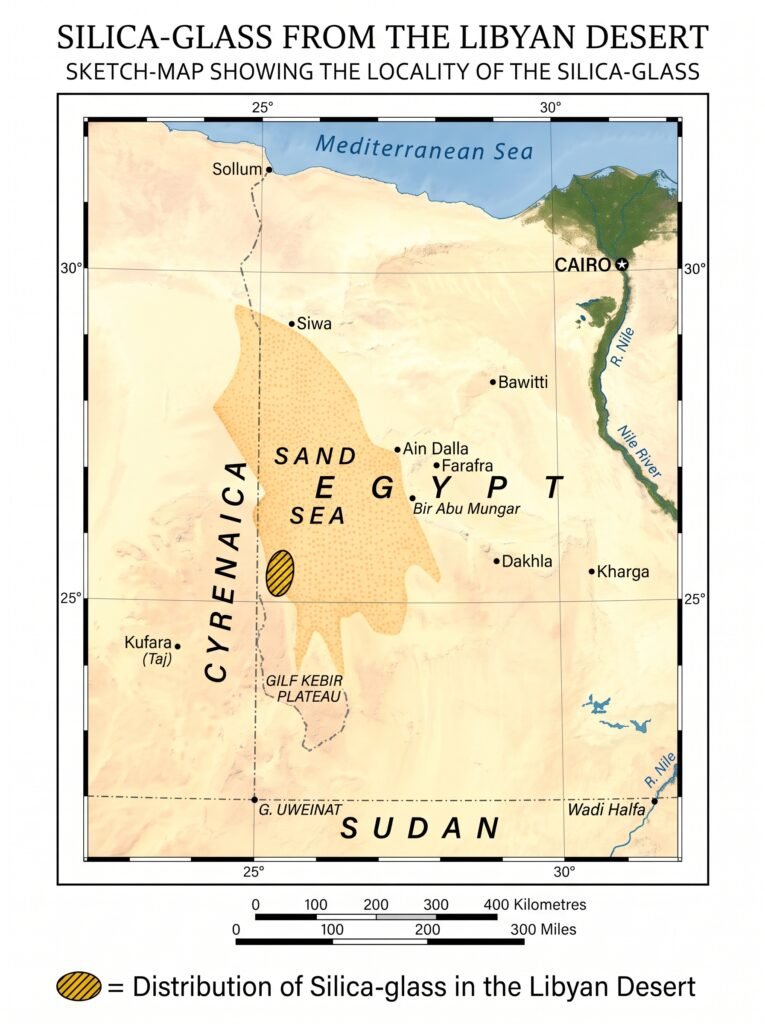
British surveyor Patrick Clayton, working for the Egyptian Geological Survey, was traversing the towering, uncharted longitudinal dunes of the Great Sand Sea south-west of the Siwa Oasis when his convoy wheels crunched across fragments of pale yellow-green glass lying loose on the interdune gravel corridors.
Clayton collected specimens and sent them to mineralogist Dr Leonard Spencer at the Natural History Museum in London. Chemical analysis quickly ruled out volcanic obsidian: the glass contained virtually no water and almost 98% pure silica, requiring melting temperatures far higher than any terrestrial volcano can produce. Spencer immediately suspected a meteorite impact—yet aerial reconnaissance and ground surveys revealed flat sandstone plains and endless sand dunes, with no crater rim in s
Libyan Desert Glass Mystery: Hypervelocity Impact vs. Atmospheric Airburst
Because no parent crater was readily visible, planetary scientists spent decades divided between two competing formation hypotheses:
- The Hypervelocity Ground-Impact Model: A stony or metallic asteroid struck the Nubian Sandstone bedrock directly at speeds exceeding 15–20 kilometres per second. The kinetic energy instantaneously vaporised the projectile and flash-melted surrounding quartz sand into puddles of molten silica, while the resulting crater was later erased by 29 million years of erosion or buried beneath massive migrating sand dunes.
- The Low-Altitude Atmospheric Airburst Model: Inspired by the 1908 Tunguska event in Siberia and the 2013 Chelyabinsk meteor, proponents argued that an incoming comet or rubble-pile asteroid exploded a few kilometres above the Sahara. According to this theory, an intense thermal radiation fireball—lasting just seconds—superheated the desert surface to over 1,700°C, glazing the sand into sheets of glass without excavating a mechanical impact crater.
For years, both models remained plausible. High-temperature minerals such as lechatelierite (pure fused quartz) and baddeleyite (thermally decomposed zircon) proved extreme heat, but neither conclusively proved extreme shock pressure.
How Microscopic Reidite Solved the Puzzle
The breakthrough came through advanced electron microscopy of tiny zircon crystals trapped inside Libyan Desert Glass—most notably in landmark studies published in 2019 by planetary scientist Dr Aaron Cavosie and colleagues.
When zircon ($\text{ZrSiO}_4$) is exposed to extreme temperatures alone (above 1,676°C), it breaks down into baddeleyite ($\text{ZrO}_2$). However, when zircon is subjected to immense shock pressure exceeding 30 gigapascals (GPa)—roughly 300,000 times Earth’s atmospheric pressure—its crystal lattice compresses into a super-dense, high-pressure polymorph called reidite.
- Why Reidite Was the Smoking Gun: Computer modelling and shock-physics experiments demonstrate that atmospheric airbursts generate thermal radiation and modest blast waves (measured in kilopascals or a few megapascals), nowhere near the 30+ GPa required to transform zircon into reidite.
- Confirmation of Ground Impact: Identifying preserved traces of former reidite inside LDG zircon grains proved beyond doubt that the glass formed during a hypervelocity meteorite impact directly into the Earth’s crust, permanently settling the airburst debate.
Candidate Craters Beneath the Sahara: Kebira, BP & Oasis
With a direct meteorite impact confirmed, geologists have turned to satellite synthetic aperture radar (SAR)—which can penetrate dry Saharan sand—and geophysical gravity surveys to hunt for the eroded or buried parent crater. Several candidate structures have been proposed over the decades:
| Candidate Structure | Location | Approximate Diameter | Current Scientific Consensus |
| Kebira Structure | Egypt / Libya border (south of strewn field) | ~31 km (multi-ring feature) | Identified via satellite imagery in 2006; subsequent field and petrographic studies suggest it is likely an eroded circular sandstone plateau rather than a confirmed impact crater. |
| BP Structure | Eastern Libya (~150 km west of strewn field) | ~2.0 – 2.8 km | Confirmed eroded impact crater (exhibiting shatter cones and shocked quartz), though considered slightly too small and distant to account for the full volume of LDG alone. |
| Oasis Structure | Eastern Libya (~150 km west-southwest) | ~11.5 – 18 km | Confirmed complex impact structure exposed in Nubian Sandstone; roughly 120 million years old (Cretaceous), making it far older than the 29-million-year-old glass. |
| Buried Great Sand Sea Crater | Directly beneath the strewn field dunes | Estimated ~10 – 15 km | Leading Hypothesis: The parent crater sits directly beneath the 100-metre-tall linear dunes of the Great Sand Sea, masked by Oligocene-to-Quaternary erosion and thick windblown sand cover. |
Why the Crater Remains Hidden Today
When the asteroid struck western Egypt nearly 29 million years ago during the Oligocene epoch, the region was not a hyper-arid desert—it was a humid, river-drained savannah landscape. Over the ensuing millions of years:
- Fluvial & Wind Erosion: Ancient river systems and relentless Saharan wind abrasion planed down the raised crater rim in the relatively soft Nubian Sandstone.
- Dune Burial: As the Sahara dried out, massive linear sand dunes—some rising over 100 metres high and stretching for hundreds of kilometres—migrated across the basin, burying the flattened crater floor while leaving heavier chunks of impact glass exposed along the wind-scoured interdune corridors.