The quartz deposits of Joaquim Felício, located in the north-central region of Minas Gerais, Brazil, represent one of the world’s most famous lapidary and mineralogical localities. Globally renowned as the original source of “Lemurian Seed Crystals” in the 1990s, the locality produces high-purity hydrothermal quartz characterised by distinct morphological habits, optical clarity, and prominent horizontal growth striations.
Geological Setting & Regional Petrology
The municipality of Joaquim Felício lies along the western flank of the Serra do Cabral, a prominent sub-range of the greater Espinhaço Range (Supergrupo Espinhaço).
- Host Lithology: Unlike the granite pegmatites common to eastern Minas Gerais (such as Governador Valadares or Teófilo Otoni), the quartz of Joaquim Felício is hosted within Proterozoic metasedimentary rocks. The country rock is dominated by fractured quartzites, sandstones, and quartz-schists.
- Hydrothermal Emplacement: The deposits formed through secondary low- to medium-temperature hydrothermal fluid injection during the late stages of the Brasiliano Orogeny (Pan-African tectonic cycle, ~500–600 million years ago). Silica-saturated ($\text{SiO}_2$) aqueous fluids migrated along fault zones, structural joints, and regional fold fractures within the quartzites.
- The “Clay Bed” Anomaly: The most celebrated visual and commercial feature of the Joaquim Felício deposits—specifically at classic workings such as Pé da Serra and Seminário—is that the quartz crystals are frequently unearthed not as massive, interlocking rock matrix plates, but as loose, isolated single crystals embedded in fine, weathered kaolinite and saprolitic sand/clay beds. Deep tropical weathering (laterisation) over millions of years broke down feldspathic minerals in and around the veins into soft kaolinite, leaving the durable quartz crystals detached and virtually undamaged by mechanical extraction.
Crystallographic Characteristics & the “Barcode” Striations
Joaquim Felício quartz displays specific physical and morphological hallmarks that distinguish it from Alpine or Arkansan quartz:
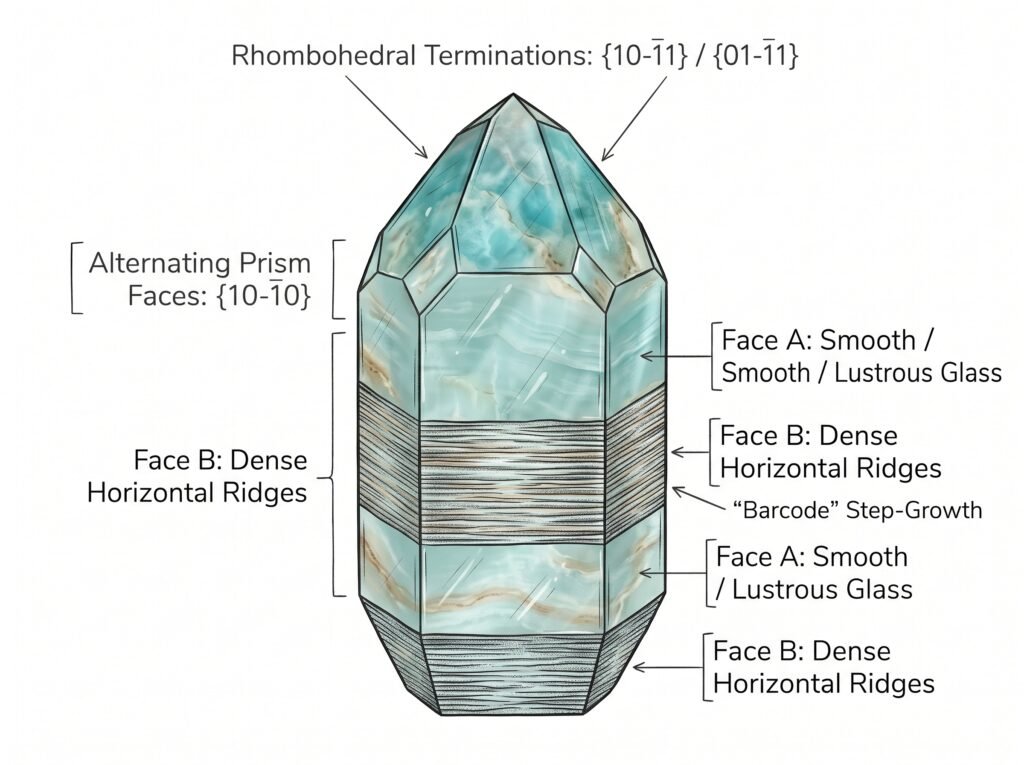
- Horizontal Striations (“Laddering” or “Barcodes”):
- Crystallographic Mechanism: The pronounced horizontal ridges running across the prism faces are oscillatory growth striations. They occur along the transition boundaries between the hexagonal prism faces $\{10\bar{1}0\}$ and the rhombohedral terminal faces $\{10\bar{1}1\}$.
- Growth Conditions: Minor fluctuations in temperature, fluid flow velocity, and silica saturation caused the crystal to alternate rapidly between vertical lengthening and lateral capping growth, leaving fine, terraced micro-steps.
- Alternating Face Texture:
- It is common for the six prism faces around the hexagonal column to alternate: one face is lustrous, glass-smooth, and transparent, while the adjacent face is matte, frosted, and deeply striated.
- Tapered / Sub-Prismatic Habit (Tessin Habit Tendency):
- Many crystals taper inward from base to termination, giving them a natural, wand-like geometry rather than a strictly parallel hexagonal cylinder.
- Surface Coatings & Chemical Inclusions:
- Iron Oxide / Haematite Dusting: Fine surface coatings of iron oxide frequently impart a pale pink, golden, or “tangerine” hue to the unwashed crystals.
- Japan Law Twins: The Pé da Serra locality near Joaquim Felício is specifically celebrated among mineral collectors for producing some of Brazil’s finest Japan Law twinned quartz crystals (two crystals intersecting at a fixed $84^\circ 33’$ angle).
The 1990s Emergence of “Lemurian Seed Crystals”
In the early 1990s, crystal author and practitioner Katrina Raphaell visited mineral warehouses receiving newly excavated material from Joaquim Felício and the broader Serra do Cabral. The unique physical traits of the lot—crystals lying loose in kaolinite rather than broken off rock faces, frosted alternating striations, and tapering wand habits—catalysed a new metaphysical movement:
- The Lore: The narrative posited that an ancient Civilization (Lemuria or Mu) had “seeded” these crystals in loose earth before an epochal collapse, encoding them with non-dual, heart-centred frequencies for future humanity.
- Tactile Reading: The horizontal growth steps became known as “stairways to heaven” or “code registers,” intended to be read by running a thumb or fingernail across the ridged faces.
- Commercial Impact: This esoteric designation dramatically transformed local artisanal mining. What was previously classified by Brazilian mining operations as standard optical-grade or specimen quartz gained a high market premium, turning Joaquim Felício into an internationally referenced locality.
Mineralogical Benchmark: Joaquim Felício vs. Other Notable Quartz
| Feature | Joaquim Felício (Serra do Cabral, Brazil) | Arkansas (Ouachita Mountains, USA) | Alpine “Rock Crystal” (Switzerland/France) |
| Geological Origin | Hydrothermal veins cutting metasedimentary quartzites/sandstones | Hydrothermal veins cutting folded Paleozoic sandstones/shales | Alpine fissures (clefts) in metamorphic/granitic gneiss |
| Primary Form | Single loose tapered points; embedded in soft kaolinite/clay beds | Dense, multi-crystal drusy clusters anchored to hard chert/sandstone | Cleft clusters, classic “Gwindel” twisted habits, or Tessin habits |
| Surface Texture | Distinct alternating matte horizontal striations with frosted faces | Predominantly bright, smooth, glassy lustres; razor-sharp prism faces | High lustre, often showing selective natural dissolution/etching |
| Common Twins | Japan Law twins ($84^\circ 33’$) | Dauphiné and Brazil Law twins | Dauphiné twins, Gwindel torsion |
| Clarity Profile | Water-clear interiors beneath frosted or iron-dusted exteriors | Ultra-high optical transparency throughout entire crystal | Highly variable, often with chlorite, rutile, or actinolite inclusions |
Mining Realities & Contemporary Availability
Today, the classic shallow pits and artisanal hand-dug trenches (garimpos) around Joaquim Felício that yielded the original 1990s finds are largely depleted or strictly regulated.
- Artisanal Working: Mining was historically conducted with hand picks, shovels, and simple water sluicing to wash away the kaolin without scratching the delicate frosted faces.
- Geographical Expansion of the Trade Name: Due to high ongoing demand for “Lemurian” quartz, mineral merchants have expanded the commercial label to striated crystals sourced from other regions across Minas Gerais (e.g., Corinto and Diamantina), Bahia, and international deposits in Madagascar, Russia, and Colombia.
- Mineralogical Authenticity: For gemmologists and mineral collectors, true Joaquim Felício specimens remain prized for their diagnostic combination of delicate horizontal step-growth, frosted-to-transparent face alternation, and historical place in modern lapidary culture.