Jet is an organic mineraloid formed from fossilised prehistoric wood subjected to extreme heat and pressure over millions of years. Renowned for its velvety, mirror-like lustre and surprisingly warm, lightweight feel, jet holds a unique place in gemmology. Revered since the Neolithic period as a formidable stone of psychic protection and grounding, it gained widespread prominence during the Roman occupation of Britain and reached peak global fashion during the Victorian mourning era. Today, jet fossilised wood continues to captivate lapidaries, historians, and crystal practitioners as a tool for shielding energy, clearing grief, and fostering inner resilience.
Alternate Names
Across different eras and traditions, jet has collected several trade, regional, and archaic names:
- Black Amber: Refers to its shared organic origin, lightweight nature, and electrostatic properties, though it is fossilised wood rather than fossilised tree resin.
- Gagates: The original classical Latin and Greek name, derived from the river Gagas in ancient Lycia.
- Witches’ Amber: A traditional folk name highlighting its historic use in protective talismans and defensive magic.
- Oltu Stone (Oltu Taşı): The regional Turkish name for high-grade jet quarried around the town of Oltu in Erzurum Province.
- Lignite Jet: A technical geological classification referencing its position between soft brown lignite and bituminous coal.
The Stone’s Science and Composition
Unlike crystalline minerals that develop repeating crystal lattice structures from inorganic chemical processes, jet is an organic mineraloid.
- Botanical Origin: Most true jet originates from the compressed trunks and branches of prehistoric gymnosperms, particularly trees closely related to the modern Monkey Puzzle tree (Araucaria araucana) and conifers of the extinct family Araucariaceae.
- Diagenetic Process: Dating largely to the Lower Jurassic period (Toarcian stage, roughly 180 million years old for high-grade British specimens), the timber was washed into marine basins, waterlogged, and buried beneath fine anaerobic mud and bituminous shale.
- Chemical Alteration: The oxygen-depleted environment halted normal microbial decay. Over eons, lithostatic pressure combined with geothermal heat drove off volatile organic compounds, polymerising the remaining carbon, hydrogen, and oxygen into a dense, solid, coalified matrix rich in hydrocarbons.
Key Physical Characteristics
Jet possesses distinct diagnostic traits that distinguish it from imitations like vulcanite, bog oak, black tourmaline, and French jet (black glass):
| Physical Property | Characteristic / Metric | Diagnostic Note |
| Chemical Formula | Amorphous carbon matrix: $\text{C, H, O}$ (trace $\text{S, N}$) | Hydrocarbon-rich organic compound |
| Mohs Hardness | 2.5 to 4.0 | Easily carved and scratched by a copper coin or knife |
| Specific Gravity | 1.30 to 1.40 | Exceptionally lightweight; feels far lighter than stone or glass |
| Refractive Index | 1.64 to 1.68 (anomalous) | Measured via the spot method on polished surfaces |
| Lustre | Resinous to vitreous | Polishes to a deep, mirror-black sheen |
| Fracture | Conchoidal | Breaks with smooth, shell-shaped curved surfaces |
| Tenacity | Brittle to slightly sectile | Can be carved and turned on a lathe without crumbling |
| Thermal Feel | Warm to the touch | Poor thermal conductor compared to cold mineral gems |
| Electrostatic Property | Triboelectric | Develops a static electric charge when rubbed vigorously |
| Streak | Brownish-black to chocolate brown | Diagnostic test on unglazed porcelain |
Common Geologic Varieties
Jet is broadly categorised into two operational grades based on the salinity of the sedimentary water during fossilisation, alongside an industrial variant:
- Hard Jet: Formed through the compression of driftwood in marine, saltwater-saturated environments. The presence of saltwater compacts the material while chemical cross-linking preserves structural elasticity. Hard jet withstands delicate carving, turning, and mirror polishing without cracking, making it the premier grade for fine jewellery.
- Soft Jet: Formed in freshwater conditions or swampy sedimentary beds under comparatively lower pressure. It is softer, significantly more brittle, and prone to cracking, flaking, or drying out under atmospheric fluctuations. While cheaper to extract, it is ill-suited for intricate lapidary work.
- Anthracitic Jet: A transition phase between high-grade jet and true anthracite coal. While it polishes to a high shine, it features higher fixed carbon content, greater brittleness, and sub-metallic mineral inclusions that complicate fine craftsmanship.
Global Mining and Volcanic Sources
True jet is found exclusively in sedimentary shale sequences rather than primary volcanic pipes; however, the geothermal heat from nearby regional volcanic and tectonic basins often accelerated the coalification process.
- Whitby, North Yorkshire, England: The world’s historic benchmark for hard jet. Extracted from the Upper Lias Whitby Mudstone Formation along wave-cut coastal platforms and cliff seams.
- Asturias, Spain: Known historically as Azabache, mined in the Villaviciosa and Tazones formations. Asturian jet provided raw material for Santiago de Compostela pilgrimage charms.
- Oltu, Erzurum Province, Turkey: Sourced from folded Eocene sedimentary strata, celebrated for its smooth density and heavily used in carving prayer beads (tesbih).
- Aveyron, France: Mined historically near Sainte-Colombe for ecclesiastical beads and crosses.
- United States: Found in Utah (Henry Mountains), Colorado, and New Mexico, where Native American artisans, particularly Navajo and Zuni craftsmen, integrated local jet into inlay work and silver settings.
Crystal Pairings: What to Combine and Avoid
When working with jet in meditation, crystal grids, or talismans, understanding its dense energetic blueprint ensures balanced outcomes.
Optimal Crystal Pairings
- Black Obsidian: Amplifies psychic shielding and clears dense, heavy blockages. Jet grounds the explosive, shadow-surfacing speed of obsidian, preventing emotional disorientation.
- Haematite: Its high iron density works in tandem with jet’s Root Chakra resonance, creating an anchoring circuit that pulls scattered energy down into the body.
- Amethyst: Balances jet’s lower-chakra anchoring with Crown Chakra spiritual awareness. This combination prevents the wearer from becoming overly lethargic while processing deep emotional grief.
- Clear Quartz: Acts as an amplifier. Because jet continuously absorbs and transmutes negative frequency signatures, clear quartz helps clear residual stagnancy from the matrix.
Crystal Pairings to Avoid
- Carnelian: Possesses a fast, hot, stimulating Sacral fire energy. Combining carnelian with jet can generate internal friction, as carnelian pushes outward drive while jet acts as an energetic brake.
- High-Grade Citrine: Vibrant, expansive solar frequency clashes directly with jet’s reflective, internal, and sorrow-absorbing vibration, dulling the benefits of both stones.
- Moldavite: Moldavite’s rapid, ungrounding tektite vibration can cause disorientation or anxiety if anchored prematurely with deep, heavy, organic sediment like jet.
Archaeology, Art and Ancient History
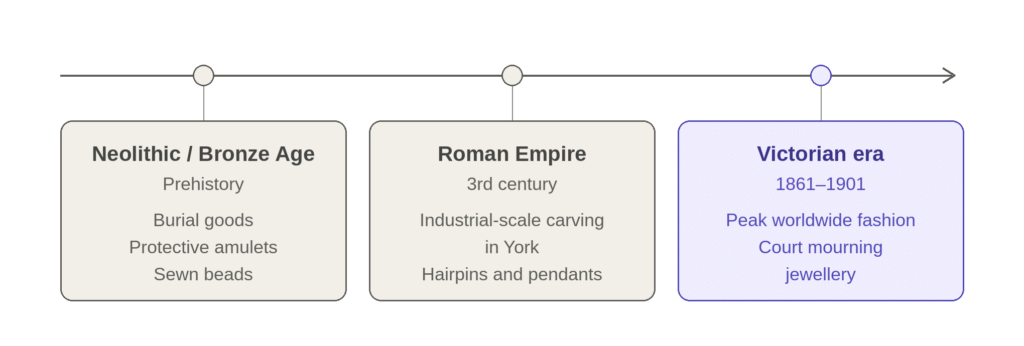
Human engagement with jet dates to the European Upper Palaeolithic and Neolithic periods, where worked jet beads and discs served as status markers and spiritual grave goods.
The Roman Empire and Eboracum
By the 3rd century AD, Roman Britain established a major extraction and processing network centred around Whitby. Raw material was transported inland to Eboracum (modern-day York), where specialised gemmarii (gem carvers) turned jet on mechanical bow-lathes into hairpins, rings, bracelets, gorgoneion pendants, and betrothal medallions. Roman artisans prized jet for its mirror-like polish and static electricity, viewing it as an active substance capable of repelling the malocchio (evil eye).
Anglo-Saxon and Viking Discoveries
Viking settlements at York and across Scandinavia yielded intricate zoomorphic jet carvings, principally miniature serpents, bears, and Thor’s hammer (Mjöllnir) pendants. In early Christian art across northern Spain, jet carvers produced higa (protective clenched-fist amulets) carried by pilgrims trekking the Camino de Santiago.
The Victorian Mourning Boom
Following the death of Prince Albert in December 1861, Queen Victoria entered perpetual mourning dress. Under strict court protocol, reflective stones, diamonds, and colourful metals were banned from royal attire for early stages of mourning. Hard Whitby jet became the only permissible adornment, prompting an explosion in global demand. By the 1870s, Whitby supported over 200 workshops and 1,500 artisans producing intricately carved cameos, collarettes, and heavy locket chains.
Folklore, Legends and Sacred Tales
Ancient naturalists documented jet with a mix of science and superstition. In his Naturalis Historia, Roman naturalist Pliny the Elder detailed the unique lore surrounding gagates:
“The kindling of jet drives off snakes and relieves suffocation of the uterus. Its fumes detect attempts to simulate a disabling illness or a state of virginity; moreover, when boiled with wine, it cures toothache, and with wax, scrofula.”
- The Sea’s Black Breath: Ancient British mariners carried unworked pebbles of sea-washed jet in their oilskins, believing the stone controlled the tides and protected ships against squalls.
- The Fire of Purity: Across rural Yorkshire, wives burned shavings of jet in hearths while their husbands were out at sea, believing the distinctive, peat-like petroleum smoke forged a psychic anchor guiding the men safely back.
- The Absorber of Shadows: Medieval folklore warned against passing down used jet without an extensive saltwater cleansing, claiming the stone retained the illnesses, griefs, and curses of its previous owners.
Metaphysical and Mystical Healing Properties
In modern energetic practice, jet is viewed primarily as an emotional vacuum cleaner and energetic sponge.
- Emotional Processing: It works directly on deep grief, melancholy, and shock, gently drawing heavy emotional weight out of the subtle body and transmuting it into neutral earth energy.
- Psychic Shielding: Unlike crystals that act as reflective mirrors (such as pyrite), jet absorbs ambient negative thoughtforms, jealousy, and psychic attack before they penetrate the auric perimeter.
- Financial Alignment: Often called the “Banker’s Talisman” in historical folk magic, jet is kept in cash drawers and accounting desks to absorb erratic spending impulses and establish conservative financial boundaries.
Astrological Connections
Jet aligns with earth and water signs whose natural temperaments benefit from structural grounding, psychological endurance, and boundary reinforcement:
- Capricorn (Primary): Ruled by Saturn, Capricorn governs structure, time, ambition, and ancestral legacy. Jet bolsters Capricorn’s innate discipline, absorbs depressive tendencies brought on by heavy workloads, and reinforces practical focus.
- Scorpio: Co-ruled by Mars and Pluto, Scorpio navigates deep emotional and shadow transformation. Jet provides a safe container for Scorpio’s intense emotional processing while preventing toxic energetic attachments.
- Virgo: Mercury-ruled Virgo often deals with nervous exhaustion, over-analysis, and systemic anxiety. Jet’s stabilising, organic vibration settles somatic tension and grounds overactive mental states.
The Chakra System
Jet operates primarily across the lower foundational centres of the human subtle body:
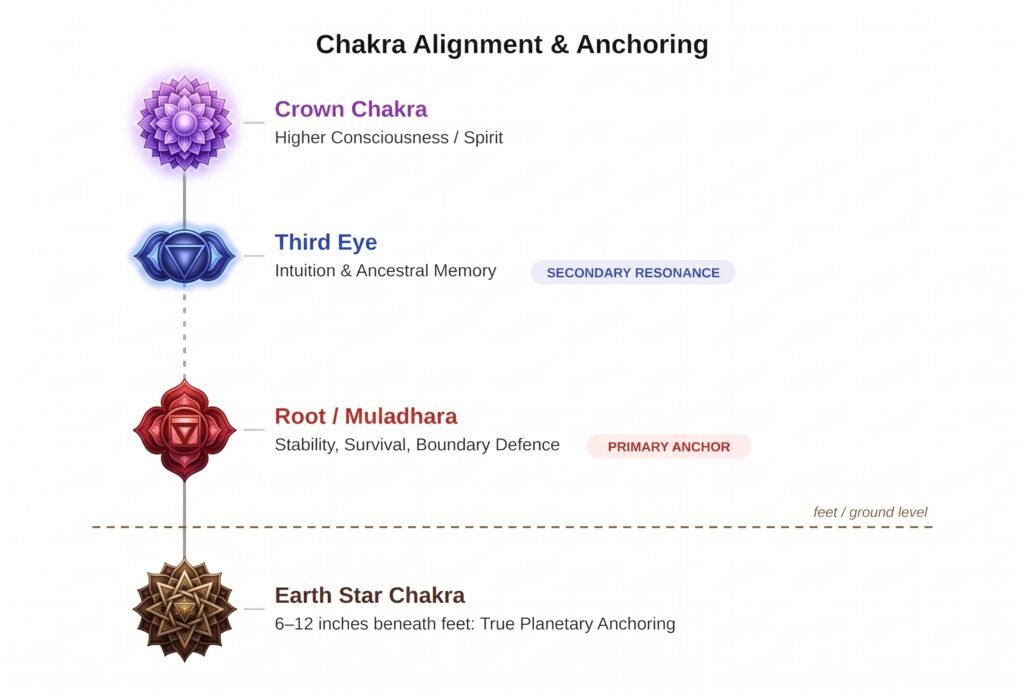
- Earth Star Chakra (Sub-feet Centre): Located 15 to 30 cm below the soles of the feet, this energy centre links individual auric fields directly to the planetary body. Jet’s fossilised plant origin makes it effective at pulling erratic, floating energy out of the crown down into this planetary anchor.
- Root Chakra (Muladhara): Positioned at the base of the spine, the Root controls survival instincts, bodily stability, and feelings of safety. Jet clears energetic blockages here, relieving the subconscious freeze/flight responses often triggered by sudden shock or grief.
- Third Eye Chakra (Ajna – Secondary Resonance): When paired with clear quartz or selenite during deep trance work, jet functions as an energetic counter-weight, stabilising the physical vessel while the higher intuitive centres access ancestral memory.
Interesting Facts
- Triboelectric Current: Jet develops a clear negative electrostatic charge when rubbed on cloth or silk, enabling it to pick up small scraps of paper and dried chaff—a trait shared with amber.
- Scent of the Forge: When subjected to a hot needle test or exposed to friction, true jet emits a distinctive, pungent smell of burning bitumen, coal, or kerosene, exposing glass and plastic simulants instantly.
- Fossilised Forests: A single piece of high-grade Whitby jet was once a fallen prehistoric tree that drifted along the margins of an ancient Jurassic ocean basin around 180 million years ago.
- Weight Illusion: Visitors holding jet for the first time often assume it is imitation resin or plastic because its low specific gravity (1.30–1.40) makes it feel roughly half as heavy as an equivalent volume of black onyx or black tourmaline.
Modern Milestones: Birthstones and Anniversaries
- Mystical & Zodiac Birthstone: While not included in the modern automated jewellers’ calendar, jet is recognised as an alternative zodiac birthstone for Capricorn (December 22 – January 19), balancing Saturnian heaviness with grounding protection.
- The 26th Wedding Anniversary: Jet serves as the traditional gemstone for the 26th wedding anniversary. Following the milestone 25th Silver Jubilee, jet represents the organic durability, resilience, and quiet endurance forged over more than a quarter-century of shared life.
Jet Fossilised Wood Frequently Asked Questions
Is jet the same thing as petrified wood?
No. While both originate from prehistoric timber, their preservation methods differ completely:
- Petrified wood undergoes permineralisation, where organic wood cells are replaced atom-by-atom with inorganic silica/quartz minerals, resulting in a heavy, brittle rock (Mohs 6.5–7.0).
- Jet undergoes coalification (specifically “jetonisation”). Individual driftwood logs were buried in oxygen-depleted, high-bitumen marine mud. It was preserved through organic hydrocarbon impregnation under compression rather than mineral replacement, resulting in a lightweight, organic gem (Mohs 2.5–4.0).
What kind of wood produces jet, and how old is it?
Most true jet, particularly British Whitby jet, is derived from ancient gymnosperms closely related to the modern Monkey Puzzle tree (Araucaria araucana). The wood was deposited during the Toarcian age of the Lower Jurassic period, making high-grade specimens approximately 180 to 183 million years old.
Is jet actually coal?
Geologically, jet is related to lignite (brown coal), but it differs significantly from domestic fuel-grade coals. Commercial coal forms from compacted peat bogs containing a jumbled mixture of plants, soil, and animal detritus. Jet forms exclusively from isolated logs or driftwood branches submerged in calm marine or lacustrine basins, giving it a uniform, non-granular structure that can be carved without crumbling.
How can I tell genuine jet from simulants like glass, vulcanite, or onyx?
Because Victorian mourning jewellery made heavy use of substitutes, real jet is frequently confused with copies:
- Thermal conductivity: Genuine jet feels warm to the touch at room temperature because it is a poor thermal conductor, unlike cold glass (“French jet”) or onyx.
- Weight / Specific Gravity: Jet has a very low specific gravity (1.30–1.40). It feels noticeably lightweight in the hand compared to glass, stone, or metal.
- Streak test: Rubbing jet against unglazed white porcelain or fine emery paper produces a distinctive chocolate-brown or ginger streak. Glass leaves no mark, while coal leaves a black streak.
- Electrostatic charge: Vigorous rubbing with silk or wool gives jet a static electric charge, enabling it to lift small scraps of paper.
- Thermal / Odour test: Touching an inconspicuous area with a red-hot pin produces a faint smell of burning coal or bitumen. Vulcanite emits a pungent sulphur/rubber smell, while plastics smell of acrid chemical resin.
What is the difference between “Hard Jet” and “Soft Jet”?
Hard Jet formed in saltwater marine conditions where pressure and chemical reactions with marine hydrocarbons created a dense, stable material. It takes a brilliant mirror polish, withstands temperature changes, and will not crack over time.
Soft Jet formed in freshwater environments (swamps and lakes). It is more brittle, subject to crazing or cracking when dry, and does not hold fine lapidary detail over decades.
Can jet get wet, and how should it be cleaned?
- Water exposure: High-grade hard jet is not harmed by brief exposure to cool or lukewarm water. However, submerged soakings, hot water, and steam cleaners must be avoided, as sudden thermal expansion can trigger fractures along dormant grain lines.
- Cleaning method: Wash gently using a soft cloth, lukewarm water, and mild detergent. Dry immediately with a lint-free cloth.
- Restoring lustre: Applying a tiny drop of pure mineral oil (or baby oil) on a cotton wool bud restores its deep black sheen. Store pieces separately in lined boxes, as harder mineral gemstones (like quartz or diamonds) will easily scratch jet’s soft surface.
Why was jet so popular in Victorian jewellery?
Following the death of Prince Albert in 1861, Queen Victoria entered deep mourning and wore only plain black. Royal court etiquette mandated that all reflective or sparkling gemstones were strictly forbidden during the early stages of bereavement. Hard Whitby jet was officially sanctioned as acceptable mourning adornment. Because of its light weight, large, dramatic mourning brooches, heavy beaded necklaces, and portrait lockets could be worn comfortably without tearing delicate fabrics.
What is the spiritual meaning and purpose of jet?
In metaphysical practice, jet is known as the “Stone of the Earth Star” and the “Spiritual Vacuum Cleaner.” Rather than reflecting negative vibrations back outwards, jet acts as an energetic filter, drawing dense, sluggish emotions—particularly grief, fear, and sorrow—out of the auric field and neutralising them.
Which chakra does jet align with?
Jet connects primarily with the Root Chakra (Muladhara) and the Earth Star Chakra located beneath the feet. Its dense, organic vibration grounds scattered mental focus, stabilises the nervous system during times of sudden shock, and instils a sense of physical safety.