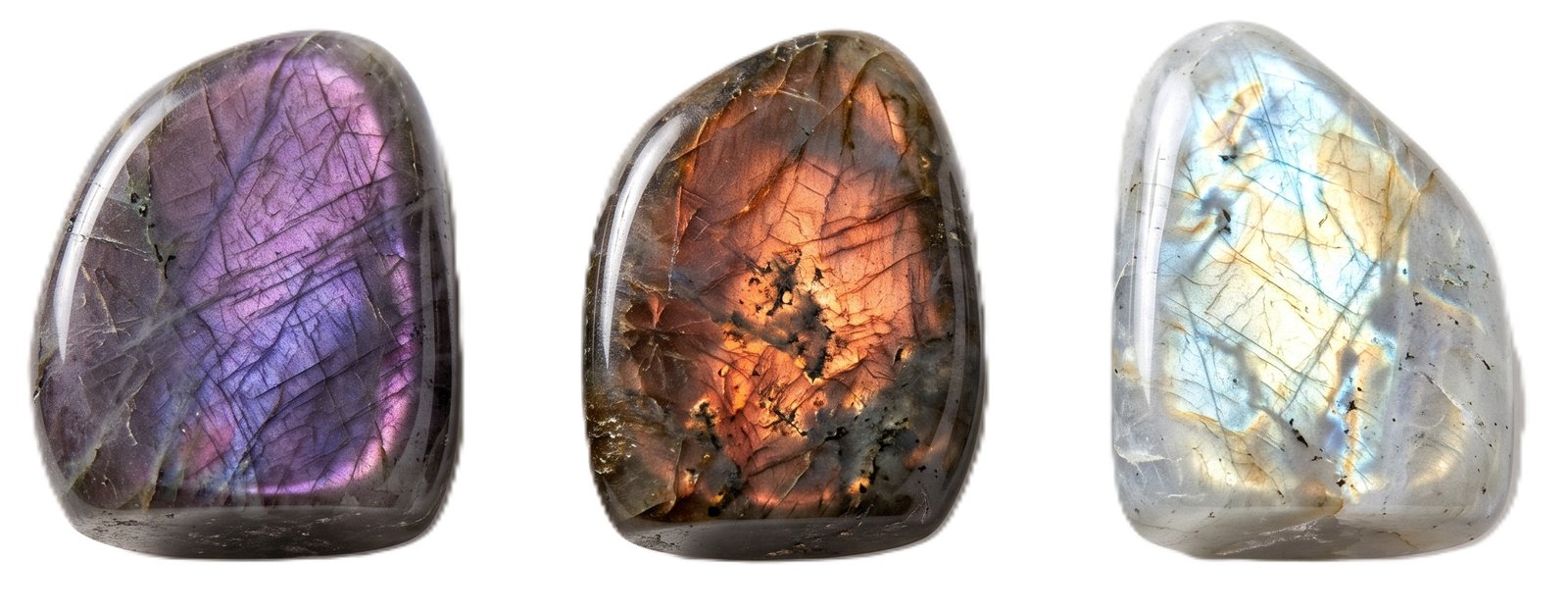
While most of us are familiar with the classic blue, green, and gold flashes of traditional labradorite, there is an entire spectrum of lesser-known treasures waiting to be explored. For gemstone collectors, crystal enthusiasts, and jewelry lovers alike, the world of rare labradorite varieties offers a breathtaking escape from the ordinary. Beyond the standard earthy tones lies a vibrant, elusive palette of stones that seem to capture the natural magic of the earth and sky—if you know where to look.
In this guide, we are going into the stunning, iridescent world of three of the most sought-after and uncommon types: the mystical Purple, the fiery Sunset, and the elusive, icy Clear labradorite. Whether you are looking to expand your collection, understand the geological marvels behind their unique “flash,” or simply feast your eyes on some of nature’s most spectacular artistry, here is everything you need to know about these rare natural wonders. Let’s explore what makes each of them so special.
Purple and Magenta Labradorite: The Rarest Schiller
Among lapidaries and collectors, purple labradorite rarity is legendary. While blue and teal specimens emerge from Madagascar by the ton, true purple, violet, and magenta stones account for a fraction of one percent of total gem-grade recovery.
Visible Spectrum Wavelengths & Lamellar Correlation:
Violet / Purple : 380 – 430 nm – Requires ultra-compressed lamellae (Rarest)
Blue / Cyan : 450 – 495 nm – Dominant labradorite exsolution range (~80%)
Green / Yellow : 500 – 570 nm – Standard broad lamellar zones
Red / Copper : 620 – 750 nm – Requires thick lamellae / iron oxide backing
The Crystallographic Physics of Violet Light
The mechanics of labradorescence depend on thin-film interference generated by alternating sub-microscopic plates of albite-rich and anorthite rich plagioclase (Bøggild exsolution lamellae):
- Under Bragg’s Law conditions for constructive interference, the wavelength reflected ($\lambda$) corresponds directly to the thickness ($d$) and refractive index ($n$) of the alternating lamellae:
$$\lambda = 2 n d \cos \theta$$
- To reflect the shortest wavelengths of visible light (violet and purple, ranging between 380 nm and 430 nm), the sub-microscopic exsolution plates must be exceptionally thin and compressed, frequently below 140 nanometers.
- During the cooling history of anorthosite plutons, sustaining a thermodynamic environment where lamellae freeze at this ultra-narrow thickness—without coarsening into broader blue-green intervals—is statistically rare.
- Furthermore, human ocular sensitivity to violet wavelengths is relatively poor compared to green and cyan light. To display a vivid, saturated purple face-up, the lamellar plates must maintain near-perfect crystallographic parallelism across an entire cleavage domain, leaving no room for structural dislocation or mechanical shear.
Grading Purple Material
- True Royal Violet / Indigo: Monochromatic, deep blue-purple flash spanning more than 75% of the face.
- “Sunset Purple” / Magenta: Multicoloured specimens where deep pinkish-purple borders coppery-orange, gold, and turquoise bands.
- Ghost / Flash-Border Purple: Common blue stones displaying a faint violet fringe only at steep oblique angles (these do not command true purple premiums).
Sunset and Golden Labradorite: Warm Interference & Copper Tones
At the opposite end of the interference spectrum sits sunset labradorite (sometimes termed “fire labradorite” or “copper-gold labradorite”). Rather than projecting nocturnal tones, these stones flash with apricot, fiery tangerine, burnished bronze, rose-copper, and sunny yellow.
What Generates the Warm Spectrum?
Warm-spectrum labradorescence occurs through one of two geological mechanisms:
- Broad Lamellar Spacing ($>300\text{ nm}$): When exsolution proceeds slowly without quenching, lamellae coarsen, reaching thicknesses that constructively amplify the longest wavelengths of the visible spectrum (600 nm to 720 nm).
- Microscopic Haematite & Ilmenite Inclusions: In many African and Indian deposits, the feldspar matrix is host to oriented microscopic platelets of iron oxides (haematite, $\text{Fe}_2\text{O}_3$, or ilmenite, $\text{FeTiO}_3$). These inclusions act as internal optical filters:
- They absorb background blue/green light scatter.
- They impart a warm, reddish-brown body tone to the host feldspar.
- When light reflects through these iron-rich layers, the resulting interference colour is warmed from pure yellow into deep peach, rust-orange, and coppery rose.
Faceted Transparent Labradorite: The Schiller-Free Anomaly
A common misconception among collectors is that all labradorite must exhibit labradorescence. In reality, gem-quality transparent labradorite is an exquisite, optical-grade plagioclase feldspar that displays no schiller whatsoever.
Instead of being cut into rounded cabochons to capture surface sheen, this material is faceted into brilliant gemstones that compete with fine citrine, scapolite, chrysoberyl, and yellow beryl.
Why Faceted Labradorite Lacks Flash
Labradorescence requires unmixing: slow plutonic cooling that allows a single, homogeneous plagioclase crystal to exsolve into distinct calcium-rich and sodium-rich lamellae.
Faceted transparent labradorite originates in fundamentally different geological environments—typically extrusive volcanic basalt flows or shallow, rapidly cooled pegmatitic pockets:
- Thermal Quenching: Magma carrying plagioclase phenocrysts erupts near or at the Earth’s surface, cooling quickly.
- Frozen Solid Solution: The high-temperature, homogeneous crystal lattice is “frozen” in place before the sodium and calcium atoms have time to migrate and separate into lamellar layers.
- Optical Result: Without Bøggild lamellae, there are no interior physical mirrors to reflect or interfere with incoming light. The crystal remains completely water-clear, transparent, and structurally unified.
Chromophores: What Drives the Colour?
Transparent labradorite ranges from water-clear to champagne, straw yellow, and deep cognac:
- Trace Iron ($\text{Fe}^{3+}$): Substitution of ferric iron for aluminium ($\text{Al}^{3+}$) within the tetrahedral silicate framework imparts a clean, sunny, or amber-gold colouration.
- Copper Nanoparticles: In localities where basaltic lavas were enriched with copper (such as the famous deposits in southeastern Oregon), plagioclase crystals can incorporate atomic copper, producing pale green, pink, and deep red dichroic hues—grading directly into gemological Oregon Sunstone.
Geological Localities for Rare Colour Varieties
| Variety | Defining Optical Quality | Primary Global Sources | Host Rock Environment |
| Purple / Magenta Flash | Ultra-compressed Bøggild lamellae ($<140\text{ nm}$) | Toliara Province (Madagascar), Ylämaa (Finland) | Layered anorthosite complexes |
| Sunset / Copper-Orange | Coarse lamellae ($>300\text{ nm}$) + iron oxide micro-platelets | Southern Madagascar, Bahia (Brazil), Finland | Plutonic anorthosites and gabbros |
| Faceted Transparent Golden | Quenched solid solution; no exsolution lamellae; $\text{Fe}^{3+}$ colouring | Casas Grandes (Chihuahua, Mexico), Madagascar | Basaltic volcanic cavities & shallow pegmatites |
| Plush / Oregon Schiller | Transparent to champagne body with metallic red/green copper schiller | Lake County & Harney County, Oregon (USA) | High-alumina subaerial basalt flows |
Market Valuation & Lapidary Challenges
Price Matrix: Commercial vs. Rare Varieties
Standard Blue/Green Cabochons
• Supply: Abundant (Madagascar, India)
• Wholesale Finished: £0.30 – £2.00 per gram (£0.06 – £0.40 / ct)
High-Saturation Sunset / Copper Cabochons
• Supply: Uncommon (<5% of mine yield)
• Wholesale Finished: £2.50 – £7.00 per gram (£0.50 – £1.40 / ct)
Top-Grade Pure Purple / Magenta Cabochons
• Supply: Exceptionally rare (<0.5% of mine yield)
• Collector Finished: £10.00 – £35.00+ per gram (£2.00 – £7.00+ / ct)
Clean Faceted Transparent Golden Labradorite
• Supply: Limited to specific volcanic localities
• Gem Trade Finished: £15.00 – £60.00+ per carat (depending on clarity/size)
The Lapidary Challenge of Cutting Rare Varieties
Cutting rare labradorite demands far higher skill than shaping commercial blue material:
- Navigating Perfect Cleavage: Like all plagioclase feldspars, transparent and rare-colour labradorite possesses perfect cleavage along $\{001\}$ and good cleavage along $\{010\}$, meeting at an oblique angle of approximately $86^\circ$. During faceting, excessive lap pressure or rapid temperature changes from dry grinding wheels will instantly cleave the gemstone along these structural planes.
- Isolating the Narrow Purple Plane: Because violet-reflecting exsolution zones often occur in thin, isolated horizons sandwiched between broader blue and green bands, the lapidary artist must pre-form and align the cabochon dome with surgical precision. Angling the cut by just three or four degrees off the lamellar plane will cause the purple flash to wash out into dull grey or pale yellow.
- Faceting Angles for Transparent Stones: Transparent golden labradorite has a relatively modest refractive index ($1.554–1.573$). To prevent optical “windowing” (where light leaks out the back, making the centre appear dead and watery), faceters must maintain strict critical pavilion angles—typically between $41^\circ$ and $43^\circ$—with crown angles set near $35^\circ$ to maximise internal reflection and dispersion.
Metaphysical Nuances of Rare Varieties
In contemporary crystal healing systems, colour frequency directly dictates chakra resonance and esoteric application:
- Purple Labradorite: Resonates directly with the Soma, Third Eye (Ajna), and Crown (Sahasrara) Chakras. Held as a premier stone for spiritual visionaries, it is used to quiet intellectual chatter, facilitate conscious astral travel, and open channels for multidimensional journeying.
- Sunset & Copper Labradorite: Bridges the gap between the Sacral (Svadhisthana) and Solar Plexus (Manipura) Chakras. It transforms the typically introspective, etheric energy of labradorite into an anchored, kinetic force—stimulating creative passion, personal agency, willpower, and physical stamina.
- Transparent Golden Labradorite: Works as a stone of mental clarity, solar activation, and purposeful alignment. Free of the shadowy, veiled qualities of dark grey labradorite, golden transparent stones are used to dispel feelings of unworthiness, sharpen logical analysis, and illuminate personal purpose.
Summary: Expanding the Feldspar Collection
Whether sought for investment portfolios, bespoke goldsmithing, or mineral collections, labradorite’s rare varieties challenge the conventional view of this common feldspar:
- Look to purple and magenta cabochons for rare optical thin-film interference.
- Choose sunset and golden varieties for the synergy of exsolution optics and iron-rich mineral inclusions.
- Explore faceted transparent stones to appreciate what plagioclase feldspar looks like when freed from internal interference and cut for pure vitreous brilliance.