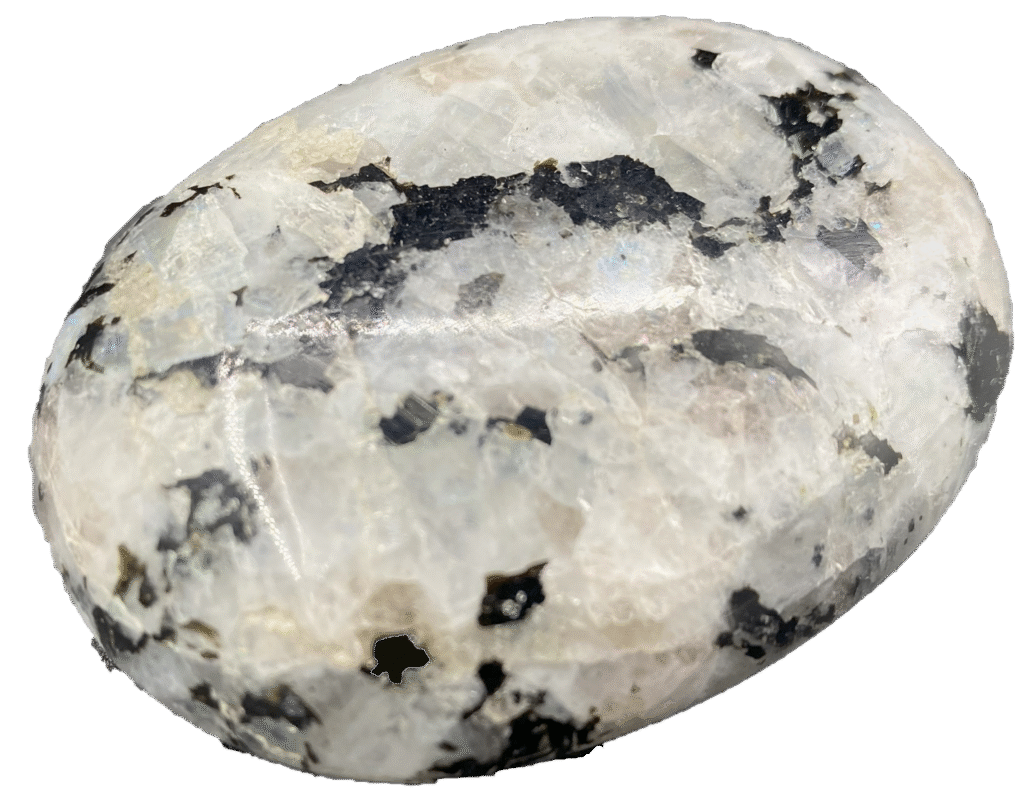
Few naming conventions in the commercial gemstone market cause as much technical confusion as Rainbow Moonstone. Sold globally in high-street artisan boutiques, crystal shops, and fine jewellery galleries, the stone is celebrated for its milky, semi-translucent body that bursts with electric blue, gold, and multi coloured spectral iridescence.
Yet from a strict gemological and mineralogical perspective, rainbow moonstone is not true moonstone. It is white labradorite.
While both minerals reside within the overarching feldspar group, they sit on fundamentally different branches of the mineral family tree. Understanding the distinction between rainbow moonstone vs labradorite exposes one of the gem trade’s most successful marketing misnomers—and reveals how distinct chemical compositions and crystallisation kinetics produce two very different optical phenomena.
The Anatomy of a Trade Misnomer
The term “Rainbow Moonstone” was not coined by mineralogists; it was conceived by lapidaries and gem merchants in the late 20th century.
True moonstone has been revered since antiquity, prized by the Romans, Greeks, and Art Nouveau masters like René Lalique for its billowy, ethereal, single-colour glow resembling moonlight floating on water. However, classical deposits of fine, transparent blue-sheen moonstone (chiefly in Sri Lanka and Myanmar) began experiencing commercial exhaustion during the latter half of the 1900s.
When substantial deposits of a pale, semi-translucent feldspar exhibiting brilliant multi-coloured flash were developed in Southern India and Madagascar, merchants faced a branding choice:
- Selling it as “White Labradorite” tied the material to common, inexpensive dark grey stones often associated with rough carving blocks and counter tops.
- Selling it as “Rainbow Moonstone” leveraged the historic prestige, romantic lore, and premium retail pricing of classical moonstone, while adding the enticing promise of a full rainbow flash.
The trade name caught on immediately. Today, gemological laboratories such as the GIA (Gemological Institute of America) accept “Rainbow Moonstone” strictly as a commercial trade name, classifying the actual mineral species as plagioclase feldspar (labradorite variety) on official identification reports.
Is Rainbow Moonstone Feldspar? The Mineralogical Divide
Yes, both stones are feldspars, but they belong to separate chemical series. The feldspar group represents the most abundant mineral family in the Earth’s crust, divided into two primary solid-solution series based on chemistry:
- The Potassium (Alkali) Feldspar Series: Orthoclase, Microcline, and Sanidine.
- The Plagioclase Feldspar Series: A continuous solid-solution continuum ranging from pure sodium feldspar (Albite) to pure calcium feldspar (Anorthite).
True classical moonstone belongs to the alkali feldspar group, whereas rainbow moonstone (white labradorite) belongs to the plagioclase feldspar group.
Chemical & Crystallographic Comparison
| Gemological Property | True Classical Moonstone | “Rainbow Moonstone” (White Labradorite) |
| Mineral Species | Orthoclase (Alkali Feldspar) | Labradorite (Plagioclase Feldspar) |
| Chemical Formula | $\text{KAlSi}_3\text{O}_8$ with $\text{NaAlSi}_3\text{O}_8$ | $(\text{Ca}, \text{Na})[\text{Al}(\text{Al}, \text{Si})\text{Si}_2\text{O}_8]$ ($\text{An}_{50}–\text{An}_{70}$) |
| Crystal System | Monoclinic ($2/m$) | Triclinic ($P\bar{1}$) |
| Optical Phenomenon | Adularescence | Labradorescence |
| Underlying Physics | Rayleigh light scattering across cryptoperthite exsolution | Thin-film interference across Bøggild exsolution lamellae |
| Dominant Visual Flash | Uniform white, silver, or soft blue floating billow | Directional, vivid electric blue, green, gold, or violet |
| Specific Gravity | $2.56 – 2.59$ (Noticeably lighter) | $2.68 – 2.72$ (Denser) |
| Refractive Index (RI) | $n_\alpha = 1.518–1.520$, $n_\gamma = 1.524–1.526$ | $n_\alpha = 1.554–1.560$, $n_\gamma = 1.562–1.573$ |
| Cleavage Angle | Right angles ($90^\circ$) | Oblique angles (~$86^\circ$ to $93^\circ$) |
| Internal Twinning | Simple Carlsbad contact twins (often seamless) | Polysynthetic (lamellar) twinning lines visible under lens |
Optical Physics: Adularescence vs. Labradorescence
The visual contrast between these two gems comes down to two distinct optical mechanisms:
True Moonstone: The Adularescent “Floating Cloud”
True moonstone displays adularescence (named after Mt. Adular in Switzerland, an early historic source).
- During high-temperature crystallisation, potassium-rich orthoclase and sodium-rich albite form a single homogeneous crystal.
- As temperatures decline, the two components unmix into alternating sub-microscopic planar layers—a structure known as cryptoperthite.
- When light strikes these ultra-thin, alternating layers, it undergoes Rayleigh scattering (the same physical mechanism that makes the sky appear blue).
- The light scatters internally in all directions, creating a soft, billowy, floating shimmer that appears to hover beneath the surface of the cabochon as a three-dimensional cloud. The colour is typically uniform: silvery-white or watery celestial blue.
Rainbow Moonstone: The Labradorescent “Interference Mirror”
White labradorite does not scatter light; it produces thin-film constructive interference, identical to standard grey labradorite or Finnish spectrolite:
- In the plagioclase series, unmixing between anorthite-rich and albite-rich phases produces Bøggild exsolution lamellae.
- These lamellae range in thickness between 120 nm and 400 nm.
- Light waves enter the crystal, reflect off the top and bottom surfaces of successive lamellae, and recombine. Certain wavelengths amplify while others cancel out, reflecting bright, planar flashes of electric blue, neon green, and warm golden hues.
- Unlike adularescence—which stays visible over broad viewing angles labradorescence is strictly planar and directional: tilt the stone off-axis, and the metallic sheen immediately switches off, revealing the milky-white host rock beneath.
How to Differentiate True Moonstone from White Labradorite
If you are evaluating loose gems, raw rough, or vintage jewellery, you can confirm whether a specimen is true orthoclase moonstone or white labradorite using four straightforward diagnostic checks.
Diagnostic Test 1: Refractometer Reading (RI)
The most conclusive non-destructive test:
- Place the flat polished base of the cabochon on a gemological refractometer.
- True Moonstone: Reads consistently between 1.518 and 1.526.
- White Labradorite: Reads substantially higher, between 1.554 and 1.570.
Diagnostic Test 2: Specific Gravity (Heavy Liquids)
Because labradorite incorporates heavy calcium ions ($\text{Ca}^{2+}$) instead of lighter potassium ($\text{K}^+$):
- True moonstone has an SG of 2.56 – 2.59.
- White labradorite has an SG of 2.68 – 2.72.
- In a calibrated bromoform solution diluted to an SG of 2.62, true moonstone floats, while white labradorite sinks to the bottom.
Diagnostic Test 3: Microscopic Examination of Inclusions
Under 10x or 40x magnification:
- True Moonstone: Displays characteristic “centipede” inclusions—small tension cracks resembling multi-legged insects running parallel to the crystal cleavage, often intersecting perpendicular crystal fissures.
- White Labradorite: Shows dense polysynthetic twinning lines (fine parallel lamellar striations resembling miniature bar codes running across cleavage planes), often accompanied by dark, micro-crystalline platelets of tourmaline, biotite, or rutile needles.
Diagnostic Test 4: Flash Geometry and Spectrum
- If the stone displays flashes of multiple distinct colours—such as an electric blue field bordered by bright chartreuse, gold, or peach—it is white labradorite.
- If the flash is soft, uniform, milky-blue or silver, and shifts like a fog across the dome without displaying planar flash boundaries, it is true orthoclase moonstone.
Metaphysical & Astrological Implications
Within esoteric crystal traditions, the technical distinction between these two feldspars carries meaningful energetic nuances.
The Energetic Profile of True Moonstone (Orthoclase)
True moonstone is universally tied to the divine feminine, lunar cycles, and emotional equilibrium:
- Chakras: Sacral (Svadhisthana) and Solar Plexus.
- Vibrational Frequency: Watery, receptive, calming, and deeply introspective.
- Core Application: Smoothing emotional turbulence, aiding reproductive balance, enhancing lucid dreaming, and fostering gentle self-acceptance.
The Energetic Profile of Rainbow Moonstone (White Labradorite)
Because it is chemically a labradorite, white labradorite carries the high-frequency, protective, and visionary signature of the plagioclase family, combined with the pure light frequency of a white base:
- Chakras: Third Eye (Ajna) and Crown (Sahasrara).
- Vibrational Frequency: Highly kinetic, expansive, awakening, and protective.
- Core Application: Auric cleansing, shielding against environmental emotional static, opening intuitive psychic channels, and driving personal metamorphosis.
While classical moonstone acts as an emotional soother, white labradorite functions as an active intuitive illuminator.
Commercial Value, Sizing & Market Practicalities
Understanding the mineral identity directly impacts buying power and setting security
True Classical Moonstone (Top-Grade Sri Lankan)
• High Transparency + Deep Watery Blue Schiller
• Price: £40 – £250+ per carat
• Market: Rare collector gem; vintage & fine heirloom jewellery
Rainbow Moonstone” (Gem-Grade White Labradorite)
• Semi-Translucent + Vivid Electric Multi-Colour Flash
• Price: £3 – £25 per carat
• Market: Modern artisan jewellery, silver wire-wrapping, everyday wear
Durability & Lapidary Caveats
Both stones rank 6.0 to 6.5 on the Mohs hardness scale, but their cleavage behaviour requires different precautions:
- True Moonstone cleaves at crisp 90° right angles. It is brittle and sensitive to thermal shock, but generally lacks the extensive internal micro-lamellar stepping of plagioclase.
- White Labradorite features oblique cleavage planes with pronounced polysynthetic twinning. If struck hard along its lamellar boundaries, it can split or shed micro-flakes along the dome.
Care Rule: Neither stone should ever enter an ultrasonic cleaner or commercial steam cleaner. Ultrasonic vibrations can force liquid into the micro-lamellar boundaries of white labradorite, causing the exsolution layers to delaminate and permanently extinguishing its flash.
Summary: A Name That Stuck
While calling white labradorite “rainbow moonstone” is scientifically inaccurate, the trade moniker has become an accepted industry convention.
As an educated collector, lapidary, or jeweller, you can appreciate the stone for what it truly is: an uncommon, calcium-rich plagioclase feldspar capable of capturing light through sub-microscopic Bøggild exsolution. When shopping, embrace the term for its aesthetic shorthand—but value and care for the piece using the rigorous science of labradorite.