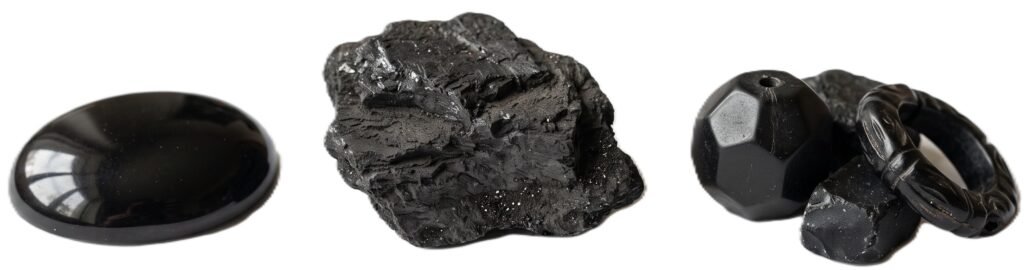
For centuries, the high value of genuine jet inspired an entire industry of convincing imitators. Victorian lapidaries and modern purveyors alike have turned to vulcanite, French jet (black glass), dyed chalcedony, bog oak, and synthetic bakelite resins to mimic its distinctive velvety depth. Even in raw field finds, distinguishing high-grade gemological jet from common bituminous coal or brittle shales is critical; while one can be turned on a lathe and polished to a mirror finish, the other will fracture, crumble, or simply smudge to soot under pressure.
Separating true organic treasure from common combustible fuel and artificial substitutes does not require destructive guesswork. In this guide, we break down the definitive physical properties, streak tests, thermal responses, and structural cues that allow collectors, jewellers, and beachcombers to determine whether an unknown piece is authentic jet, ordinary coal, or a proven fake.
Diagnostic Comparison Matrix
| Material | Specific Gravity (SG) | Refractive Index (RI) | Mohs Hardness | Streak Test | Thermal Feel | Diagnostic Microscopic & Structural Features | Friction / Thermal Reaction |
| Whitby Jet (Hard) | 1.30 – 1.35 | 1.64 – 1.68 (Spot) | 2.5 – 4.0 | Ginger-brown to chocolate | Warm | Crisp carved facet junctions; compressed woody grain; micro-pyrite inclusions; conchoidal fracture. | Triboelectric (attracts dust); burning peat/bituminous coal odour; tiny oily residue on hot point. |
| French Jet (Black Glass) | 2.50 – 3.00 (up to 4.00) | 1.50 – 1.55 | 5.5 – 6.5 | None / White scratch | Cold | Mould seam lines; hemispherical bubble cavities; swirl lines; chipped facet edges showing sharp glass conchoidal flakes. | Inert to hot point; no static charge; no odour. |
| Vulcanite (Ebonite) | 1.15 – 1.20 | ~1.60 | 2.0 – 2.5 | Brownish | Warm | Moulded relief with soft edges; light oxidisation fades to olive-khaki/brown; lacks cellular grain. | Emits pungent, acrid burning rubber and sulphur odour under friction or hot needle. |
| Gutta-Percha | 0.95 – 1.02 | ~1.52 | 1.5 – 2.0 | Brownish | Warm | Moulded rather than carved; dark grey/brown cast; prone to crazing; very low density (floats in water). | Thermoplastic (softens at ~60°C); exudes a faint sweet, rubbery odour. |
| Bog Oak / Bog Yew | 0.80 – 1.10 (up to 1.25) | Organically variable | 1.5 – 2.5 | Greyish-brown | Warm | Pronounced open wood pores/vessels; fibrous splintering; matte/satin finish; lacks conchoidal fracture; cannot take a high mirror polish. | Smells of burnt wood/charcoal; inert to solvents; does not melt. |
| Bakelite / Catalin | 1.25 – 1.30 | 1.63 – 1.66 | 2.5 – 3.0 | Pale yellow/brown | Warm | Mould lines; uniform surface; flashes orange-yellow with Simichrome/409 test. | Pungent formaldehyde/carbolic acid odour under hot water or thermal probe. |
| Spanish Jet | 1.25 – 1.33 | 1.64 – 1.68 | 2.0 – 2.5 | Brownish-black | Warm | Visually identical to Whitby jet, but more brittle; prone to micro-crazing and dehydration fractures. | Bituminous coal odour, but with a significantly stronger, sharper sulphur pungency. |
Step-by-Step Laboratory Testing Protocol
1. Visual & Microscopic Examination (Non-Destructive)
Using a 10× triplet loupe or a stereoscope gemological microscope (20×–40×), Jet Or Coal or fake can be identified.
- Tooling vs. Moulding: Look along the edges and within carved recesses. Genuine Whitby jet exhibits crisp graver and gouge marks, scraper striations, and slight asymmetry typical of hand-lapidary work. Simulants like vulcanite, gutta-percha, and glass typically display rounded edges, flashing lines, mould seams, or sprue scars.
- Surface Inclusions & Pores: High-power dark-field or reflected illumination may reveal faint remnants of the original Araucarioxylon woody tracheids or cellular growth rings. In contrast:
- Glass exhibits round or elongated gas bubbles, devitrification patches, or curved mould wrinkles.
- Bog oak displays wide, open fibrous timber pores that lack complete bituminisation.
- Wear and Fracture: Inspect broken edges. Jet exhibits a clean, smooth conchoidal fracture. Glass shows sharp, glassy conchoidal chips with vitreous lustre, whereas vulcanite and plastics show granular or irregular tears without shell-like fracturing.
2. Thermal Inertia & Tactile Assessment (Non-Destructive)
- Touch Temperature: Hold the specimen against the lips or cheek. Because jet has a very low thermal conductivity, it feels immediately warm or neutral to the touch. French jet (glass), black tourmaline, or black onyx conduct heat away quickly and will feel markedly cold.
- Acoustic Tap: When two pieces of loose jet are lightly tapped together, they produce a dull, plastic-like “clack”, whereas glass or black chalcedony rings with a sharp, high-pitched clink.
3. Hydrostatic Weighing (Specific Gravity)
Specific gravity is one of the most reliable discriminators between jet and glass, and helps separate jet from plastics.
$$\text{SG} = \frac{W{\text{air}}}{W{\text{air}} – W{\text{water}}}$$
- Procedure:
- Record the precise dry weight of the unmounted gem on an electronic scale calibrated to 0.001 g ($W{\text{air}}$).
- Suspend the piece using fine wire (accounting for tare weight) into a beaker of distilled water, ensuring no air bubbles cling to the surface, and record the immersed weight ($W{\text{water}}$).
- Result Interpretation:
- 1.30 to 1.35: Strongly supports Whitby jet (or Spanish jet).
- > 2.40: Immediately confirms glass or crystalline minerals (onyx, tourmaline, haematite).
- < 1.10: Indicates gutta-percha or light synthetic resins.
- 1.15 to 1.25: Suggests vulcanite or bog oak.
4. Refractometer Testing (Distant Vision / Spot Method)
Because carved antique jet rarely presents an optical-quality flat facet, standard critical-angle reading is difficult:
- Apply a tiny droplet of refractive index contact liquid (RI 1.81) to the cylinder.
- Place the smoothest curved or flat polished surface of the specimen onto the cylinder.
- Utilise the distant vision (spot) technique by viewing the liquid spot through the eyepiece from 30–40 cm away.
- Reading: Authentic hard Whitby jet will yield a shadow borderline between 1.64 and 1.68.
- Glass typically reads around 1.50–1.55.
- Plastics range from 1.52 to 1.58 (with the exception of Bakelite/phenolics at 1.63–1.66).
5. Triboelectric (Electrostatic) Test (Non-Destructive)
- Rub the specimen vigorously against a dry silk cloth or clean wool flannel for 15–20 seconds.
- Bring the piece within 2–3 mm of tiny fragments of tissue paper or ash.
- Reaction: Authentic Whitby jet develops a strong static electrical negative charge and will pick up the particles readily. Glass develops minimal to no electrostatic lift under standard manual friction.
Secondary and Minimally Destructive Tests
Only carry out these tests if non-destructive steps remain inconclusive, and strictly on a hidden facet, drill hole, or uncarved reverse.
6. Streak Test
- Draw an unexposed edge gently across an unglazed white porcelain streak plate.
- Jet: Leaves a distinctive chocolate-brown to brownish-black streak.
- Glass / Onyx: Leaves no mark or a white powder streak (scratching the plate).
- Vulcanite / Plastics: Leaves a pale greyish-brown streak.
- Anthracite Coal: Leaves a distinctly black streak.
7. Thermal Reaction (Micro-Probe / Hot Point)
- Heat a fine stainless steel needle to dull red heat.
- Touch the tip for a fraction of a second to the inside of a bead drill hole or the raw back under magnification.
- Whitby Jet: Produces a faint wisp of white smoke with an aroma characteristic of burning bituminous coal, peat, or oily timber. It leaves a microscopic black scorch and slight oily trace, but does not melt or drip.
- Vulcanite: Releases an immediate, overpowering stench of burning rubber and pungent sulphur.
- Plastics: Melts or leaves a soft, indented welt accompanied by the smell of formaldehyde (Bakelite) or celery/acid (celluloid/casein).
- Glass: Unaffected; no smoke, odour, or melt mark.
Frequent;y Asked Questions
How can genuine Whitby Jet be distinguished from its Victorian counterparts and fakes?
Genuine Whitby Jet can be distinguished from fakes by testing across physical density and optical behaviour, surface morphology and thermal characteristics, and by observing for specific diagnostic microscopic features and friction/thermal reactions as described in the diagnostic protocol.
What are the non-destructive and minimally destructive tests, and what do they reveal about Whitby Jet?
Non-destructive tests include Visual & Microscopic Examination, Thermal Inertia & Tactile Assessment, Hydrostatic Weighing, Refractometer Testing, and Triboelectric Test; minimally destructive tests involve the Streak Test and the Thermal Reaction with a micro-probe. Together, these assess edge quality, surface features, heat response, refractive readings, static electricity, streak colour, and burn/smoke signatures to distinguish Whitby Jet from simulants.
How is Specific Gravity tested and interpreted when distinguishing Whitby Jet from glass or plastics?
Specific gravity is measured by weighing the dry sample in air and in water to compute SG = Wair/(Wair – Wwater). Values around 1.30 to 1.35 strongly support Whitby Jet; greater than about 2.40 indicates glass or crystalline minerals; less than 1.10 suggests gutta-percha or light resins; 1.15 to 1.25 points to vulcanite or bog oak.
What are the main steps in the Step-by-Step Laboratory Testing Protocol for identifying Whitby Jet?
The protocol consists of Visual and Microscopic Examination to identify edge marks and surface features; Thermal Inertia and Tactile Assessment; Hydrostatic Weighing to determine Specific Gravity; Refractometer Testing using a distant-vision spot method; and the Triboelectric Test to assess electrostatic reaction.
What does the Diagnostic Comparison Matrix compare for Whitby Jet and its common substitutes?
The matrix compares material type across specific gravity, refractive index, Mohs hardness, streak, thermal feel, diagnostic microscopic and structural features, and friction or thermal reaction to help separate Whitby Jet from glass, vulcanite, gutta-percha, bog oak, Bakelite, and Spanish Jet.
How can genuine Whitby Jet be distinguished from its Victorian counterparts and fakes?
Genuine Whitby Jet can be distinguished from fakes by testing across physical density and optical behaviour, surface morphology and thermal characteristics, and by observing for specific diagnostic microscopic features and friction/thermal reactions as described in the diagnostic protocol.
What does the Diagnostic Comparison Matrix compare for Whitby Jet and its common substitutes?
The matrix compares material type across specific gravity, refractive index, Mohs hardness, streak, thermal feel, diagnostic microscopic and structural features, and friction or thermal reaction to help separate Whitby Jet from glass, vulcanite, gutta-percha, bog oak, Bakelite, and Spanish Jet.
What are the main steps in the Step-by-Step Laboratory Testing Protocol for identifying Whitby Jet?
The protocol consists of Visual and Microscopic Examination to identify edge marks and surface features; Thermal Inertia and Tactile Assessment; Hydrostatic Weighing to determine Specific Gravity; Refractometer Testing using a distant-vision spot method; and the Triboelectric Test to assess electrostatic reaction.
How is Specific Gravity tested and interpreted when distinguishing Whitby Jet from glass or plastics?
Specific gravity is measured by weighing the dry sample in air and in water to compute SG = Wair/(Wair – Wwater). Values around 1.30 to 1.35 strongly support Whitby Jet; greater than about 2.40 indicates glass or crystalline minerals; less than 1.10 suggests gutta-percha or light resins; 1.15 to 1.25 points to vulcanite or bog oak.
What are the non-destructive and minimally destructive tests, and what do they reveal about Whitby Jet?
Non-destructive tests include Visual & Microscopic Examination, Thermal Inertia & Tactile Assessment, Hydrostatic Weighing, Refractometer Testing, and Triboelectric Test; minimally destructive tests involve the Streak Test and the Thermal Reaction with a micro-probe. Together, these assess edge quality, surface features, heat response, refractive readings, static electricity, streak colour, and burn/smoke signatures to distinguish Whitby Jet from simulants.