Long before North Yorkshire’s rugged cliffs drew Victorian mourning jewellery fans, Whitby Jet fascinated collectors, and the region lay warm.
It was an expanse of warm, shallow subtropical sea bordered by dense prehistoric forests.
Standing tall within that Early Jurassic landscape roughly 180 million years ago were ancient conifers.
They belonged to the Araucariaceae family, ancestors of the modern monkey puzzle tree (Araucaria araucana).
The journey from living timber to velvety, mirror-sheened gemstone is one of the most remarkable anomalies in paleobotany and geology. When violent storms uprooted these massive trees, rivers washed the driftwood out into the stagnant waters of the Cleveland Basin. Moreover, these waters were oxygen-depleted. The logs sank into toxic euxinic muds. Extreme pressure and an infusion of liquid hydrocarbons initiated the rare process of ionisation. Whitby Jet exemplifies this transformation.
Exploring how monkey puzzle wood formed Whitby jet reveals the botanical origins of Britain’s most celebrated organic gem. Moreover, it shows the extraordinary sequence of Jurassic events required to fossilise ancient wood into pure black treasure.
The Jurassic Setting and Botanical Origins
Approximately 182 to 183 million years ago, during the Toarcian Age, the British Isles lay beneath a warm sea.
Additionally, nearby low-lying landmasses enjoyed a subtropical greenhouse climate dominated by dense gymnosperm forests, which would yield Whitby Jet.
The dominant canopy trees were ancestral conifers of the family Araucariaceae (most notably genera related to Araucarites and Agathis). Additionally, these trees possessed distinct structural characteristics.
- High resin content: A complex matrix of terpenoid oleoresins packed within cellular ducts.
- Dense secondary xylem: Tracheids with biseriate, alternate bordered pitting typical of araucarian wood.
Violent storms, seasonal monsoonal floods, and riverbank erosion undercut these coastal forests.
Consequently, they send massive trunks and broken branches surging into river deltas and open marine waters as driftwood.
Waterlogging and the Anoxic Seabed
Most driftwood in open water decomposes rapidly due to mechanical wave action, wood-boring bivalves (Teredo shipworms), and aerobic fungi. However, the driftwood destined to become Whitby Jet encountered a very specific marine crisis: the Toarcian Oceanic Anoxic Event (T-OAE).
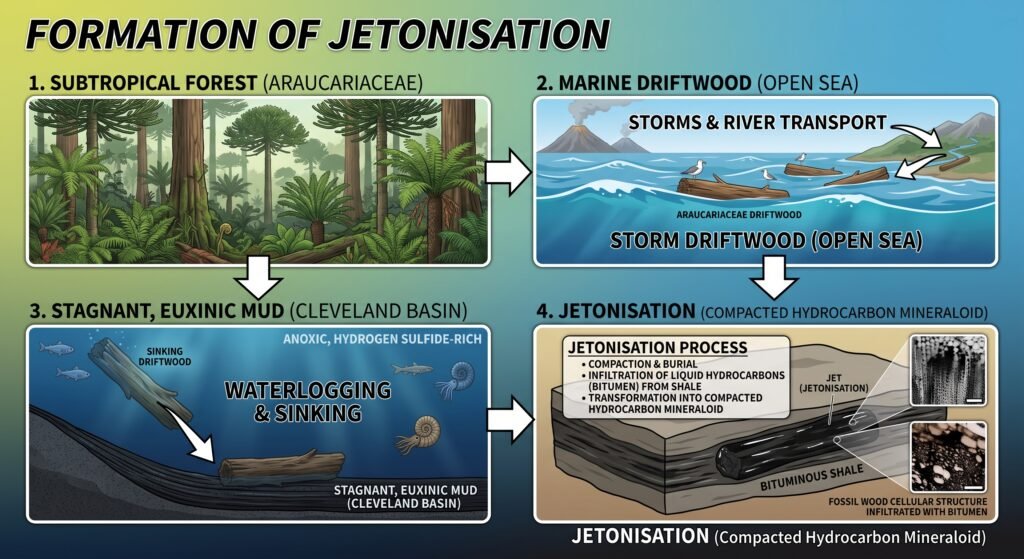
- Waterlogging & Sedimentation: After weeks or months drifting, the araucarian logs became waterlogged and sank to the seabed.
- Euxinic Conditions: Due to severe ocean stratification and stagnant circulation, the seafloor muds (now the Whitby Mudstone Formation, specifically the Mulgrave Shale Member) were completely depleted of dissolved oxygen and poisoned with free hydrogen sulphide (H2S).
- Absence of Scavengers: Wood-boring molluscs and macro-decomposers could not survive in this benthic “dead zone.” Instead of rotting, the wood settled undisturbed into fine organic muds alongside dying ammonites, dibranchiate cephalopods, and algae.
The Chemistry of “Ionisation”
Jet is not simply high-grade coal or petrified wood. Traditional fossil wood petrifies when silica (SiO2) or calcite (CaCO3) precipitates within cellular voids, replacing organic structures with stone. Typical bituminous coal forms from terrestrial peat bogs where an entire ecosystem’s plant debris is crushed under broad regional heat and overburden.
Jet formation(ionisation) involves an isolated piece of driftwood subjected to a unique diagenetic sequence:
Secondary Bitumen Impregnation
As organic-rich sapropelic muds buried the wood, massive blooms of marine algae and micro-plankton settled into the sediments. Under early diagenesis, these algal remains broke down into liquid and gaseous hydrocarbons (sapropel/bitumen).
The dense, resinous araucarian logs acted like a sponge. Under compaction, these liquid hydrocarbons diffused into the cellular tracheids of the wood, completely permeating the vascular walls and cross-linking with the tree’s natural diterpenoid resins.
Anaerobic Sulphate Reduction
Sulphate-reducing anaerobic bacteria thrived on the periphery of the decomposing mud, producing bisulphide ions that reacted with available iron. This is why natural jet often exhibits thin surface films or internal micro-nodules of brass yellow iron disulphide (pyrite, FeS2).
Plastic Compression
Burial pressures compressed the cellular structure vertically. Because of the bitumen infusion and lack of petrifying silicates, the wood did not crack into brittle shards; it yielded plastically. Under overburden pressure, circular tracheid cells flattened into lenticular ellipses, converting the rounded trunk into an elongated, oval-shaped lens commonly referred to by Yorkshire miners as a “plank” or “jet rock.”
Hard Jet vs. Soft Jet: Depositional Geochemistry
Geologists and gemmologists distinguish between two primary varieties of jet based on the chemical salinity of their depositional basins:
| Property | Hard Jet (Marine) | Soft Jet (Freshwater / Estuarine) |
|---|---|---|
| Depositional Waters | Anoxic marine shale (saltwater) | Deltaic sandstones & freshwater clays |
| Geological Formation | Whitby Mudstone Formation (Mulgrave Shale) | Estuarine & Saltwick Formations |
| Bitumen Infiltration | High; thoroughly saturated by marine hydrocarbons | Low to moderate |
| Thermal / Humidity Resilience | Extremely stable; does not crack or craze easily | Prone to desiccating, checking, and splitting |
| Specific Gravity | 1.30 to 1.35 | 1.15 to 1.25 |
| Lapidary Quality | Takes an exceptional, vitreous-to-velvety polish | Brittle; inferior polish, fractures under stress |
Physical and Gemmological Profile
Because authentic Whitby Jet retains its original botanical framework beneath secondary hydrocarbon saturation, it displays diagnostic gemmological and material behaviours:
- Chemical Composition: Approximately 75–80% carbon, 7–9% hydrogen, 10–15% oxygen, with trace nitrogen and sulphur.
- Mohs Hardness: 2.5 to 4.0. Soft enough to carve with steel scrapers and gravers, yet resilient enough to hold crisp facet edges.
- Specific Gravity: 1.30 to 1.35. Exceptionally lightweight; large carved Victorian mourning collarettes and heavy bead ropes could be worn comfortably without straining the neck.
- Thermal Conductivity: Poor conductor. Unlike cold obsidian, tourmaline, or black glass (French jet), genuine jet feels warm to the touch immediately against skin.
- Triboelectric Properties: When rubbed vigorously against wool or silk, jet accumulates static electricity, readily attracting scraps of paper or ash—a property noted by Pliny the Elder and classical Roman lapidaries.
- Microscopic Structure: In thin sections examined under polarised light, the original woody grain is frequently preserved. Transverse cuts display compressed seasonal growth rings and bordered tracheid pits identical to modern Araucaria.
The transformation of Jurassic Monkey Puzzle driftwood into jet represents a rare geochemical equilibrium: an exact alignment of botanical resin density, oceanic anoxia, and bituminous hydrocarbon saturation that preserved ancient drift timber as a deep black, workable organic gemstone.