Walk into almost any metaphysical shop and you can pick up a tumbled piece of labradorite for the price of a coffee—leading many to assume it is strictly a budget mineral. However, as this Labradorite Price Guide explores, top-tier collector cabochons and rare colour specimens regularly fetch £10 to £45+ per gram (£2 to £9+ per carat) on the fine gem market.
This vast price disparity catches many buyers off guard. Because labradorite cannot be evaluated with standard gemstone clarity and colour scales, its worth is dictated by optical physics, lapidary cutting skill, and structural soundness.
Understanding what separates low-grade commercial material from investment-grade specimens comes down to four critical factors: flash coverage across the face, body matrix darkness, chromatic spectrum rarity, and the presence of internal fractures.
The 4 Critical Drivers of Labradorite Value
When evaluating rough, carved display pieces, or finished jewellery cabochons, professional gem dealers assess four distinct criteria:
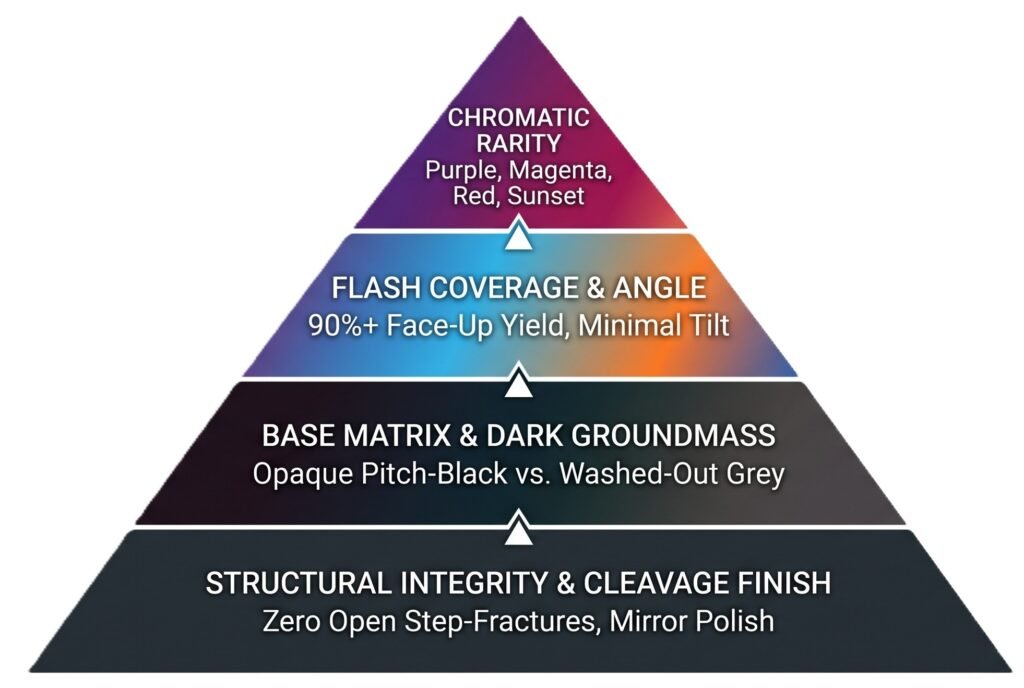
Chromatic Rarity (The Reflected Wavelength)
The specific colours reflected by the stone’s sub-microscopic Bøggild exsolution lamellae dictate the baseline pricing tier:
- Commercial Baseline (Cyan, Teal, & Electric Blue): Accounts for roughly 85% to 90% of gem-grade recovery. Abundant and affordable.
- Mid-Tier (Lime Green, Canary Gold, & Bronze): Less common; often occurs as secondary halos bordering blue zones.
- Top-Tier / Rare (Copper, Peach, Sunset Orange, & Ruby Red): Highly sought after; requires thick, specialised lamellae ($>300\text{ nm}$) or dense iron-oxide backings.
- Master-Grade / Ultra-Rare (Pure Purple, Royal Violet, & Magenta): Requires ultra-compressed exsolution layers ($<140\text{ nm}$). Represents less than 0.5% of total mine yield and commands the highest premiums in the plagioclase market.
Flash Coverage & “Face-Up” Angle
A stone may possess rare purple flash, but if that flash only appears when the stone is tilted at an extreme $75^\circ$ angle, its commercial and jewellery value collapses.
- Grade A / Commercial: The flash covers 30% to 50% of the face, or requires noticeable tilting to reveal.
- Grade AA / Fine: Flash covers 60% to 85% of the surface area with good forward-facing visibility.
- Grade AAA / Gem Grade: Full “face-up” yield. The flash ignites across 90% to 100% of the polished dome when viewed straight on, maintaining its reflection across a wide arc of movement.
Base Groundmass Darkness (The Contrast Engine)
Just as black opals command vastly higher prices than white or crystal opals, labradorite relies on its host matrix to absorb stray light scatter:
- Translucent Pale / Cloudy Grey Matrix: Common in low-grade Madagascar material. The pale background scatters white light, causing the interference flash to look milky, washed out, or hazy.
- Opaque Charcoal to Velvet-Black Matrix: Characteristic of high-grade deposits and authentic Finnish spectrolite. The dark background acts as an optical absorber, creating intense contrast that makes the interference colours appear luminous and saturated.
4. Structural Integrity & Surface Cleavage
Because plagioclase feldspar features perfect cleavage along $\{001\}$ and good cleavage along $\{010\}$, cutting and polishing it is technically difficult:
- Low-grade stones frequently exhibit “stepping”—rough, jagged cleavage steps and surface-reaching fissures that interrupt the dome’s reflection and snag fingernails.
- High-value stones are cut and polished with complete structural cohesion: flat or domed surfaces polished to an uninterrupted mirror sheen with zero open fractures across the flash plane.
Comprehensive Price Breakdown: Rough, Slabs, and Cabochons
Labradorite pricing changes dramatically depending on the form in which it is traded. While bulk rock is bought by the metric ton or kilogram, finished jewellery stones are sold strictly by the gram or carat.
| Commercial Category | Quality Tier | Typical Appearance & Colour Profile | Wholesale Price (UK / Global) | Retail Price (Finished Stones) |
| Uncut Rough (Mine-Run) | C / Commercial | Large boulders, pale grey matrix, patchy blue flash ($<25\%$) | £3 – £10 per kg | £15 – £30 per kg |
| Uncut Rough (Lapidary-Grade) | A / Select | Hand-cobbed blocks, strong blue/gold face planes | £25 – £60 per kg | £70 – £120 per kg |
| Finnish Spectrolite Rough | AA / Gem Grade | Opaque black matrix, guaranteed full-spectrum lines | £250 – £800+ per kg | £1.00 – £2.50 per gram |
| Finished Cabochons (Standard) | A / Commercial | Standard oval/teardrop, blue/teal flash, grey body | £0.15 – £0.40 per gram | £0.60 – £2.00 per gram |
| Finished Cabochons (Sunset/Gold) | AA / Fine | Apricot, copper, bronze, multi-hued gold coverage ($>80\%$) | £0.80 – £2.50 per gram | £3.00 – £8.00 per gram |
| Finished Cabochons (Purple/Violet) | AAA / Top Gem | Pure violet, magenta, or sharp multi colour bands | £3.00 – £12.00 per gram | £15.00 – £40.00+ per gram |
| Authentic Finnish Spectrolite | Master Grade | Intense full-spectrum (red/orange/purple) on black base | £8.00 – £25.00 per gram | £25.00 – £75.00+ per gram |
| Faceted Transparent Golden | Gem Quality | Eye-clean, transparent straw-to-amber yellow, brilliant cut | £5.00 – £20.00 per carat | £25.00 – £70.00+ per carat |
The Lapidary Yield Penalty: Why Cut Stones Cost More per Gram
A frequent question among collectors is why a finished 20-gram cabochon can cost £60 when unworked rough sells for £40 per kilogram. The answer lies in the yield penalty inherent to feldspar crystallography.
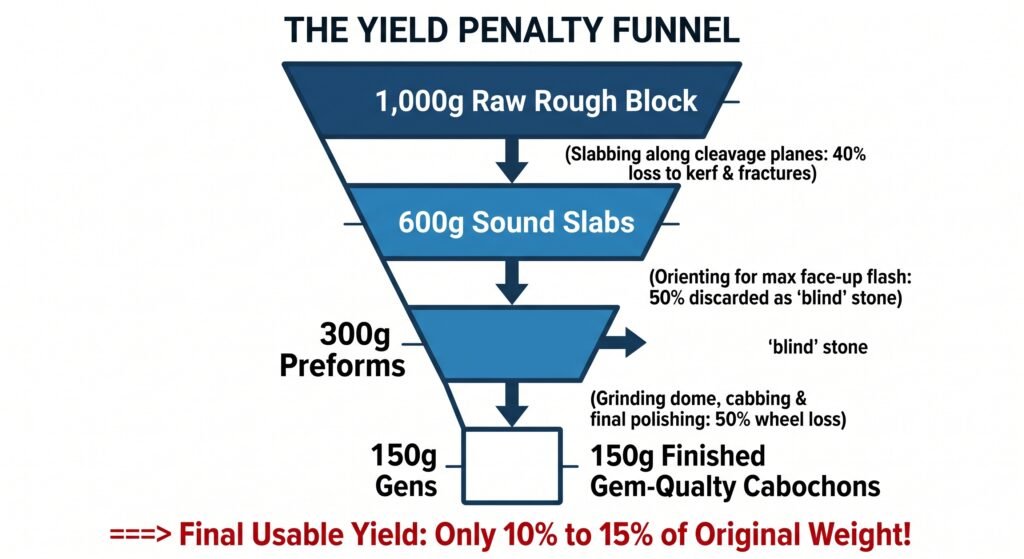
- Orientation Kerf Loss: To capture labradorescence, the saw blade must slice precisely parallel to the microscopic exsolution planes. Slicing at an incorrect angle renders the stone “blind” (a flat, dull grey rock). Experienced lapidaries often discard half a boulder simply to isolate the single high-flash horizon.
- Cleavage Spalling: Because labradorite fractures easily along $\{001\}$, diamond blades and coarse grinding wheels frequently catch micro-lamellae, tearing flakes out of the stone. A preform can split along its cleavage planes midway through the 600-grit sanding stage, turning a potential £50 cabochon into scrap.
- Consumables & Labour: Achieving a mirror polish on plagioclase requires slow, progressive diamond or cerium oxide laps to avoid frictional heat that causes thermal shock. The cost per gram reflects the specialised time and high attrition rate behind each finished piece.
Architectural Slabs vs. Gem-Grade Specimens
When labradorite transitions from the jeweller’s bench to interior architecture (such as kitchen worktops, wall cladding, and monument facades), pricing mechanisms shift from weight-based metrics (per gram) to area-based metrics (per square meter).
- Commercial Architectural Slabs (e.g., Ukrainian Volga Blue or Madagascar Extra):
- Typically sold in 20 mm or 30 mm thickness.
- Price ranges from £250 to £800+ per square meter, depending on the density of iridescent phenocrysts per square foot.
- Why the Valuation Differs:
- Architectural stone does not require 100% surface flash; rather, it values structural stability, low porosity, compressive strength, and an even distribution of chatoyant “eyes” floating across an otherwise durable, dark matrix.
- Gem-grade cabochons demand continuous, uninterrupted flash across the entire piece, which cannot be sustained across a two-meter kitchen island slab.
Value Traps: How to Avoid Overpaying
When purchasing high-tier labradorite, watch for these common retail pricing distortions:
- The “Wet Photography” Premium: Online sellers frequently photograph rough or low-polish cabochons submerged in water or wiped with mineral oil. This temporarily deepens contrast and simulates a flawless polish on a stone that will dry into a dull, grey, stepped surface. Always insist on seeing dry, diffuse-daylight photographs or video.
- Mislabeled “Spectrolite” from Madagascar: Standard Madagascar labradorite displaying a trace of orange or bronze is often branded as “Madagascar Spectrolite” to justify a 400% price markup. True spectrolite comes exclusively from the Ylämaa region of Finland, characterized by an opaque pitch-black matrix and saturated rainbow banding.
- Extreme Oblique Flash Angles: Beware of stones photographed at extreme, near-horizontal angles. A cabochon is only worth top-tier prices if it flashes when viewed directly or under a gentle, natural tilt. If you have to twist your neck $80^\circ$ to see the blue, it should be priced as commercial B-grade material.
- Resin Doublets Sold as Solid Gems: Inexpensive foil-and-resin imitations mimic rare purple-flash labradorite at bargain prices. Always inspect the stone from the side to verify that the colour is an internal crystalline reflection, not a thin iridescent sheet glued beneath a glass or clear resin cap.
Summary: Quick Valuation Checklist
Before buying or pricing a piece of labradorite, run through this five-point value rubric:
- [Colour Spectrum: Is it common blue/green, or rare copper, sunset, purple, or full-spectrum?
- [Flash Coverage: Does the flash cover $>80\%$ of the face, or is it patchy and localized?
- Viewing Angle: Does it ignite face-up, or does it require an extreme, impractical tilt?
- Matrix Quality: Is the background opaque and dark (high contrast), or pale and cloudy?
- Surface Finish: Is the dome free of cleavage steps, chips, and surface cracks?
By applying these criteria, collectors and jewellers can look past superficial trade names and accurately value labradorite based on its true optical rarity, lapidary labour, and geological excellence.