Treasured for its deep, velvety lustre and poignant historical resonance, antique Whitby jet jewellery occupies a unique place in the decorative arts. From intricate Victorian mourning brooches and carved cameos to dramatic multi-strand beads, authentic jet from North Yorkshire’s rugged coastline is not a cold mineral, but a delicate, fossilised organic gemstone formed millions of years ago under intense ocean-bed pressure. Because it is warm to the touch, lightweight, and capable of taking a mirror-like polish, historical lapidaries could craft breathtakingly detailed pieces that still captivate collectors today.
However, that same organic structure makes antique jet exceptionally vulnerable compared to quartz, agates, or precious metalwork. With a low Mohs hardness and a susceptibility to thermal shock, chemical degradation, and surface micro-crazing, well-meaning modern cleaning methods—such as ultrasonic baths, harsh detergents, or saturated soaking—can cause irreparable harm.
Whether you are looking to revive a family heirloom, maintain an expanding personal collection, or preserve fragile carved detailing for future generations, proper conservation requires a specialist approach. In this comprehensive guide, we explore the safest, conservator-approved techniques to clean, protect, and store your antique Whitby jet jewellery to ensure its striking, inky brilliance endures for decades to come.
Cleaning Protocols
Because jet is porous and relatively soft (Mohs 2.5–4.0), aggressive chemical cleaners and ultrasonic baths will destroy antique finishes and loosen historic mountings.
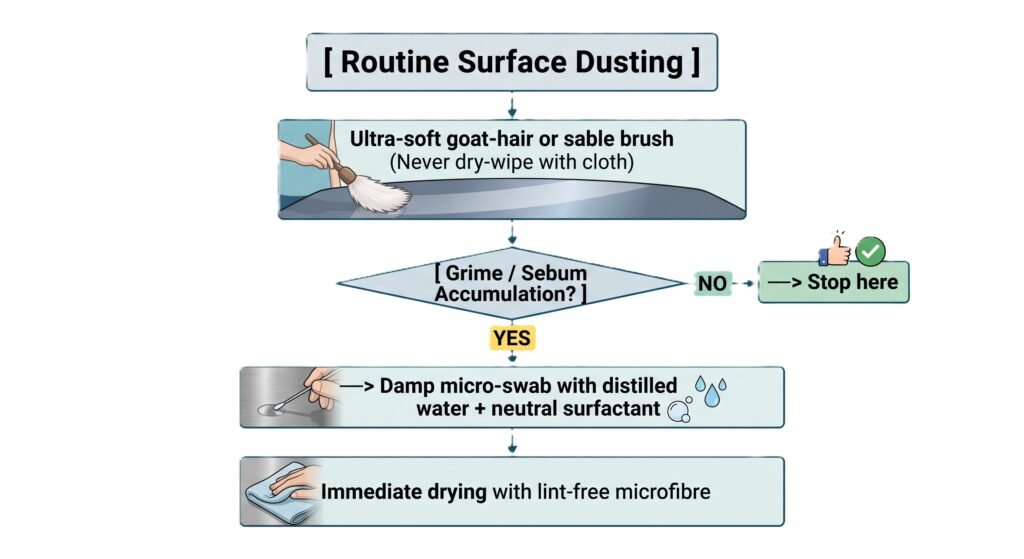
Routine Maintenance
- Dry Dusting: Use a soft, natural-bristle artist’s brush (such as sable, pony, or goat hair) to lift particulate grit out of deep carving recesses. Avoid wiping dry pieces with a cloth; ambient dust contains silica quartz particles (Mohs 7) that cause micro-scratches on the softer jet surface.
- Surface Cleaning: If sebum, cosmetics, or handling residues have dulled the piece:
- Moisten a medical-grade cotton swab (Q-tip) with distilled water mixed with a trace drop of a conservation-grade, non-ionic detergent (e.g., Dehypon or dilute liquid dish soap free from fragrances and dyes).
- Roll the swab lightly over the surface—never scrub.
- Work in small sections, immediately following with a second swab moistened with pure distilled water to rinse.
- Pat dry immediately with a clean, lint-free micro fibre lens cloth.
Strict Prohibitions
- No Ultrasonic or Steam Cleaners: Ultrasonic vibrations exploit natural micro-fractures and cleat lines, causing catastrophic shattering. Steam will cause rapid thermal shock and dissolve historical adhesives.
- No Solvents or Alcohols: Methylated spirits, acetone, alcohol wipes, and jewellery dip solutions dissolve the volatile hydrocarbon binders within the jet, stripping its natural polish and turning the surface grey or chalky.
- Avoid Traditional Oil Treatments: Old advice often suggests treating faded jet with olive oil, linseed oil, or petroleum jelly. These oils oxidise, turn rancid, attract atmospheric grit, seep into porous cavities, and permanently discolour the material.
Structural Conservation and Repairs
Victorian jet pieces were constructed using methods specific to the 19th century, often involving lead solder, brass stampings, or organic hide glues.
Caution Whitby jet expands and contracts at a different rate than the metal pins, hinges, and rivets embedded within it. Never force a tight antique clasp or attempt to bend metal pins while they are anchored directly into the jet body.
Restoring Lustre
If a piece has lost its deep velvety shine due to dry storage, avoid modern furniture waxes or petroleum polishes.
- Buffing very gently with a dry, plush jeweller’s chamois leather or a dry micro fibre cloth is usually sufficient to bring back the natural shine.
- Professional conservators occasionally apply a micro-crystalline wax (such as Renaissance Wax) in an exceptionally thin, sparing layer. This protects against atmospheric moisture and oxidisation without degrading the hydrocarbons, but it should only be done on thoroughly cleaned, stable pieces.
Stabilising Cracks and Loose Mountings
- Adhesive Re-attachment: Victorian lapidaries secured pin backs and brooch hinges into carved cavities using shellac or gutta-percha cement. If a metal finding detaches:
- Never use cyanoacrylate (superglue) or standard hardware epoxies; they outgas, create irreversible bonds, and can craze the jet.
- Use a reversible, conservation-grade acrylic adhesive (such as Paraloid B-72 dissolved in acetone/ethanol) or traditional dark button shellac applied with low, controlled heat by an experienced restorer.
- Strung Beads: Antique necklaces strung on original silk or cotton thread are almost invariably compromised by rot or stretching. Re-string Victorian jet beads onto modern coated braided steel wire (e.g., Beadalon) or fresh knotted silk, placing small silicone or leather rondelles between large carved beads to stop abrasive friction.
Safe Storage Protocols
Jet requires stable environmental conditions to prevent checking (surface crazing), shrinkage, and fracture.
| Factor | Recommended Standard | Risk of Non-Compliance |
|---|---|---|
| Relative Humidity (RH) | 45% – 55% | Low RH dries the organic matrix (crazing); high RH corrodes internal brass/iron pins. |
| Temperature | 15°C – 20°C (Stable) | Sudden temperature spikes induce thermal shock and conchoidal fractures. |
| Light Exposure | Low / Indirect (No direct UV) | Excessive UV radiation causes organic degradation, brittleness, and fading. |
| Storage Material | Acid-free tissue, archival board, unbleached cotton | Wood resins, oak boxes, and acidic cardstocks outgas acids that corrode settings. |
- Individual Compartmentalisation: Jet is soft enough to be deeply gouged by diamonds, sapphires, silver brooches, or even black glass (“French jet”). Store each piece flat in its own acid-free, textile-lined compartment or inside a dedicated unbleached cotton drawstring pouch.
- Avoid Air-Tight Sealed Plastics: Do not seal antique jet long-term inside airtight zip-lock bags. Minor organic outgassing needs to dissipate; completely trapped micro-climates can accelerate degradation if moisture is present.
- Keep Away from Direct Heat: Avoid display cabinets placed near radiators, south-facing window sills, or under hot incandescent spotlighting.