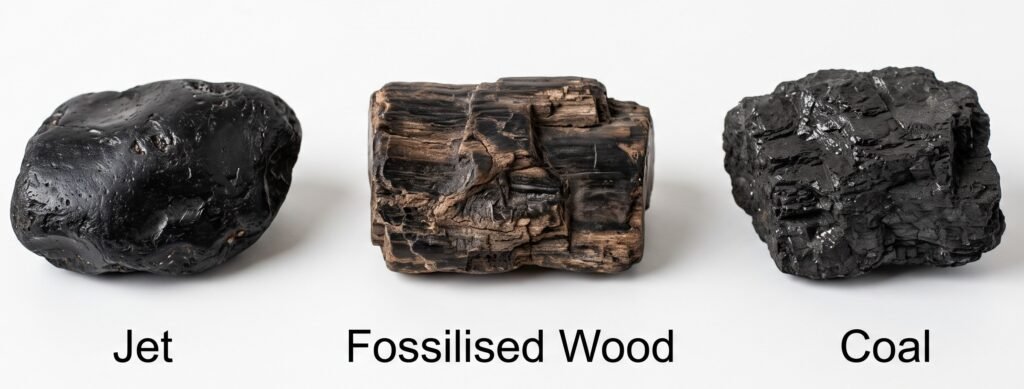
Holding a piece of polished black material in your hand often raises more questions than answers. When evaluating Jet vs Petrified Wood vs Coal, specimens uncovered along a storm-swept coastline, unearthed from a gravel pit, or discovered in an antique jewellery box frequently share a deceptively similar first impression: deep obsidian tones, a subtle waxy or glassy sheen, and an origin rooted in prehistoric timber.
Yet beneath that shared arboreal lineage lie three completely distinct geological journeys. One was preserved and hydrocarbon-infused within calm, prehistoric ocean beds; another was molecularly turned to solid stone by silica-rich volcanic groundwaters; and the third was crushed across massive inland swamps into stratified fuel. Telling them apart is not merely a matter of academic interest—it dictates whether a specimen can be carved on a jeweller’s lathe, cut with diamond lapidary wheels, or simply crumble away to dust under pressure.
To help you quickly diagnose an unknown specimen or cut through the overlapping terminology used by collectors and fossil hunters, we have broken down the most common questions regarding how these three materials compare in composition, durability, and testing.
Core Physical and Chemical Comparison
| Property | Jet | Petrified Wood | Coal (Bituminous / Anthracite) |
|---|---|---|---|
| Material Classification | Organic mineraloid | Pseudomorph fossil / Silicate rock | Organic sedimentary rock / Metamorphic rock |
| Primary Composition | Hydrocarbon polymer matrix (vitrinite-rich) | Silicon dioxide (SiO2: chalcedony/opal/quartz) | Carbon (60–95%+), volatile matter, ash, sulphur |
| Mohs Hardness | 2.5 – 4.0 | 6.5 – 7.0 | 1.0 – 2.5 (Bituminous); 2.5 – 3.0 (Anthracite) |
| Specific Gravity | 1.30 – 1.35 | 2.58 – 2.65 | 1.15 – 1.50 (Bituminous); 1.40 – 1.80 (Anthracite) |
| Fracture & Tenacity | Conchoidal; tough, sectile, carvable | Conchoidal to uneven; brittle, hard | Uneven to conchoidal; highly brittle, friable |
| Thermal Feel | Warm to the touch (low thermal conductivity) | Cold to the touch (high thermal conductivity) | Cool to warm; soils fingers easily |
| Electrostatic Reaction | Readily picks up static charge when rubbed | Negative (no static pickup) | Weak to negative |
| Primary Modern Use | Fine lapidary, jewellery, ornament | Display slabs, cabochons, furniture | Thermal energy, metallurgical coke |
Geological Formation and Origins
1. Jet: The Submarine Coalification of Driftwood
Unlike ordinary coal seams, jet does not originate from broad terrestrial mire or peat-bog accumulations.
- The Precursor Material: The finest geological jet—such as Jurassic Whitby jet from the Mulgrave Shale Member (Yorkshire, UK)—derives from the driftwood of fallen coniferous trees closely related to modern Araucaria (Monkey Puzzle trees).
- The Environment: Individual logs washed out to sea, became waterlogged, and sank into calm, stagnant marine basins. They were quickly sealed inside anoxic, organic-rich bituminous muds.
- The Metamorphic Process: Deprived of oxygen, the wood avoided fungal and bacterial decay. Over millions of years, hydrostatic lithostatic pressure flattened the cylindrical trunks into lens-shaped seams (stauves). Marine bitumen and liquid hydrocarbons permeated the collapsing cellular framework, resulting in an exceptionally compact, homogenous organic matrix free of detrital mineral grains.
2. Petrified Wood: Epigenetic Mineral Replacement
Petrified wood (permineralised or replaced fossil wood) retains the microscopic anatomical structure of trees without retaining the original carbon compounds.
- Permineralisation vs Replacement: Groundwater rich in dissolved silicates (SiO2, frequently derived from weathering volcanic ash layers) pervasively saturates subterranean logs.
- The Petrifaction Mechanism: In initial stages, silica deposits inside the empty cellular lumens (permineralisation). Over extended periods, as cellulose and lignin break down molecule by molecule, microcrystalline quartz, chalcedony, or amorphous opal replaces the organic cell walls (replacement/pseudomorphism).
- Colour Genesis: The striking bands seen in deposits like the Chinle Formation of Arizona originate from trace metal impurities captured during precipitation—iron oxides impart reds and ochres, manganese creates purples and blacks, and chromium or cobalt produces rare greens.
3. Coal: Mass Accumulation of Terrestrial Peat
Coal is a stratified, combustible sedimentary rock that represents massive vegetation burial rather than single-log preservation.
- The Peat Stage: Extensive layers of lycophytes, seed ferns, and early gymnosperms died and collapsed in stagnant, freshwater coastal swamps (notably during the Carboniferous period). Standing water limited available oxygen, arresting aerobic decay and producing thick beds of peat.
- The Coalification Series: As subsequent sediments stacked overhead, pressure and geothermal heat initiated continuous metamorphism:Peat⟶Lignite⟶Sub-Bituminous⟶Bituminous⟶AnthraciteDuring this maturation, moisture, oxygen, and volatile matter were driven out, leaving a concentrated carbon mass. Coal remains heterogenous, comprised of diverse microscopic organic constituents known as macerals (vitrinite, inertinite, and liptinite) mixed with inorganic clays, pyrite, and quartz silt.
Distinctive Characteristics in Hand Specimen
The visual differences between mineralised wood and carbonaceous materials are pronounced in hand specimens:
Key Diagnostic Tests
To differentiate jet, petrified wood, anthracite, and common substitutes (like French jet/black glass or vulcanite), run these standard diagnostic checks:
1. Mohs Hardness and Scratch Test
- Petrified Wood: Hardness 6.5–7. Will not be scratched by a steel penknife or masonry nail (hardness 5.5). In fact, it easily scratches window glass.
- Jet: Hardness 2.5–4. Readily scratched by a steel pin or copper coin, but resists scratching with a fingernail (hardness ~2.2).
- Coal: Bituminous coal is soft (1.0–2.5) and easily gouged; anthracite sits at 2.5–3.0, behaving similarly to soft jet on a scratch plate.
2. Specific Gravity and Heft
- Jet: Remarkably lightweight (1.30−1.35 g/cm3). When held in the palm, large beads or pendants feel surprisingly buoyant and warm due to very low thermal conductivity.
- Petrified Wood: Heavy and stony (2.58−2.65 g/cm3). Transmits a classic stone chill when pressed against the cheek or lips.
- Coal: Anthracite is slightly denser than jet (1.40−1.80 g/cm3), while bituminous coal hovers around 1.15−1.50 g/cm3.
3. Streak Plate and Scribing
- Jet: Leaves a chocolate-brown to umber streak on an unglazed porcelain tile.
- Bituminous Coal: Leaves a distinctly black, sooty streak that easily rubs off into powder.
- Petrified Wood: Leaves a white streak (or scratches the porcelain plate altogether).
4. Hot Point Test (Micro-destructive)
Applying an incandescent needle to an inconspicuous area under magnification:
- Jet: Gives off a faint, characteristic paraffinic, oily, or burning coal odour, without melting like modern plastics.
- Petrified Wood: Entirely inert; zero odour, no smoke, and no damage.
- Coal: Yields an acrid, sharp, sulphurous smoke.
- Vulcanite / Early Rubber (Simulant): Pungent smell of burning tyre or scorched rubber.
5. Triboelectric (Static Charge) Test
When briskly rubbed against wool, silk, or dry flannel:
- Jet: Generates a strong negative electrostatic charge capable of lifting light scraps of paper or tissue fibres (earning it the historical name black amber).
- Anthracite and Petrified Wood: Produce no noticeable static charge under standard conditions.
Lapidary and Workability Considerations
- Petrified Wood must be treated like agate. It requires water-cooled diamond-blade lapidary saws, silicon carbide or diamond grits running through 60 to 3,000 mesh, and cerium oxide or diamond paste for the final polish.
- Jet cannot tolerate aggressive friction heating, which fractures its delicate hydrocarbon binders. It is worked with fine wood-carving gouges, files, and high-speed rotary burrs, followed by wet pumice sanding and finishing on wooden or cloth laps charged with jeweller’s rouge.
- Coal (with the exception of ultra-dense Pennsylvania anthracite) is rarely suited for intricate lapidary work; it suffers from pervasive macro- and micro-cleat fractures that cause the workpiece to crumble under point-load pressure.
Summary
While jet, petrified wood, and coal all trace their ancestry back to prehistoric forests, their ultimate destinies could hardly be more distinct. What began as fallen timber millions of years ago was fundamentally transformed by the chemistry of its burial environment—yielding a mineralised agate-hard gemstone, a tough and velvety carver’s medium, or a combustible rock that powered the industrial world.
Understanding these differences transforms how you handle and value each specimen. Where petrified wood demands the heavy-duty diamond saws and cooling baths of hard-stone lapidary, jet rewards delicate hand-carving and careful conservation away from drying heat and abrasive grit. Coal, with its brittle structure and internal fracture lines, remains largely unsuited to fine craftsmanship altogether.
Whether you are scouring coastal shale beds after a storm, cataloguing an antique mourning brooch, or building an educational fossil collection, a few simple observations—heft, hardness, streak, and thermal touch—will swiftly unmask the material in your palm. Far from interchangeable black stones, each is a distinct time capsule from deep geological history, preserved through the disparate forces of fire, water, and deep time.
Frequently Asked Questions: Jet vs Petrified Wood vs Coal
Is jet a type of coal or petrified wood?
Jet is an organic mineraloid closely related to low-rank coals (such as lignite and sub-bituminous coal), but formed under distinct marine conditions. Unlike petrified wood—which has undergone complete epigenetic replacement by silica minerals like chalcedony and quartz—jet retains its original carbonaceous, hydrocarbon-rich organic structure, formed from driftwood compressed within anoxic marine mudstones.
How can you tell the difference between jet and coal?
Jet is tough, sectile, and dense enough to be carved and lathed without fracturing, whereas commercial bituminous coal is brittle, dusty, and prone to shattering along natural cleat lines. Diagnostic testing readily separates them: drawn across an unglazed porcelain streak plate, jet leaves a chocolate-brown to umber streak, while coal leaves a sooty, jet-black mark. Jet also accumulates a strong electrostatic charge when rubbed briskly with wool, which coal does not.
Why is petrified wood so much heavier and harder than jet?
Petrified wood is composed of silicon dioxide (SiO2), giving it a high Mohs hardness of 6.5 to 7.0 and a specific gravity of 2.58 to 2.65 g/cm³. It scratches glass, resists steel blades, and feels heavy and cold in the hand. By contrast, jet consists of an organic hydrocarbon polymer matrix; it sits at a soft 2.5 to 4.0 on the Mohs scale, has a remarkably light specific gravity of 1.30 to 1.35 g/cm³, and feels warm against the skin due to its low thermal conductivity.
Can coal ever turn into petrified wood?
No. Coal and petrified wood represent two completely separate geological processes that cannot transition from one to the other. Coalification is a metamorphic process driven by heat and pressure that concentrates carbon while driving out moisture and volatile matter from broad peat swamps. Petrifaction requires silica-saturated groundwater to infiltrate buried logs, precipitating microcrystalline quartz directly into cell cavities and cell walls before the wood can decompose or compress.
How do you distinguish black petrified wood from Whitby jet in hand specimens?
Black petrified wood will easily scratch ordinary window glass or a pocket knife blade, leaves a colourless or white streak, and produces a stony chill when held to the lips. Jet is soft enough to be scratched by a steel point or copper coin, produces a warm cinnamon-brown streak on unglazed ceramic, and feels distinctly light, smooth, and warm to the touch.