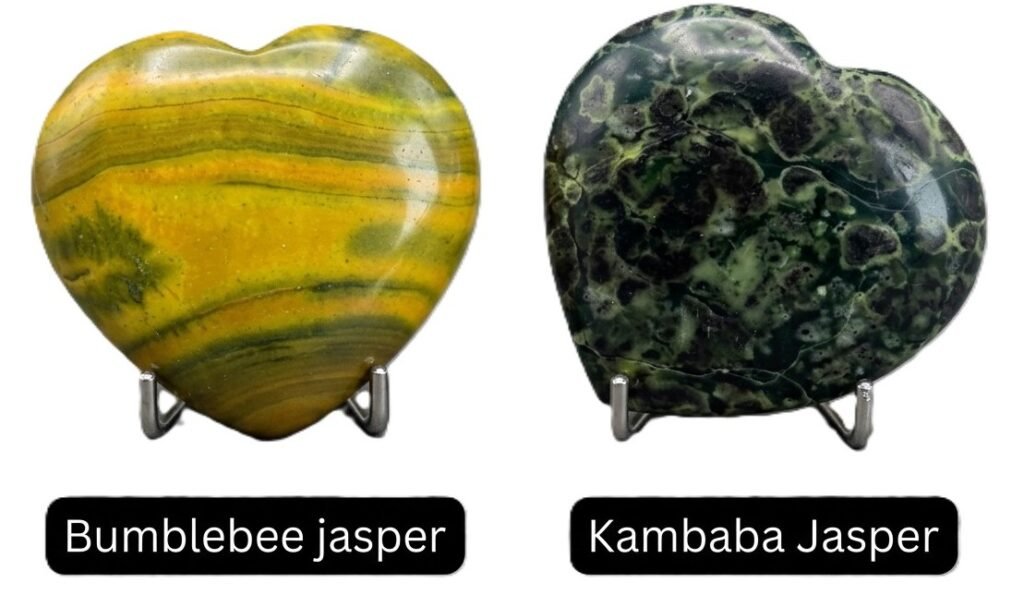
Jasper, a popular gemstone known for its stunning patterns and earthy colours, often finds itself replicated in the market. While genuine jasper possesses distinct characteristics, distinguishing it from imitations can be challenging. This article explores the difference between Real vs Fake Jasper by providing simple tests that anyone can perform.
Understanding these distinctions is crucial for gemstone enthusiasts and collectors alike, ensuring that you can make informed purchases and avoid falling for cleverly crafted imitations. Distinguishing true jasper from common lookalikes does not require an expensive laboratory setup. With everyday household items and a few simple checks, you can reliably test your stones at home. The guide shows visual inspection, density tests, and UV light examinations, to equip you with the knowledge to confidently identify authentic jasper.
What Is Real Jasper, Anyway?
Geologically, jasper is an opaque micro crystalline quartz (chalcedony) coloured by mineral impurities—most commonly iron oxides, which produce deep reds, yellows, and browns.
Because it is made of densely packed quartz crystals, genuine jasper has three signature traits:
- It is tough and hard: It cannot be scratched by pocketknives or window glass.
- It is chemically inert: Common household acids and solvents will not dissolve it or strip its colour.
- It is completely opaque: Even when held directly in front of a strong light beam, light will not pass through it (unlike translucent agate or glass).
5 Simple Tests to Identify Real Jasper
1. The Light & Magnification Check (No Tools Needed)
Before performing any physical tests, inspect the stone under bright lighting with your naked eye or an inexpensive jeweller’s loupe ($10\times$ magnification):
- Look for trapped bubbles: Slag glass is often sold as “sea jasper” or “cherry jasper.” True jasper forms underground through mineral precipitation and never contains spherical air bubbles. If you see tiny round bubbles suspended inside, it is glass.
- Check the cracks for pooling dye: Stones sold with neon shades like hot pink, electric blue, or vivid purple are almost always dyed. Under magnification, artificial dye concentrates heavily in spiderweb-like micro-fractures, leaving the centres of individual mineral grains pale.
- Look through the stone: Hold a bright torch directly against the back of the piece. True jasper remains stubbornly opaque. If light shines through the edges like a coloured lampshade, you are likely holding agate, chalcedony, or coloured glass.
2. The Knife Scratch Test (Testing Hardness)
Mineral hardness is measured on the Mohs scale from 1 (talc) to 10 (diamond). Genuine jasper rates between 6.5 and 7.0, making it harder than most common metals.
| Material | Mohs Hardness | Can it scratch true jasper? |
| Fingernail | ~2.5 | No |
| Copper penny | ~3.0 | No |
| Pocketknife / Steel nail | ~5.0 – 5.5 | No |
| Window glass | ~5.5 | No |
| Steel workshop file | ~6.5 | Rarely / Borderline |
| Genuine Jasper | 6.5 – 7.0 | Baseline |
How to test:
- Pick a hidden spot, such as the flat back of a pendant or near a bead drill hole.
- Press the tip of a clean steel knife blade or nail against the spot with firm, controlled pressure and try to make a short scratch.
- Wipe the spot with a damp cloth to clear any residue.
What to look for:
- Real Jasper: The steel slides off cleanly without leaving a gouge. Any visible silvery mark is actually soft metal rubbed off the blade onto the harder stone.
- Fake or Soft Simulant: The blade digs in easily, carving a powdery groove. If it scratches easily, your stone is likely dyed marble, calcite, howlite, or resin.
3. The Acetone Rub (Catching Artificial Dyes)
Many vivid “designer jaspers” are actually white howlite, cheap marble, or porous quartzite soaked in industrial dyes.
How to test:
- Dip a clean white cotton swab in 100% pure acetone (available at hardware or beauty stores; avoid oily nail polish removers with added fragrances).
- Rub the swab vigorously against a small section of the stone—especially around fissures, crevices, or bead holes—for 20 to 30 seconds.
What to look for:
- Real Jasper: The cotton swab stays completely white. Natural jasper gets its colour from iron and silica locked inside the mineral matrix, which acetone cannot dissolve.
- Dyed Stone: The cotton swab quickly stains with pink, purple, blue, or green pigment.
- Coated Stone: If the stone has been coated in paraffin wax or plastic sealant to hide flaws, the surface will turn dull or sticky.
4. The Vinegar Drop (The Acid Test)
Popular decorative stones like Bumblebee “Jasper” are trade names, not true jaspers. Bumblebee stone is a soft volcanic rock primarily made of calcite and gypsum containing arsenic and sulphur. Calcite is a carbonate mineral that reacts quickly to acid.
How to test:
- Place a single drop of plain 5% white household vinegar onto an unpolished edge or back surface.
- Look closely under good light or a magnifying lens.
What to look for:
- Real Jasper: Nothing happens. Jasper is an acid-resistant silicate; the vinegar sits harmlessly on the surface.
- Carbonates & Calcite lookalikes: The drop will gently fizz and produce tiny carbon dioxide bubbles as the acid dissolves the calcium carbonate. (Wipe and rinse the stone immediately after testing so the surface is not damaged.)
5. The Water Displacement Test (Testing Density)
Specific Gravity ($SG$) is simply a measure of how dense a stone is compared to water. Jasper has a predictable density range of 2.58 to 2.91, meaning it feels noticeably heavier in the hand than plastic or resin imitations.
You can test this at home using a digital kitchen scale (precise to 0.01g), a small cup of water, and a piece of thread:
1. Weigh the stone dry: Weigh your clean, dry stone on the scale and write down the number in grams (Weight in Air).
2. Zero the water cup:Ensure the scale reads exactly zero. Place a cup of room-temperature water on the scale and press the Tare (zero) button to set it to zero again.
3. Suspend the stone in water:Do not let the stone touch the bottom or sides. Tie a thin piece of sewing thread around the stone. Lower it gently into the water until it is fully submerged. Record the reading on the scale (Weight in Water).
4. Calculate the density: Divide the dry weight by the submerged weight:
Specific Gravity = Dry Weight in Air / Weight of an qual volume of water
What the Numbers Mean:
- 2.58 – 2.91: Genuine jasper (stones with more iron, like red jasper, sit closer to 2.70–2.90).
- 1.05 – 1.40: Plastic or resin fake (feels exceptionally light and warm in hand).
- 2.50 – 2.59: Dyed howlite or light chalcedony.
Quick Reference: Common “Fake Jaspers” to Watch For
| Trade Name | What It Actually Is | Why It’s Not True Jasper |
| Bumblebee Jasper | Calcite & gypsum with arsenic/sulphur minerals | Soft (Mohs ~3.5–4); fizzes in acid; toxic dust when cut. |
| Dalmatian Jasper | Aplite (igneous rock with feldspar and tourmaline) | A composite rock rather than microcrystalline quartz. |
| Aqua / Purple Jasper | Dyed Howlite or Quartzite | Acetone lifts the dye; howlite scratches with a knife. |
| Red “Sea” Jasper | Moulded slag glass | Contains round gas bubbles; breaks with translucent glass edges. |