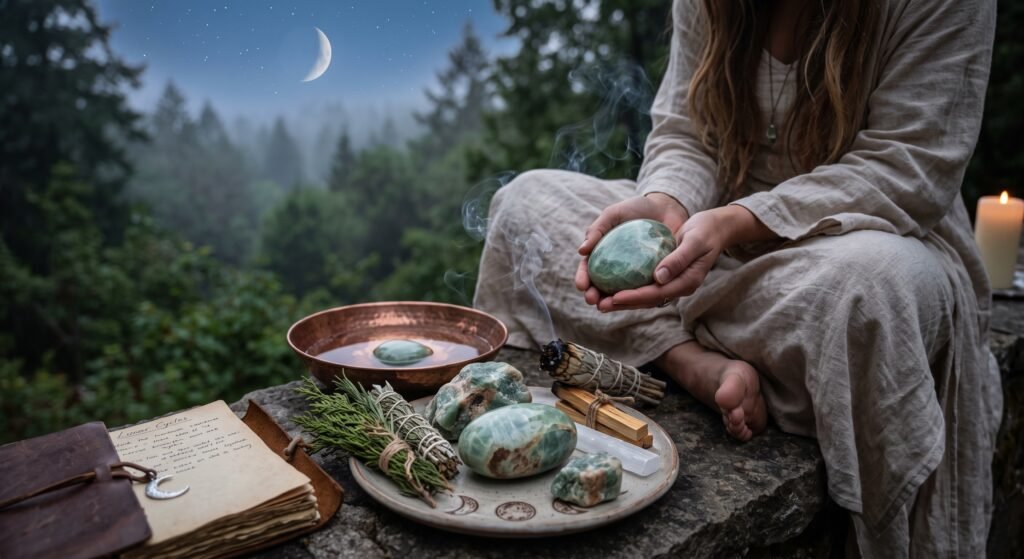
Green Moonstone occupies a distinctive niche in ritual work because it bridges two elemental forces: water (lunar cycles, emotional depths, intuition) and earth (plant vitality, physical grounding, the green ray of the heart). Unlike traditional white moonstone, which is predominantly worked with during the peak luminosity of the Full Moon, Green Moonstone is historically and ritually tied to the Dark Moon, the New Moon, and transitional thresholds. The most popular Green Moonstone rituals include:
1. New Moon “Seed Setting” Ritual
Because green feldspar resonates with both germination and lunar beginnings, it is a primary altar stone for the New Moon (the dark phase just as the sliver of light returns).
- Purpose: To plant energetic intentions that require slow, steady physical growth over weeks or months (e.g., launching a venture, breaking old patterns, cultivating health).
- Working Method:
- Practitioners cleanse the stone during the dark phase of the moon using smoke (such as mugwort, cedar, or rosemary).
- A small, unglazed clay dish or shallow bowl is filled with living soil or dried garden herbs.
- The intention is written on natural parchment, folded tightly, and placed into the soil.
- The Green Moonstone is laid directly atop the buried parchment to act as an anchor.
- The bowl remains on the altar until the Full Moon, with practitioners holding the stone at each intermediate phase (First Quarter, Waxing Gibbous) to visualise the intention breaking through the surface of daily life.
2. Earth & Garden Blessing Ritual
Echoing European agricultural folklore—where moonstones were set into plowed fields to coax healthy shoots from the ground—practitioners use green adularia to connect with garden devas and elemental spirits.
- Purpose: Enhancing plant resilience, restoring vitality to stressed soil, or consecrating a greenhouse/allotment.
- Working Method:
- A tumbled or raw piece of Green Moonstone is placed in a clear glass bowl of rainwater gathered under a waxing moon.
- The bowl is left outdoors overnight to absorb the ambient starlight and lunar pull.
- At dawn, the stone is removed and carried clockwise (deosil) around the perimeter of the garden beds.
- The water is lightly flicked onto the leaves of struggling plants or the base of young seedlings.
- Finally, the stone is nestled at the base of the garden’s central plant or tree to anchor the energetic perimeter through the growing season.
3. “Heart-Cauldron” Emotional Release & Forgiveness Ritual
In energetic healing practices, Green Moonstone is viewed as an emotional poultice—particularly for individuals holding resentment, grief, or hyper-vigilant emotional barriers.
- Purpose: Reconciling past emotional wounds without becoming numb or defensive.
- Working Method:
- Practitioners prepare a warm ritual bath infused with Epsom salts, rose petals, and lemon balm or chamomile.
- The Green Moonstone is held over the sternum (the Heart Chakra / Anahata) for several minutes of conscious diaphragmatic breathing.
- Visualising the adularescent shimmer of the stone drawing out hardened, stagnant green-grey energetic weight, the practitioner transfers that tension into the stone.
- The stone is then submerged gently in the water, setting the mental boundary that the water dissolves the emotional residue while the mineral remains clear.
- After the bath, the stone is immediately placed on a bed of dry sea salt or outside on bare earth to neutralise residual static.
4. Lunar Scrying & Nighttime Divination
While white moonstone and clear quartz are more common for high-contrast scrying, high-grade, polished Green Moonstone cabochons or palm stones are used in water-gazing and intuitive threshold work.
- Purpose: Accessing ancestral or subterranean intuitive messages; interpreting subtle, subconscious impulses rather than stark, sharp visions.
- Working Method:
- The stone is placed at the bottom of a dark, ceramic or cast-iron water bowl under indirect candlelight (never direct overhead light).
- The practitioner softens their gaze, watching how the flickering candle flame catches the subsurface adularescent flash through the water.
- The gentle, shifting play of green and silvery light acts as a visual focal point to quiet the conscious mind and allow hypnagogic imagery or intuitive flashes to surface.
5. Transition & Rites of Passage (Menarche, Menopause, Major Life Shifts)
Green Moonstone is aligned with biological and life-stage thresholds, honouring the innate cyclical nature of the body and mind.
- Purpose: Easing the physiological and psychological friction of shifting from one phase of life into another.
- Working Method:
- A small pouch of green cloth is assembled containing a piece of Green Moonstone, dried sage or raspberry leaf, and a silver coin or token.
- The initiate or practitioner sits during the Balsamic (waning crescent) moon, holding the talisman and speaking out loud the identity or chapter being formally released.
- As the Moon passes into its new cycle, the talisman is kept beneath the mattress or on a night stand for an entire 28-day lunar cycle to steady hormonal and psychological transitions.
Ritual Cleansing and Dedication Protocol
Because Green Moonstone is softer than quartz (Mohs 6–6.5) and has perfect cleavage planes, standard ritual maintenance avoids harsh physical methods:
- Cleansing: Prefer sound (tuning forks or singing bowls), dried herb smoke, or passive resting on selenite plates over saltwater baths, which can corrode micro-fractures.
- Charging: Avoid prolonged exposure to midday solar heat, which can fade subtle trace mineral inclusions. Charge exclusively under twilight, starlight, or the soft light of the Waxing to Full Moon.
Additional Rituals
For additional rituals using other stones and crystals see some of my other articles Green Aventurine Wealth Manifestation Ritual and Room Clearing Ritual: Using Hydrosol mist & Sound Tools
These are my personally selected and curated Green Moonstone products