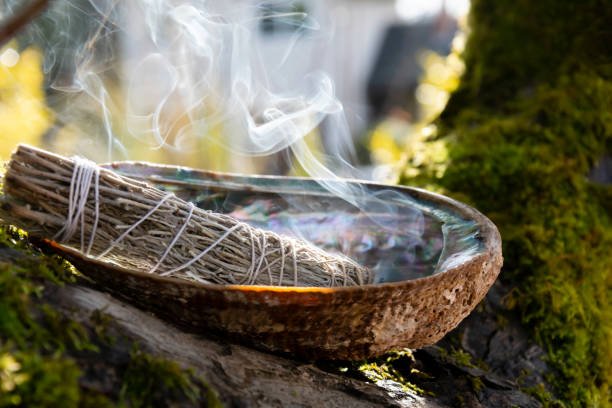
Smoke Cleanse Your House is an ancient, cross-cultural practice. It involves burning aromatic botanicals to purify, reset, and refresh the energy of a space. Additionally, Although often linked to Indigenous ceremonies like smudging, smoke cleansing is widespread in global folk traditions. Finally, From European juniper rituals to Mediterranean resin burning, and to Middle Eastern and Asian incense practices.
Whether moving into a new home or resetting after an intense life transition, smoke cleansing serves as energetic reset. It also helps clear residual tension from conflict or illness and maintain seasonal balance. Although smoke cleansing and smudging are often used online, they are not the same.
Smudging has ceremonial meanings in many First Nations cultures and may involve sacred medicines such as sage and sweetgrass. Practices and protocols differ between Nations, and there is no single universal Indigenous smudging ceremony.
For a general household ritual not tied to a specific Indigenous tradition, smoke cleansing is a useful term. Consequently, it is broader in scope. There is also no scientifically established evidence that smoke removes “negative energy” as a measurable physical substance. The energetic or spiritual effects described in this guide belong to spiritual traditions, folklore and personal practice.
The physical smoke itself is a combustion product, so ventilation and sensible fire precautions are important.
Preparation
A successful house cleansing begins before anything is lit. Rather than immediately walking around the house with burning herbs or incense, spend a few minutes preparing both the physical environment and your purpose for performing the ritual.
Decide Why You Are Cleansing
Your intention does not need to be complicated. You might smoke cleanse because:
- you have recently moved house;
- someone has moved out;
- the household has experienced arguments or tension;
- you have had visitors and want to reset the atmosphere;
- a room feels emotionally uncomfortable or stagnant;
- you are beginning a new stage of life;
- you want to prepare a meditation, spiritual or ritual space;
- you have finished decluttering or spring cleaning;
- you want to mark the end of a difficult period;
- you simply want the home to feel calmer and more intentional.
Try reducing your purpose to one sentence. For example: “”I am clearing this home of what is no longer welcome and creating a peaceful space for everyone who lives here.” The exact words are less important than having a clear purpose.
Physically Clean First
Smoke cleansing should not replace ordinary cleaning. If possible, first:
- remove rubbish;
- wash dirty dishes;
- put away items that are out of place.
- Clean surfaces, empty bins, and vacuum or sweep floors.
- Clear heavy clutter from floors and corners so smoke can circulate unhindered.
- Ensure pets and sensitive individuals (those with asthma or respiratory sensitivities) are in a well-ventilated, separate space or outdoors.
This creates an important psychological distinction between removing physical disorder and performing the symbolic or spiritual cleansing that follows. Many people also find that decluttering beforehand makes the ritual feel more deliberate.
Gather Your Materials
Depending on your preferred tradition or practice, you may use dried aromatic herbs, loose botanical material or incense. You will also need:
- a safe surface on which to place it;
- your chosen prayer, affirmation or intention if you use one.
- Herb Bundle or Loose Botanicals: Common choices include garden sage (Salvia officinalis), rosemary (protection and clarity), mugwort (intuition and deep clearing), cedar (grounding and purification), or lavender (calm and restorative balance).
- Heatproof Vessel: A ceramic bowl, cast iron skillet, abalone shell, or censer to catch falling ash and embers.
- Ignition Source: Matches or a utility lighter.
- Fire Safety: A small bowl of dry sand or soil nearby to snuff out embers immediately if needed.
- Feather or Fan (Optional): To gently guide smoke into target zones.
Your container should be capable of catching hot ash and embers. Never assume that an attractive decorative dish is heatproof.
UK fire services recommend using purpose-designed, heat-resistant holders on stable surfaces and keeping burning incense or herbs away from curtains, clothing, paper and other combustible materials. Burning material should never be left unattended.
Think Carefully About Your Herbs
Different cultures have developed their own relationships with aromatic plants and smoke. If you are using a plant associated with a living cultural tradition, research where that practice originates rather than assuming every herb has a universal spiritual meaning.
White sage (Salvia apiana) deserves particular attention. It has profound cultural significance for Indigenous peoples of Southern California and northern Baja California, while increasing commercial demand has contributed to illegal and unsustainable harvesting. The California Native Plant Society specifically warns about the poaching of wild white sage.
If buying white sage, investigate its provenance rather than assuming a product labelled “natural” or “wild harvested” has been responsibly obtained. Locally grown or cultivated aromatic plants can provide alternatives for a personal smoke-cleansing practice.
Opening Windows
Creates an Exit Route: Stagnant, heavy energy needs a physical pathway to leave the home alongside the smoke. Without an exit point, the smoke and dislodged energy merely recirculate within the rooms.
Maintains Airflow & Fire Safety: Open windows reduce concentrated smoke inhalation, allow fresh air to balance the atmosphere, and prevent smoke detectors from triggering.
Draft Direction: Open at least one window or exterior door in each major area of the house to create a gentle, steady cross-breeze.
Having one or more windows or external doors open has a straightforward physical purpose: burning plant material generates particulate matter, and ventilation helps reduce the accumulation of smoke indoors. Fire-service guidance specifically recommends opening windows or doors when burning sage, herbs or incense.
In spiritual interpretations, the open window is sometimes given an additional symbolic role. The idea is that if the ritual is intended to remove unwanted influences, the open window provides an “exit” through which they can leave.
A Practical Approach
Before beginning:
- Open several windows slightly.
- Open an external door if practical.
- Make sure the resulting draught cannot blow sparks or embers onto combustible materials.
- Check that children and pets remain secure.
- Keep your normal escape routes clear.
Do not disable your smoke alarms simply because you are conducting a cleansing ritual.
UK Government guidance recommends working smoke alarms on every level of the home and explicitly advises never removing their batteries simply because an alarm has been triggered accidentally.
Where to Begin
The starting location depends directly on the primary intent of your ritual:
| Intent | Starting Point | Movement Pattern | Purpose |
| Banish / Expel | Deepest interior room or rear of the house | Back-to-front | Guides stagnant energy toward the main exterior exit. |
| Bless / Seal | Front entry or primary threshold | Front-to-back | Establishes boundary protection and draws vital energy i |
There is no universal starting point for a household smoke cleansing. One of the most practical methods is to begin at the main entrance. The doorway represents a natural boundary between the home and the outside world and provides an obvious beginning and ending point.
- Stand quietly at the entrance for a moment.
- Think about why you are cleansing.
- Light a small amount of your chosen material according to its instructions. If using dried herbs, allow them to catch briefly and then extinguish the flame so that the material smoulders rather than continuing to burn with an open flame.
- Keep the smouldering material over your fire resistant container.
- Once you have established a controlled amount of smoke, begin moving through the house.
- You are not trying to fill the property with dense smoke.
- A small amount is sufficient for a symbolic ritual.
Clockwise Versus Intuitive Movement
You will frequently encounter instructions telling you that you must cleanse clockwise. This is not a universal rule as the direction used in ritual depends upon the spiritual system being followed and sets the energetic current:
Clockwise (Deosil): Moving clockwise through rooms aligns with growth, welcoming high-vibrational energy, inviting peace, and sealing positive intentions.
Counter-Clockwise (Widdershins): Moving counter-clockwise breaks up heavy density, banishes stale environments, and unbinds lingering tension or negative patterns.
Intuitive Movement: Rather than following a strict geometric line, intuitive movement allows you to navigate directly toward spaces that feel cold, heavy, or uncomfortable. Trusting somatic cues (such as feeling chills or physical heaviness) lets you spend more time clearing specific trouble zones..
For a personal household smoke cleansing, you therefore have two straightforward options:
Method 1: Follow a Consistent Route, Beginning at the front door, move systematically around each room. You might follow the walls clockwise until you return to the doorway and then proceed to the next room. This method is particularly useful in a large house because it reduces the likelihood of forgetting an area.
Method 2: Move Intuitively, Alternatively, allow the layout of the home and your own attention to determine the route. You might naturally feel that one room requires more attention than another. A hallway might need only a brief pass, while a bedroom associated with illness, grief, arguments or disturbed sleep might feel deserving of a slower, more deliberate ritual.
Neither method is inherently superior. However, Consistency provides structure; intuition provides flexibility.
If you belong to a particular religious, magical or cultural tradition, follow its established directional practices instead.
Corners and Doorways
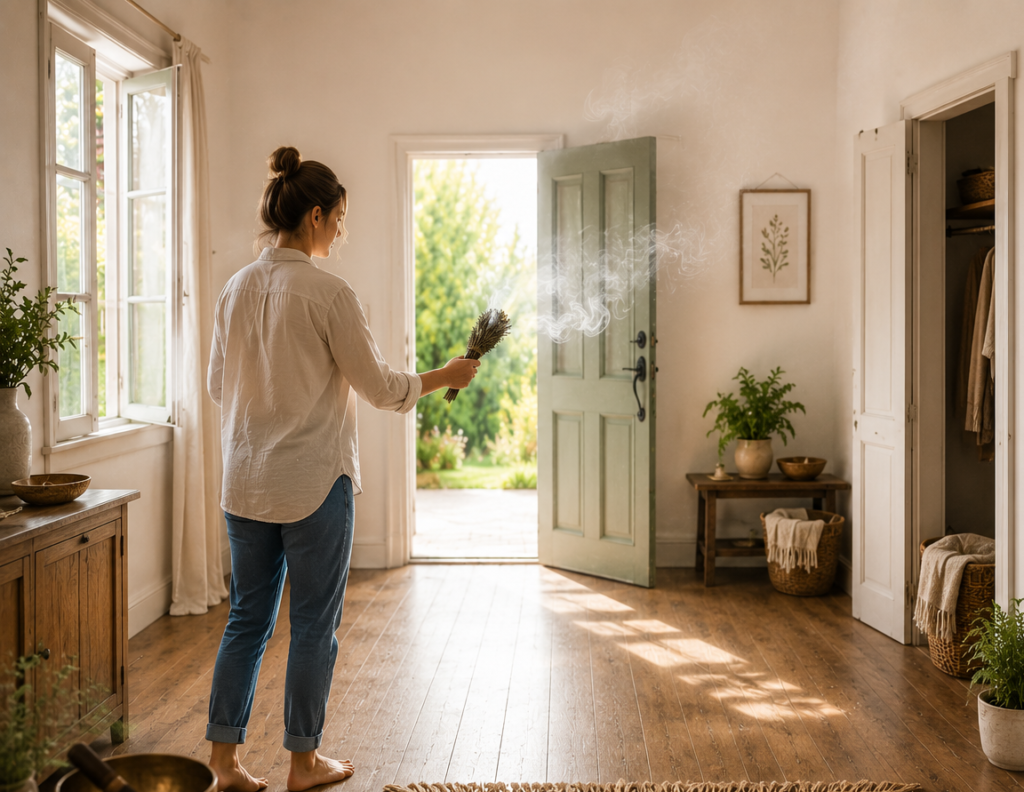
Corners and doorways receive particular attention in many contemporary cleansing rituals. From a practical perspective, corners are places where air circulation can be limited and where dust and clutter accumulate. In energetic interpretations of smoke cleansing, they are consequently described as places where stagnant energy may “settle”.
Move towards each corner and gently direct a small amount of smoke into the area. Taking care to not saturate it but paying particular attention to:
- corners behind doors;
- alcoves;
- unused sections of rooms;
- cupboards that are part of your intended cleansing;
- areas where clutter has recently been removed.
Doorways are thresholds, transitional spaces separating one environment from another. Move the smoke carefully around the doorway, paying attention to the sides and upper frame without bringing burning material close to the structure itself. You can repeat your intention as you cross the threshold.
For example: “Only peace and goodwill are welcome in this room.”
Windows
Windows can similarly be treated as boundaries between the house and the outside environment. Trace window frames to seal exterior boundaries, and pass smoke over reflective surfaces to clear visual or energetic imprints.Move nearby while keeping the burning material safely away from curtains, blinds and other fabrics. Never wave a smouldering bundle directly beneath curtains.
Upstairs/Downstairs
A multi-storey home raises another common question: Should you start upstairs or downstairs? Again, there is no universal spiritual rule. The most important consideration is creating a logical route that does not leave you wandering repeatedly through areas you have already cleansed.
Option 1: Bottom to Top
Begin at the main entrance downstairs and work systematically upwards. A possible route is:
front door → downstairs rooms → hallway → stairs → landing → bedrooms → upper rooms.
This works well if your ritual is focused on bringing cleansing energy progressively throughout the entire home.
Option 2: Top to Bottom
Another popular approach is to begin on the highest floor and gradually work towards the ground floor and main entrance. Symbolically, this can represent gathering everything unwanted and progressively directing it towards the exit.
A possible route is:
upper bedrooms → landing → stairs → ground-floor rooms → hallway → front door.
This method has an especially satisfying sense of completion if your intention is removal or release.
Which Should You Choose?
Choose the route that makes sense for the purpose and architecture of your house. For a cleansing focused specifically on removing something symbolically, working towards the main external doorway can provide a strong ritual structure. For general blessing, renewal or consecration, beginning at the entrance and moving progressively through the property may feel more natural.
Intention and Prayers
Smoke alone does not have to constitute the entire ritual. In many spiritual practices, intention is what gives ritual actions their meaning.
Indigenous sources describing First Nations smudging similarly emphasise intention and prayer, although those traditions have their own teachings and should not simply be copied out of cultural context. For a personal smoke-cleansing practice, you can formulate your own words. They can be spoken aloud, whispered or repeated silently.
Simple Cleansing Intention: “I release from this home everything that no longer serves the people who live here. May this be a place of peace, safety and happiness.”
After Conflict: “I release anger, resentment and tension from this room. May understanding, patience and kindness take their place.”
New Home: “I honour everything that happened here before me. I now welcome a new chapter of peace, happiness and abundance into this home.”
Protection Intention: “May this home remain a place of safety, warmth and peace. May everyone who enters do so with good intentions.”
You do not need elaborate language, a short statement that genuinely reflects your purpose is often more meaningful than memorising somebody else’s prayer.
A Step-by-Step Whole-House Smoke Cleansing
Once your preparation is complete, the entire process can be brought together into a simple sequence.
Step 1: Physically Prepare the House
Tidy, declutter and clean the rooms you intend to cleanse.
Step 2: Establish Ventilation
Open suitable windows or doors before lighting anything.
Step 3: Check Fire Safety
Make sure smoke alarms are working, combustible materials are clear of your route and you have a suitable heat-resistant container.
Step 4: Establish Your Intention
Pause before beginning.
State clearly what you want the ritual to represent.
Step 5: Light Your Chosen Material
Create only enough smoke for the ritual.
Avoid producing clouds of smoke.
Step 6: Begin Your Route
Start at your chosen threshold or room and move methodically through the property.
Step 7: Work Around Each Room
Move around the perimeter rather than simply standing in the centre.
Step 8: Pay Attention to Corners
Allow a small amount of smoke to reach neglected areas while maintaining a safe distance from walls, fabrics and furnishings.
Step 9: Acknowledge Doors and Windows
Treat thresholds as symbolic points of transition.
Step 10: Repeat Your Intention
You can use the same words throughout the house or adapt them to individual rooms.
Step 11: Continue Through Every Intended Room
Maintain a logical route so you know which areas have already been completed.
Step 12: Return to Your Finishing Point
Depending on your chosen method, this may be the front door, an open window or the place where you originally began.
Step 13: Consciously End the Ritual
Do not simply stop because you have run out of rooms.
Pause and acknowledge that the cleansing is complete.
Step 14: Extinguish Everything Completely
Do this before beginning any other activity.
Finishing the Ritual
The final stage is psychologically important because it creates a clear boundary between the ritual and ordinary activity.
If you began at the main entrance, you might return there.
If you have deliberately worked from upstairs towards the front door, stand at the doorway for a final moment.
Repeat a closing statement such as: “This cleansing is complete. What I wished to release has been released. May this home remain peaceful, welcoming and protected.”
Some practitioners like to finish by introducing something associated with the qualities they want to encourage. That might mean:
- lighting a candle later, once the smoke ritual is safely finished;
- playing calming music;
- opening curtains and letting in daylight;
- placing fresh flowers in the room;
- diffusing a preferred fragrance;
- meditating;
- sitting quietly;
- making tea;
- spending time with the people who share the home.
The underlying idea is useful even outside spiritual belief:
do not focus solely on what you are removing; decide what you want the home to represent afterwards.
Extinguishing Herbs
This is one part of the ritual where symbolism should never override physical safety. A bundle that appears extinguished may still contain a hot ember internally.
- Snuffing in Sand or Soil: Press the glowing tip firmly into a bowl filled with clean sand, soil, or crushed salt until all smoke stops completely.
- Crushing in a Heatproof Dish: Firmly stub the tip against the interior base of a cast-iron or ceramic bowl.
- Avoid Water on Bundles: Never douse a herb stick with water unless dealing with an emergency. Wetting the bundle ruins the core, causes rot or mould, and prevents it from relighting cleanly in future sessions.
- Do not put still-hot plant material directly into a household bin.
- Do not leave it smouldering while you move on to another activity.
- Do not leave burning or smouldering material unattended.
- Do not assume it is safe simply because visible smoke has stopped.
If you intend to keep a partially used dried bundle, allow it to become completely cold before storing it.
What to Do Afterwards
Once the source of smoke has been completely extinguished, allow fresh air to continue circulating. This helps remove remaining airborne particles and odours.
Burning plant material generates particulate matter, and smaller inhalable particles can penetrate deeply into the respiratory system. Ventilation therefore has a practical health purpose rather than merely a ritual one. You may then want to sit quietly in the cleansed room for several minutes.
Notice:
- how the room smells;
- how the light feels;
- whether the space seems calmer;
- whether your own mood has changed;
- whether there is anything else you now want to tidy or rearrange.
This is also a good time to introduce your desired atmosphere. If the cleansing represented a fresh start, make a small physical change that reinforces it.
- Move a chair.
- Change the bedding.
- Put away the last pile of clutter.
- Place a plant near the window.
The ritual then becomes connected with an observable change in your surroundings.
Alternatives to Smoke
Alternatives can include:
- prayer;
- meditation;
- bells;
- singing bowls;
- clapping;
- music;
- symbolic sweeping;
- fresh air;
- visualisation;
- cleaning with a personally meaningful scent;
- arranging flowers or plants;
- simply opening the windows while stating your intention.
The symbolic structure of the ritual can remain intact without combustion.
Common Smoke Cleansing Mistakes
Cleansing with Closed Windows: Traps both smoke and dislodged energy, creating an irritated, congested room.
Neglecting Fire Safety: Walking around without an underlying catch-dish risks hot ash dropping onto rugs, floorboards, or furniture.
Rushing High-Density Areas: Walking too quickly through closets, basements, or cluttered corners without letting the smoke penetrate.
Leaving an Energetic Vacuum: Clearing away heavy energy without introducing positive intention, light, or fresh sound afterwards.
Over-Smoking the Area: Thick clouds of billowing smoke are unnecessary; a steady, thin ribbon of fragrant smoke is all that is required.
Expecting the Ritual to Solve Physical Problems Smoke cleansing cannot remove mould, repair damp, eliminate carbon monoxide, resolve unsafe wiring or substitute for proper cleaning. If a room smells unusual or makes occupants physically unwell, investigate the physical cause rather than assuming the problem is energetic.
Removing the Batteries From Smoke Alarms: Never disable a smoke alarm to conduct a ritual. If your method generates enough smoke to repeatedly activate alarms, reconsider the amount of material you are burning or use a smoke-free practice.
Frequently Asked Questions
Should I Smoke Cleanse With the Windows Open or Closed?
Open. Good ventilation reduces the accumulation of combustion products indoors, and UK fire-service guidance specifically recommends opening windows or doors when burning herbs or incense.
Some spiritual traditions additionally interpret the opening as an exit for unwanted energy.
Should I Start Upstairs or Downstairs?
Either can work. If your intention is removing unwanted influences, beginning at the highest point and gradually moving towards the front door can create a logical symbolic route.
If you are blessing or renewing the whole property, beginning at the main entrance and moving progressively through the house can work equally well.
Do I Have to Move Clockwise?
No. Clockwise movement has particular meanings in some ritual systems, but it is not a universal requirement of smoke cleansing. Use the conventions of your own tradition or simply follow a consistent route.
How Much Smoke Do I Need?
Very little. You do not need to make a room visibly smoky. A small, controlled amount is sufficient for symbolic purposes and reduces unnecessary exposure to airborne particles.
What Should I Say While Smoke Cleansing?
Use words that clearly express your intention. For example: “”I release tension and negativity from this home and welcome peace, warmth and happiness.” You can also pray according to your own faith or remain silent.
Can I Smoke Cleanse Without Saying Anything?
Yes. Silent intention, meditation or visualisation can form the contemplative part of the ritual.
Can I Smoke Cleanse at Night?
You can, but additional fire-safety considerations apply. Never burn herbs if you are tired or likely to fall asleep, and ensure everything is completely extinguished before going to bed. Fire-service guidance advises against burning ceremonial materials where people are sleeping
Can I Smoke Cleanse at Night?
You can, but additional fire-safety considerations apply. Never burn herbs if you are tired or likely to fall asleep, and ensure everything is completely extinguished before going to bed. Fire-service guidance advises against burning ceremonial materials where people are sleeping.
How Often Should I Smoke Cleanse My House?
There is no required schedule. Some people cleanse:
- when moving into a new property;
- after illness or stressful events;
- after arguments;
- after unwanted visitors;
- during seasonal cleaning;
- before spiritual work;
- at the beginning of a new year;
- whenever they feel the home needs a reset.
It can be an occasional ritual rather than a routine obligation.
Can I Smoke Cleanse Just One Room?
Yes. A bedroom, meditation area, office or other individual room can be cleansed without performing the ritual throughout the entire property.
Should I Clean Before Smoke Cleansing?
Ideally, yes. Physical cleaning and decluttering can make the ritual feel more purposeful and ensures smoke cleansing is not being used as a substitute for dealing with an actual source of dirt, odour or discomfort
Can I Smoke Cleanse a New House?
Yes. Moving house is one of the occasions on which people commonly choose to perform a cleansing or house-blessing ritual. You might acknowledge previous occupants before establishing your own intention for the property.
What If I Cannot Burn Herbs in My Home?
Use a smoke-free ritual. Open the windows and use prayer, bells, music, meditation, visualisation, symbolic sweeping or another personally meaningful practice. Smoke is a ritual tool, not a requirement for creating an intentional cleansing practice.
Is Smoke Cleansing the Same as Smudging?
Not necessarily. “Smoke cleansing” is a broad descriptive term for ritual practices involving smoke. Smudging refers particularly to sacred practices found among many First Nations peoples, although traditions and protocols differ considerably between communities. Sacred medicines can include sage, cedar and sweetgrass.
Is White Sage Endangered?
The issue is more complicated than the common internet claim that “white sage is endangered”. The major concern highlighted by conservation organisations and recent ethnobotanical research is intense commercial exploitation and poaching of wild populations, together with habitat pressure and the cultural impact this has on Indigenous communities that have longstanding relationships with the plant.
The responsible question when buying it is therefore not simply whether the species is officially endangered, but where the material came from and how it was obtained.
Can Smoke Cleansing Remove Negative Energy?
Many spiritual traditions and practitioners believe that ritual smoke can cleanse, transform or remove unwanted spiritual influences. That is a spiritual claim rather than an established scientific finding. The ritual may nevertheless function as a meaningful way of marking transition, focusing intention and consciously changing how you interact with your environment.
What Should I Do Immediately After Smoke Cleansing?
First make certain every ember is completely extinguished. Then continue ventilating the house.
Afterwards, introduce whatever represents the atmosphere you wanted to create: daylight, fresh flowers, music, meditation, clean bedding, quiet reflection or simply spending peaceful time in the space.