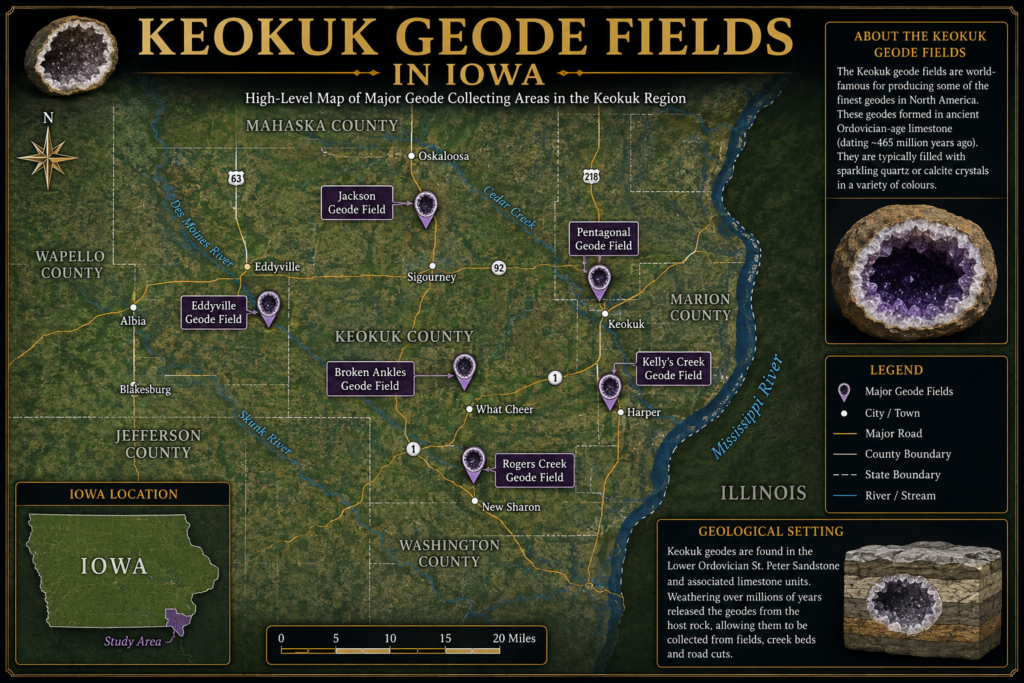
Nestled along the tri-state junction where southeastern Iowa, northeastern Missouri, and western Illinois converge lies a premier geological treasure: Keokuk Geodes. Named after the Mississippi River town of Keokuk, Iowa, this field yields world-class quartz and calcite. It is renowned for secondary mineral geodes, celebrated for their abundance, structural variety, and collector quality.
In 1967, the Iowa General Assembly designated the geode as Iowa’s official State Rock. Today, Keokuk geodes remain a bucket-list quarry for collectors, amateur geologists, and mineral collectors worldwide.
This comprehensive guide covers the geological history, formation environment, inner mineral varieties, and a complete geode collecting field guide for harvesting Keokuk geodes.
1. Geological Setting and Historical Discovery
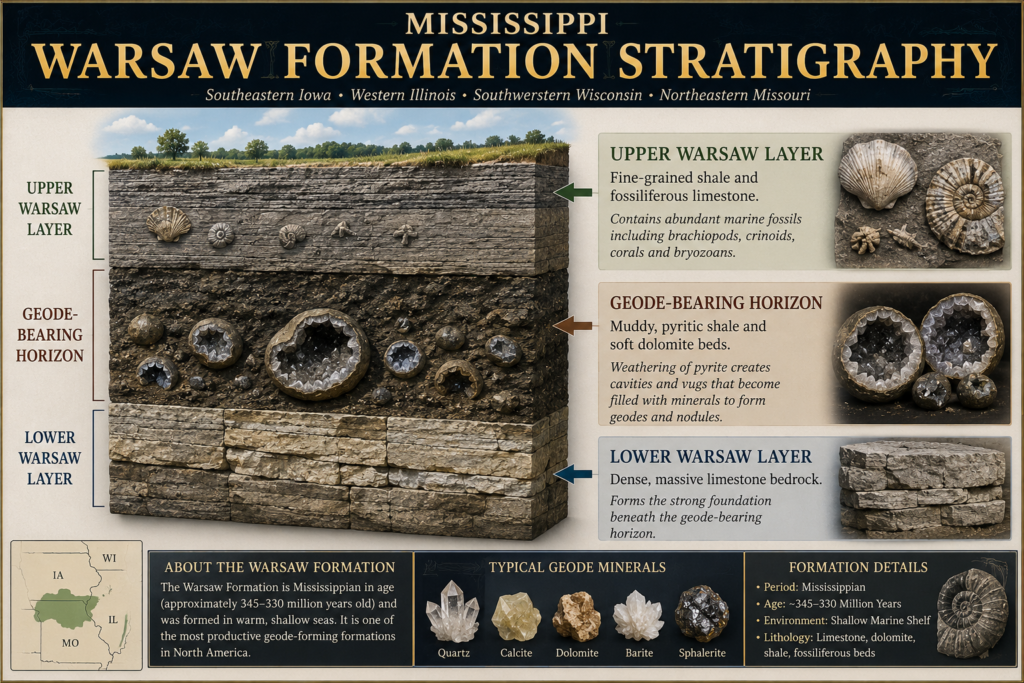
The Keokuk geode field spans roughly a 70-mile radius centred around Keokuk, Iowa. Geologically, these geodes occur almost exclusively within the Mississippian-age Warsaw Formation. This is a layer of fossiliferous shale, siltstone, and argillaceous limestone deposited about 340 million years ago when a shallow, warm inland sea covered the central North American continent.
Discovery and Native American History
Long before European settlers arrived, Native American tribes across the upper Mississippi River Valley collected Keokuk geodes from creek beds. Tribes used broken geode fragments as sharp scrapers and sacred ceremonial objects, viewing the hollow, crystal-filled spheres as houses for earth spirits.
When 19th-century geologists first surveyed the region, they discovered creek banks so littered with weathered-out geodes that local streams appeared paved with round, knobby stones.
2. How Keokuk Geodes Formed
Unlike the volcanic amethyst geodes of South America, Keokuk geodes are strictly sedimentary in origin. Their development spans millions of years across three distinct phases:
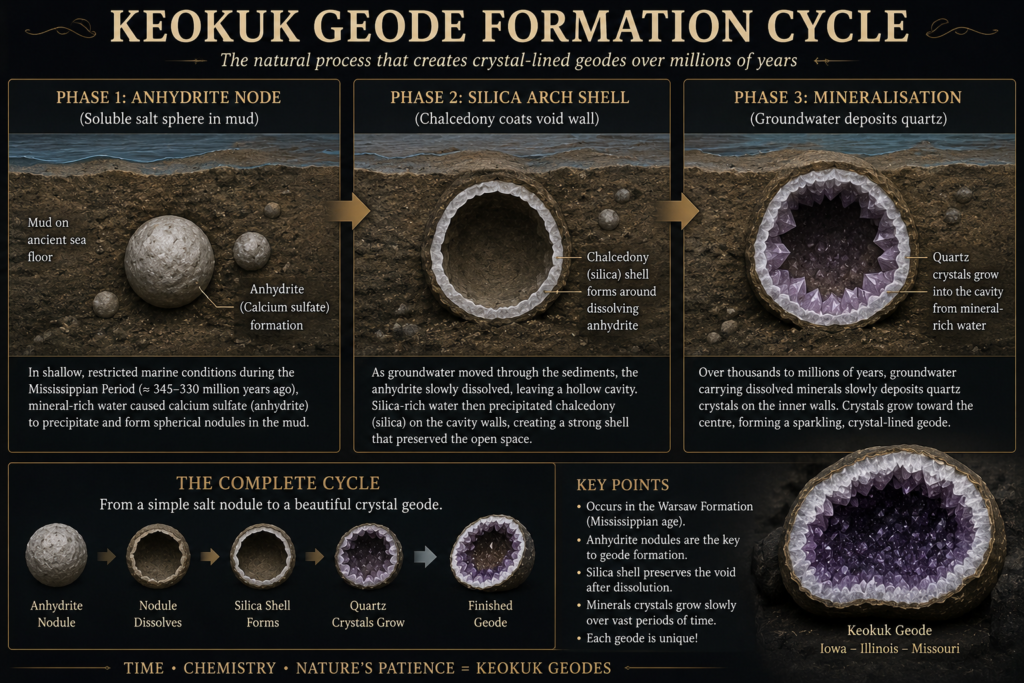
- Evaporite Nucleation (340 Million Years Ago): In the warm, shallow Mississippian sea, spherical nodules of soluble anhydrite ($\text{CaSO}_4$) or gypsum grew within soft, muddy ocean floor sediments.
- Dissolution and Shell Formation: As the sediments compressed into shale and limestone, acidic groundwater dissolved the anhydrite nodules, leaving spherical voids. Simultaneously, silica-rich fluids coated the cavity walls with a tough, impermeable layer of micro crystalline chalcedony. This shell acted as a structural arch, preventing the surrounding mud from crushing the hollow cavity.
- Internal mineralisation: Over tens of millions of years, mineral-saturated groundwater percolated through fractures in the chalcedony shell, slowly precipitating sparkling crystal points growing inward toward the empty core.
3. Minerals Found Inside Keokuk Geodes
One factor that sets Keokuk geodes apart from other world specimens is their remarkable mineral diversity. While quartz dominates, over 17 distinct secondary minerals have been identified inside Keokuk cavities.
| Mineral | Appearance & Characteristics |
|---|---|
| Quartz | Clear, milky white, or smoky crystal points |
| Calcite | Golden, orange, or white rhombohedral crystals |
| Pyrite & Marcasite | Metallic golden to brassy crystal sprays |
| Chalcopyrite | Iridescent “peacock” metallic coatings or dusting |
| Goethite | Dark brown to black needle-like inclusions |
| Millerite | Extremely rare, brass-yellow hair-like needles |
| Barite & Dolomite | White tabular blades and pink saddle-shaped crystals |
- Quartz: The foundation of most Keokuk geodes. Features range from sparkling druzy coatings to thick, macro crystalline points.
- Calcite: Frequently occurs as large, pristine, golden or white dog tooth spar sitting atop quartz beds.
- Millerite (The Holy Grail): Keokuk is world-famous among collectors for producing rare, delicate, needle like metallic inclusions of millerite (nickel sulphide) radiating like fine brass hairs across quartz or calcite points.
4. Collecting Field Guide: How to Find Keokuk Geodes
Hunting for Keokuk geodes is an accessible, family-friendly adventure, but knowing where and how to search is key to a successful dig.
A. Essential Gear and Safety Equipment
- Crack Hammer (2–4 lb) & Cold Chisels: Standard hammers can shatter; use hardened steel rock-cracking hammers.
- Safety Goggles & Work Gloves: Flying shale and quartz splinters present high eye hazards.
- Heavy-Duty Buckets / Backpacks: Geodes are dense; sturdy 5-gallon buckets are recommended.
- Sturdy Footwear: Water shoes or mud boots for wading in creek beds.
B. Prime Locations to Search
Keokuk geodes occur across southeastern Iowa (Lee County), northeastern Missouri (Clark County), and western Illinois (Hancock County):
- Creek Beds and Gravel Bars (Public Waterways): Stream erosion naturally carves through the Warsaw Formation, washing heavy geodes down into gravel bars. Focus on creek bends, gravel deposits below small waterfalls, and exposed shale banks after heavy spring rains.
- Fee-for-Dig Private Mines & Sites: Several local landowners and quarry operators offer legal, fee-based access to unweathered Warsaw shale beds where geodes can be dug directly out of clay layers (e.g., Sheffler Geode Mine in Wayland, Missouri, or Jacobs Geode Gallery in Keokuk, Iowa).
Important Legal Note: Always secure explicit landowner permission before entering private creek beds or quarries. Collecting in Iowa State Parks is restricted to strict personal-use limits (check local DNR regulations).
C. Field Identification: Spotting a Good Geode
Not every round rock in the Warsaw Formation is a hollow geode—many are solid nodules or mud-filled rocks.
- The Weight Test: Compare two similar-sized rocks. A true, hollow geode feels noticeably lighter than a solid limestone or chert rock of equivalent size.
- The “Rattle” Test: Shake the rock near your ear. Occasionally, broken crystal points or calcite rhombohedrons rest loose inside, producing a distinct rattling noise.
- The Bumpy Skin: Keokuk geodes feature a distinct “cauliflower-like” or bumpy, knobby chalcedony outer crust.
5. Safely Opening Your Keokuk Geodes
Cracking open a freshly harvested geode is the ultimate thrill of geode collecting. To preserve the internal crystals without crushing the specimen into dust, follow these methods:
1.The Soil Pipe Cutter Method (Best Result):Produces clean halves with minimal crystal damage.
Wrap the chain of a mechanical soil pipe cutter around the geode’s equator. Apply gradual, even pressure using the lever until the chain snaps the geode evenly into two clean halves.
2.The Hammer & Chisel Method (Traditional Field Method):Requires patience and light tapping.
Place the geode on a soft bed of dirt or sand. Set a cold chisel along the equator and tap gently with a 2 lb hammer. Rotate the rock slightly after each tap, scoring a continuous line around the circumference until it splits open along its natural seam.
3.The Canvas Bag Method (Fastest Field Method):Best for quick checks on smaller specimens.
Place the geode inside a thick canvas or burlap bag to contain flying debris. Strike the top of the bag firmly with a crack hammer. Inspect the pieces for crystal cavities.
Summary Checklist for Keokuk Geode Hunters
- Geological Horizon: Mississippian Warsaw Formation (~340 million years old).
- Location: Tri state area around Keokuk, Iowa (SE Iowa, NE Missouri, W Illinois).
- Key Mineral Signs: Light weight, bumpy cauliflower skin, quartz points, golden calcite, and rare brassy millerite needles.
- Field Golden Rule: Always wear eye protection and respect private property boundaries while hunting.
Frequently Asked Questions
What is the geological setting of the Keokuk geode field and where is it located?
The Keokuk geode field lies in a roughly 70‑mile radius around Keokuk, Iowa, in the tri‑state area where southeastern Iowa, northeastern Missouri, and western Illinois converge. The geodes occur almost exclusively within the Mississippian Warsaw Formation, a layer of fossiliferous shale, siltstone, and argillaceous limestone deposited about 340 million years ago when a shallow inland sea covered the region.
How did Keokuk geodes form?
Keokuk Geodes are sedimentary in origin and formed through three phases. First, evaporite nucleation occurred in a warm Mississippian sea when anhydrite nodules grew in sediments. Second, acidic groundwater dissolved the nodules and a chalcedony shell formed to protect the hollow cavity. Third, mineralisation occurred as mineral-saturated groundwater percolated through fractures, slowly precipitating crystal points toward the core.
What minerals are typically found inside Keokuk geodes?
Keokuk geodes are quartz-predominated but contain over 17 distinct secondary minerals. Common minerals include quartz, calcite, pyrite and marcasite, chalcopyrite, goethite, millerite (rare and highly prized), and barite and dolomite. Inside, quartz points, calcite rhombohedrons, and in some specimens millerite needle inclusions are notable features.
How can a collector identify a good Keokuk geode in the field?
A good Keokuk geode is lighter than a solid rock of the same size, may produce a rattling sound if crystals are present inside, and displays a bumpy, cauliflower‑like chalcedony outer crust. Distinguishing hollow geodes from solid nodules or mud-filled rocks requires these field tests and careful inspection.
What are safe and recommended methods to open a Keokuk geode?
Safe opening methods include the soil pipe cutter method for clean halves with minimal crystal damage; the hammer and chisel method for traditional field splitting along the natural seam; and the canvas bag method for quick checks on smaller specimens. Each method aims to preserve internal crystals while avoiding excessive breakage.