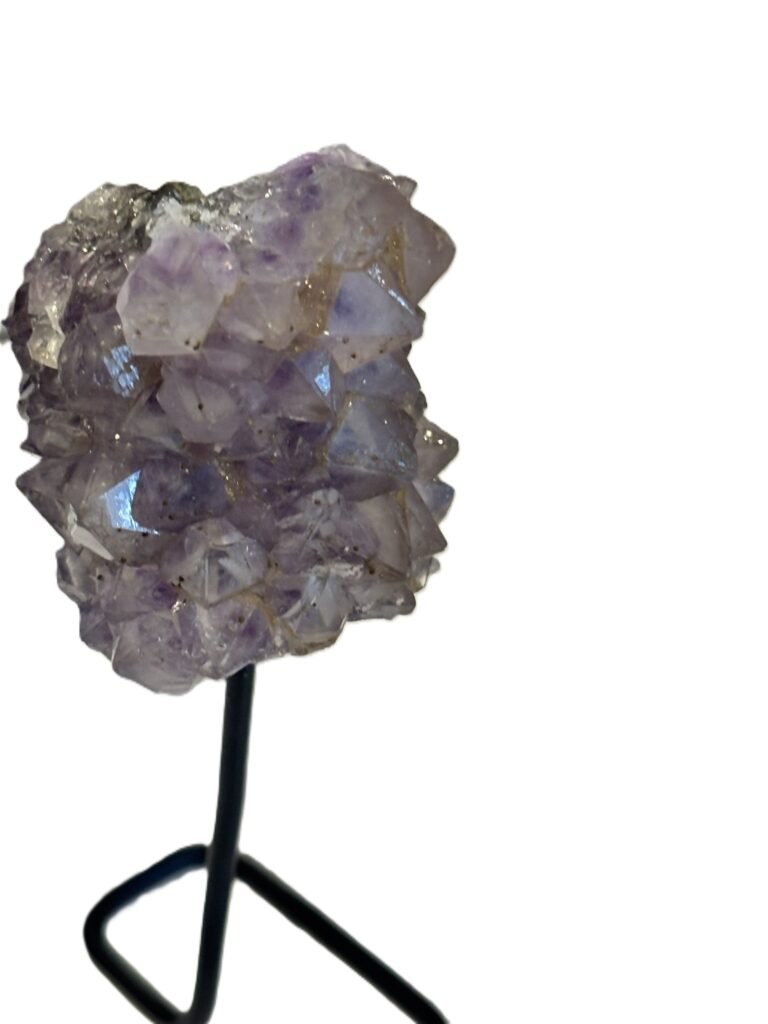
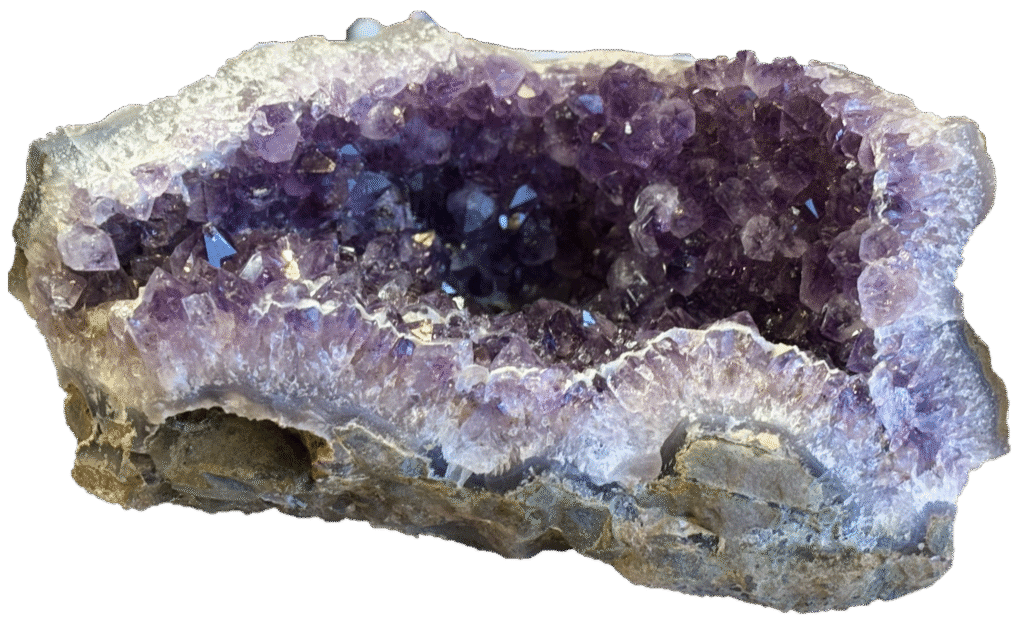
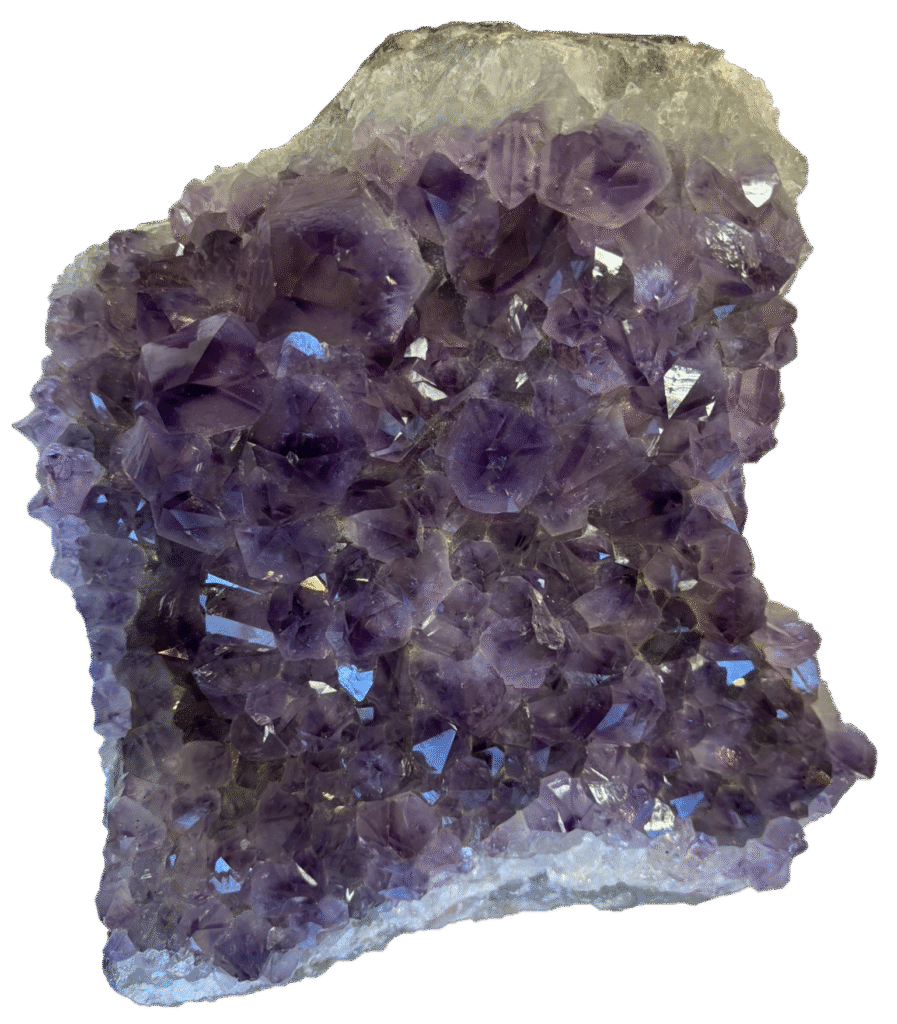
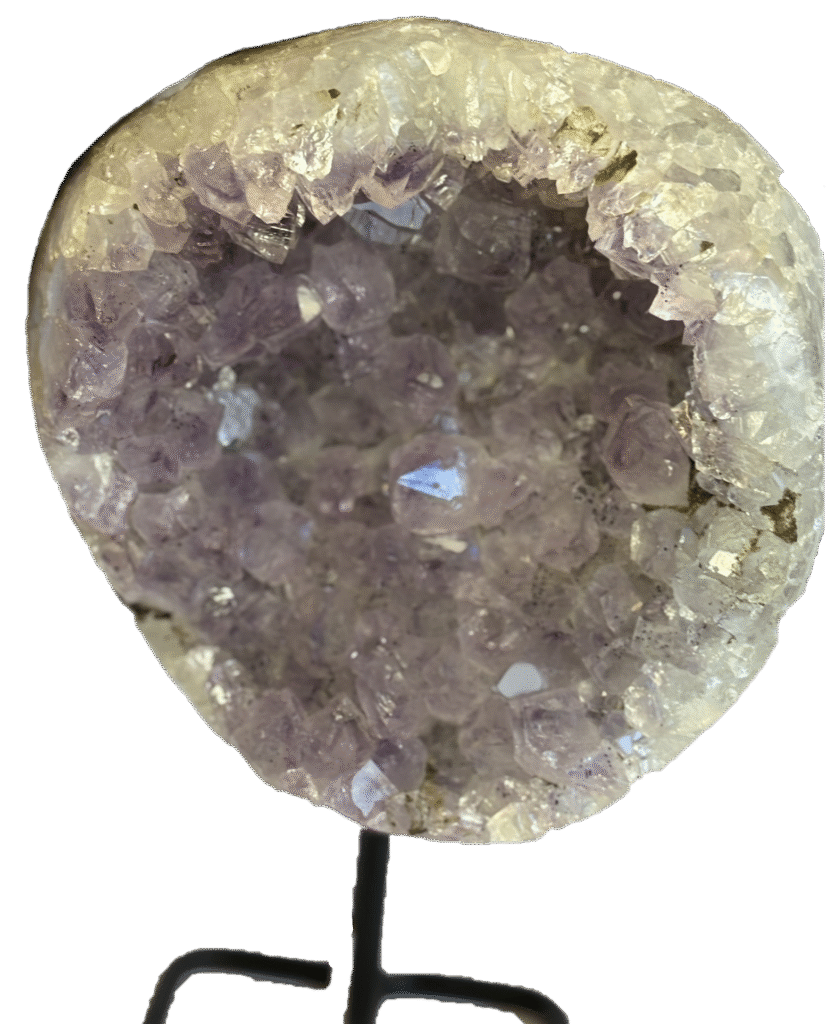
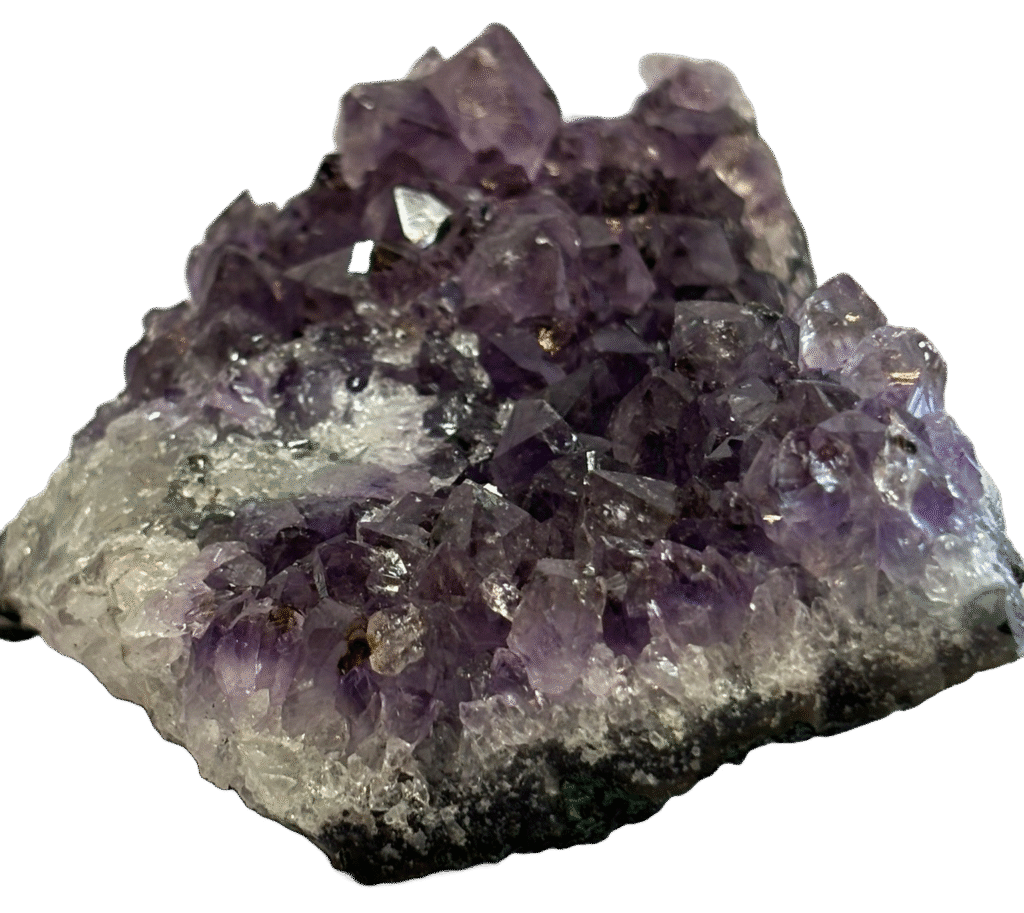
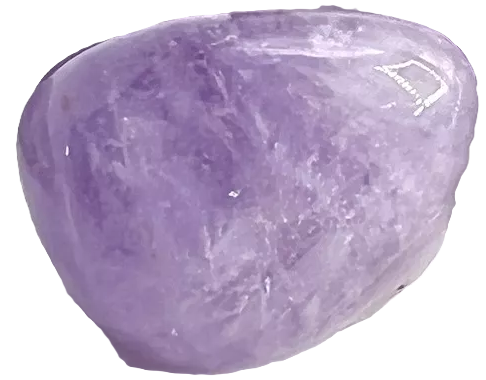
South America is the centre of amethyst production. Brazilian Amethyst deposits lie across the border of southern Brazil and northern Uruguay. The Paraná Continental Flood Basalt Province hosts the most abundant amethyst deposits on Earth. Free standing 10-foot cathedral geodes are mined deep underground in Brazil. The grape amethyst from open pits in Uruguay completes the picture. Together, these regions supply most commercial amethyst geodes, lapidary carvings, and fine mineral specimens worldwide.
This comprehensive guide explores the shared geological origins of these deposits. It also covers the distinct mining methods used in Brazil and Uruguay. Finally, it highlights the visual characteristics that set their Brazilian Amethyst apart.
1. Geological Origins: The Cretaceous Flood Basalts
Approximately 130 to 120 million years ago, during the Early Cretaceous period, the supercontinent of Gondwana was splitting apart to form the South Atlantic Ocean. This tectonic breakup triggered one of the largest volcanic events in Earth’s history: the outpouring of the Paraná Continental Flood Basalt Province.
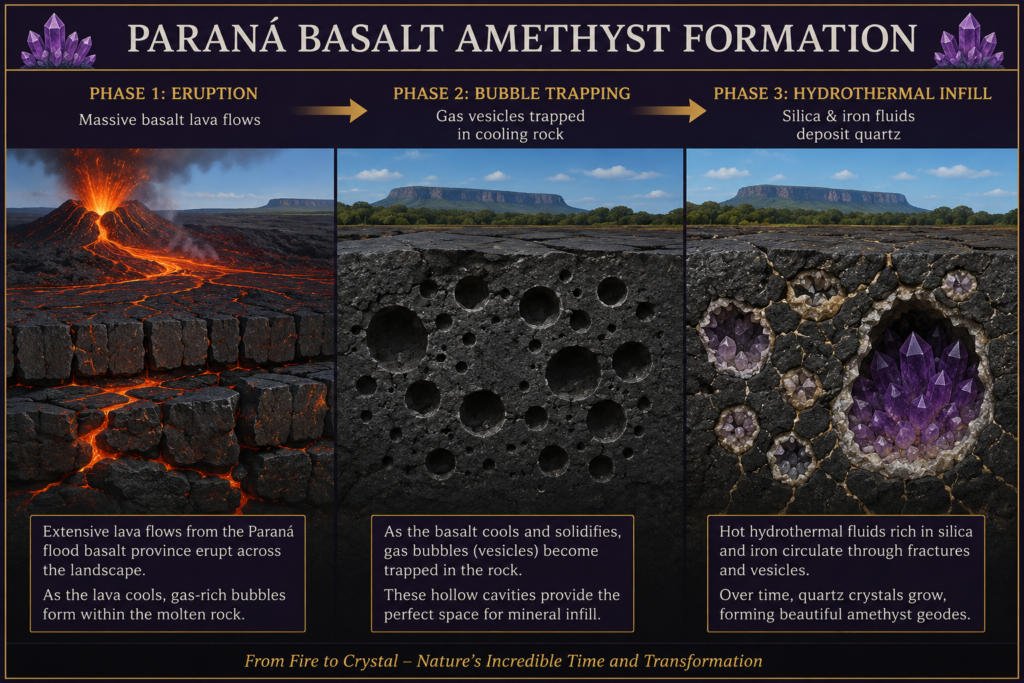
- Lava Outpouring: Layer after layer of super heated basaltic lava flooded hundreds of thousands of square miles across present-day southern Brazil and northern Uruguay.
- Vesicle Trapping: As the thick lava flows cooled from the top down, trapped steam, carbon dioxide, and volatile gases expanded into smooth, rounded bubbles known as vesicles.
- Hydrothermal Mineralisation: Long after the lava solidified, silica-rich hydrothermal fluids containing trace amounts of ferric iron ($\text{Fe}^{3+}$) percolated through the cooling basalt, filling the vesicles. Over millions of years, natural background gamma radiation from surrounding basaltic rocks oxidised the iron ($\text{Fe}^{3+} \right-arrow \text{Fe}^{4+}$), turning the growing quartz points vibrant purple.
2. Brazilian Amethyst Fields (Rio Grande do Sul)
Brazil is the world’s largest producer of amethyst geodes, with the primary mining operations centred in the state of Rio Grande do Sul, particularly around the town of Ametista do Sul (“Amethyst of the South”).
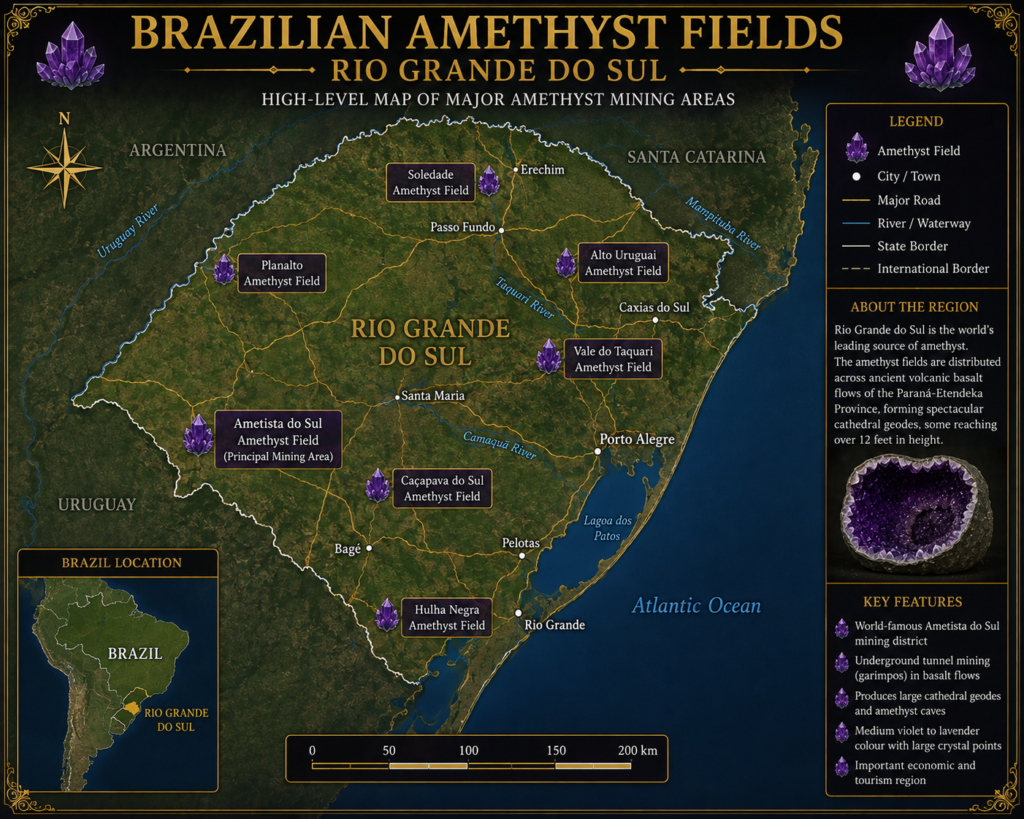
Underground Gallery Mining (Garimpos)
Unlike open-pit rock quarries, Brazilian amethyst geodes are extracted primarily through horizontal underground tunnels carved directly into basalt hillsides by independent miners known as garimpeiros.
Miners use light explosives and pneumatic jackhammers to blast through the dense basalt bedrock. Once a geode pocket is struck, miners switch to hand tools, carefully chiselling around the outer basalt skin to extract the cavity intact.
Key Visual & Structural Traits
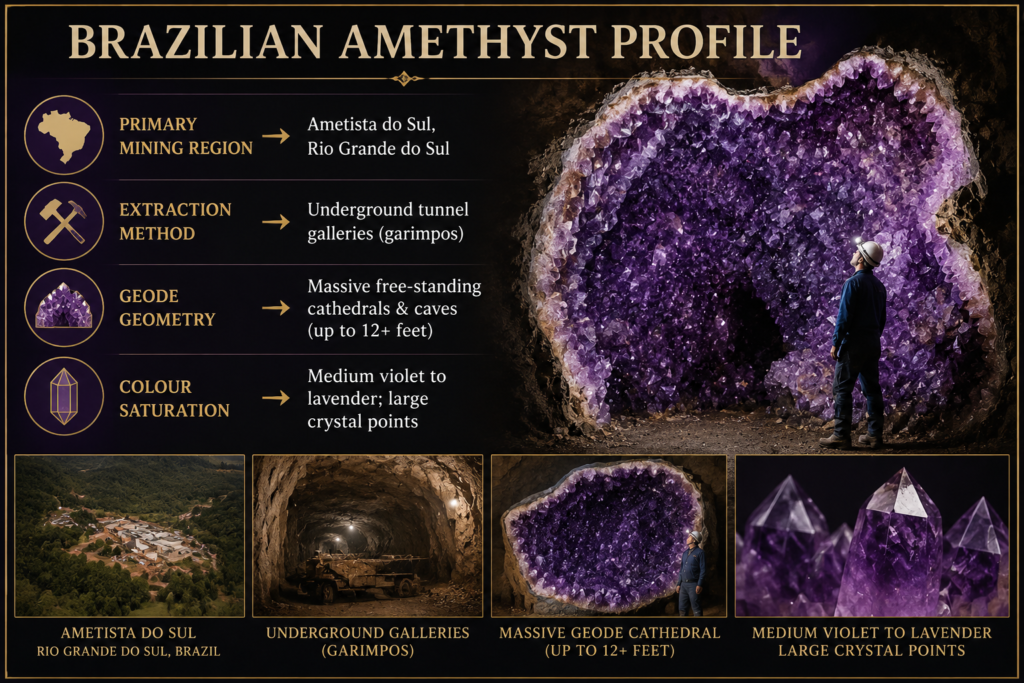
- Enormous Scale: Brazil is world-famous for yielding gigantic, hollow, vertical “cathedrals” and walk-in amethyst caves.
- Point Size: Brazilian geodes feature medium to large hexagonal crystal points (1 cm to 5+ cm across).
- Associated Minerals: Brazilian geodes frequently house striking secondary mineral deposits perched on the purple crystals—most notably golden calcite rhombohedral, white gypsum blades, and dark green celadonite rinds.
3. Uruguayan Amethyst Fields (Artigas Region)
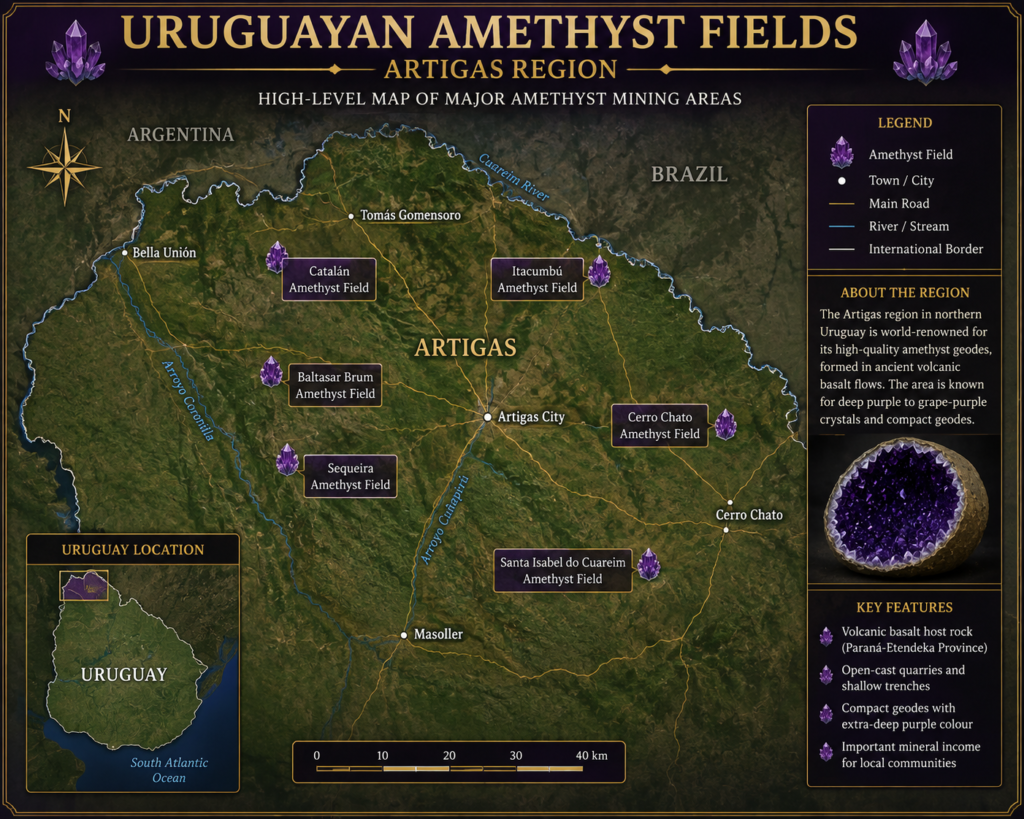
Located just across the southern border of Brazil, northern Uruguay’s Artigas Department produces what is universally recognised as the highest-grade amethyst on the planet.
Open-Pit Mining Mechanics
Because the geode-bearing basalt flows in Artigas lie closer to the surface, Uruguayan operations favour open-cast pit mining over deep tunnelling. Excavators strip away topsoil and weathered rock layers to expose the basalt beds. Miners then use diamond-wire saws, hydraulic splitters, and delicate hand chiselling to free the geodes without fracturing their fragile inner crystals.
The “Uruguay Deep Purple” Benchmark
Uruguayan amethyst is celebrated globally for its unmatched colour saturation:
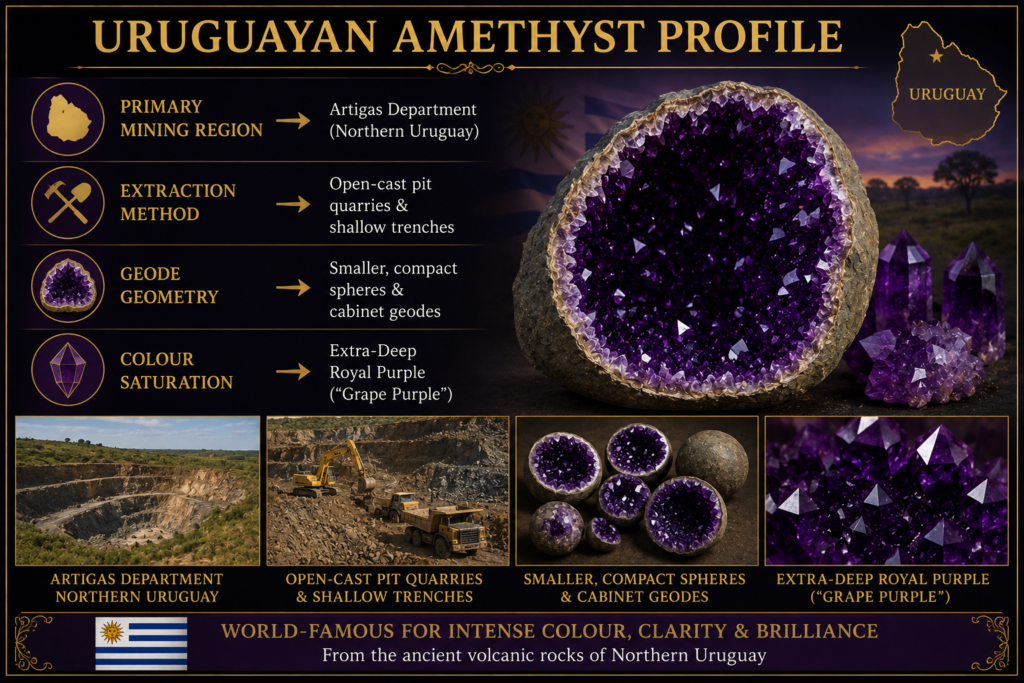
- Intense Saturation: Crystals display an extra-dark, velvety royal purple hue—often described in the mineral trade as “deep grape” or “royal violet.”
- Blue & Red Flashes: Under direct light, premium Uruguayan points display internal flashes of electric magenta, crimson red, and indigo blue.
- Compact Point Structure: Points tend to be smaller and more tightly clustered than Brazilian specimens, producing a shimmering, high lustre “druzy to medium” crystal face.
- Thin Basalt Skin: Uruguayan geodes feature very thin outer basalt walls, making them lighter per unit of colour saturation compared to heavy-backed Brazilian geodes.
4. Regional Comparison: Brazil vs. Uruguay
While both regions share the same Cretaceous flood basalt geological origin, subtle differences in fluid chemistry, cooling rates, and iron concentrations create distinct commercial products.
| Diagnostic Feature | Brazilian Amethyst Geodes | Uruguayan Amethyst Geodes |
| Primary Location | Rio Grande do Sul (Ametista do Sul) | Artigas Department |
| Typical Colour Range | Light lavender, medium violet, to deep purple | Intensely saturated “Extra-Deep Royal Purple” |
| Crystal Point Size | Medium to Very Large (1 cm – 5+ cm) | Small to Medium (Druzy to 2 cm) |
| Geode Sizes | Giant Cathedrals (3 ft – 12+ ft tall) | Small to Medium (Handheld to 3 ft cabinet pieces) |
| Outer Basalt Rind | Thick, heavy green/grey basalt backing | Thin, compact, lightweight rock skin |
| Secondary Minerals | Abundant golden calcite, barite, & celadonite | Less frequent calcite; occasional goethite needles |
| Market Designation | Volume home decor, large cathedrals, tumbling stock | High-end mineral collections, fine jewellery, luxury decor |
5. Processing, Polishing, and Exporting
Once extracted from the basalt matrix in Brazil or Uruguay, raw geodes undergo extensive lapidary preparation before entering the international mineral trade:
1.Washing and Inspection:Removal of loose mud, clay, and fractured outer basalt.
Mined geodes are pressure-washed with water to clear soil and loose debris. Lapidary technicians inspect the shell for structural cracks and determine optimal cut orientation.
2.Sawing and Opening:Precision cutting using large diamond-rimmed saws.
Geodes are mounted on diamond lapidary saws to split them into matching pairs, open-faced cathedrals, or flat-based standing specimens.
3.Rim Grinding & Edge Polishing:Grinding the rough basalt edge surrounding the purple cavity.
Technicians use diamond-grit grinding wheels to smooth the rough outer basalt border, revealing the surrounding ring of banded chalcedony and agate.
4.Reinforcement & Finishing:Applying protective backing and base levelling.
If the outer basalt crust is thin or fractured, technicians apply a thin coat of green-dyed epoxy resin or dark mortar to the back to reinforce structural integrity and create a flat, self-standing base.
Summary Checklist for Buyers & Collectors
- Brazilian Geodes: Best choice for impressive size, giant architectural cathedrals, large crystal points, and golden calcite associations.
- Uruguayan Geodes: Best choice for maximum purple colour saturation (“deep grape”), high crystal lustre, and top-tier collector display pieces.
- Care Reminder: Both Brazilian and Uruguayan amethyst can fade over time if exposed to direct sunlight or strong UV light; display all natural specimens away from sunny window sills.
Frequently Asked Questions
What is the geological origin of Brazilian and Uruguayan amethyst geodes?
Both Brazilian and Uruguayan amethyst geodes originate from the Paraná Continental Flood Basalt Province, which formed during the Early Cretaceous as Gondwana split and vast basalt lava flows enveloped vesicles that later filled with silica-rich fluids and trace ferric iron, producing purple quartz over millions of years.
How do mining methods differ between Brazil and Uruguay?
In Brazil, geodes are mainly extracted through underground galleries carved into basalt hillsides by garimpeiros, using light explosives and pneumatic jackhammers before carefully chiselling the geode pockets free. In Uruguay, open-pit mining is preferred because the geode-bearing basalts lie closer to the surface, with diamond-wire saws, hydraulic splitters, and delicate chiselling used to free the geodes without fracturing their crystals.
What distinguishes Uruguayan amethyst geodes from Brazilian ones in appearance and size?
Uruguayan amethyst geodes are renowned for intense colour saturation, with an extra-deep royal purple and occasional blue or red flashes under light, and typically feature smaller, more tightly clustered points with a lighter outer basalt skin. They are usually smaller to medium in size, compared with the giant cathedral geodes and larger crystal points commonly found in Brazil.
What are the key visual and structural traits of Brazilian amethyst geodes?
Brazilian geodes are famous for enormous cathedral-sized forms, with medium to large crystal points ranging from 1 cm to over 5 cm, and a thick outer basalt rind often accompanied by golden calcite rhombohedra, white gypsum blades, and green celadonite inclusions.
What steps are involved in processing, polishing, and exporting Brazilian and Uruguayan amethyst geodes?
After extraction, geodes are washed and inspected for cracks, then cut with diamond rims to open matching pairs or cathedrals, followed by rim grinding to reveal the banded chalcedony and agate. A protective backing or base is applied as needed to reinforce the piece before it enters the international mineral trade.
These are my personally selected and curated Amethyst products
Products by Category