Amethyst geodes are among the most revered natural geological formations in the world. Ranging from small hand-held desktop specimens to giant multi-ton cathedral geodes standing over ten feet tall, these glittering purple wonders captivate mineral collectors, lapidary artists, interior designers, and crystal enthusiasts alike.
However, not all Amethyst Geodes are created equal. Prices can range from a few dollars for pale, fractured, lavender specimens to tens of thousands of dollars for rich, velvety deep-purple cathedrals with flawless clarity and undamaged basalt rims.
This comprehensive guide covers the specific geological conditions required to form amethyst geodes, the commercial grading system used to evaluate purple colour saturation, key quality factors, and major global mining origins.
1. How Amethyst Geodes Form: Fire, Iron and Radiation
All geodes require a pre-existing cavity and silica-rich fluids to grow. Amethyst Geodes require a very specific recipe of fluid chemistry, trace metal inclusions, and natural radiation.
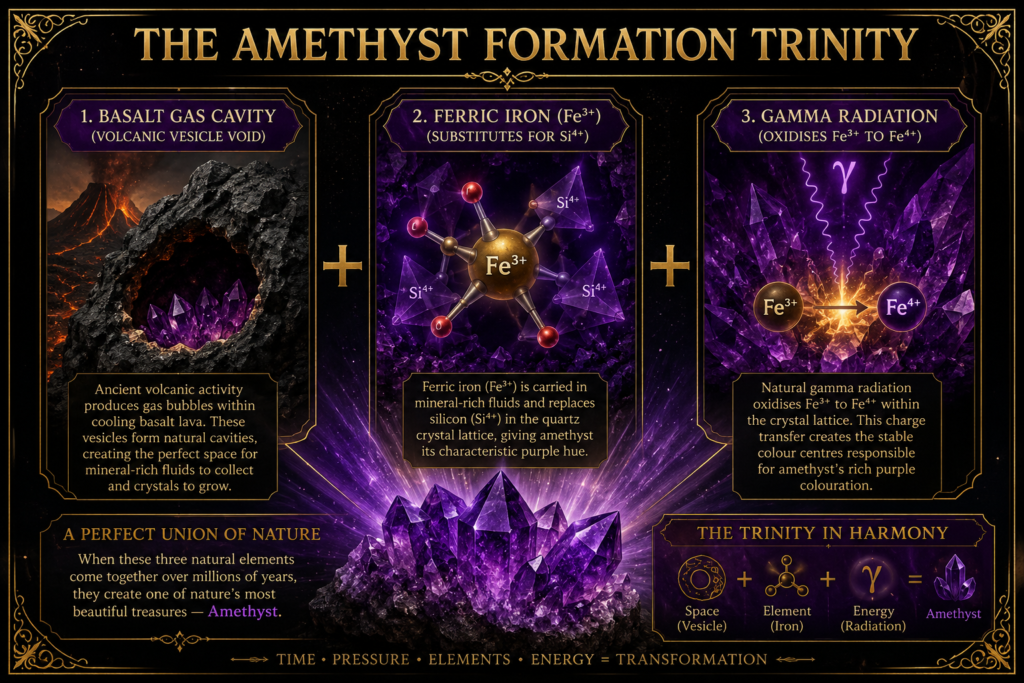
The Step-by-Step Geological Process
- Volcanic Bubble Creation: Massive flood-basalt eruptions (most notably during the Cretaceous period ~120 million years ago) trap superheated gas bubbles (vesicles) within cooling lava.
- Silica & Iron Inflow: Hydrothermal fluids saturated with dissolved silica ($\text{SiO}_2$) and trace amounts of ferric iron ($\text{Fe}^{3+}$) seep into the sealed gas voids.
- Quartz Lattice Substitution: As quartz crystals grow inward from the cavity walls, iron ions ($\text{Fe}^{3+}$) substitute for silicon ions ($\text{Si}^{4+}$) within the growing crystal lattice. At this stage, the quartz is still completely colourless.
- Natural Radiative Colouration: Over millions of years, low levels of natural gamma radiation emitted by potassium, thorium, and uranium in surrounding basalt rocks bombard the quartz crystals. This radiation ejects an electron from the iron ion, oxidising $\text{Fe}^{3+}$ into $\text{Fe}^{4+}$ colour centres. These $\text{Fe}^{4+}$ ions absorb light in the yellow-green spectrum, causing the reflected light to appear rich violet and deep purple.
2. Colour Grading: Decoding “Deep Purple” and Commercial Quality
Colour saturation is the single most critical factor in determining the market value of an amethyst geode. In commercial mineral trades, amethyst colour is graded across a distinct spectrum.
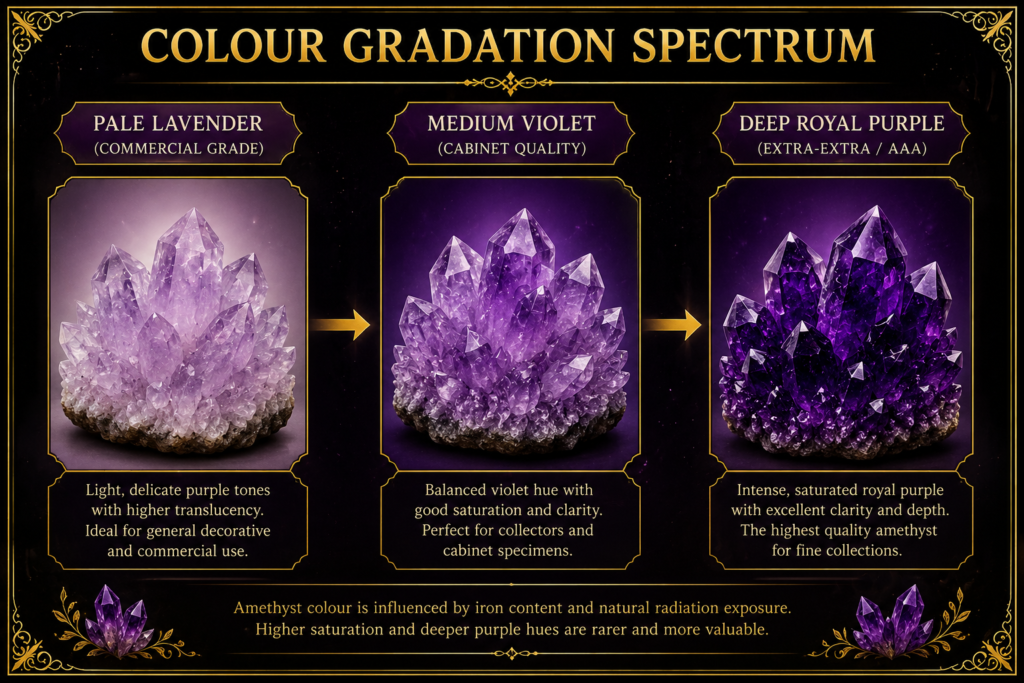
| Grade Class | Trade Name | Visual Appearance | Primary Market & Value |
| Grade AAA / Extra Deep | Deep Royal Purple / “Grape” | Intensely saturated, dark royal purple to ink-violet with flashes of blue and red. No pale or white zones. | Premium collector pieces, museum displays, luxury decor; commands highest price per kilo. |
| Grade AA / Extra | Deep Violet | Solid medium-to-dark purple colour throughout crystal points. Minimal pale bases. | High-end crystal shops, fine home displays, fine lapidary carving. |
| Grade A / Medium | Standard Purple | Moderate violet tone; crystal bases often fade into milky quartz or white chalcedony. | Common retail mineral specimens, tumbling stock. |
| Grade B / Commercial | Pale Lavender / Lilac | Very light, washed-out pinkish-purple or greyish-tan hue; weak iron concentration or low radiation exposure. | Budget gift shops, decorative chips, low-tier home accents. |
3. Key Quality Factors Beyond colour
While colour saturation sets the baseline grade, mineral collectors and wholesale buyers evaluate several other key structural criteria to determine an amethyst geode’s overall value:
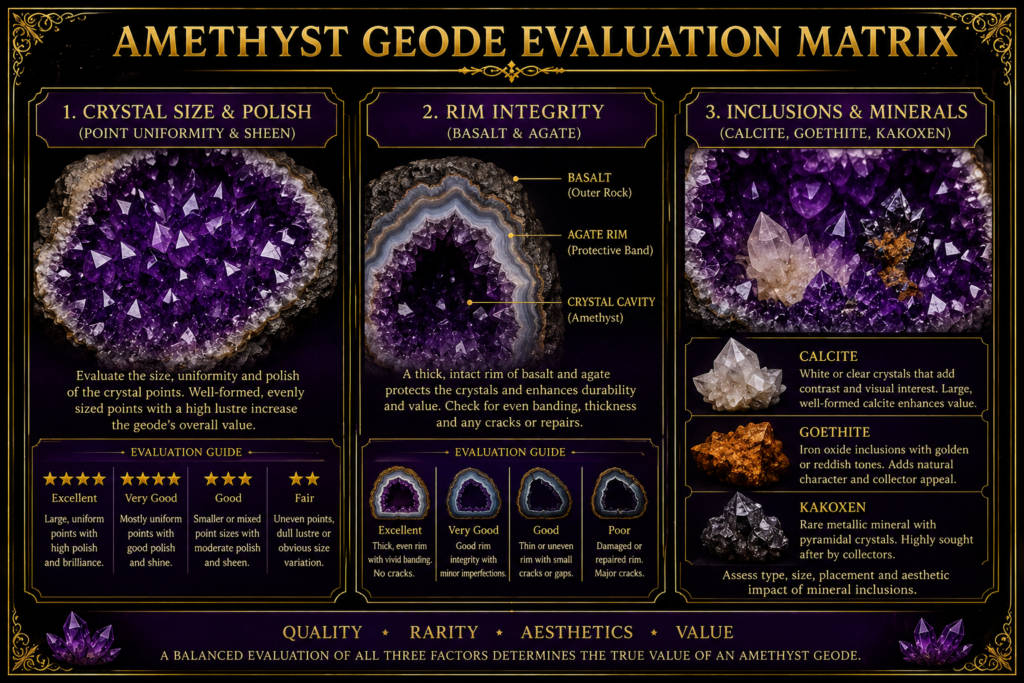
A. Crystal Point Size and Uniformity
- Micro-Points (Druzy): Tiny, sugar-like crystals coating the geode wall. High sparkle, but individual points are small.
- Medium-to-Large Points: Well-defined hexagonal crystal terminations (1 cm to 5+ cm across). Larger, undamaged crystal points with high clarity and lustre command significantly higher prices.
- Point Integrity: Specimens with pristine, un-chipped terminations carry a premium over geodes damaged during extraction or transport.
B. Outer Rim and Agate Banding
- Agate Banding (The “Skin”): A high-quality amethyst geode should feature a distinct, polished ring of banded chalcedony or agate immediately surrounding the purple crystals.
- Basalt / Concrete Backing: Natural geodes retain a thin layer of dark green or grey volcanic basalt on the back. Cheap or damaged specimens are often reinforced with artificial concrete or painted green backing—a red flag for collectors.
C. Associated Secondary Mineral Inclusions
Geodes containing secondary minerals growing atop or alongside the amethyst crystals are considered rare and highly desirable:
- Golden Calcite: Large golden-yellow or white rhombohedral calcite crystals perched on purple amethyst.
- Goethite & Kakoxenite: Golden, reddish, or needle-like broom inclusions trapped inside the crystal points.
- Gypsum & Barite: White tabular crystals growing inside the central cavity.
4. Major Global Sources: Uruguay vs. Brazil
While amethyst geodes occur in several countries, two South American regions dominate the global market:
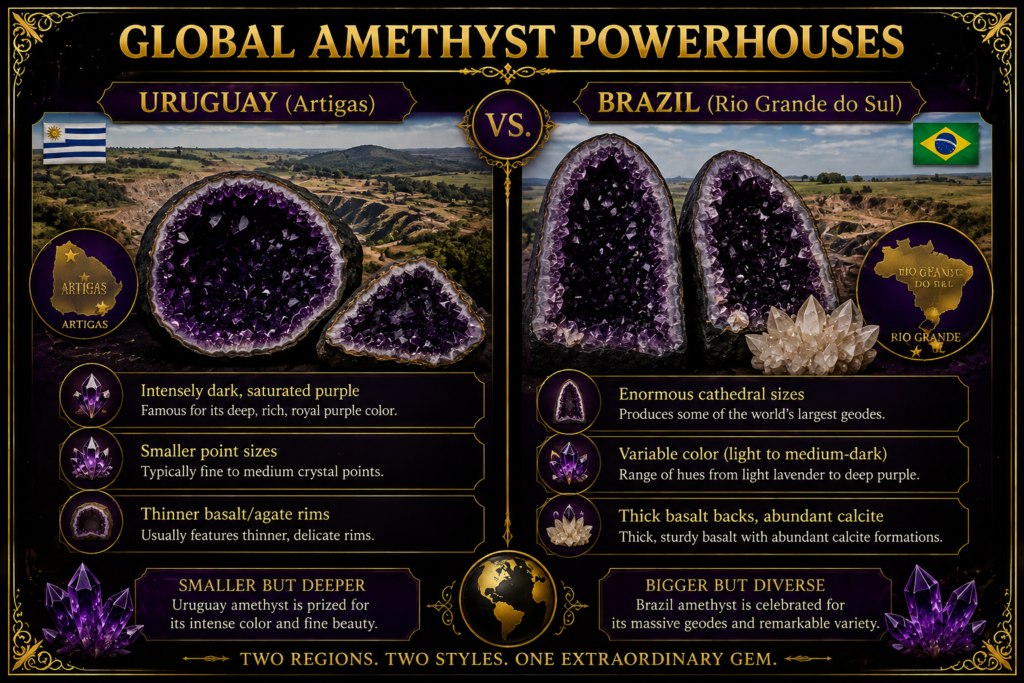
Uruguay (Artigas Region)
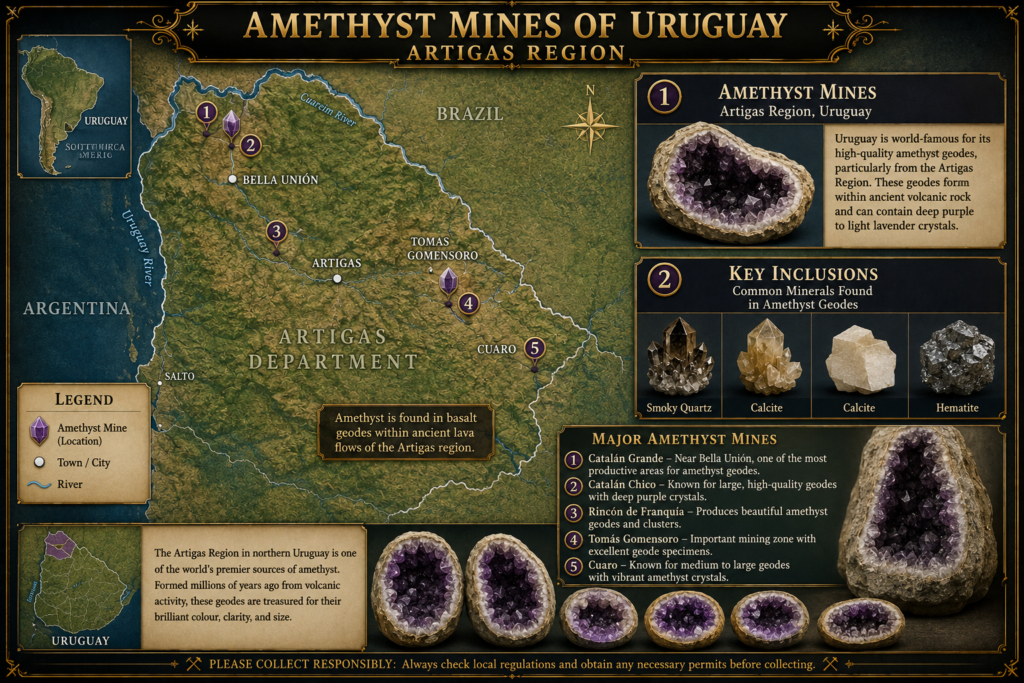
- Characteristics: Celebrated worldwide for producing the deepest, most intensely saturated “deep purple” amethyst.
- Point Structure: Points tend to be smaller to medium-sized, but feature exceptional lustre, deep colour saturation, and sharp crystal clarity.
- Geode Size: Typically smaller (hand-held up to medium cabinet sizes), though larger specimens exist.
Brazil (Rio Grande do Sul & Bahia)
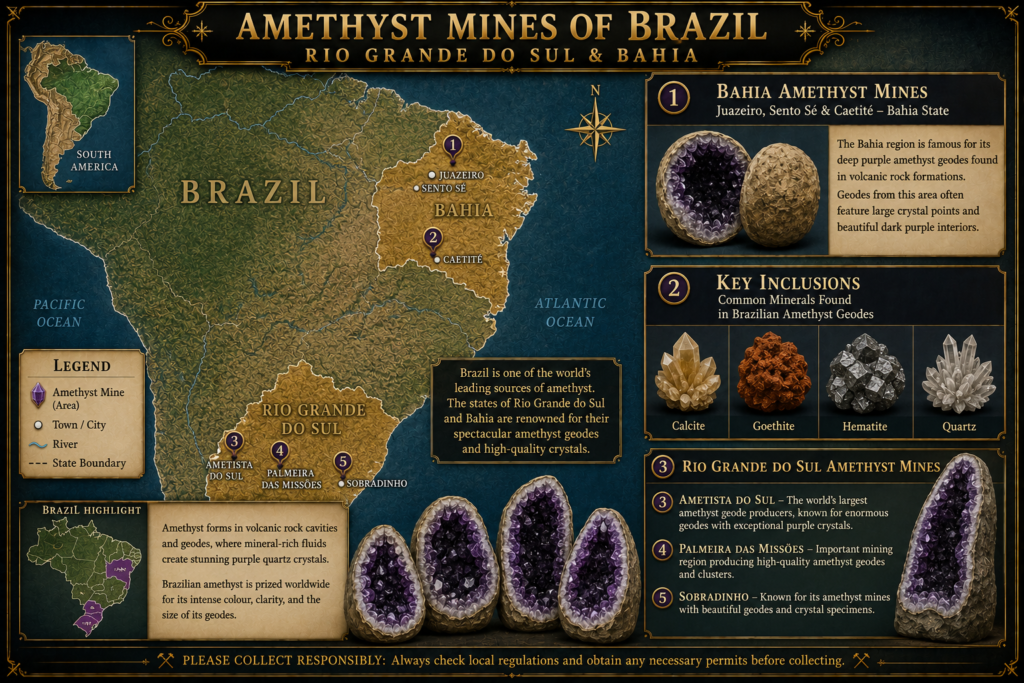
- Characteristics: Famous for producing massive, freestanding “cathedral” geodes, hollow archways, and giant amethyst caves standing up to 12 feet tall.
- Point Structure: Larger crystal points, but colour ranges widely from pale lavender to deep violet.
- Geode Size: Unmatched scale; supplies the vast majority of commercial and home decor amethyst geodes worldwide.
5. Detecting Artificial Alterations and Treatments
Because deep purple Amethyst Geodes carry a high market premium, buyers should be aware of common enhancements and artificial modifications.
- Heat Treatment (Fake Citrine): Heating low-grade purple amethyst to approximately 450°C–500°C turns the iron ions golden-orange, transforming cheap amethyst into burnt-orange “heat-treated citrine.”
- Artificial Dyeing: Lower-grade, pale quartz geodes are sometimes dyed with purple chemicals. Dyed geodes often show dark dye concentration along internal fractures and cracks.
- Painted Outer Shells: Look closely at the exterior basalt backing. Authentic geodes have natural rock skins, whereas heavily repaired or reinforced pieces use dark green paint over epoxy or concrete.
- Sunlight Fading Caution: Natural amethyst can lose its deep purple saturation over time if exposed to direct sunlight or strong UV light, as UV rays reverse the $\text{Fe}^{4+}$ oxidation state back to $\text{Fe}^{3+}$. Display specimens away from sunny windows.
Summary Evaluation Checklist
When shopping for or grading an amethyst geode, use this quick 4-step checklist:
- colour: Is it pale lilac (Grade B), vibrant violet (Grade A/AA), or dark royal grape purple (Grade AAA)?
- Terminations: Are the crystal point tips intact and sharp, or broken and abraded?
- Edges & Backing: Is there a clean agate rim surrounding the crystals, and is the backing natural basalt rather than painted concrete?
- Natural State: Is the purple colour uniform and natural, with no signs of dye pooling or heat-alteration?
Frequently Asked Questions
How do Amethyst Geodes Form?
Amethyst geodes form when a pre-existing cavity in volcanic rock is later filled by silica-rich fluids. The process involves volcanic bubble creation, inflow of silica and ferric iron, quartz lattice substitution by iron, and long-term natural gamma radiation that oxidises iron to create the deep violet colour.
What defines the colour grade of Amethyst Geodes and how does it affect value?
Colour saturation is the most critical factor in value, with geodes graded from pale lavender to deep royal purple. The market uses a spectrum where Grade AAA/Extra Deep corresponds to deep royal purple, Grade AA/Extra to deep violet, Grade A/Medium to standard purple, and Grade B/Commercial to pale lavender.
What other quality factors influence an Amethyst Geode’s value besides colour?
Beyond colour, evaluators look at crystal point size and uniformity, the integrity of crystal terminations, the outer agate rim, the natural basalt backing, and any secondary mineral inclusions such as golden calcite, goethite, kakoxenite, gypsum, or barite.
Where do the world’s best Amethyst Geodes come from, and what characterises each source?
Two main sources dominate: Uruguay (Artigas region), known for deep purple colour and small to medium points with exceptional lustre, and Brazil (Rio Grande do Sul and Bahia), renowned for large cathedral geodes with massive points and broad colour ranges from pale to deep violet.
How can buyers detect artificial alterations or treatments in Amethyst Geodes?
Be aware of heat treatment that turns amethyst into fake citrine, artificial dyeing that leaves dye concentrated along fractures, painted outer shells simulating natural rock, and be mindful that natural amethyst can fade in direct sunlight due to reversal of Fe4+ back to Fe3+.