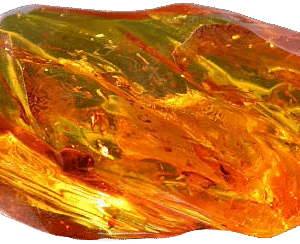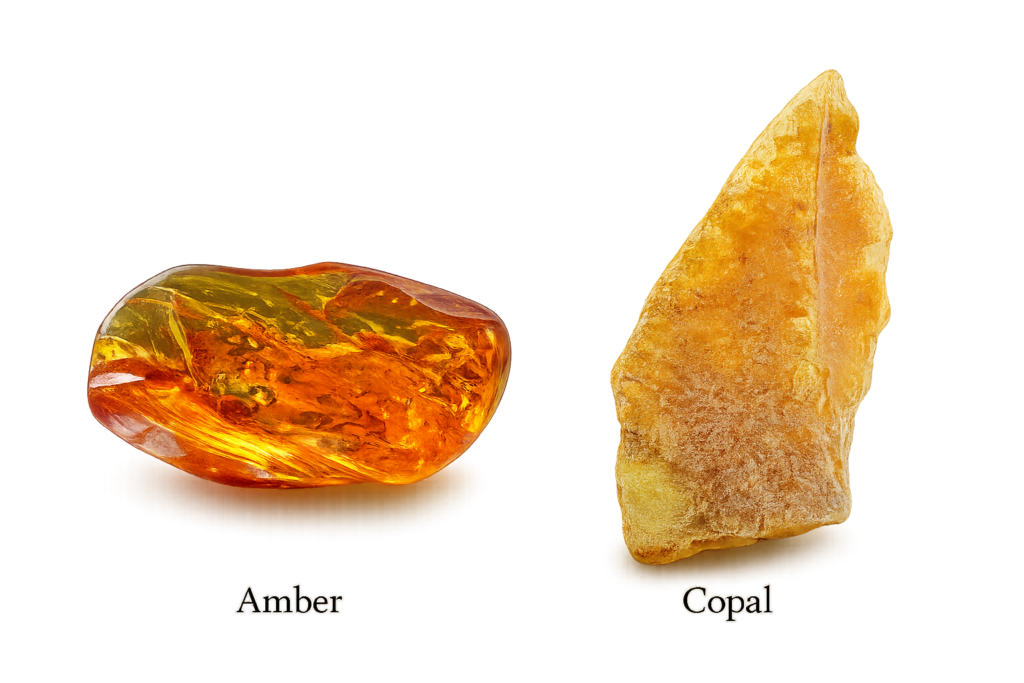
While both amber and copal are celebrated in jewellery making, historical artifacts, and holistic healing, they represent entirely different stages of a remarkable geological timeline. Often mistaken for one another due to their striking visual similarities, honey-like hues, and ability to trap ancient organic matter, these materials are actually millions of years apart.
Amber is fully fossilised tree resin that has undergone extensive chemical changes over geological epochs, typically requiring millions of years to achieve its stable, hardened state. Copal, on the other hand, is an immature, sub-fossilised resin. It is much younger, softer, and chemically unstable compared to true amber. Understanding the distinct differences between amber and copal is essential for gemologists, collectors, history enthusiasts, and metaphysical practitioners alike. This article explores their scientific profiles, geological histories, cultural impacts, and metaphysical roles.
Alternate names
To accurately navigate the marketplace and historical texts, it helps to understand the regional and commercial names applied to both materials.
Amber: Also known as Bernstein (German, meaning “burning stone”), Elektron (Ancient Greek, the root word for electricity), Succinite (specifically for mineral-rich Baltic amber), and Tiger’s Soul (in ancient Chinese lore).
Copal: Frequently referred to as Young Amber, Protoburnstein, Kauri Gum (New Zealand variety), Zanzibar Copal, and Animé (historically used in European commerce due to its bright, clear appearance).
The stones Science and Composition
From a strict scientific perspective, neither amber nor copal are true stones or minerals. Because they originate from biological organic matter rather than geological mineral crystals, they are classified as organics or mineraloids.
Both begin as sticky resin secreted by plants—mostly ancient conifers or angiosperm flowering trees—as a defence mechanism against insects, fungal diseases, and physical damage.
The primary difference lies in the process of polymerisation. When resin is exuded, volatile organic compounds called terpenes evaporate, causing the substance to thicken into copal. Over millions of years, if buried under the right conditions of heat and sedimentary pressure, these remaining compounds cross-link into giant, stable macromolecules. This complete molecular transformation turns the vulnerable copal into durable, fully fossilized amber.
Key Physical Characteristics
Because copal has not completed the full journey of polymerisation, its physical properties differ noticeably from true amber.
| Property | True Amber | Copal |
| Age | Generally 15 million to over 100 million years old | Less than 10,000 years to roughly 5 million years old |
| Mohs Hardness | 2.0 to 2.5 (More scratch-resistant, breaks crisply) | 1.5 to 2.0 (Noticeably softer, can feel slightly gummy) |
| Solubility Test | Highly resistant to solvents; drops of acetone or alcohol will not affect the surface. | Soluble; a single drop of acetone or alcohol makes the surface sticky within seconds. |
| Melting Point | High (200°C to 300°C); emits an aromatic, pleasant pine or incense scent. | Low (approx. 150°C); melts quickly and can emit a sharper, brighter resinous odor. |
| Specific Gravity | 1.05 to 1.10 (Floats easily in saturated saltwater) | 1.03 to 1.08 (May float, but reacts differently due to lower density) |
Common Geologic Varieties
Each material presents distinct varieties based on the specific ancient ecosystems that generated them.
Amber Varieties
- Baltic Amber: The most famous variety, containing high levels of succinic acid, harvested around the Baltic Sea region.
- Dominican Amber: Sourced from the extinct Hymenaea protera tree; famous for being exceptionally clear and occasionally exhibiting a striking natural blue fluorescence under UV light.
- Burmite: Cretaceous-era amber from Myanmar, often reaching ages of 99 million years, highly prized for ancient fossil inclusions.
Copal Varieties
- Madagascar Copal: A highly abundant, bright yellow variety frequently sold packed with modern insects and sold under the misleading name “amber.”
- Colombian Copal: Sourced from legume trees, often highly transparent but deeply susceptible to heat and solvent damage.
- Mexican/Mesoamerican Copal: Collected for centuries primarily from Bursera trees, valued more as a ceremonial incense than a gemstone.
Global Mining and Volcanic Sources
Unlike traditional gemstones like diamonds or sapphires, amber and copal are not typically found in volcanic pipes or metamorphic rock veins. Instead, they are sourced from alluvial sedimentary deposits where ancient rivers or marine environments swept away, concentrated, and buried the original forest floors.
- Amber Hotspots: The primary global hubs are the Kaliningrad Oblast in Russia (accounting for the vast majority of Baltic amber), the mountain ranges of the Dominican Republic, the sea cliffs of Lithuania, and parts of Myanmar and Mexico.
- Copal Hotspots: Major deposits are centered around East Africa (Madagascar and Tanzania), Colombia, Indonesia, and the traditional harvesting forests of Southern Mexico and Central America.
Crystal Pairings: What to Combine and Avoid
In holistic and metaphysical energetic practices, combining organics with minerals requires careful attention to structural hardness and energetic frequencies.
Optimal Crystal Pairings
Because amber and copal both carry warm, radiant, and fluid solar energy, they pair beautifully with stones that share or support their grounding properties.
- Jet: Like amber, Jet is an organic mineraloid (fossilized wood). Combining them creates a highly stable balance of solar light (amber) and deep earthly protection (jet).
- Clear Quartz: Amplifies the gentle, slow-moving energies of organic resins, making their supportive properties easier to perceive.
- Carnelian or Sunstone: Aligns perfectly with the warm, creative colors and self-confidence frequencies associated with both resins.
Crystal Pairings to Avoid
- High-Hardness Abrasives (e.g., Raw Quartz Clusters, Black Tourmaline): Storing or wearing delicate amber or copal directly alongside hard, jagged crystals will physically scratch, pit, or crack the soft surfaces of the resins.
- Extremely Heavy, Cold Earth Minerals (e.g., Hematite or Magnetite): The dense, heavy energetic pull of magnetic minerals can easily overwhelm the light, subtle energy of soft copal.
Archaeology, Art and Ancient History
Both substances have left profound marks on human material culture, though their historic timelines reflect their geography.
Amber was one of the earliest luxury trade items in human history. The “Amber Road” was an ancient European trade network that carried Baltic amber down to the Mediterranean, where Egyptian pharaohs, Greek elites, and Roman emperors used it for jewelry, amulets, and status symbols. Pieces of Baltic amber were even discovered embedded in the breastplate of King Tutankhamun.
Copal holds an equally sacred place in the Americas. To the Maya and Aztecs, copal resin (copalli) was viewed as the “brain of the earth” and the literal sweat of the gods. It was cast into sacred cenotes (sinkholes) as offerings or shaped into ceremonial figurines and burned during high-stakes religious rituals to carry prayers to the heavens.
Folklore, Legends and Sacred Tales
The mysterious origin of these warm stones sparked vivid storytelling across ancient cultures.
- The Tears of the Heliades: In Greek myth, when Phaethon died trying to drive the sun chariot, his grieving sisters were transformed into poplar trees along the Eridanus river. Their tears hardened into gleaming drops of elektron (amber).
- The Food of the Spirits: Mesoamerican lore treats copal smoke as holy nourishment for spirits. During modern Día de los Muertos (Day of the Dead) celebrations, burning copal is still believed to create a sensory pathway that guides souls back to their family altars.
Metaphysical and Mystical Healing Properties
Holistic practitioners draw a clear distinction between the energetic states of amber and copal.
- Amber’s Energy: Viewed as an ancient, highly grounded accumulator of earth memory. It is utilized to draw out stagnation, absorb dense negative energies, and transmute emotional pain into bright, resilient vital force. It feels slow, warm, and deeply settled.
- Copal’s Energy: Experienced as much lighter, faster-moving, and more ethereal. Because it is younger, its energy is closely linked to cleansing, fresh beginnings, immediate purification, and sparking creative inspiration.
Astrological Connections
- Leo & Taurus: Amber is traditionally assigned to Leo, reflecting its vibrant solar energy, warmth, and affinity for gold tones. It is also linked to Taurus for its earthy, slow-growing protective properties.
- Solar Signs: Copal is more universally associated with the sun itself rather than a single zodiac sign, acting as a supportive ally for anyone seeking to cultivate personal power, warmth, and self-expression.
The Chakra System
Because of their distinct yellow, orange, and golden-brown hues, both amber and copal operate primarily within the lower-to-middle energy centers:
- Sacral Chakra: Both materials stimulate the center of creativity, emotional fluidity, and sexual energy, encouraging balanced flow and emotional expression.
- Solar Plexus Chakra: They act as direct batteries for the seat of personal will, helping to clear self-doubt, build internal warmth, and strengthen personal boundaries.
Interesting facts
- Static Electricity: Amber was the exact substance used by ancient philosophers to discover static electricity. Rubbing amber vigorously against a piece of wool allows it to pick up lightweight items like feathers or dust.
- The Amber Room: Built in Prussia during the 18th century, this world-famous room was constructed entirely of amber panels backed with gold leaf. It disappeared mysteriously during World War II and remains one of history’s great unsolved art mysteries.
Modern Milestones: Birthstones and Anniversaries
While not recognized on standard modern birthstone lists (which favor crystalline gems), amber serves as an accepted alternative astrological birthstone for November.
In traditional gift-giving, amber represents the 10th wedding anniversary, symbolizing a decade of warm, durable, and resilient bonding. Copal is rarely used for these milestones due to its fragile, soft nature.
Amber v Copal Frequently Asked Questions (FAQ)
How can I easily tell if my jewellery is amber or copal at home?
The safest non-destructive method is the Static Test. Rub the item vigorously against a dry wool cloth for 20 seconds. True amber will develop a strong static charge capable of picking up small bits of tissue paper or ash. Copal will generate almost no static charge. To test unmounted material safely, apply a tiny drop of rubbing alcohol or nail polish remover to an inconspicuous spot; copal will turn sticky almost immediately, while amber remains completely unaffected.
Are the bugs inside Madagascar copal dinosaurs-era fossils?
No. Because Madagascar copal ranges from just a few hundred years old to a few million years old, the insects trapped inside are anatomically modern species. They are not prehistoric dinosaurs, but rather ancestors of the local insects thriving in East African ecosystems today.
Can copal turn into amber over time if stored properly?
No. The transformation from copal to amber requires millions of years of intense sedimentary pressure, heat, and a low-oxygen environment deep underground to facilitate cross-linking of the polymer chains. Storing copal in a drawer or jewellery box will only cause it to dry out, oxidize, and slowly develop a network of fine surface cracks (crazing).
Is Baltic amber better than Dominican amber?
Neither is inherently “better,” as they serve different interests. Baltic amber is older, tougher, contains therapeutic succinic acid, and is deeply tied to historical European craftsmanship. Dominican amber is younger but prized by scientists and collectors for its extreme clarity, diverse insect inclusions, and rare blue fluorescent varieties.er?
These are my personally selected and curated Amber and copal products