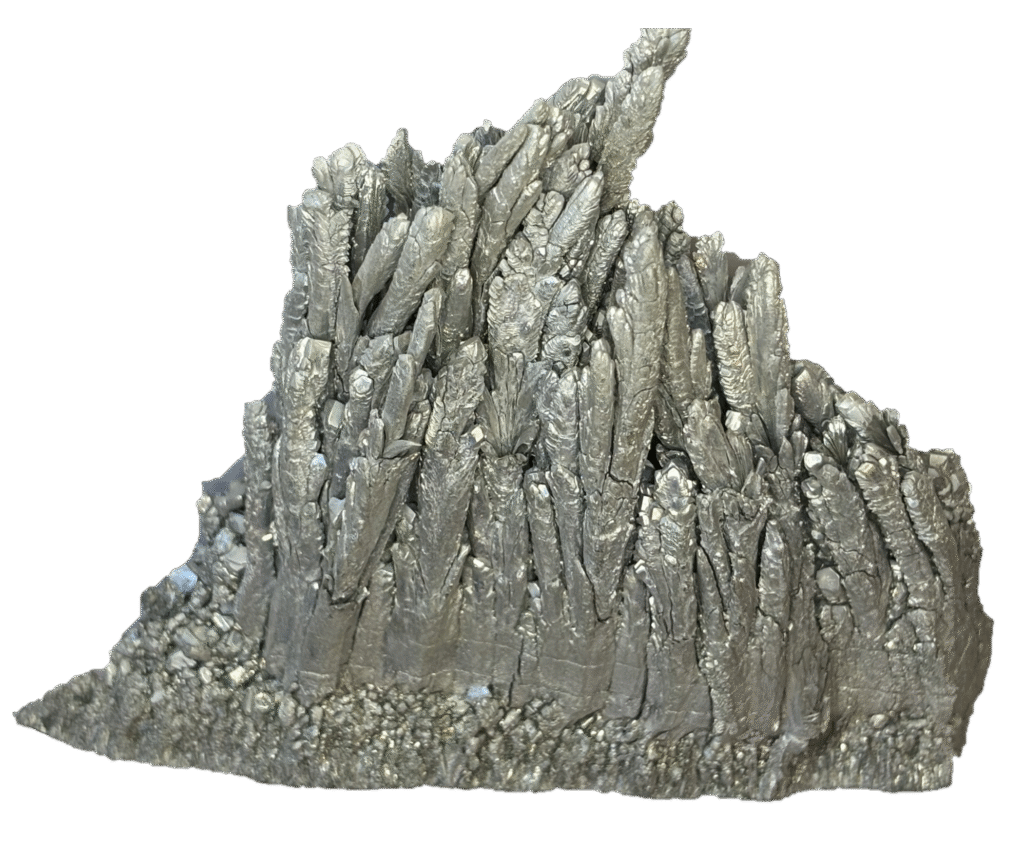
Navigating the Real v Mislabelled Crystalline Magnesium argument starts with an essential mineralogical truth: every gleaming, feather-like metallic magnesium cluster on the collector market is laboratory- or industrially-grown via high-temperature vacuum vapour deposition, never mined from the Earth’s crust. Because elemental magnesium ($\text{Mg}$) is far too reactive to survive exposure to atmospheric oxygen and groundwater as a free native metal, online listings advertising “100% natural raw mined magnesium crystals” from fictional localities are either mislabelled or outright deceptive.
Understanding the genuine origin of vapour-deposited crystalline magnesium protects buyers from paying inflated “rare mine find” prices while helping collectors separate pristine, high-purity specimens (99.95%+ Mg) from oxidised, moisture-damaged stock or heavy pot-metal castings. While authentic laboratory-grown clusters possess a true hexagonal close-packed crystal lattice, a bright silvery-white lustre, and an unmistakable specific gravity of 1.74, improper storage or bare-hand handling quickly dulls their stepped hopper plumes into chalky white magnesium hydroxide.
In this buyer’s guide, we break down Real v Mislabelled Crystalline Magnesium across origin disclosure, specific gravity weight checks, crystal habit, and surface lustre—equipping you with a straightforward five-point inspection checklist so you can buy authentic, well-preserved specimens with complete confidence.
Why “Natural Mined Magnesium Crystals” Do Not Exist
Unlike quartz, pyrite, or calcite, elemental magnesium ($\text{Mg}$) is far too chemically reactive to survive in Earth’s crust as a free native metal. Any exposed metallic magnesium in nature reacts immediately with atmospheric oxygen, groundwater and carbon dioxide to form stable compounds such as magnesite ($\text{MgCO}_3$), dolomite, or olivine.
To grow pure metallic crystals, industrial refiners heat calcined dolomite and ferrosilicon (Iron and Silicon) inside an oxygen-free steel vacuum retort at roughly $1,150^\circ\text{C}–1,200^\circ\text{C}$, causing magnesium vapour to condense directly onto a cooled sleeve into feathery hexagonal crowns. Reputable mineral dealers disclose this origin transparently as vapour-deposited or laboratory-grown crystalline magnesium rather than inventing fictional mine localities.
5-Point Buyer Checklist: Authentic Vapour-Deposited Magnesium vs Poor Stock
| Inspection Criterion | Authentic, High-Grade Specimen | Low-Grade, Oxidised, or Misrepresented Stock |
| Origin Disclosure | Clearly labelled as vapour-deposited / lab-grown elemental magnesium (99.95%+ Mg). | Claimed to be “natural mined native magnesium” from fictional localities. |
| Surface Lustre & Colour | Crisp, bright silvery-white metallic sheen with clean, reflective stepped hopper faces. | Covered in chalky grey-white powder ($\text{Mg(OH)}_2$) from moisture exposure or bare-hand handling. |
| Weight in the Hand (SG) | Startlingly lightweight (specific gravity 1.74—roughly 35% lighter than aluminium). | Feels heavy like lead, zinc, or bismuth (SG 7.1–9.8), indicating a cheap pot-metal casting or mislabelled stibnite/bismuth. |
| Crystal Geometry | Elongated, feather-like hexagonal columns with sharp chevron-stepped dendritic growth. | Rounded, bubbly, or uniform mould seams typical of cast metal ingots rather than vapour condensation. |
| Packaging & Protection | Shipped dry in rigid boxes with acid-free tissue or cushioned foam and silica gel. | Tossed loose into plastic bags with harder tumbles, causing crushed Mohs 2.0–2.5 tips. |
What Determines Fair Value in Crystalline Magnesium?
Because vapour-deposited magnesium crowns are harvested from industrial distillation retorts, pricing depends primarily on aesthetic preservation and crystal architecture rather than geological rarity:
- Intact Terminal Plumes: Specimens cleaved cleanly from the condenser wall with unbroken, soaring feather-like crystal tips command higher collector premiums than crushed or abraded edge pieces.
- Clean Metallic Contrast: Clusters showing bright, unoxidised silver facets across deep sculptural crevices are far more desirable than dull, handled pieces.
- Proportional Weight & Display Stability: Well-balanced clusters with a flat, stable base matrix display effortlessly without requiring glued stands that could damage the soft metal.
These are my personally selected and curated Crystalline Magnesium products