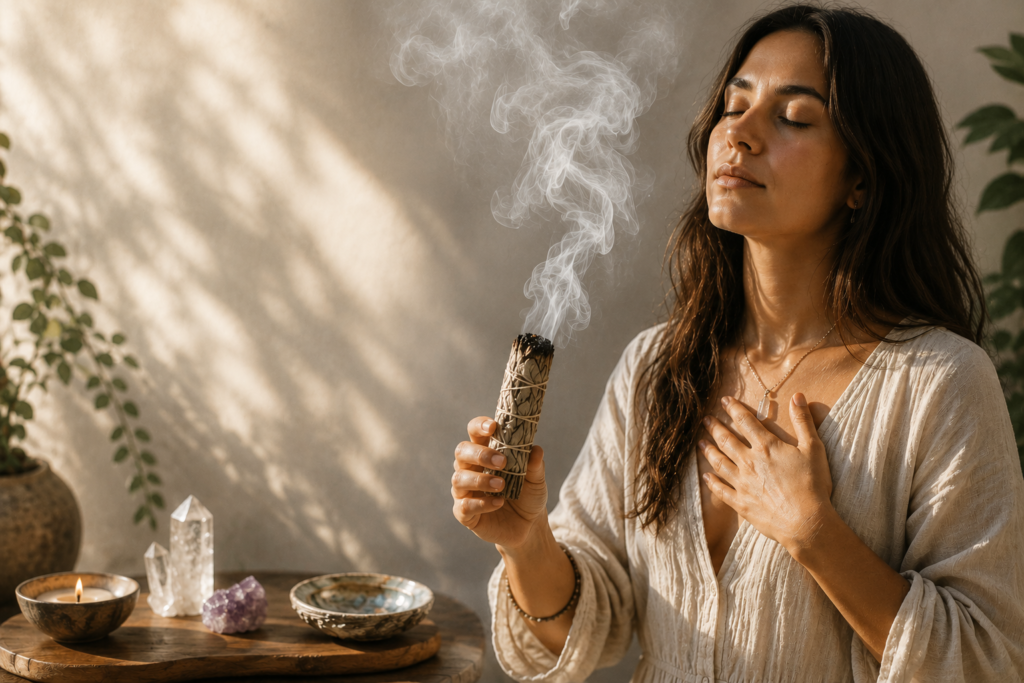
Smoke Cleanse Yourself, a simple ritual, involves moving aromatic smoke around the body to symbolically release unwanted energy. It marks a transition and helps create a clearer mental boundary between what has passed and what comes next.You might choose a personal ritual before meditation after returning from a demanding environment. This can follow an argument, mark new chapter, or simply offer Smoke Cleanse Yourself as a moment of reflection.
Descriptions such as cleansing your aura, removing negative energy, or clearing stagnant energy belong to spiritual and metaphysical belief systems. Smoke Cleanse Yourself has not been scientifically established as a treatment for anxiety, illness, trauma, or other physical conditions. Mental health conditions are not supported by this approach.
There is also a practical consideration: burning herbs produces smoke and airborne particles. Combustion is a recognised source of indoor particulate matter. Inhalable particles can irritate the eyes, nose and throat and may aggravate respiratory conditions. For this reason, personal smoke cleansing is best approached as an intentional spiritual or reflective practice, with good ventilation and sensible fire precautions.
History of Personal Smoke Cleansing
Humans have incorporated aromatic plants and smoke into religious, ceremonial and domestic practices for centuries, but these traditions should not all be treated as one interchangeable practice.
The term smudging is particularly associated with ceremonial traditions belonging to Indigenous peoples of North America. Historical objects held by the Smithsonian National Museum of the American Indian include braided sweetgrass associated with Pikuni Blackfeet purification practices, as well as tied sage, grass and cedar materials identified as ceremonial or smudging materials.
The Smithsonian also documents the use of sage smoke to cleanse a ceremonial pipe before prayer, demonstrating that smoke cleansing can form part of a much larger ceremonial and spiritual framework rather than simply being a technique for making something “energetically clean”.
Smoke-based ritual practices also occur outside Indigenous North American traditions. For example, the Smithsonian has documented contemporary Mexican-American curanderismo practices in which spiritual cleansing may incorporate sage, cedar or copal alongside other ceremonial elements.
For a general modern practice that is not connected to a specific Indigenous ceremony, smoke cleansing or herbal smoke cleansing is therefore often the clearer term.
Respect also extends to the plants themselves. Some plants have particular cultural significance, and the Smithsonian specifically notes that plants such as white sage may be sacred and should not be gathered without appropriate community permission.
What Does It Mean to Smoke Cleanse Yourself?
Within contemporary spiritual practice, smoke cleansing yourself usually involves passing aromatic smoke around the outside of your body while concentrating on an intention. Rather than imagining that the smoke is physically washing your body, think of the ritual as combining three elements:
Smoke → focused attention → symbolic transition
The physical action gives your intention a visible form. You might imagine releasing tension from the day, leaving an argument behind, preparing yourself for meditation or entering a new stage of life.
There is no scientific instrument that can demonstrate that smoke has removed an “energetic field”, so energetic cleansing should be understood here as spiritual language and personal symbolism rather than a measurable medical process.
Tools and Equipment Needed
A personal smoke cleansing ritual can be extremely simple. You do not need an elaborate altar or collection of crystals.
Herbal Bundle or Loose Herbs: Depending on your practice, you might use:
- rosemary
- lavender
- garden sage
- cedar
- mugwort
- dried rose petals
- other aromatic plants meaningful to you
If you use a bundled herb stick, make certain it has been thoroughly dried before lighting it.
Fireproof Bowl: Keep a heat-resistant container underneath the burning herbs to catch loose embers and ash. Ceramic, stone or metal vessels designed to withstand heat are preferable to ordinary decorative bowls.
Matches or Lighter: Use these only to establish the initial flame. The objective is normally to create a glowing ember that produces smoke rather than allowing the herbs to continue burning with an open flame.
Sand: A small container of clean sand can provide a convenient way to extinguish the bundle completely when you finish.
Open Window or Ventilation: Ventilation is an important part of the practical ritual. Burning plant material generates particulate matter. The US Environmental Protection Agency recommends adequate ventilation when candles or incense are burned indoors, while Asthma + Lung UK advises using candles and incense in well-aired, larger spaces and opening windows where possible.
Optional Items:
You might also include:
- a candle
- meditation cushion
- journal
- affirmation card
- crystal
- bell
- music
- bowl of dried herbs
- meaningful spiritual object
These are optional. The essential ingredient in a personal ritual is the attention you bring to it.
Preparation: Before lighting anything, prepare both yourself and the room.:
- Open a window or door so that fresh air can circulate.
- Move away from curtains, paper, bedding, dried decorations and other flammable materials.
- Place your fireproof bowl within easy reach. If you have long hair, secure it before beginning. Avoid loose sleeves or clothing that could pass near the ember.
- Take a few moments to decide why you are performing the ritual.
- Your intention might be: Or: I leave the events of today behind me and return my attention to the present.
You do not need elaborate wording. A short intention that feels meaningful is usually easier to maintain throughout the ritual.
How to Smoke Cleanse Yourself
Step 1: Light Your Herbs
- Hold the end of the herb bundle over your fireproof container.
- Light the tip and allow the flame to establish briefly.
- Extinguish the open flame so that the herbs smoulder gently.
You need only a small amount of smoke. Creating a room full of dense smoke does not make the ritual more effective and unnecessarily increases exposure to combustion particles.
The Feet-to-Head Smoke Cleansing Method
One of the simplest ways to structure a personal cleansing ritual is to work gradually upwards.
- Hold the smoking bundle away from your skin and clothing.
- Do not touch yourself with the burning herbs.
- Begin near your feet.
- Slowly guide the smoke around:
Feet → ankles → legs → hips → torso → shoulders → arms → hands → neck → head
- Imagine the smoke marking the boundary between whatever you wish to leave behind and the state you wish to enter.
- You can move the smoke using the bundle itself or gently direct it with your free hand.
- There is no requirement for the smoke to touch every part of your body. The movement is symbolic.
- Some people make one continuous movement from feet to head. Others repeat the process several times.
- Neither method is inherently more powerful.
Cleansing Around Your Hands
Hands have strong symbolic associations with action, work, creativity and interaction with other people.
- Hold your hands comfortably in front of you and allow a small amount of smoke to move around them.
- Turn your palms upwards and then downwards.
- You might use an intention such as: May my actions reflect the person I choose to be.
This can be particularly meaningful after work, social interaction or completing a difficult task.
Cleansing Around Your Heart
- Next, move the bundle safely in front of the centre of your chest.
- Keep plenty of distance between the ember and your clothing.
- Rather than deliberately inhaling the smoke, simply allow it to move through the surrounding space.
- You might imagine releasing emotional heaviness or creating room for compassion, gratitude or calm.
An affirmation could be: I acknowledge what I feel, release what I no longer need and make space for what comes next.
Remember that this is symbolic spiritual language. Smoke cleansing is not a treatment for heart conditions, anxiety, trauma or other medical or psychological conditions.
Cleansing Around Your Head
- Finish by moving the smoke around the space surrounding your head.
- Keep the burning bundle well away from your face, eyes and hair.
- There is no need to inhale the smoke.
- You might visualise mental clutter dispersing as the smoke rises.
Try:I release distraction and return my attention to the present moment.
You can then gently guide the smoke upwards and away from yourself.
Setting Intentions During Smoke Cleansing
The difference between simply burning aromatic herbs and performing an intentional ritual is largely the meaning you attach to the action. Your intention can be spoken aloud, whispered or repeated silently. Try keeping it short.
- For Release: I release what no longer belongs with me.
- For New Beginnings: I welcome this new chapter with clarity and intention.
- For Grounding: I return my attention to this moment.
- After a Difficult Day: The events of today are finished. I allow myself to move forward.
- For Confidence: I move forward with courage and trust in myself.
- Before Meditation: I create space for stillness, awareness and reflection.
Smoke Cleansing Before Meditation
Smoke cleansing can be incorporated into a meditation routine as a transition ritual. The advantage is not that smoke has been proven to improve meditation. Instead, repeating the same sequence can provide a clear behavioural signal that your everyday activities have ended and your meditation practice is beginning.
- Open a window and prepare your meditation area.
- Light your herbs and use only enough smoke for the ritual.
- Move from feet to head while repeating: “I release distraction and become present.”
- Extinguish the herbs completely.
- Then sit down for your normal meditation practice.
This creates a simple sequence:
Prepare → Cleanse → Extinguish → Sit → Breathe → Meditate
You can also write your own affirmation before beginning.
Smoke Cleansing After a Stressful Situation
After an argument, demanding working day, crowded event or emotionally difficult experience, you may find it useful to create a deliberate boundary between the experience and what happens next. Smoke cleansing can serve as that boundary. Instead of telling yourself that the smoke is medically removing stress from your body, frame the ritual more realistically:
The stressful event happened → I acknowledge it → I deliberately mark its ending → I choose what I do next.
Move the smoke slowly from your feet towards your head. As you do so, you might say: “I acknowledge what happened without carrying it into everything that follows.”
- When you reach your head, pause.
- Extinguish the herbs.
- Open the window fully for several minutes and allow the room to air.
You could then follow the ritual with another grounding activity such as journaling, walking, stretching, drinking water or quiet meditation.
Smoke Free Alternatives to Smoke Cleansing
Smoke is not essential for creating a meaningful cleansing ritual. This is particularly important for anyone who dislikes smoke or lives with people who are sensitive to airborne pollutants. The health professions notes that inhalable particulates can irritate the eyes, nose and throat and may worsen respiratory conditions.
However, there are many smoke free cleansing methods available:
Sound Cleansing: Move around your body with a a bell, singing bowl, chimes, clapping, gentle drumming. Imagine the sound marking the same symbolic transition that smoke would otherwise represent.
Herbal Sachets: Place dried lavender, rosemary or other meaningful botanicals inside a fabric pouch. Hold the sachet while repeating your intention or move it symbolically around your body.
Visualisation: Close your eyes and imagine light moving gradually from your feet towards your head. With each breath, imagine unwanted thoughts or emotional residue leaving your awareness.
Shower or Bath Ritual: Water can provide an intuitive alternative. While washing, consciously associate the action with leaving the events of the day behind. This is a symbolic ritual rather than a claim that water removes measurable negative energy.
Breath and Intention: The simplest version requires no equipment. Just stand quietly and take several comfortable breaths and repeat: “I release the past moment and return to the present.”
Smoke Cleansing Safety: Because this practice involves burning plant material, fire and air quality deserve as much attention as the spiritual elements.
- Keep the ember away from your skin, face, hair and clothing. Always use a fire-resistant container underneath it and never leave burning or smouldering herbs unattended.
- Keep smoke away from children and pets and be considerate of other people sharing the property.
- Avoid deliberately inhaling herbal smoke.
- Ventilate the room well. Burning materials indoors creates particulate matter, and reducing the source of indoor particulate pollution is generally the most effective way to reduce exposure.
People with asthma, COPD or other respiratory conditions can be particularly vulnerable to airborne particles. If smoke causes coughing, wheezing, breathlessness, headache, dizziness or irritation, stop the ritual, extinguish the source and move to fresh air.
As an alternative, choose a smoke free ritual which can be as effective.
Fresh Herbs: Instead of burning rosemary or lavender, hold fresh or dried sprigs and gently move them around your body while repeating your affirmation.
Finishing Your Personal Cleansing Ritual: When you feel finished, place the bundle in your fireproof container.
- Press the burning end gently into sand or another suitable fire-safe extinguishing medium until no glowing ember remains.
- Check it carefully, do not assume that a bundle has gone out simply because you cannot see smoke.
- Then allow fresh air to circulate through the room.
- Take a final moment to acknowledge your intention. You might say “The ritual is complete. I carry my intention forward.”
- Then continue with your day, meditation, journaling or rest.
Frequently Asked Questions
Can I smoke cleanse myself?
Yes. Personal smoke cleansing is practised as a spiritual or reflective ritual in which aromatic smoke is moved around the body while focusing on an intention. Claims about cleansing an aura or energetic field should be understood as spiritual beliefs rather than medically established effects.
Do I start at my head or my feet?
There is no universal rule for a general personal smoke cleansing practice. A feet-to-head method provides an easy structure and can symbolically represent grounding first before moving upwards towards the heart, hands and head.
How many times should I pass the smoke around myself?
There is no scientifically established or universally required number. One slow pass from feet to head may be sufficient. Some spiritual traditions attach meaning to particular numbers, but these should not automatically be presented as universal rules.
Should I inhale the smoke?
No. Deliberately inhaling smoke is unnecessary. Burning materials produce airborne particles, so keeping smoke exposure low and maintaining ventilation is preferable.
Should I open a window when smoke cleansing myself?
Yes. Good ventilation helps disperse smoke and combustion particles. The EPA recommends adequate ventilation when burning incense or candles indoors, and Asthma + Lung UK similarly recommends well-aired spaces and opening windows where possible.
What herbs can I use?
Rosemary, lavender, garden sage, cedar and other aromatic herbs may be used depending upon your own practice and intention. Research any plant before burning it, particularly if you have allergies, pets or respiratory sensitivities.
Some plants also have specific cultural significance. White sage, for example, is sacred within particular Indigenous contexts, and sourcing and cultural context deserve consideration.
Is smoke cleansing the same as smudging?
Not necessarily. Smudging can refer specifically to Indigenous North American ceremonial practices with their own cultural, spiritual and community contexts. Museum collections document sage, cedar and sweetgrass materials associated with such traditions.
For a personally created practice that is not part of one of those traditions, smoke cleansing is generally a clearer description.
Can smoke cleansing remove negative energy?
Within spiritual traditions, practitioners may describe the ritual as clearing negative or stagnant energy. There is no established scientific method demonstrating that smoke removes a measurable human energy field, however. The value of the practice can instead be understood through ritual, symbolism, intention and personal spiritual belief.
Can smoke cleansing reduce anxiety or stress?
It should not be used as a medical treatment for either. Someone may personally find a quiet ritual relaxing or find that it helps them mark the end of a stressful experience, but that is different from demonstrating that smoke itself treats anxiety or stress.
Can I smoke cleanse before meditation?
Yes. It can work particularly well as a symbolic transition into meditation. Complete the smoke ritual first, extinguish the herbs safely and then begin your meditation.
Can I cleanse myself after being around negative people?
You can use a cleansing ritual to symbolically separate yourself from an unpleasant or emotionally demanding interaction. Rather than assuming another person has literally attached negative energy to you, you might frame the intention as: “I leave that interaction where it belongs and return my attention to myself.”
What if I cannot use smoke?
Use a smoke-free ritual instead. Sound, visualisation, fresh herbs, herbal sachets, water, journaling and intentional breathing can all provide the same ritual structure without combustion.
How often should I smoke cleanse myself?
There is no required schedule. Some people may choose to do it:
- before meditation
- after demanding social situations
- after an argument
- when moving home
- before beginning a new project
- during a major life transition
- whenever they want to deliberately mark a fresh start
The practice does not need to become compulsory. Its purpose is to support an intentional moment, not to create anxiety about being spiritually “unclean”.
What is the most important part of personal smoke cleansing?
For a personal spiritual practice, intention and mindful attention matter more than producing large quantities of smoke.
Use a small amount, remain conscious of fire and air quality, respect the cultural origins of practices you borrow from, and treat energetic language as spiritual symbolism rather than medical fact.