
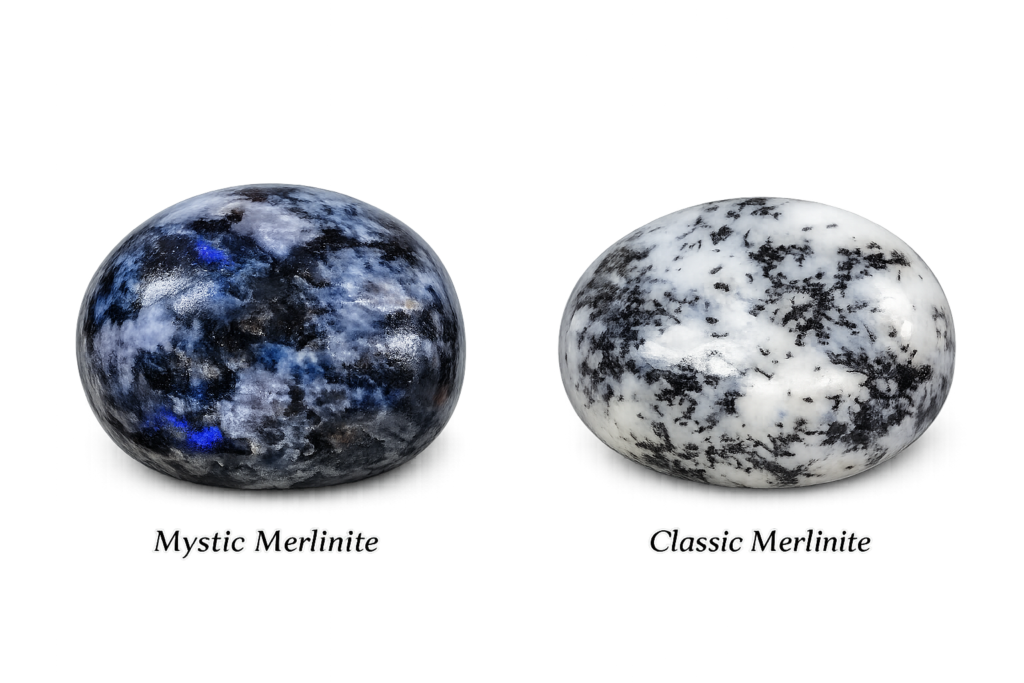
If you are expanding your mineral collection, you have likely encountered a confusing trade-name overlap: Merlinite. Sellers frequently list two completely different stones under this single name. On one hand, Classic Merlinite is a pale, translucent chalcedony marked by dark, tree-like inclusions. On the other, Mystic Merlinite (or Gabbro Indigo Merlinite) is a heavy, dark igneous rock defined by rich charcoal and indigo hues. While both share a connection to Western esoteric tradition, their geological origins, mineral compositions, and energetic qualities could not be more distinct. Here is how to confidently identify and choose between mystic merlinite v classic merlinite
If you are expanding your mineral collection, you have likely encountered a confusing trade-name overlap: Merlinite. Sellers frequently list two completely different stones under this single name. On one hand, Classic Merlinite is a pale, translucent chalcedony marked by dark, tree-like inclusions. On the other, Mystic Merlinite (or Gabbro Indigo Merlinite) is a heavy, dark igneous rock defined by rich charcoal and indigo hues. While both share a connection to Western esoteric tradition, their geological origins, mineral compositions, and energetic qualities could not be more distinct. Here is how to confidently identify and choose between them.
At a Glance: Key Differences
| Feature | Classic Merlinite | Mystic Merlinite (Indigo Gabbro) |
| Primary Mineral Type | Silicate (Quartz / Chalcedony variety) | Igneous Rock (Plutonic Gabbro matrix) |
| Colour Profile | White, pale grey, or opaque cream with black tree-like inclusions | Deep black, charcoal, and grey with dark indigo or midnight-blue flashes |
| Key Inclusions | Manganese oxides / Psilomelane | Plagioclase feldspar, pyroxene, magnetite, quartz |
| Mohs Hardness | 6.5 to 7 | 6 to 7 |
| Primary Origin | New Mexico (USA), Madagascar | Madagascar, Australia, USA |
| Geological Formation | Sedimentary / Hydrothermal precipitation | Slow-cooling subsurface magma (Plutonic) |
1. Geological Origins & Mineral Composition
Classic Merlinite
Geologically speaking, Classic Merlinite is a form of Dendritic Agate or Dendritic Opal. It consists primarily of silicon dioxide ($\text{SiO}_2$).
The hallmark feature of Classic Merlinite is its stark contrast: a snowy white or translucent chalcedony matrix marked by dark, branch-like patterns called dendrites. These fern-like formations are not fossilised plants; rather, they are crystallisations of manganese oxide or iron that trickled into tiny fissures as the silicate stone formed.
Mystic Merlinite
Mystic Merlinite is a coarse-grained, intrusive igneous rock known as Gabbro. It is not a chalcedony or agate.
Formed deep beneath the Earth’s crust when molten magma cools at an extraordinarily slow rate, it develops a phaneritic texture—meaning the individual mineral grains are large enough to see with the naked eye. Its dark base is primarily composed of calcium-rich plagioclase feldspar and pyroxene, infused with accessory minerals like magnetite, quartz, and ilmenite that give the rock its subtle indigo or midnight-blue sheen under direct light.
For a deeper dive into the exact volcanic formation and mineral breakdown of this rock, explore our comprehensive [Ultimate Guide to Gabbro Indigo Merlinite].
2. Appearance and Identification
Telling the two apart in person or online is simple once you know what visual markers to look for:
Visual Indicators of Classic Merlinite
- Background: Light grey, milk-white, or semi-translucent cream.
- Patterns: Delicate, sharp, black or dark-brown “branches,” “ferns,” or “moss” spreading across the surface.
- Light Reaction: Light passes through the thinner edges of the white base (translucent).
Visual Indicators of Mystic Merlinite
- Background: Dark charcoal, deep slate, or pitch black.
- Patterns: Blocky, swirling, or mottled patches rather than thin branches.
- Light Reaction: Entirely opaque. When rotated under bright light, high-grade pieces display a subtle, shimmering flash of dark indigo or violaceous blue, caused by light interferences within microscopic layers of feldspar.
3. Metaphysical Differences and Uses
In crystal healing and esoteric practices, both stones are associated with the legendary wizard Merlin, duality, and intuitive expansion—yet they approach energy work from contrasting directions.
Classic Merlinite: The Stone of Higher Vision
- Primary Chakra: Third Eye (Ajna) and Crown (Sahasrara).
- Energetic Vibe: Light, airy, expansive, and high-vibrational.
- Best Used For: Accessing higher consciousness, enhancing divination (like tarot or scrying), and clearing mental fog. Its white-and-black contrast represents bringing hidden spiritual truths into clear, conscious light.
Mystic Merlinite: The Stone of Shadow Work and Grounding
- Primary Chakra: Root (Muladhara) and Third Eye (Ajna).
- Energetic Vibe: Subterranean, dense, protective, and deeply transformative.
- Best Used For: Shadow work, emotional integration, and past-life regression. Because of its heavy, iron-rich gabbro foundation, Mystic Merlinite anchors you firmly to the Earth while you process buried emotions, making it far more grounding than its classic counterpart.
How to Avoid Buying the Wrong Stone Online
Because “Merlinite” is an un-regulated trade name rather than an official International Mineralogical Association (IMA) classification, online sellers frequently mix up these terms.
To ensure you receive the exact material you want:
- Check the Base Colour: If the seller’s listing shows a dark black and grey stone with blue shimmer, you are looking at Gabbro / Mystic Merlinite. If it shows a pale, white stone with black dendrites, it is Dendritic Agate / Classic Merlinite.
- Inquire About Density: Mystic Merlinite is noticeably heavier due to its iron and magnesium content.
- Verify the Geological Name: Reputable vendors will explicitly state “Indigo Gabbro” in the specifications for Mystic Merlinite, and “Dendritic Agate/Opal” for Classic Merlinite.
Frequently Asked Questions
Is Mystic Merlinite the same as Black Star Diopside?
No. While both are dark minerals containing pyroxene, Black Star Diopside exhibits a distinct four-rayed star effect (asterism) caused by magnetite inclusions and is an monoclinic pyroxene mineral, whereas Mystic Merlinite is a multi-mineral igneous rock.
Can both stones get wet?
Classic Merlinite (silicate/chalcedony) is generally water-safe. However, Mystic Merlinite should not be submerged in water for extended periods due to its iron-bearing minerals (like magnetite), which can oxidize or degrade over time.
Which one should a beginner start with?
If you want a gentle, uplifting stone for meditation and mental clarity, start with Classic Merlinite. If you are doing deep self-reflection, trauma healing, or heavy grounding work, opt for Mystic Merlinite.
