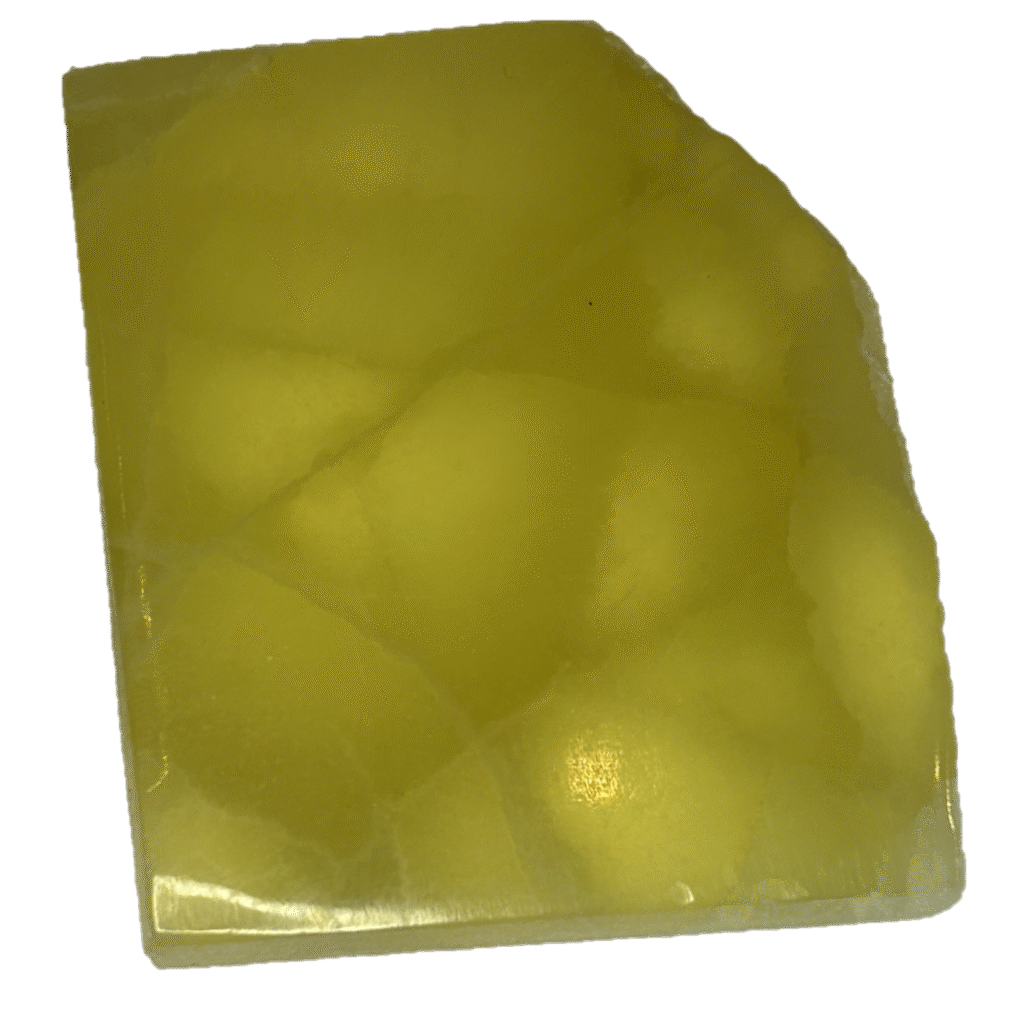
At first glance across a lapidary display, distinguishing between Lemon and Honey Calcite can seem surprisingly tricky. Both share the same fundamental calcium carbonate (CaCO3) baseline, both fracture along identical rhombohedral cleavage planes, and both carry that characteristically smooth, slightly waxy feel to the touch. Yet beneath that shared mineralogical foundation lie two distinct geological stories, defined by completely different chromophoric trace elements, environmental formation histories, and aesthetic profiles.
Telling them apart comes down to training your eye on the subtle markers of colour saturation, crystal habit, and light transmission. Where Lemon Calcite displays a sharp, translucent, citrus-bright clarity driven by dispersed trivalent iron and natural lattice colour centres, Honey Calcite draws its deep, golden-cognac warmth from trapped organic humic compounds and rich iron oxide dispersions.
Whether you are sorting rough specimens in the workshop, cataloguing inventory for a mineral collection, or choosing the right vibrational ally for focused intentional work, this diagnostic guide breaks down the visual clues, geological differences, and simple physical tests you need to confidently identify each stone.
Chemical Foundation: The Carbonate Baseline
At their structural core, both Lemon Calcite and Honey Calcite are polymorphs of calcium carbonate:
$$\text{CaCO}_3$$
They crystallise within the trigonal crystal system (hexagonal scalenohedral class), built from alternating planes of calcium cations ($\text{Ca}^{2+}$) and carbonate anions ($\text{CO}_3^{2-}$).
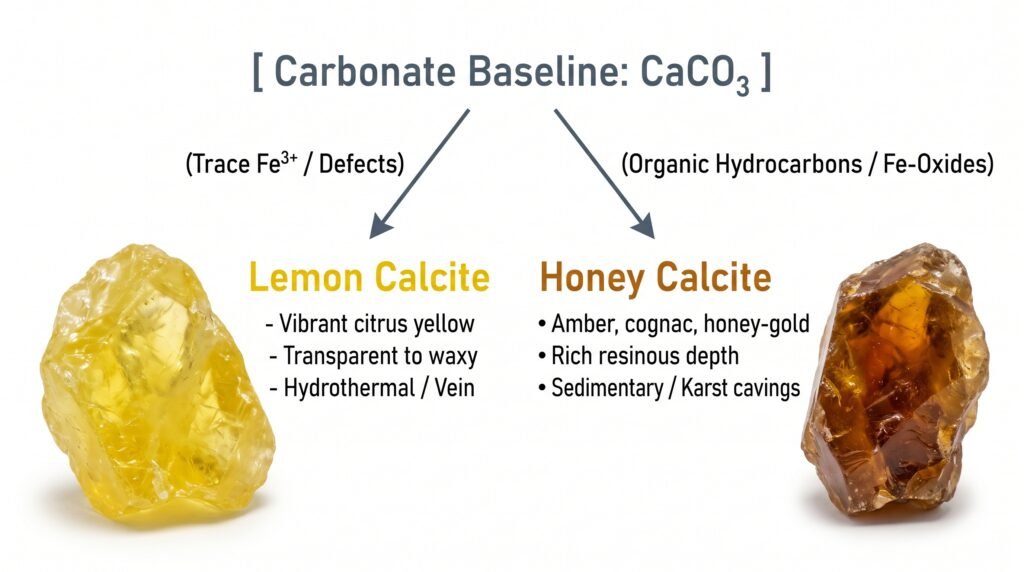
The stark difference in appearance between the two arises from minute impurities, secondary mineral substitutions, and internal lattice modifications absorbed during crystallisation.
Chromophore Differences: Why the Colours Diverge
The primary geological differentiator between Lemon and Honey Calcite is their chromophoric chemistry: the exact agents responsible for light absorption and reflection.
What Colours Lemon Calcite?
- Dispersed Iron ($Fe^{3+}$): Minute traces of trivalent iron substitute into the calcium sites within the crystal lattice.
- Structural Colour Centres: Ionising background radiation within surrounding strata creates point defects in the lattice, trapping free electrons. These trapped electrons absorb higher-energy violet and blue wavelengths ($400\text{–}450\text{ nm}$), transmitting a bright, pale, lemon-yellow hue.
- Purity of Matrix: Lemon calcite generally forms with minimal bulk organic contamination, maintaining a sharp, light-transmitting clarity.
What Colours Honey Calcite?
- Heavy Iron Oxide & Hydroxide Dispersions: Higher concentrations of iron oxides (such as micro-particulate goethite or haematite) disperse throughout the matrix, introducing warm golden-brown undertones.
- Organic Inclusions & Humic Compounds: Honey calcite frequently precipitates in sedimentary karst settings where groundwater percolates through organic-rich topsoils. Soluble fulvic and humic acids become trapped within the precipitating calcite layers, yielding deep amber, cognac, and golden-treacle hues.
- Zoned Deposition: Microscopic bands of variable organic density often create noticeable colour banding when viewed under directional illumination.
Comparative Matrix: Diagnostic Physical Properties
| Diagnostic Property | Lemon Calcite | Honey Calcite |
| Colour Range | Citron, neon-yellow, pastel lemon, chartreuse tint | Golden-amber, deep butterscotch, cognac, burnt honey |
| Mohs Hardness | 3.0 (standard across all pure calcite) | 3.0 (can feel slightly more brittle due to organic banding) |
| Cleavage | Perfect rhombohedral $\{10\bar{1}1\}$ in 3 directions at $74^\circ 55’$ | Perfect rhombohedral $\{10\bar{1}1\}$ in 3 directions at $74^\circ 55’$ |
| Lustre | Vitreous to waxy; distinct “soapy” feel | Vitreous to highly resinous; warm vitreous polish |
| Diaphaneity | Transparent to translucent | Translucent to sub-translucent (rarely fully transparent) |
| Specific Gravity | $2.71$ | $2.71\text{–}2.72$ (micro-variations due to inclusion density) |
| UV Fluorescence | Pale pinkish-orange or inert under LWUV | Rich golden-yellow, apricot, or pink under LWUV/SWUV |
| Acid Reaction | Vigorous effervescence in cold dilute $5\%\text{ HCl}$ | Vigorous effervescence in cold dilute $5\%\text{ HCl}$ |
Distinct Geologic Varieties & Growth Habits
Calcite assumes over 300 distinct crystal habits. However, Lemon and Honey varieties express themselves in noticeably different common forms due to their depositional environments.
Prominent Lemon Calcite Varieties
- Rhombohedral Cleavage Masses: Coarse-grained, crystalline massive blocks showing distinct internal cleavage planes; the primary yield from Balochistan, Pakistan.
- Iceland Spar (Optical Lemon): Rare, gem-quality cleavage rhombs that display strong, crisp optical double refraction alongside a subtle yellow wash.
- Columnar & Prismatic Aggregates: Elongated prismatic crystals terminating in low rhombohedrons, occasionally displaying stepped “elestial” etching.
Prominent Honey Calcite Varieties
- Scalenohedral “Dogtooth” Spar: Classic, sharply pointed scalenohedra that form dramatic crystal clusters lining mineralised vugs and limestone cavities.
- Speleothemic & Banded Travertine (Onyx-Marble): Layered, fibrous formations deposited layer by layer in cave passages, hydrothermal springs, and aquifer channels.
- Nailhead Spar: Prismatic crystals capped by flat, blunt rhombohedral terminations, frequently coated with fine secondary drusy crusts.
Geological Genesis & Locality Comparison
The environmental context of deposition influences the final crystal structure and inclusion profile of each stone.
Lemon Calcite Depositional Settings
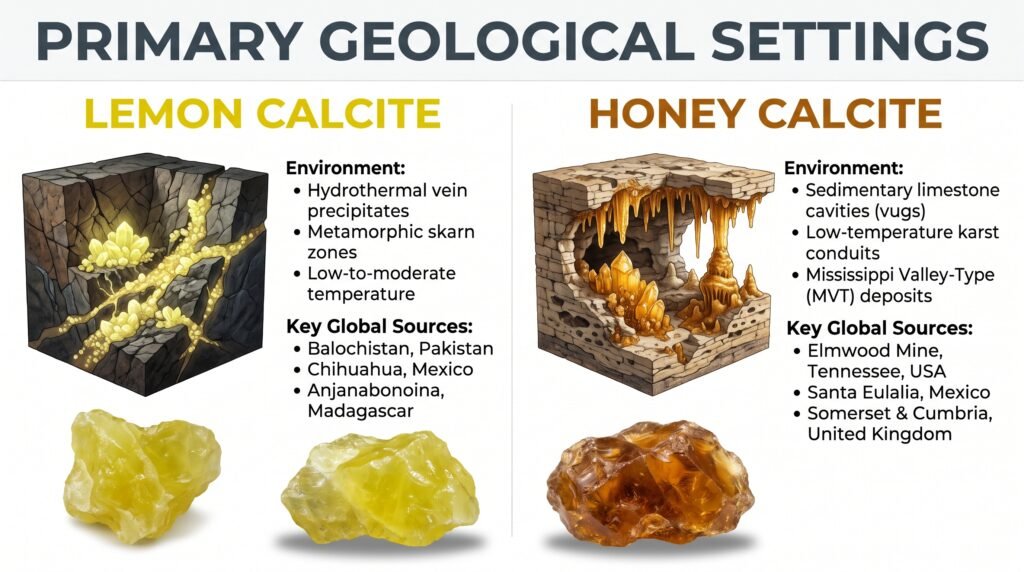
Lemon Calcite generally forms within moderate-temperature hydrothermal veins and fault-line breccias. Alkaline, calcium-rich fluids circulate through fractures in limestone or marble host rocks, cooling steadily under moderate overburden pressure.
The conditions favour sustained crystal growth free from dense suspended muds or heavy organic tannins, producing clean, broad cleavage blocks.
Honey Calcite Depositional Settings
Honey Calcite is predominantly a low-temperature sedimentary and epigenetic mineral. It is famous in classic Mississippi Valley-Type (MVT) lead-zinc ore bodies, where it crystallised inside vugs alongside Sphalerite, Galena, Fluorite, and Barite.
The circulating groundwaters in these basins had extensive contact with organic-rich shales, infusing the growing crystal lattice with microscopic hydrocarbon fractions.
Workshop Handling, Lapidary Behaviour & Practical Care
Because both Lemon and Honey varieties share an exceptionally low Mohs hardness of 3, neither is suitable for aggressive lapidary techniques or heavy jewellery wear (such as everyday rings). However, subtle structural differences affect how they cut and polish.
Cleavage Vulnerability
Both materials possess three directions of perfect rhombohedral cleavage at approximately $75^\circ$. A sharp impact along these cleavage vectors will cause immediate, clean planar splitting.
Honey Calcite containing distinct organic growth bands can shear unevenly along banded zones if subjected to thermal shock on a lap wheel.
The Waxy Finish & Acid Sensitivity
Both varieties feature calcite’s signature slightly greasy or waxy tactile feel. This surface texture is easily destroyed by chemical exposure:
- Acid Hazards: Never allow either variety to come into contact with household vinegar, citric acid, chemical jewellery cleansers, or acidic sweat. Calcite effervesces rapidly, stripping high polishes in seconds.
- Water Precautions: Prolonged soaking in plain or salted water dissolves the surface microscopic crystalline structure, leaving a chalky white film. Clean strictly with dry microfiber cloths, or rinse briefly under cool running water and dry immediately.
Summary of Distinctions
When identifying specimens in the field or sorting inventory for retail:
- Select Lemon Calcite when seeking sharp citrus hues, high transparency, minimal organic inclusion, and uniform internal light transmission.
- Select Honey Calcite when looking for deep amber-gold warmth, scalenohedral (“dogtooth”) crystal formations, rich internal banding, or classic MVT mineral associations.
Lemon and Honey Calcite Frequently Asked Questions
How can I tell Lemon Calcite from Honey Calcite by appearance?
Lemon Calcite shows a sharp, translucent, citrus-bright clarity due to dispersed trivalent iron and lattice colour centres, while Honey Calcite displays warm golden‑cognac hues from iron oxide dispersions and organic inclusions. Look for lemony brightness and clear transparency in Lemon Calcite, versus deep amber‑gold tones and banding in Honey Calcite.
What tests help distinguish Lemon Calcite from Honey Calcite?
You can compare colour saturation, crystal habit, and light transmission. Lemon Calcite is typically more transparent with a pale lemon yellow, whereas Honey Calcite tends toward deeper golden and cognac tones with possible banding from organic inclusions.
Are Lemon Calcite and Honey Calcite equally hard and easy to durably polish?
Both have a Mohs hardness of 3, so neither is suitable for aggressive lapidary techniques or heavy jewellery wear; Honey Calcite may feel slightly more brittle due to organic banding, but both share a waxy, soapy feel and require careful handling.
What are the main geological differences that create their colours?
Lemon Calcite derives its colour from dispersed iron (Fe3+) and lattice colour centres that transmit a bright lemon hue, while Honey Calcite gains its warmth from heavy iron oxide dispersions and organic inclusions such as humic compounds that yield amber to cognac colours.
Where do Lemon Calcite and Honey Calcite commonly form and what does that imply for identification?
Lemon Calcite commonly forms in moderate‑temperature hydrothermal veins and fault‑line breccias with clean, broad cleavage blocks, while Honey Calcite forms in low‑temperature sedimentary and epigenetic settings, often in Mississippian Valley‑Type ore environments with organic‑rich wall rocks; recognising these contexts helps anticipate colour, banding, and crystal habits.
These are my personally selected and curated Lemon and Honey Calcite products