Crystal infused elixirs and gem waters have become popular rituals for aligning subtle energy, meditating, and setting daily intentions. Lapis lazuli celebrated for millennia as the stone of total awareness, truthful communication, and Throat Chakra (Vishuddha) resonance is naturally sought after for throat-opening practices.
However, a dangerous misconception persists across wellness spaces: the idea that any polished gemstone can be dropped directly into a jug of drinking water.
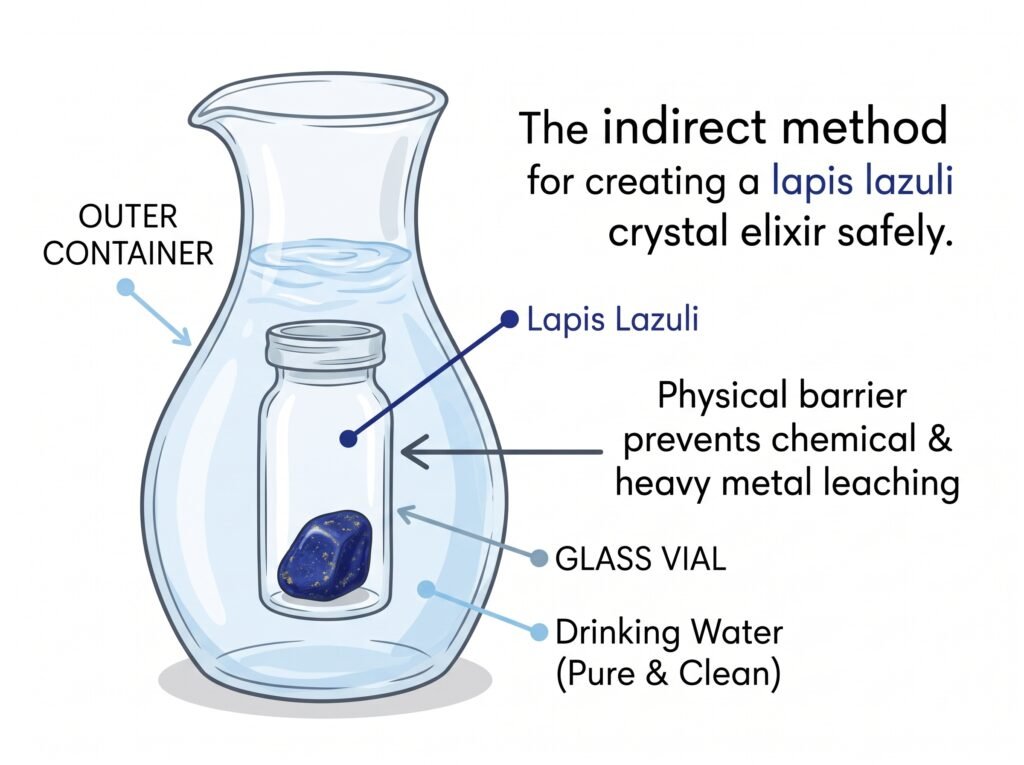
Lapis lazuli must never be placed directly into drinking water. It is chemically reactive, mineralogically toxic when ingested in dissolved forms, and inherently porous. To harness its energetic frequency safely, practitioners must use the indirect method, creating a physical glass barrier between the stone and the water.
The Mineral Chemistry: Why Lapis Lazuli Is Not Water-Safe
Lapis lazuli is not an inert single crystal like quartz ($SiO_2$). It is a complex, polymineralic metamorphic rock composed of varying ratios of lazurite, calcite, pyrite, and secondary silicates. When submerged in water, this aggregate structure breaks down chemically and physically.
| Mineral Component | Hazard When Submerged |
| Pyrite ($\text{FeS}_2$) | Oxidises; releases iron & sulphur; potential traces of arsenic/metals |
| Calcite ($\text{CaCO}_3$) | Porous matrix dissolves; harbours bacteria in micro-fissures |
| Lazurite ($(\text{Na,Ca})_8[\text{AlSiO}_4]_6(\text{SO}_4,\text{S},\text{Cl})_2$) | Trapped trisulphur radical anions; degrades and leaches in water |
| Commercial Polish / Waxes / Dyes | Industrial chemical coatings leach directly into beverage |
The Pyrite Hazard: Iron Sulphides and Heavy Metal Contaminants
The glittering gold flecks that give lapis lazuli its celestial beauty are pyrite ($\text{FeS}_2$, iron disulphide).
- When exposed to water and dissolved oxygen, pyrite undergoes chemical oxidation, producing iron oxides and sulphate compounds:
$$2\text{FeS}_2 + 7\text{O}_2 + 2\text{H}_2\text{O} \longrightarrow 2\text{Fe}^{2+} + 4\text{SO}_4^{2-} + 4\text{H}^+$$ - In standing water, this reaction causes water acidification and sulphurous leaching.
- Furthermore, geological pyrite rarely occurs in laboratory-pure form; natural mineral matrices frequently host trace elements of toxic heavy metals, including arsenic, nickel, and antimony, which leach directly into standing liquid.
The Porous Calcite Matrix: Structural Decay and Microbial Traps
The white clouds and veins in lapis lazuli are composed of calcite ($\text{CaCO}_3$, calcium carbonate).
- Calcite measures just 3.0 on the Mohs hardness scale and dissolves slowly in standing liquids, particularly if the water is mildly acidic (such as standard tap water or filtered water that has absorbed atmospheric carbon dioxide).
- As calcite micro-veins degrade, microscopic crevices open within the stone. These tiny fissures trap stagnant moisture, creating an ideal breeding ground for bacteria, biofilm, and mould that cannot be effectively sanitised without harsh chemical washes (which further corrode the rock).
Lazurite and Trapped Sulphur Anions
The royal blue colour of lapis lazuli is derived from lazurite, an aluminosilicate framework containing trapped trisulphur radical anions ($\text{S}_3^-$). Prolonged soaking breaks down microscopic mineral bonds on rough or fractured edges, releasing sulphurous compounds that degrade water purity and create an unpalatable, rotten-egg odour.
Commercial Sealants, Waxes, and Dye Contaminants
Because lapis lazuli is relatively soft (Mohs 5.0 to 5.5) and slightly porous, the vast majority of commercial tumbled stones, cabochons, and polished spheres are treated with paraffin waxes, plastic polymers, or chemical polishing compounds (such as aluminium oxide or cerium oxide slurry) to preserve their sheen. Soaking these treated stones leaches industrial chemicals directly into your beverage.
The Solution: The Indirect Glass Barrier Method
Energetic practitioners work under the principle that a stone’s subtle vibrational frequency interacts through electromagnetic resonance, which passes unhindered through non-porous glass without requiring physical contact with the water itself.
By keeping the stone isolated in a separate glass container, you receive the full metaphysical intention of the mineral while keeping your water 100% pure, non-toxic, and free of mineral sediment.
Step-by-Step: Preparing a Safe Throat-Opening Elixir
What You Will Need:
- One authentic lapis lazuli specimen: Clean, dry tumbled stone or small polished palm stone.
- One thin-walled, sealable glass vial or test tube: Must be made of food-grade borosilicate glass, completely clean and bone dry inside.
- One outer glass jug, carafe, or wide-mouth mason jar: Food-safe clear glass.
- Spring or filtered water: High-quality drinking water.
- Optional supportive quartz: A clear quartz point (placed inside the dry vial alongside the lapis) to act as an energetic amplifier.
Preparation Protocol:
- Cleanse the External Stone (Dry Methods Only):
Cleanse your lapis lazuli using smoke (cedar, frankincense, or dried sage), sound frequencies (a 741 Hz tuning fork for the Throat Chakra), or resting it atop a dry slab of selenite for an hour. Do not rinse or soak the stone in salt water. - Assemble the Closed Vial:
Place the completely dry lapis lazuli specimen inside your small borosilicate glass vial and seal the top firmly with a clean cork or food-grade silicone stopper. Ensure no moisture is trapped inside the vial. - Position the Vial Within the Carafe:
Place the sealed vial upright into your large outer glass carafe. Carefully pour your spring or filtered drinking water into the carafe around the outside of the glass vial. The water should rise along the sides of the vial without ever touching the stone itself. - Infusion and Throat Chakra Focusing:
- Location: Place the carafe in a cool, quiet location out of direct, harsh sunlight (which can overheat water and encourage algal growth).
- Timing: Allow the water to rest undisturbed for 2 to 4 hours. Morning light or early twilight is ideal.
- Intention Setting: While the water sits, hold your hands near the exterior of the carafe. Focus on the Throat Chakra (Vishuddha), visualising a clear, radiant sky-blue light flowing into the vessel. Affirm your intention:
“My voice is clear, my truth is spoken with kindness, and my words align with wisdom.”
- Decant and Store:
Carefully lift the sealed glass vial containing the dry lapis out of the carafe and set it aside. Pour your infused elixir into clean bottles. Consume within 24 to 48 hours.
Ritual Applications for Throat-Opening Elixir
- Pre-Public Speaking or Performance: Drink a small glass 30 minutes before giving a presentation, recording a podcast, or having a challenging conversation to calm vocal tension and ease mental anxiety.
- Morning Journaling Practice: Keep a glass of indirect elixir on your desk while free-writing or dream journaling to assist in unblocking self-censorship.
- Throat Mist Spray: Decant a portion of the indirect water into an amber glass spray bottle alongside a drop of organic chamomile or peppermint floral water (hydrosol). Mist lightly around your throat and chest before meditation.
Summary Safety Checklist
- Never drop raw or polished lapis lazuli directly into a drinking glass, jug, or reusable water bottle.
- Never ingest water that has had direct contact with pyrite, calcite, or lazurite.
- Always use a food-grade glass vial as an impenetrable barrier between the mineral and the liquid.
- Inspect your glass vial before every use to ensure there are no hairline fractures or loose seals.