Long before geologists classified it as a feldspar mineral shimmering with optical interference, northern folklore held a far more celestial explanation: the timeless Labradorite Legend. According to traditional Inuit lore, the Northern Lights did not always dance freely across the Arctic skies. There was an era when the dazzling ribbons of violet, gold, and emerald were trapped beneath the jagged coastal rocks of Labrador, locked away in cold, dark silence while the polar nights stretched on without their guiding glow.
Everything changed with the intervention of an ancestral warrior who refused to leave the heavens in shadow. Armed with a spear carved from raw spirit and determination—the fabled Spear of Fire—he struck the jagged stone formations with full force. The impact shattered the granite prison, unleashing towering curtains of light that surged upward to reclaim the night sky. Yet not all the celestial fire escaped into the atmosphere; a fraction remained captured forever within the stone’s crystalline fractures, giving birth to the luminous iridescence we still witness in labradorite today.
The Mythic Narrative: The Spear and the Shoreline
In the oral traditions of the Inuit and their regional predecessors along the Labrador peninsula, the world existed in a close dialogue between the terrestrial realm, the spirit realm, and the elements.
The Trapped Lights
According to the legend, there was an era when the night sky was entirely dark. The vibrant ribbons of light that now dance across polar skies did not dwell in the heavens; instead, the celestial fire was trapped beneath the surface of the coastal cliffs lining the Labrador coast.
The stone along the shoreline was heavy, charcoal-grey, and cold to the touch. Yet within its interior, an ancient light was imprisoned, yearning for the boundless expanse of the stars. The world below sat shrouded in long, harsh winter darkness, cut off from the celestial illumination that offered hope and guidance to voyagers on the ice.
The Strike of the Spear
An Inuit warrior—wandering the desolate coast during the depths of winter—felt drawn to the shoreline rocks. Sensing the vital energy contained inside the stone, he raised his spear and drove it with all his might into the face of the mineral outcrop.
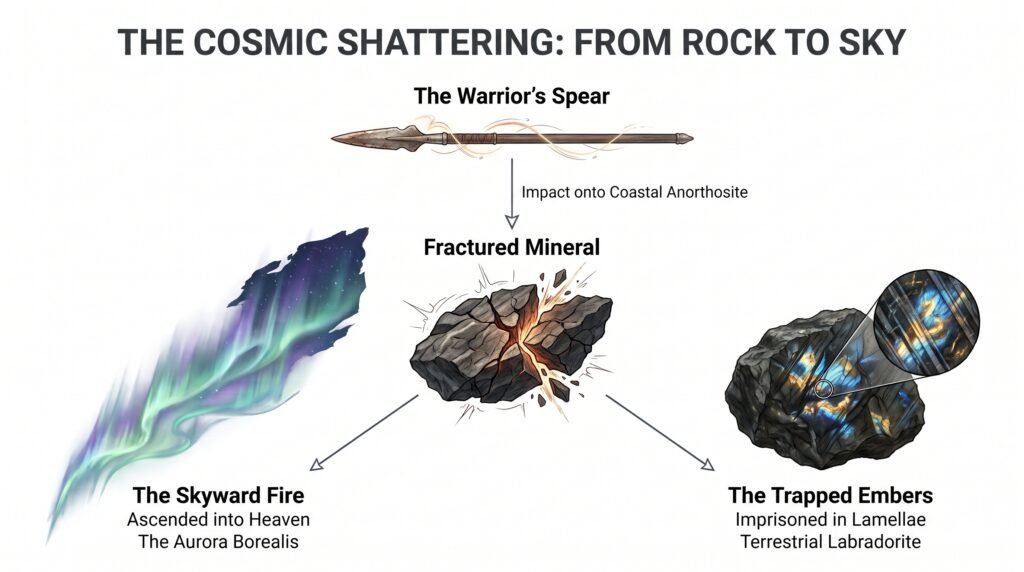
The blow shattered the rock with a resonant crack, fracturing the dense matrix. From the cleft, brilliant sheets of iridescent green, electric blue, violet, and gold broke free. The released luminescence surged upward in great, undulating waves, climbing into the atmosphere to take its rightful place in the polar sky as the Aurora Borealis.
The Birth of “Frozen Fire”
The warrior’s strike freed the vast majority of the celestial glow. However, some of the radiant light could not escape. Bound too tightly within the mineral’s crystalline layers, pockets of shimmering luminescence remained trapped deep inside the stone.
The rocks that bore the impact became labradorite, a physical stone that looks like a dark, unassuming coastal boulder until direct light strikes it at the angle of the spear’s blow, reigniting the “frozen fire” hidden within its heart.
Cultural Cosmology: The Northern Lights in Inuit Tradition
To fully understand why labradorite was tied to the aurora, one must consider what the Northern Lights represent within traditional Inuit world views (Inuit Qaujimajatuqangit).
The Spirits of the Ancestors
In Arctic oral traditions, the Aurora Borealis is not a mechanical atmospheric curiosity; it is alive.
- Many Inuit communities regarded the lights as the spirits of ancestors (aqsalijaat), dancing in the celestial realm or playing a traditional game across the heavens using a walrus skull.
- The lights served as a luminous veil separating the physical world from the spirit worlds (quviasukvik, the realm of joy).
- To see the colours of the aurora preserved inside a rock meant that labradorite was fundamentally steeped in ancestral presence. Carrying a piece of the stone was equivalent to carrying a sliver of that spiritual realm—an amulet that offered ancestral guidance, safe passage through blizzards, and protection against malevolent wilderness spirits.
Shamanic Visioning (Angakkuit)
For the traditional Inuit shaman (angakkuq), trance states and spirit journeys were essential for maintaining balance between human communities and the spirit keepers of sea animals (such as Sedna or Nuliajuk).
Because labradorite possessed the rare ability to transition instantly from ordinary grey earth to celestial light, it functioned as an ideal symbolic tool for the angakkuq. It embodied the central lesson of the shamanic path: that ordinary physical matter is merely a veil concealing a vibrant inner world of spirit.
Archaeological Reality: Labradorite in Prehistoric Arctic Cultures
The folkloric connection between the stone and northern cultures is grounded in concrete archaeology. Prehistoric populations engaged directly with labradorite and related regional rocks across northeastern North America.
| Cultural Horizon | Approximate Era | Archaeological Evidence & Usage |
| Maritime Archaic Tradition | ~7,500 – 3,500 BP | Quarrying of anorthositic materials; polished stone celts and decorative plagioclase objects recovered from burial mounds (e.g., L’Anse Amour). |
| Pre-Dorset / Paleo-Inuit | ~4,000 – 2,800 BP | Lithic debitage found near regional quarry zones; use of hard siliceous stones for scrapers, microblades, and adzes. |
| Dorset Culture (Tuniit) | ~2,500 – 1,000 BP | Mastery of artistic miniature carvings; retrieval of unusual chatoyant and optical stones for ritual caches and amulets. |
| Thule Tradition (Ancestral Inuit) | ~1,000 BP – Historic | Extensive seasonal travel along coastal Labrador; oral curation of mineral lore, place names, and quarry sites near Nain. |
Archaeological excavations along the coast of Labrador, northern Quebec, and the island of Newfoundland have documented that early Arctic and Subarctic peoples possessed a sophisticated understanding of regional geology.
While everyday tools like harpoon tips and ulus favoured finer-grained silicates like chert, quartz, and Ramah quartzite, unusual or iridescent minerals were intentionally gathered from secondary glacial deposits and coastal outcrops. These materials were shaped into personal amulets, placed in burial sites, or used in ritual contexts where the visual “life” of the stone commanded deep spiritual reverence.
The Bridge Between Myth and Modern Science
What makes the Inuit legend compelling to modern gemologists and geologists is how accurately the mythic narrative describes the physical nature of the stone:
- The Origin Point: The legend places the event squarely along the shoreline of coastal Labrador. In 1770, Moravian missionaries formally documented the mineral on Paul’s Island near Nain, Labrador—the type-locality from which the mineral derives its scientific name today.
- The Dynamic Optical Shift: The legend notes that the stone remains dark until struck by illumination at a specific angle, mirroring the warrior’s spear. In optical physics, labradorescence is directional: light must enter at the precise angle of the internal sub-microscopic Bøggild exsolution lamellae (120 to 400 nm) to produce the constructive interference that unleashes the spectral flash.
- The Spectral Match: The colours described in the myth—electric greens, cyans, deep blues, and rare magentas—match the emission spectra of energised atmospheric oxygen and nitrogen during auroral storms ($557.7\text{ nm}$ for oxygen green; $391.4\text{ nm}$ and $427.8\text{ nm}$ for nitrogen blue and violet).
Summary: The Living Stone of the Far North
The Inuit legend of the spear and the frozen fire is more than a bedtime fable. It represents an ancient culture’s relationship with one of the most physically striking landscapes on earth.
By seeing the Aurora Borealis in the cleavage faces of coastal anorthosite, the Inuit wove the sky, the earth, and human bravery into a single story. Labradorite remains a testament to that vision: a fragment of the subarctic coast holding the light of the polar skies.
Labradorite Legend Frequently Asked Questions
What is the Labradorite Legend and what does it describe?
The Labradorite Legend is an Inuit folklore narrative that explains how the Northern Lights were once trapped beneath Labrador’s coastal rocks. A warrior’s strike with the Spear of Fire shattered the rock, releasing the aurora into the sky while some light remained imprisoned inside the stone, giving Labradorite its shimmering iridescence.
How does labradorite exhibit labradorescence and how is it connected to the aurora?
Labradorite shows labradorescence when light enters its lamellar structure at a precise angle, causing constructive interference that flashes green, blue, violet, and gold. This optical behavior mirrors the legend’s idea of celestial fire breaking free and rising as the Aurora Borealis, linking the stone’s shine to the aurora’s spectral display.
What is the Spear of Fire and its role in the myth?
The Spear of Fire is the ancestral warrior’s tool in the myth who strikes the coastal granite, fracturing it and releasing the trapped lights. The blow creates the upgoing auroral waves while some light remains trapped inside the stone, giving birth to labradorite’s glow.
How is Labradorite linked to Inuit cosmology and spiritual beliefs?
In Inuit tradition, the aurora is alive and connected to the spiritual realm. Labradorite’s ability to carry the colors of the aurora within its interior made it a symbol of ancestral presence and protection, used as amulets and in shamanic practices to bridge the physical world with spirit worlds.
What archaeological evidence shows Labradorite’s use in prehistoric Arctic cultures?
Archaeological findings across Labrador, northern Quebec, and Newfoundland show ancient peoples valued iridescent minerals like labradorite, shaping them into amulets, placing them in burials, and using them in ritual contexts, alongside other regional stones in cultures from the Maritime Archaic to Thule traditions.