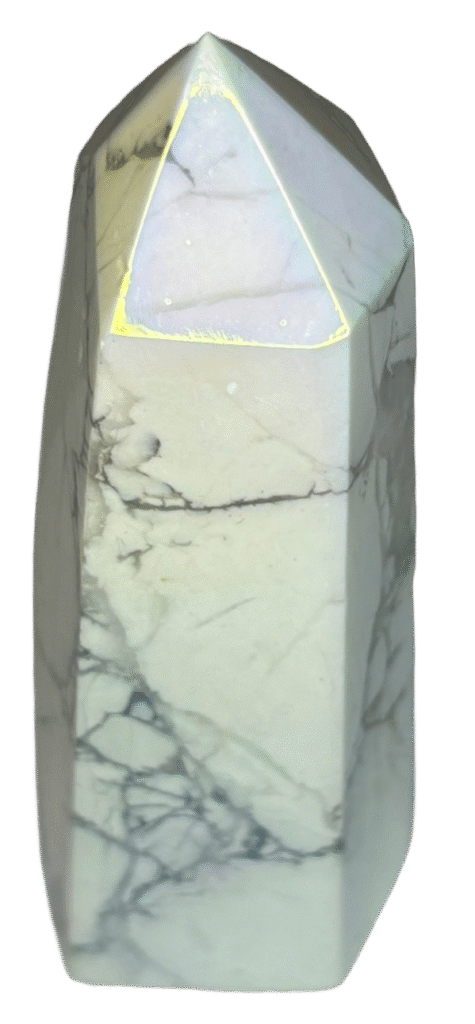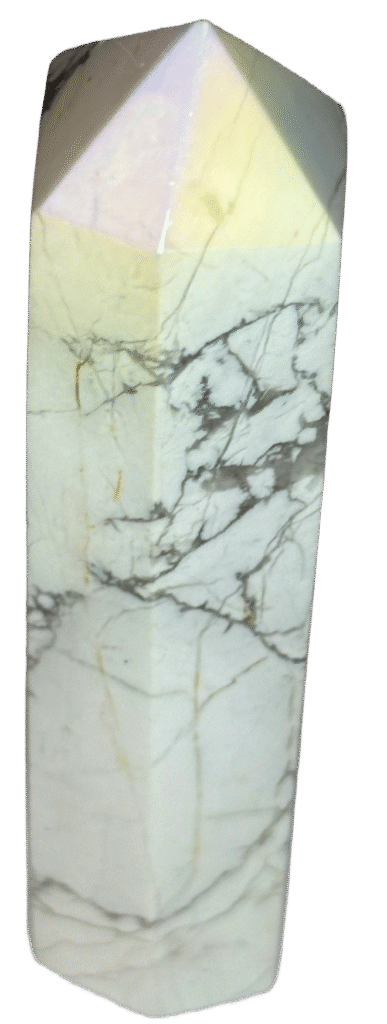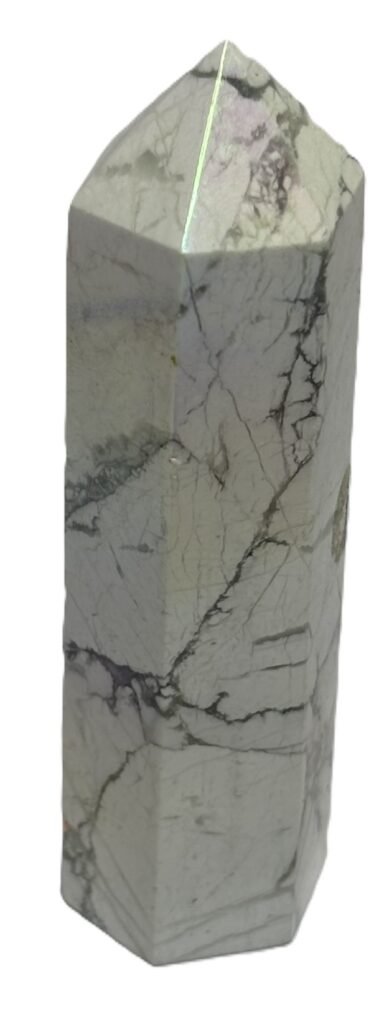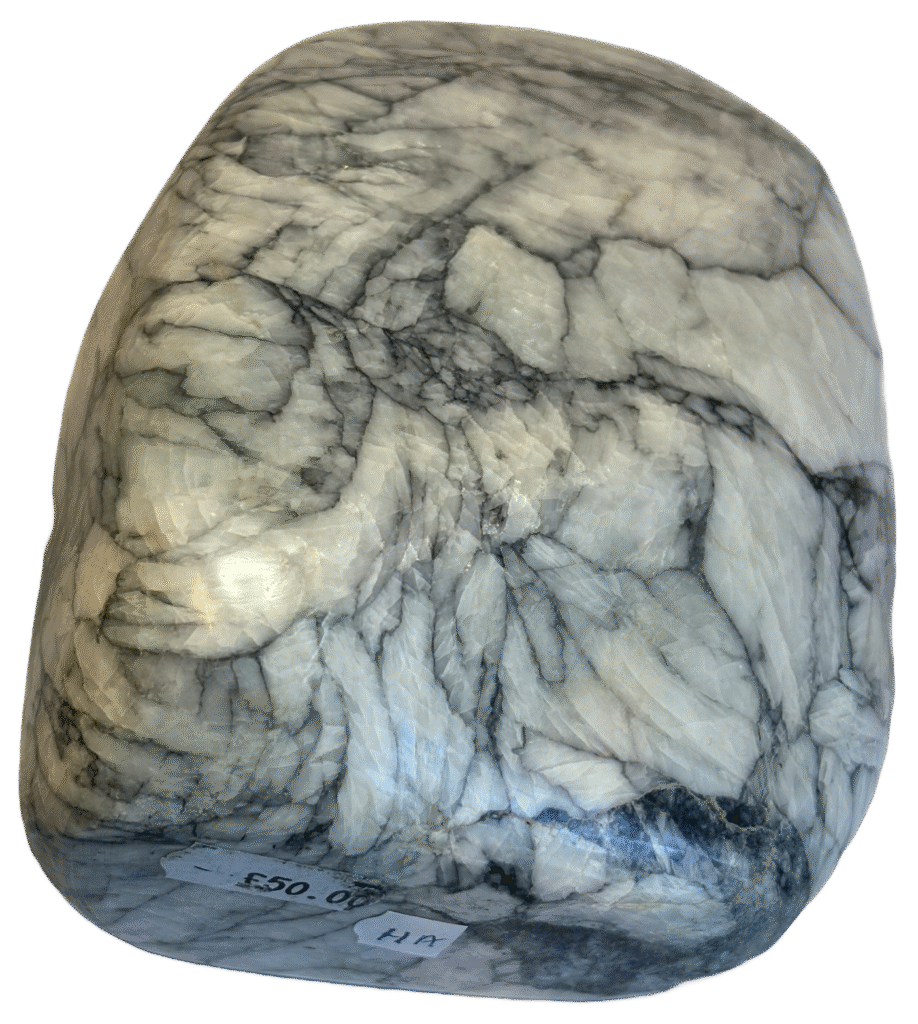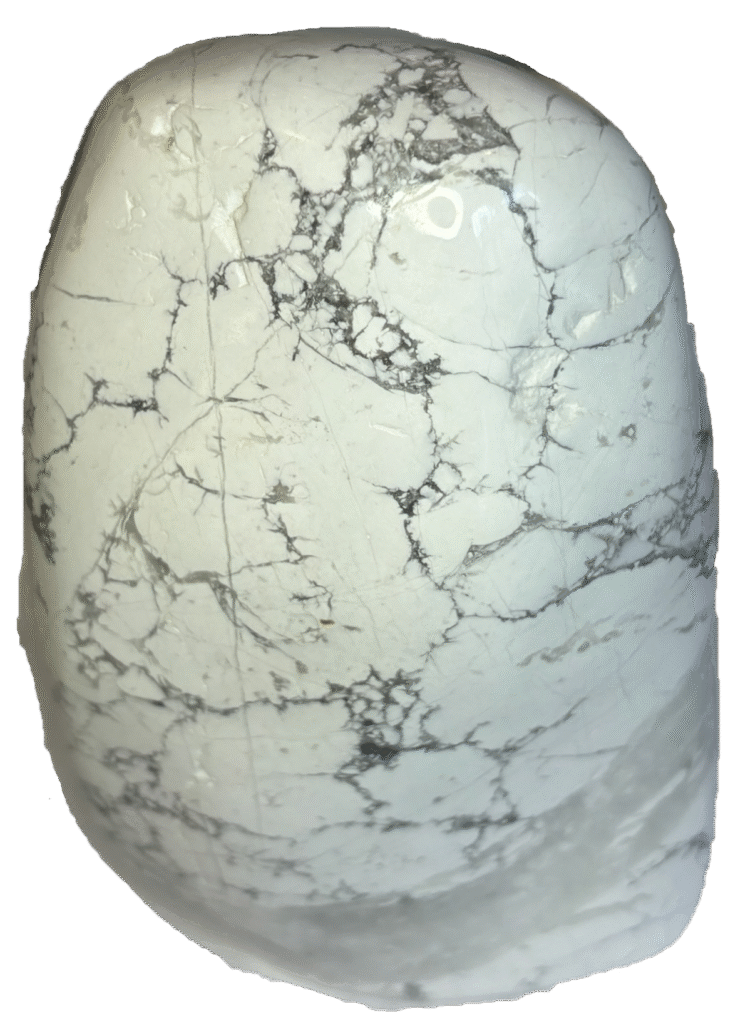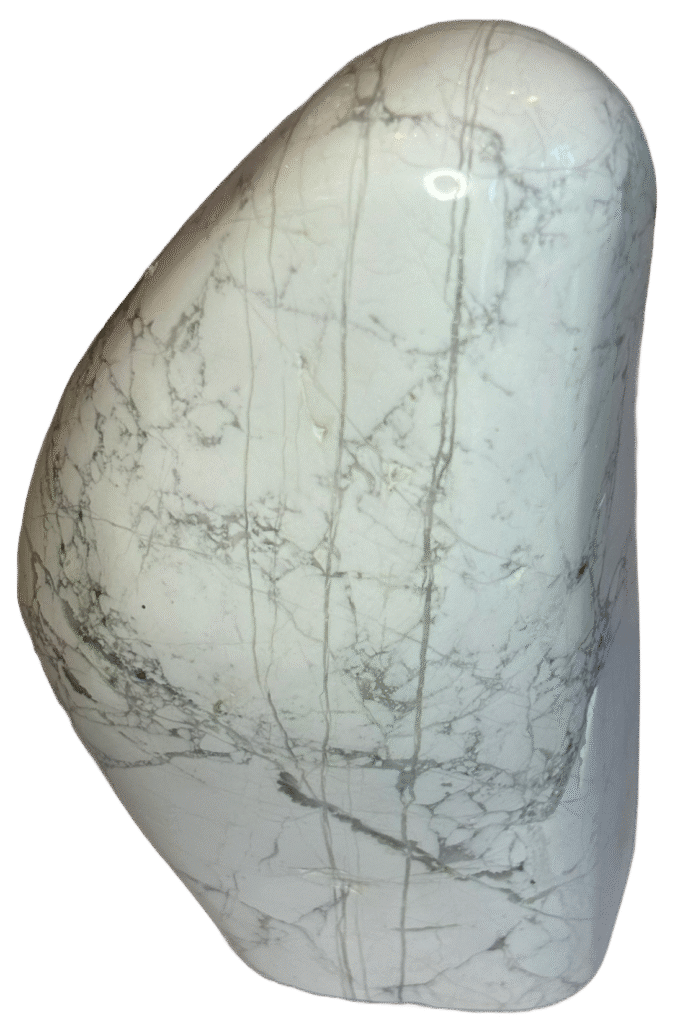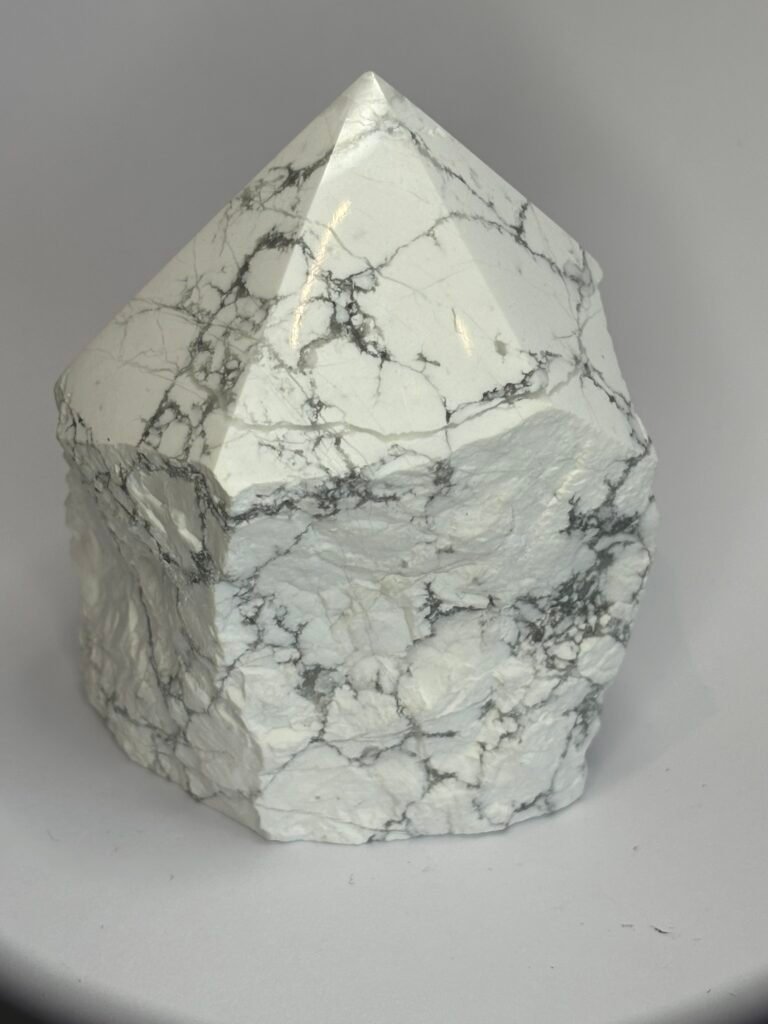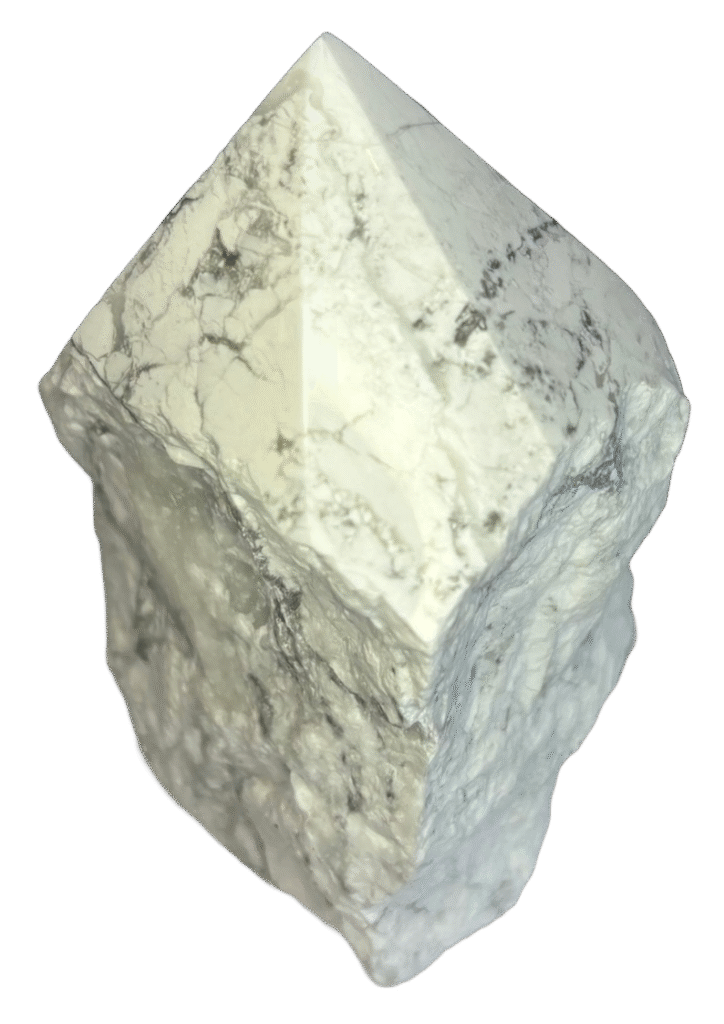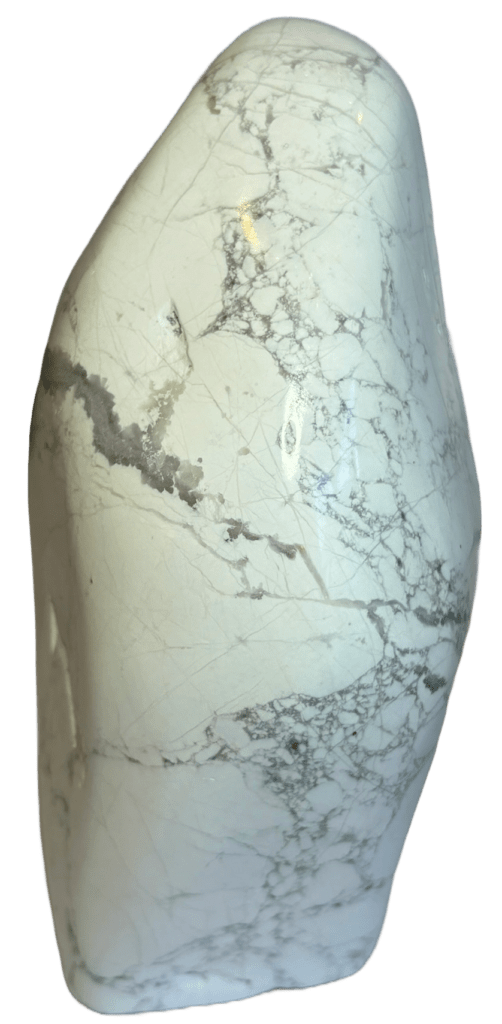
Howlite is an opaque, porcelain white borate mineral celebrated for its intricate web of grey, black, or dark brown veins. First identified in 1868 within the gypsum quarries of Nova Scotia, it forms predominantly as compact, nodular masses resembling cauliflower heads. While prized in gemology and lapidary work for its silky, receptive surface, howlite is renowned in metaphysical traditions as a supreme stone of emotional tranquillity. Its soft, cooling frequency absorbs turbulent energy, quietens racing thoughts, relieves chronic stress, and aids deep meditation, serving as a restorative talisman for mental clarity, patience, and profound, restful sleep.
Alternate names
- Silico-boro-calcite: The original descriptive mineralogical name assigned by Henry How upon discovery.
- Turquenite: Commercial trade name designated specifically for howlite that has been dyed sky blue to imitate natural turquoise.
- White Turquoise: A widely used commercial misnomer; howlite is chemically distinct from authentic turquoise.
- White Buffalo Stone (or White Buffalo Turquoise): A marketing label occasionally misapplied to natural howlite, though genuine White Buffalo stone from Tonopah, Nevada, is a distinct calcite-alum phosphate mineral.
- Kaolinite Imitation / Calcomarble: Minor historical lapidary trade terms for dense, white varieties without veins.
The stones Science and Composition
Howlite is an inoborate mineral classified chemically as a calcium borosilicate hydroxide.
- Chemical Formula: $\text{Ca}_2\text{B}_5\text{SiO}_9(\text{OH})_5$
- Crystal System: Monoclinic ($2/m$)
- Formation Environment: Sedimentary evaporite basins. It precipitates from boron-bearing hydrothermal waters interacting with calcium-rich sediments in arid lacustrine (playa lake) environments, frequently interbedded with gypsum, anhydrite, and colemanite.
- Micro structure: Euhedral crystals are exceptionally rare (typically under 1 cm and tabular). The mineral almost universally precipitates as dense, micro crystalline, cryptocrystalline aggregates that yield a sub-chalky, porous texture capable of absorbing foreign chemical dyes.
Key Physical Characteristics
| Characteristic | Specification |
| Colour | Milky white, ivory, or pale grey, crossed by black, dark brown, or grey veins |
| Mohs Hardness | 3.5 |
| Lustre | Sub-vitreous, dull, or earthy; takes a porcelain polish |
| Diaphaneity | Opaque; extremely thin crystalline edges may show faint translucency |
| Cleavage | None visible in massive form (prismatic $\{010\}$ on rare crystals) |
| Fracture | Conchoidal to uneven |
| Streak | White |
| Specific Gravity | 2.53 – 2.59 |
| Refractive Index | $n_\alpha = 1.583 – 1.586$, $n_\beta = 1.596 – 1.600$, $n_\gamma = 1.605 – 1.608$ |
| Birefringence | $\delta = 0.022$ (Biaxial negative) |
Common Geologic Varieties
- Natural White Howlite: The pure, un-altered mineral phase displaying a bright white to cream groundmass laced with spiderweb veins composed of matrix rock, quartz, or secondary iron oxides.
- Dyed Howlite (“Turquenite”): Chemically stained using copper phthalocyanine dyes to replicate Robin’s egg blue turquoise.
- Artificially Coloured Varieties: Artificially tinted in green, crimson, purple, or deep blue shades (often marketed under trade misnomers like “Malachite Howlite” or “Lapis Howlite”).
- Nodular / Cauliflower Howlite: The raw, unworked botryoidal growth habit extracted directly from evaporite clays.
Global Mining and Volcanic Sources
Howlite originates in continental lacustrine evaporite sequences linked to Tertiary-age volcanism:
- Canada: The type locality at Brookville, Windsor, and Newport, Hants County, Nova Scotia, where it occurs within thick Carboniferous gypsum and anhydrite deposits.
- United States: Tick Canyon in Lang, Los Angeles County, California (famous for nodular masses up to several hundred pounds embedded in colemanite rich clays), and Esmeralda County, Nevada.
- Mexico: Extensive evaporite workings at the Cerro Colorado borate deposit in Sonora.
- Turkey: The Emet Borate Basin in Kütahya Province, yielding substantial nodular borate formations.
- Additional Deposits: Documented occurrences in sedimentary graben basins across Germany, Russia, and the Liaoning Province of China.
Crystal Pairings: What to Combine and Avoid
Optimal Crystal Pairings
- Amethyst: Deepens third-eye intuition, soothes insomnia, and filters high-frequency spiritual downloads through howlite’s grounding calm.
- Clear Quartz: Amplifies howlite’s capacity to absorb negative thought loops and clarifies mental fog.
- Selenite: Energetically purifies howlite’s receptive lattice while aligning the higher transpersonal chakras.
- Rose Quartz: Softens emotional self-criticism, balances the heart, and fosters deep emotional processing without defensive triggers.
- Blue Lace Agate: Pairs directly with howlite to neutralise heated temperaments and foster gentle, articulately spoken boundaries.
Crystal Pairings to Avoid
- Carnelian: High-velocity sacral heat directly counters howlite’s calming, introspective stillness.
- Red Jasper: The dense, grounding physical stimulation of red jasper can overwhelm howlite’s subtle crown work.
- Citrine: Radiant, projective solar plexus fire overpowers howlite’s cooling, receptive yin frequency, rendering intentional stillness difficult.
Archaeology, Art and Ancient History
Because howlite was first scientifically classified by Canadian chemist and mineralogist Henry How in 1868, it lacks an ancient archaeological footprint under its own mineralogical name.
Earlier civilisations that mined evaporite basins frequently grouped micro crystalline borates alongside soft alabasters, gypsum, and limestones. In 19th-century decorative lapidary arts, howlite was swiftly adopted following its discovery in Nova Scotia and California for carved ornamental figurines, snuff boxes, and architectural inlays. Its ability to take a smooth polish made it an immediate favourite for Victorian gem collectors who prized unusual regional borates.
Folklore, Legends and Sacred Tales
Although modern lore sometimes conflates howlite with ancient stones due to its resemblance to white turquoise, specific traditions have grown around its soothing energy:
- The Peacemaker’s Shield: In late-19th-century frontier folklore, miners and travellers carried polished white nodules as “temper-breakers,” believing the cool stone absorbed hot tempers and violent impulses during disputes.
- Lunar Reverence: Modern esoteric lore links howlite to lunar deities such as Selene, associating the stone’s chalky, cratered natural nodules with the surface of the full moon, invoked to quiet nocturnal anxiety and calm stormy seas.
- Guardian of the Dreamtime: Contemporary North American metaphysical traditions view white howlite as a dream stone, placed under the pillow to ward off nightmares and foster lucid, spiritually coherent dream states.
Metaphysical and Mystical Healing Properties
- Emotional Mastery: Howlite acts as an energetic sponge for rage, resentment, and impatience, whether self-generated or directed from external sources.
- Cognitive De-escalation: Quiets incessant mental chatter, perfectionist tendencies, and racing thoughts, making it an essential ally for meditation and mindfulness.
- Somatic Relief: Esoterically applied to soothe tension headaches, soften jaw clenching, and balance physical calcium distributions across skeletal and muscular networks.
- Spiritual Attunement: Prepares the conscious mind for astral journeying, past-life recall, and channelling higher dimensional insight by clearing lower mental baggage.
Astrological Connections
- Gemini: Calms the dual-sign’s restless mental activity, soothing nervous exhaustion and grounding rapid communicative impulses.
- Virgo: Softens critical perfectionism and mitigates the obsessive worry associated with an overactive analytical mind.
- Libra: Aligns with Libra’s quest for internal equilibrium, dissolving passive-aggressive resentment and clarifying diplomatic resolution.
- Taurus: Aids steadfast Taurus in breaking through stubborn mental stagnation while supporting steady emotional resilience.
The Chakra System
- Crown Chakra (Sahasrara): Howlite’s primary focal point. Its clean white resonance clears the sahasrara gateway, releasing spiritual stagnation and opening pathways to cosmic consciousness.
- Third Eye Chakra (Ajna): Encourages intuitive visual journeying and dissolves subconscious illusions.
- Throat Chakra (Vishuddha): Facilitates peaceful, unhurried articulation, especially when dealing with confrontations or deep emotional expression.
Interesting facts
- Deceptive Chameleon: Howlite is the most widely used mineral substrate in the jewellery industry for creating faux turquoise, lapis lazuli, and red coral due to its porous nature.
- Cauliflower Mimic: In its raw geological state, howlite nodules develop rounded, knobby lobes that closely resemble small heads of white cauliflower.
- Rarity of Crystals: Well-formed individual crystal prisms are among the rarest borate formations on Earth, with almost all global production coming from massive nodular deposits.
- Low Density: With a specific gravity around 2.55, howlite is noticeably lighter in hand than turquoise (which ranges up to 2.90), providing an easy physical distinction.
Modern Milestones: Birthstones and Anniversaries
- Birthstone Affiliations: Recognised as an alternative modern birthstone for Gemini (May 21 – June 20).
- Anniversary Milestones: Associated with the 11th and 14th wedding anniversaries as an alternative gift stone, symbolising tranquillity, enduring patience, and harmonious, non-combative communication within long-term partnerships.
Howlite Frequently Asked Questions
How can I tell natural white howlite from genuine white turquoise?
True white turquoise is an aluminophosphate mineral with a Mohs hardness of 5 to 6 and a higher density. Howlite is noticeably softer (Mohs 3.5), lighter in weight, and can be scratched by a copper coin, whereas white turquoise cannot.
How do I clean and care for howlite jewellery?
Because howlite has a low hardness of 3.5 and high porosity, clean it solely with a soft, dry or slightly damp microfibre cloth. Never submerge it in water for prolonged periods, avoid ultrasonic cleaners, and keep it away from harsh household chemicals, perfumes, and acidic solutions.
How is howlite dyed to look like turquoise?
Rough howlite nodules or pre-shaped cabochons are soaked in heated baths containing specialised organic pigments or chemical dyes. The porous borosilicate structure draws the dye deep into its micro-fissures while leaving the dark matrix veins unaffected, mimicking turquoise matrix patterns.
Can howlite go in water or salt?
Howlite should not be left in water or buried in salt. Prolonged water immersion can compromise its natural polish and degrade porous fissures, while salt crystals can scratch its delicate surface and dry out bonded matrix material. Use smudging, sound, or selenite charging plates instead.
These are my personally selected and curated Howlite products
Products by Category

Aura Howlite point AHOW1
£24.00
Aura Howlite point AHOW2
£18.00
Aura Howlite Point AHOW3
£18.00
Blue Howlite Apple Pendant

Howlite freeform HA
£50.00
Howlite Freeform HB
£52.50
Howlite freeform HC
£48.50
Howlite Rough And Polished Point A
£22.00
Howlite Rough and polished point C
£25.00