
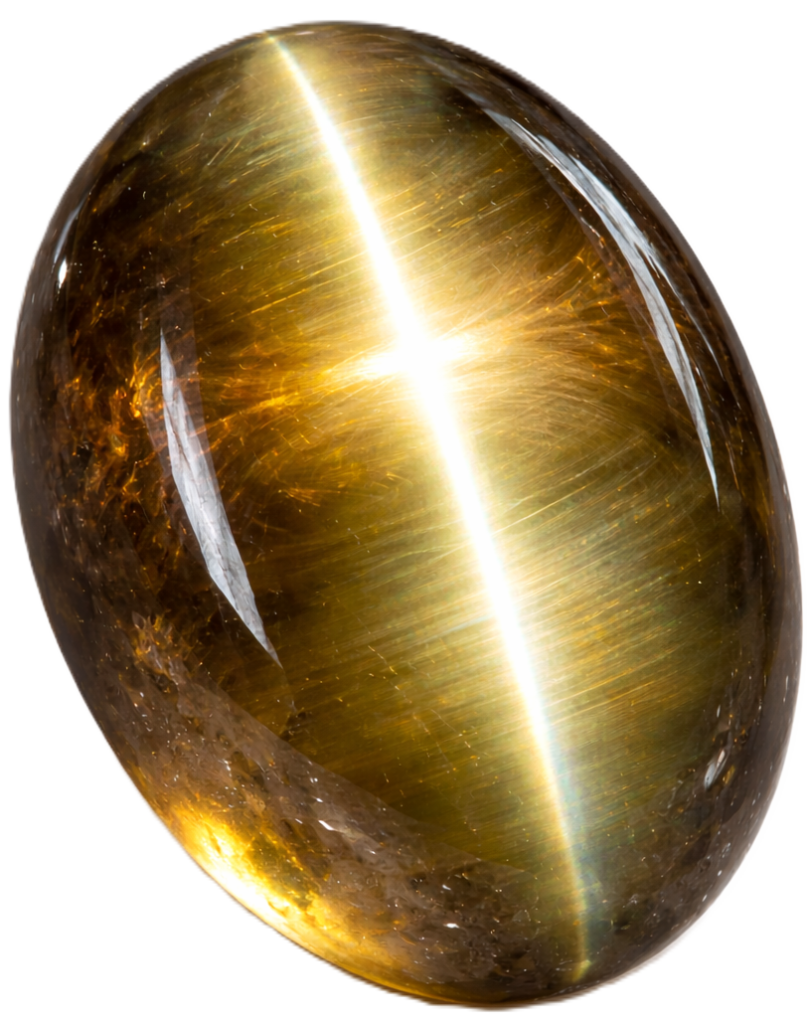
Cat’s Eye is a captivating gemstone known for its distinctive band of reflected light that resembles the slit eye of a cat. This phenomenon, called chatoyancy, gives the stone a luminous, moving line across its surface when light hits it. Throughout history, Cat’s Eye has been admired as both a protective talisman and a stone of intuition, luck and prosperity.
Highly valued in jewellery and spiritual practices, Cat’s Eye is most commonly associated with Chrysoberyl Cat’s Eye, although several other minerals can also exhibit the cat’s-eye effect.
Origins of the Name and Alternate Names
The name Cat’s Eye comes directly from the stone’s resemblance to the eye of a feline. When polished into a cabochon shape, a narrow band of light appears across the surface, mimicking the vertical pupil of a cat. The effect is caused by tiny parallel fibres or inclusions within the crystal that reflect light in a single band.
Alternate Names
Depending on the mineral variety, Cat’s Eye may also be known as:
- Chrysoberyl Cat’s Eye (the most valuable and traditional form)
- Cymophane (a technical name for Chrysoberyl Cat’s Eye)
- Tiger’s Eye (a different mineral but often confused due to a similar effect)
- Quartz Cat’s Eye
- Apatite Cat’s Eye
- Tourmaline Cat’s Eye
- Scapolite Cat’s Eye
- Aquamarine Cat’s Eye
Historically, the term “Cat’s Eye” alone referred only to Chrysoberyl, while other stones are usually labelled with their mineral name first.
Composition, Physical Characteristics and Varieties
Chemical Composition
The most prized Cat’s Eye is Chrysoberyl Cat’s Eye, composed of: Beryllium aluminium oxide (BeAl₂O₄) Its cat’s-eye effect forms due to fine needle-like inclusions of rutile or hollow tubes aligned within the crystal structure.
Physical Characteristics
- Crystal system: Orthorhombic
- Hardness: 8.5 on the Mohs scale
- Transparency: Translucent to opaque
- Lustre: Silky to vitreous
- Formation: Metamorphic and pegmatitic deposits
- Optical effect: Chatoyancy (moving light band)
High-quality stones show a sharp, centred band of light that appears to glide across the surface when the stone is rotated.
Colour Range
Cat’s Eye stones occur in several colours:
- Honey yellow
- Golden green
- Greenish yellow
- Brownish green
- Grey
- Milky green
- Yellow-brown
The most valuable colour is often described as “honey milk” or “milk and honey”, where one side appears milky and the other golden when illuminated.
Varieties Exhibiting the Cat’s Eye Effect
Several gemstones can display chatoyancy:
- Chrysoberyl Cat’s Eye (most valuable)
- Quartz Cat’s Eye
- Tourmaline Cat’s Eye
- Apatite Cat’s Eye
- Scapolite Cat’s Eye
- Aquamarine Cat’s Eye
- Moonstone Cat’s Eye
However, Chrysoberyl Cat’s Eye remains the most famous and highly prized.
Geographical Locations Where Cat’s Eye Is Found
Cat’s Eye gemstones are found in various regions worldwide, particularly in areas rich in metamorphic rocks and gem-bearing gravels.
Major sources include:
- Sri Lanka The most famous source of high-quality Chrysoberyl Cat’s Eye.
- India Historically important deposits, particularly in southern India.
- Brazil Produces several varieties including quartz cat’s eye.
- Tanzania Known for attractive golden and green stones.
- Myanmar (Burma) Produces fine chrysoberyl specimens.golden and green stones
- China Source of various cat’s-eye quartz varieties.
- Australia Occasional deposits in pegmatite formations.
- Sri Lanka remains the most celebrated location for top-quality Cat’s Eye gemstones.
Archaeological Finds and Historical Usage
Cat’s Eye has been prized for centuries for both its beauty and mystical associations.
Ancient Civilisations
In ancient cultures, Cat’s Eye stones were believed to ward off evil spirits and protect against misfortune. In India, the gemstone has long been associated with Ketu, a powerful astrological influence in Vedic astrology. Warriors and travellers often carried Cat’s Eye as a protective talisman against danger and hidden enemies.
Medieval Europe
During the Middle Ages, Cat’s Eye was believed to protect against:
- Witchcraft
- Evil spells
- The “evil eye”
- Sudden illness
It was sometimes worn as an amulet or set into protective jewellery.
Victorian Jewellery
In the 19th century, Cat’s Eye gemstones became fashionable in Victorian jewellery, particularly in rings and brooches.Their mysterious glowing line made them a symbol of good fortune and watchfulness.
Astrology
In Vedic astrology, Cat’s Eye is worn to balance the influence of Ketu, believed to reduce obstacles and bring spiritual clarity.
Interesting Facts About Cat’s Eye
- The optical effect seen in Cat’s Eye is called chatoyancy, derived from the French word chat meaning “cat”.
- A high-quality Cat’s Eye can display a sharp, single luminous band that moves across the stone.
- The most prized stones display the “milk and honey” effect, where two distinct colours appear on either side of the light band.
- Chrysoberyl Cat’s Eye is one of the hardest natural gemstones, making it durable for jewellery.
- Cat’s Eye gemstones can appear to open and close like a cat’s pupil in changing light.
Folklore, Superstitions, Legends and Tales
Throughout history, Cat’s Eye has been surrounded by powerful myths and legends.
Guardian Stone
In many cultures, Cat’s Eye was believed to act as a guardian stone, protecting its owner from unseen dangers and malicious forces.It was often carried by merchants and travellers to ensure safe journeys and financial protection.
The Watchful Eye
Legends suggested the stone contained the watchful gaze of a mystical feline spirit, capable of seeing through deception and illusion.Because of this belief, Cat’s Eye was used by those seeking truth and protection from betrayal.
Luck and Prosperity
In parts of Asia, Cat’s Eye was thought to attract:
- Wealth
- Success
- Opportunity
- Unexpected good fortune
However, some traditions warn that the stone should only be worn by those whose astrological charts favour it.
Mystical and Healing Properties
In crystal healing traditions, Cat’s Eye is considered a powerful protective and grounding stone.
Emotional Healing
It is believed to help with:
- Confidence
- Mental clarity
- Overcoming fear
- Releasing negative thought patterns
Spiritual Benefits
Practitioners say Cat’s Eye may:
- Strengthen intuition
- Enhance psychic awareness
- Improve spiritual focus
- Protect against negative energies
Protective Qualities
Cat’s Eye is often associated with:
- Protection from harmful intentions
- Shielding from psychic attack
- Strengthening personal boundaries
Cat’s Eye and Astrology
Cat’s Eye has a particularly strong connection with Vedic astrology.
Planetary Connection
It is associated with the shadow planet Ketu, which represents:
- Karma
- Spiritual enlightenment
- Detachment
- Sudden change
Wearing Cat’s Eye is believed to balance Ketu’s influence.
Zodiac Signs Linked to Cat’s Eye
Cat’s Eye is commonly linked to:
- Leo
- Aries
- Sagittarius
- Capricorn
These signs are thought to benefit from its grounding and protective qualities.
Cat’s Eye and the Chakra System
Cat’s Eye is primarily associated with the Root Chakra and Solar Plexus Chakra.
Root Chakra (Muladhara)
Supports:
- Grounding
- Stability
- Protection
- Personal security
Solar Plexus Chakra (Manipura)
Encourages:
- Confidence
- Personal power
- Determination
- Motivation
Some practitioners also associate it with the Third Eye Chakra due to its intuitive properties.
Cat’s Eye as a Birthstone
Cat’s Eye is sometimes used as an alternative birthstone for November, alongside topaz and citrine. It is also worn by individuals seeking the influence of Ketu in Vedic astrology.
Wedding Anniversary Association
Cat’s Eye gemstones are sometimes given to celebrate the 18 th wedding anniversary The stone symbolises protection, wisdom and enduring strength within a marriage.
Crystals That Work Well With Cat’s Eye
Cat’s Eye pairs well with stones that enhance protection and spiritual awareness.
Compatible crystals include:
- Tiger’s Eye – enhances courage and grounding
- Black Tourmaline – strengthens energetic protection
- Hematite – promotes stability and grounding
- Smoky Quartz – helps release negative energy
- Labradorite – enhances intuition and psychic awareness
- Citrine – supports prosperity and abundance
These combinations are often used in meditation or protective jewellery.
Crystals to Avoid Pairing With Cat’s Eye
Some crystal practitioners recommend avoiding pairing Cat’s Eye with highly stimulating or emotionally intense stones, including:
- Moldavite – can create overwhelming energetic shifts
- Malachite – may amplify emotional intensity
- Red Jasper – may create excessive grounding energy when combined
This advice varies among practitioners, and individual experiences may differ.
Caring for Cat’s Eye Crystals
To maintain its beauty and energy:
- Clean gently with warm water and mild soap
- Avoid harsh chemicals
- Store separately from softer stones to prevent scratching
- Energetically cleanse using moonlight, incense smoke, or sound
Due to its hardness, Chrysoberyl Cat’s Eye is durable, but softer varieties should be handled carefully.
Conclusion
Cat’s Eye is a fascinating gemstone that blends striking optical beauty with centuries of mythology, protection and spiritual symbolism. Revered across cultures as a stone of watchfulness, intuition and prosperity, it remains popular both in jewellery and crystal healing traditions. Whether valued for its mystical associations or its mesmerising glowing band of light, Cat’s Eye continues to captivate collectors, healers and gemstone enthusiasts around the world.
