
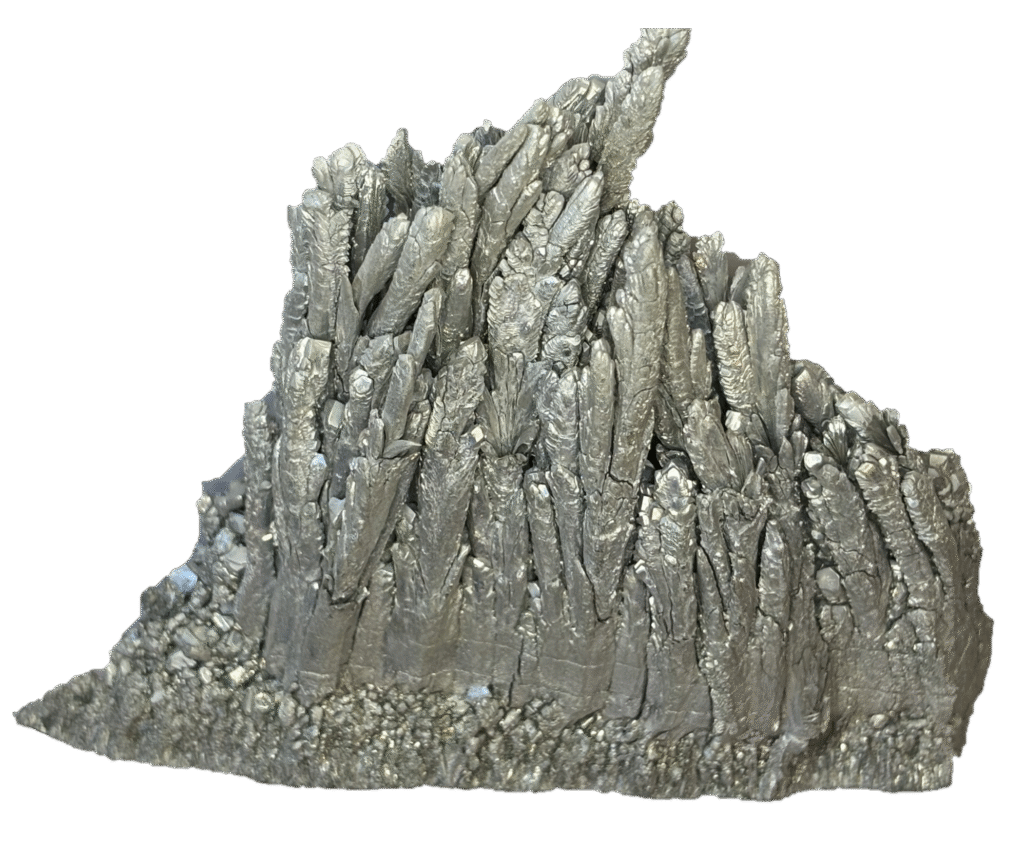
Magnesium metal is a striking, ultra-lightweight alkaline earth element celebrated in modern lapidary, elemental collecting, and energy work for its brilliant silvery-white lustre and potent grounding-yet-energising presence. While magnesium is the eighth most abundant element in the Earth’s crust—forming the structural backbone of beloved gemstones such as Peridot, Spinel, Serpentine, and Magnesite—pure elemental magnesium is too chemically reactive to exist uncombined in nature. Instead, laboratory-refined crystalline magnesium specimens and sublimated dendritic “crystals” offer collectors a tangible connection to the primordial spark of stellar nucleosynthesis and terrestrial geology.
Alternate Names
Throughout chemical history, industrial metallurgy, and contemporary crystal collecting, magnesium metal and its foundational compounds have carried several distinct designations:
- Magnium: The original name proposed by Sir Humphry Davy upon isolating the metal in 1808, later discarded to avoid confusion with manganese.
- Magnesia: Derived from the ancient Greek region of Magnesia in Thessaly (and Magnesia ad Sipylum in modern-day Turkey), where magnesium-rich earths were first gathered.
- Element 12 / Mg: Its formal designation on the Periodic Table of Elements.
- Vapour-Deposited Magnesium Crystals: The trade name for laboratory-grown, hopper-shaped metallic crystal clusters prized by mineral and element collectors.
- Flash Metal / Elektron: Historical trade terms referring to its use in early photographic flash powders and early 20th-century lightweight aerospace alloys.
The Stone’s Science and Composition
Unlike traditional silicate or carbonate gemstones, elemental magnesium is a pure alkaline earth metal belonging to Group 2 of the periodic table.
Key Physical Characteristics
Magnesium metal possesses physical properties that immediately distinguish it from heavier metals such as Galena, Pyrite, or Bismuth:
- Colour & Lustre: Bright silvery-white with a brilliant metallic lustre when freshly cleaved or sublimated, gradually softening to a satin grey as its protective oxide film matures.
- Exceptional Lightness (Specific Gravity): At just $1.738\text{ g/cm}^3$, magnesium is roughly one-third lighter than aluminium and feels astonishingly weightless in the palm compared to its metallic appearance.
- Hardness & Tenacity: Rated between 2.0 and 2.5 on the Mohs scale, making it soft enough to be scratched by a copper coin or fingernail pressure. In pure polycrystalline form, it exhibits brittle shear-band fracture rather than high ductility.
- Optical & Pyrophoric Behaviour: Completely opaque. Finely divided shavings or powders ignite readily at $473^\circ\text{C}$, burning with an intense, blinding white light rich in ultraviolet wavelengths.
Common Geologic Varieties
Because native elemental magnesium does not occur freely in the Earth’s crust, collectors and practitioners encounter it in distinct refined morphologies alongside its primary natural host ores:
- Sublimated Crown & Hopper Crystals: Laboratory-grown via vacuum distillation, displaying stepped, geometric hexagonal terracing and mirror-bright faces.
- Cast Ingots & Turned Spheres: Machined elemental spheres and palm stones used for tactile meditation and scientific study.
- Magnesite ($\text{MgCO}_3$): The primary carbonate ore, occurring in massive white nodular masses or rare transparent rhombohedral crystals.
- Dolomite ($\text{CaMg(CO}_3)_2$): A double carbonate sedimentary mineral forming pearly, saddle-shaped pink or white crystals.
- Brucite ($\text{Mg(OH)}_2$) & Carnallite: Hydroxide and evaporite halide minerals that serve as major industrial feedstocks alongside seawater brines.
Global Mining and Volcanic Sources
While pure magnesium metal is refined electrochemically or thermally (via the Pidgeon and Dow processes), its mineral precursors are deeply tied to ultramafic volcanic terrains, ancient evaporite basins, and oceanic brines:
- Ultramafic & Ophiolite Belts: Magnesium-rich mantle rocks (peridotite and dunite) weather into massive magnesite veins across China (Liaoning Province—the world’s largest producer), Turkey, Greece (Euboea), and Austria (Styria).
- Sedimentary & Evaporite Basins: Vast dolomite and carnallite beds are mined in Russia (Ural Mountains), Brazil, Australia (Queensland’s Kunwarara deposit), and North Korea.
- Marine & Brine Extraction: Trillions of tonnes of dissolved magnesium ions reside in Earth’s oceans and hypersaline lakes, actively harvested in the United States (Great Salt Lake, Utah), Israel/Jordan (the Dead Sea), and Norway.
Crystal Pairings: What to Combine and Avoid
In energetic practice and grid architecture, magnesium metal acts as a high-frequency conductor and cellular “spark plug,” requiring thoughtful pairing to balance its brisk, catalytic energy.
Optimal Crystal Pairings
- Peridot (Olivine): A magnesium-iron silicate that shares magnesium’s core elemental signature, harmonising solar vitality with heart-centred renewal.
- Black Tourmaline (Schorl) or Smoky Quartz: Essential grounding anchors that prevent magnesium’s rapid, nervous-system-stimulating frequency from feeling scattered.
- Amethyst or Lepidolite: Soothing companions that channel magnesium’s restorative calm toward deep mental stillness and restorative sleep.
- Clear Quartz: Amplifies magnesium’s crisp, clarifying current within sacred geometry grids.
Crystal Pairings to Avoid
- Moldavite or Phenakite (in ungrounded layouts): Combining high-vibration tektites with elemental magnesium without an Earth anchor can induce sensory overwhelm or jitteriness.
- Raw Halite, Selenite, or Water-Charged Stones: Because magnesium metal corrodes in moisture and reacts vigorously with acids and saline solutions, never store or grid it alongside damp stones, salt lamps, or water-cleansing bowls.
- High-Mohs Rough Specimens (Corundum, Topaz, Quartz points): With a soft Mohs hardness of 2.0–2.5, abrasive contact will rapidly scratch and dull magnesium’s mirror lustre.
Archaeology, Art and Ancient History
Long before humanity isolated the pure silvery metal, magnesium compounds shaped ancient medicine, architecture, and alchemy:
- Classical Antiquity: Ancient Greek physicians and writers—including Hippocrates and Pliny the Elder—documented magnesia alba (magnesium carbonate) and bitter mineral springs as purging remedies and soothing poultices.
- Architectural Heritage: Magnesium-rich dolomitic marbles were quarried across the Mediterranean to erect classical temples and enduring monuments.
- 1618 Epsom Discovery: In Surrey, England, farmer Henry Wicker discovered that bitter well water refused by his cattle rapidly healed skin abrasions—giving rise to Epsom salts ($\text{MgSO}_4 \cdot 7\text{H}_2\text{O}$).
- Isolation of the Element: Scottish chemist Joseph Black proved magnesia was a distinct earth in 1755, and Sir Humphry Davy first isolated elemental magnesium via electrolysis in London in 1808, followed by Antoine Bussy producing pure coherent metal in 1831.
- Early Photography & Aviation: During the Victorian and Edwardian eras, burning magnesium ribbon and flash powder revolutionised indoor photography, before lightweight magnesium alloys transformed 20th-century aviation.
Folklore, Legends and Sacred Tales
- The Flame of Prometheus: Because magnesium ignites into a star-bright white blaze that resists quenching by water, modern alchemists and elemental practitioners associate it with the mythical fire stolen from the heavens—a spark of divine illumination that cannot be extinguished by emotional floods.
- The Emerald Heart of Flora: Every molecule of plant chlorophyll holds a single magnesium ion at the exact centre of its porphyrin ring. In botanical folklore, magnesium is revered as the “green alchemist” that translates raw solar light into living terrestrial nourishment.
- The Healing Wells of Thessaly: Regional legends from ancient Magnesia spoke of sacred earth spirits who blessed local clays and waters with the power to ease bodily cramps, cool fevers, and restore weary travellers.
Metaphysical and Mystical Healing Properties
- Nervous System De-escalation & Release: Echoing its vital biochemical role in calming neuromuscular tension, elemental magnesium is used in holistic crystal work to dissolve rigid stress patterns, mental agitation, and physical restlessness.
- Catalytic Clarity & Mental Spark: Associated with quick cognitive breakthroughs, clearing brain fog, and igniting creative momentum when feeling stagnant or weighed down.
- Lightness of Being: Its astonishingly low physical density serves as a somatic reminder to release heavy emotional burdens and approach life’s challenges with agility.
- Energetic Purification: Viewed as a purifying solar-lunar bridge that clears stagnant energy from the auric field without harshness.
(Note: Metaphysical and crystal healing properties are traditional spiritual beliefs and do not replace professional medical advice or dietary supplementation.)
Astrological Connections
- Ruling Planets: The Sun (reflecting its blinding white ignition and role at the heart of photosynthesis) and Uranus (governing electricity, sudden insight, aviation, and nervous-system impulses).
- Zodiac Signs: Leo (solar vitality, radiant expression, and heart warmth) and Aquarius (innovation, lightness, elemental air/ether clarity, and humanitarian foresight).
- Elemental Correspondence: Fire and Air—bridging physical Earth mineral origins with weightless aerial lift and brilliant combustion.
The Chakra System
- Solar Plexus Chakra (Manipura): Magnesium’s primary resonance centre, governing personal agency, metabolic spark, digestive ease, and the healthy release of tension held in the diaphragm.
- Crown Chakra (Sahasrara): Its silvery-white metallic sheen and brilliant white flame connect upward to pure spiritual clarity, higher insight, and mental quietude.
- Heart Chakra (Anahata): Through its inseparable bond with green chlorophyll and Peridot, magnesium fosters emotional renewal and openness.
Interesting Facts
- Water Makes It Burn Brighter: Burning magnesium reacts exothermically with water to strip oxygen atoms and release flammable hydrogen gas—meaning water feeds a magnesium fire rather than extinguishing it.
- Forged in Massive Stars: Every atom of magnesium on Earth was created inside aging giant stars through carbon and neon nuclear fusion before being scattered into space by supernova explosions.
- Essential to Human Life: An adult human body stores roughly 20 to 25 grams of magnesium (primarily in bone tissue), where it acts as an indispensable cofactor for over 300 enzymatic reactions, including ATP energy synthesis and DNA stability.
- Meteorite Clues to the Early Solar System: Excesses of the stable isotope $^{26}\text{Mg}$ inside primitive carbonaceous chondrite meteorites help cosmochemists date the earliest solid minerals formed in our Solar System.
Modern Milestones: Birthstones and Anniversaries
- Traditional & Modern Birthstones: While elemental magnesium is not a traditional birthstone, its signature magnesium-rich gemstone—Peridot ($\text{Mg}_2\text{SiO}_4$)—is the official birthstone for August and the traditional gem for the 16th wedding anniversary.
- Modern Milestone Significance: In contemporary elemental collecting, pure magnesium spheres and lab-grown crystal clusters are gifted to mark 12th anniversaries (honouring Atomic Number 12), milestones in science or engineering, and moments of personal reinvention.
Extensive FAQ Section
1. Does pure magnesium metal occur naturally in the ground?
No. Because magnesium has a high chemical affinity for oxygen and water, it never occurs as a free native metal in Earth’s crust. All natural specimens occur as compounds (such as Magnesite, Dolomite, or Peridot), while pure metallic crystals are grown in vacuum sublimation chambers.
2. Is it safe to hold or wear elemental magnesium metal?
Solid ingots, turned spheres, and lab-grown crystal clusters are safe to handle with clean, dry hands. However, avoid exposing them to sweat, acids, or moisture, and never sand or file the metal at home—fine magnesium dust is highly flammable.
3. How do I cleanse and care for a magnesium metal specimen?
Use strictly dry cleansing methods such as sound baths (singing bowls), smoke cleansing with rosemary or frankincense, or resting the specimen near Selenite. Never cleanse magnesium in water, salt water, or vinegar, as moisture causes surface oxidation and corrosion.
4. Why does magnesium feel so light compared to other metals?
With a density of $1.74\text{ g/cm}^3$, magnesium’s atomic structure packs lighter nuclei with wider metallic spacing than iron ($7.87\text{ g/cm}^3$) or lead ($11.34\text{ g/cm}^3$), making it the lightest structural metal in common use.
5. What is the difference between Magnesium metal and Magnesite?
Magnesium ($\text{Mg}$) is a pure silvery metallic element, whereas Magnesite ($\text{MgCO}_3$) is a natural white or cream carbonate mineral containing magnesium bonded with carbon and oxygen.
6. Can I make a crystal elixir or gem water with magnesium metal?
No. Never place elemental magnesium metal directly into drinking water, as it slowly reacts with water to form magnesium hydroxide and hydrogen gas, altering pH and degrading the specimen.
