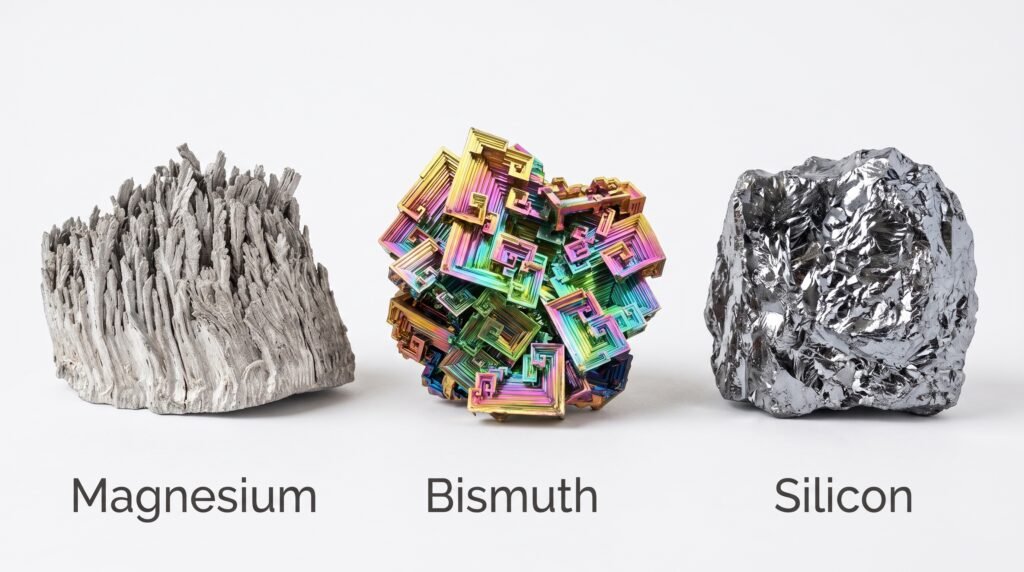
Step into any specialist mineral gallery and you are bound to encounter three dazzling, laboratory-grown elemental crystals: silvery, hexagonal Magnesium, rainbow-iridescent Bismuth, and mirror-bright, geometric Silicon. Because high-purity elemental Magnesium (Mg) is far too reactive to survive unoxidised in Earth’s crust—and native Bismuth (Bi) and Silicon (Si) rarely form large, aesthetic natural specimens—metallurgists and crystal growers cultivate all three inside controlled furnaces and vacuum chambers. The results look like futuristic sculptures, yet each metal obeys a completely different atomic architecture and growth physics.
In this comparative guide, we place lab-grown Magnesium, Bismuth, and Silicon side by side to examine how their crystal habits form, from vacuum-sublimated hexagonal Magnesium prisms and terraced, stair-stepped Bismuth hopper crystals to Czochralski-pulled Silicon boules. You will learn how to tell these three elements apart by lustre, density, Mohs hardness, and tarnish behaviour, discover which specimens make the finest display pieces, and get practical care rules to preserve their metallic brilliance for decades.
If you are building an element collection or expanding beyond natural stones featured in our crystalline magnesium guide, comparing these three crystalline elements side by side highlights just how diverse synthetic crystal growth can be.
Side-by-Side Comparison: Magnesium, Bismuth & Silicon
| Feature | Crystalline Magnesium (Mg\text{Mg}Mg) | Crystalline Bismuth (Bi\text{Bi}Bi) | Elemental Silicon (Si\text{Si}Si) |
| Element Category | Alkaline earth metal | Post-transition metal | Metalloid (semiconductor) |
| Typical Purity | 99.95% – 99.99% | 99.99% | 99.9999%+ (6N–9N electronic grade) |
| Growth Method | Vacuum vapour deposition (gas to solid sublimation) | Melt-growth / Czochralski or crucible cooling (liquid to solid) | Czochralski pulling or chemical vapour deposition (CVD) |
| Crystal System | Hexagonal (Hexagonal Close-Packed) | Trigonal / Rhombohedral | Cubic (Diamond cubic lattice) |
| Characteristic Habit | Feathery, columnar, stepped dendritic plumes | Sharp, geometric, spiral stair-step hopper cubes | Bladed polycrystalline shards, needles, or cylindrical boules |
| Colour & Lustre | Bright silvery-white metallic (natural $\text{MgO}$ film) | Iridescent rainbow oxide sheen over silvery-pink metal | Dark gunmetal-grey to blue-black sub-metallic lustre |
| Mohs Hardness | 2.0 – 2.5 (very soft) | 2.25 (soft and brittle) | 6.5 – 7.0 (hard; scratches glass) |
| Specific Gravity | 1.74 (ultra-lightweight) | 9.78 (extremely dense and heavy) | 2.33 (lightweight, similar to quartz) |
| Water & Acid Sensitivity | Strict dry care; reacts with water, salt, and acids | Water-safe briefly, though prolonged moisture dulls oxide colours | Chemically inert in water and most household acids |
1. Growth Mechanism: Vapour vs Melt
The sharpest scientific contrast between these three elements lies in the phase transition used to grow them:
- Crystalline Magnesium forms from vapour. Under deep vacuum, magnesium gas condenses directly onto a cooled steel sleeve, building feathery, coral-like columns.
- Crystalline Bismuth forms from a liquid melt. Because bismuth—like water—expands by roughly 3.3% when it solidifies, cooling a pot of molten bismuth causes sharp-edged, stair-stepped hopper crystals to nucleate on the surface. When lifted from the liquid melt at ~271°C, the hot bismuth surface reacts with air to form a thin bismuth(III) oxide layer whose varying thickness creates vivid rainbow interference colours.
- Elemental Silicon is typically pulled as massive single-crystal cylindrical ingots (boules) via the Czochralski process at $1,414^\circ\text{C}$ for semiconductor wafers, or deposited via chemical vapour deposition (CVD) into polycrystalline rods. Broken off-cuts and dendritic crust pieces enter the mineral market as razor-sharp, dark gunmetal-grey crystal clusters.
2. Density & Weight in the Hand
Holding all three specimens at once offers one of the best hands-on lessons in specific gravity:
- Bismuth (SG 9.78) feels startlingly heavy—more than five times denser than magnesium of the same volume.
- Silicon (SG 2.33) feels close to ordinary quartz (SG 2.65) or porcelain.
- Magnesium (SG 1.74) feels almost weightless for a metal, roughly 35% lighter than aluminium.
3. Hardness & Handling Differences
While elemental silicon (Mohs 6.5–7.0) is hard enough to scratch window glass and resist everyday handling, both magnesium (Mohs 2.0–2.5) and bismuth (Mohs 2.25) are soft metals that dent or scratch easily. Furthermore, magnesium is chemically reactive—requiring strict dry storage away from moisture and skin salts—whereas silicon and bismuth remain stable in normal household air.