Long before it became a favourite among modern crystal collectors, Larvikite served as the silent backdrop to historic cities, grand civic buildings, and world-renowned monuments. Forged roughly 300 million years ago in the subterranean depths of Norway’s Oslo Rift, this striking dark monzonite represents a unique meeting point between ancient planetary forces and international human design. Unravelling Larvikite History reveals how a rare, volcanic stone transformed from coastal glacial boulders into Norway’s official national stone and a defining feature of world architecture.
In this guide, we trace the complete journey of Larvikite across science, trade, and architectural heritage. You will explore how deep-seated magma chambers created its iconic silvery-blue schiller, how 19th-century Norwegian coastal quarries evolved into global export powerhouses, and why Edwardian architects, luxury high-rises, and iconic British landmark buildings turned to this resilient stone for exterior cladding.
1. The Oslo Paleorift: Tectonic Genesis and Magmatic Evolution
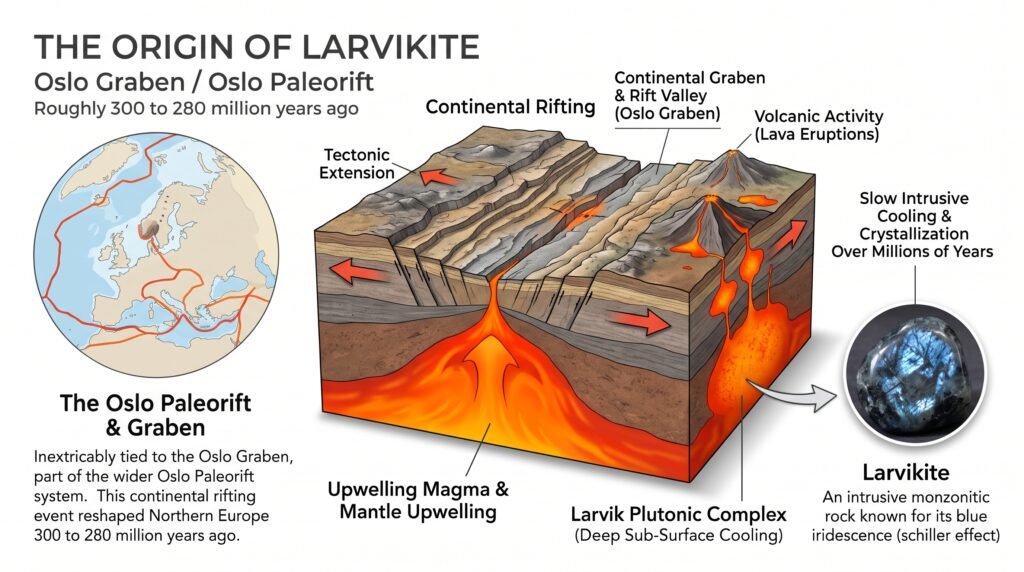
The origin of Larvikite is inextricably tied to the Oslo Graben, part of the wider Oslo Paleorift system. This continental rifting event profoundly reshaped Northern Europe between the Late Carboniferous and Early Permian periods (roughly 300 to 280 million years ago).
Continental Extension and Magma Emplacement
During the breakup of Pangaea’s northwestern margins, the regional continental crust stretched and thinned. Crustal extension caused massive blocks of crust to drop along parallel faults, forming a graben valley. Beneath this rift, decompression melting in the upper mantle pushed high-temperature basaltic magmas into the lower crust.
As these magmas pooled, extensive fractional crystallisation and crustal assimilation occurred. The resulting subalkaline, silica-undersaturated to silica-saturated intermediate melts migrated upward, lodging several kilometres beneath the surface within the Larvik Plutonic Complex (LPC).
Sub-Solidus Cooling and Schiller Physics
Rather than erupting as volcanic lava, the magmas of the LPC cooled exceptionally slowly within deep plutonic chambers over hundreds of thousands of years. This slow subterranean cooling allowed large, tabular ternary feldspar phenocrysts to grow.
As temperatures dropped below the feldspar solvus (roughly 700°C to 500°C), the ternary feldspar solution became unstable. A solid-state process called cryptoperthitic exsolution occurred: potassium-rich and sodium-rich phases separated into microscopic, alternating sub-lamellae only nanometres thick. This nanostructure is responsible for Larvikite’s distinctive optical interference—refracting incident light to produce its iconic blue and silver schiller.
2. The Norwegian Quarrying Landscape: From Boulders to Global Industry
The extraction of Larvikite is geographically concentrated in Vestfold County, southern Norway, primarily around the coastal communities of Larvik, Sandefjord, and the Tvedalen valley.
19th-Century Industrialisation
For centuries, local Norwegian communities utilised glaciated, surface-weathered Larvikite boulders for domestic foundations, harbour walls, and simple coastal retaining structures. Commercial quarrying in the modern sense did not emerge until the 1880s.
The transformation of Larvikite from a local curio into an international export commodity was spearheaded by local industrialists alongside pioneering Norwegian geologist Waldemar Christofer Brøgger, who systematically mapped and described the alkaline intrusive rocks of the Oslo region. By the turn of the 20th century, deep-cut quarries with steam-powered winches, diamond wire saws, and dedicated coastal shipping links transformed the port of Larvik into a major global stone terminal.
Ring Complexes and Commercial Quarrying Zones
Geologists have identified at least ten circular, semi-concentric ring intrusions within the Larvik Plutonic Complex, each representing distinct magmatic pulses:
- Light Larvikite (Lys Larvikite / “Blue Pearl”): Extracted heavily in the Tvedalen district west of Larvik. These rocks are characterised by a lighter silvery-grey matrix with extensive, broad flashes of ice-blue feldspar.
- Dark Larvikite (Mørk Larvikite / “Emerald Pearl”): Mined primarily around Klåstad and Stålaker east of Larvik. This variety exhibits a midnight-black or dark olive groundmass accented by intense petrol-green and deep royal-blue schiller facets.
3. Global Architectural Cladding: The Face of Modern Commerce
From the late Victorian era through the mid-century Art Deco movement and into contemporary high-rise architecture, Larvikite became an international design staple. Prized by stonemasons and architects alike, it bridged functional engineering with luxury aesthetics.
Physical Durability in Urban Environments
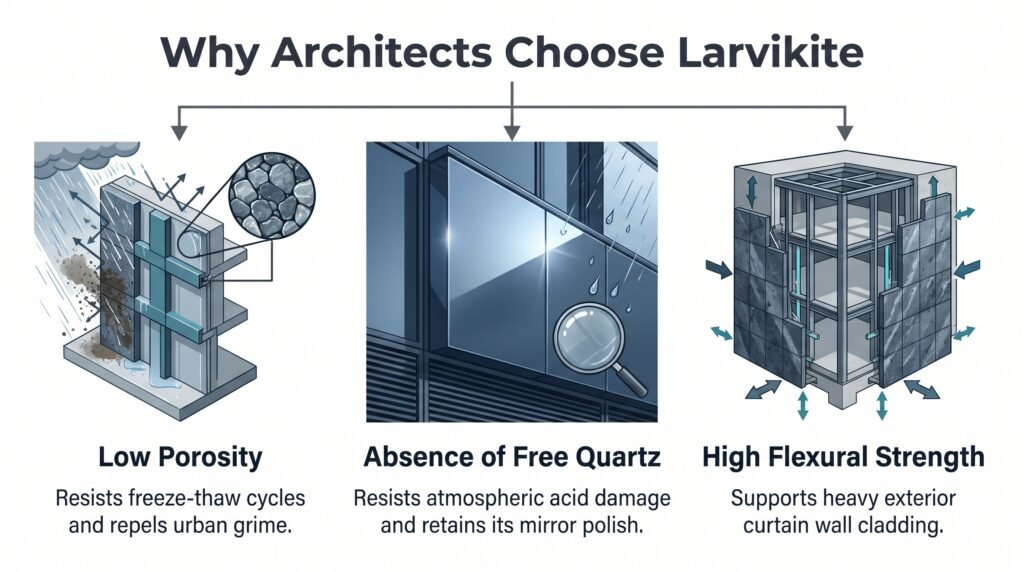
Architects frequently specify Larvikite over true granites, limestones, and marbles for exterior commercial cladding due to its exceptional technical properties:
- Minimal Water Absorption (Porosity < 0.2%): Larvikite’s tightly interlocked igneous grain boundary network prevents water infiltration. In northern climates subject to harsh winter freeze-thaw cycles, this near-zero porosity eliminates frost-wedging, cracking, and surface spalling.
- Chemical Stability: Unlike marbles and limestones composed of calcite, Larvikite contains no acid-sensitive carbonate minerals. It withstands acid rain, industrial pollutants, vehicle exhaust, and coastal salt spray without pitting or etching.
- Absence of Free Quartz: True granite contains high proportions of quartz (Mohs 7), which can make uniform sawing and edge profiling brittle. Larvikite’s augite-syenite matrix allows masons to achieve clean, crisp chamfers and hone mirror-like finishes that endure for decades outdoors.
Architectural Typologies and Global Landmark Installations
| Architectural Era | Dominant Application | Historic / Modern Context |
|---|---|---|
| Late Victorian & Edwardian (1890–1914) | Bank plinths, civic entrances, hotel frontages | Chosen to communicate imperial permanence, institutional wealth, and unyielding fiscal security. |
| British Public House Architecture (1900–1950) | Exterior pub fronts, lower splash-courses, interior bar tops | Widely known colloquially in the UK as “Pub Stone”. Chosen because beer, spirits, and acidic liquids will not etch its polished face. |
| Mid-Century Modern (1940–1970) | Exterior curtain cladding, lobby wall veneers | Clad onto monumental civic buildings, most notably featured within parts of the United Nations Headquarters complex in New York. |
| Contemporary Luxury Design (1980–Present) | Kitchen worktops, airport terminal fascias, luxury retail flagships | Heavily featured across luxury flagships (e.g., Harrods in London, major European banking headquarters, high-end automotive showrooms). |
4. Modern Heritage & Sustainable Quarrying
In February 2008, the Geological Society of Norway officially designated Larvikite as the National Stone of Norway (Norges nasjonalbergart). This award recognised not only the stone’s unique geological origin—being found in commercial quantities nowhere else on Earth—but also its economic contribution as Norway’s primary natural stone export.
Modern Quarry Management and Environmental Reclamation
Today, Larvikite quarrying operates under strict Norwegian environmental legislation:
- Resource Maximisation: Historically, dimension stone extraction produced significant quarry waste due to natural jointing and fracture lines. Modern operations crush non-block material into heavy aggregate used for European coastal breakwaters, railway ballast, and high-durability road surfacing.
- Landscape Rehabilitation: Depleted extraction benches are backfilled, graded, and replanted with native boreal flora to restore local biodiversity, with several historic quarry pits repurposed as public geological parks and educational walking trails.
Frequently Asked Questions (FAQ)
Why is Larvikite commonly called “Blue Pearl Granite” if it isn’t granite?
In the commercial stone and dimension surfacing industry, the term “granite” is applied loosely to virtually any hard, crystalline silicate rock that can take a high polish. Petrologically, a true granite must contain between 20% and 60% free quartz. Larvikite is an augite syenite/monzonite and contains little to no free quartz (often under 5%, or feldspathoid-bearing), meaning it is scientifically inaccurate to classify it as a granite.
Why is Larvikite so common on British pub frontages?
Throughout the late 19th and early 20th centuries, British brewery architects sought durable, hygienic exterior materials that could withstand damp street conditions, horse traffic, soot, and spilled alcohol. Larvikite’s low porosity, resistance to acidic alcohol spills, and ease of cleaning made it the premier choice for ground-floor pub fascias, earning it the longstanding trade nickname “Pub Stone.”.
Where is Larvikite found outside of Norway?
True Larvikite originates exclusively from the Larvik Plutonic Complex in southern Norway. While minor occurrences of petrologically related nepheline-bearing monzonites exist in small pockets within the Kola Peninsula of Russia and parts of southern Canada, none possess the structural consistency, expansive reserves, or vivid optical schiller found in the Norwegian deposits.