
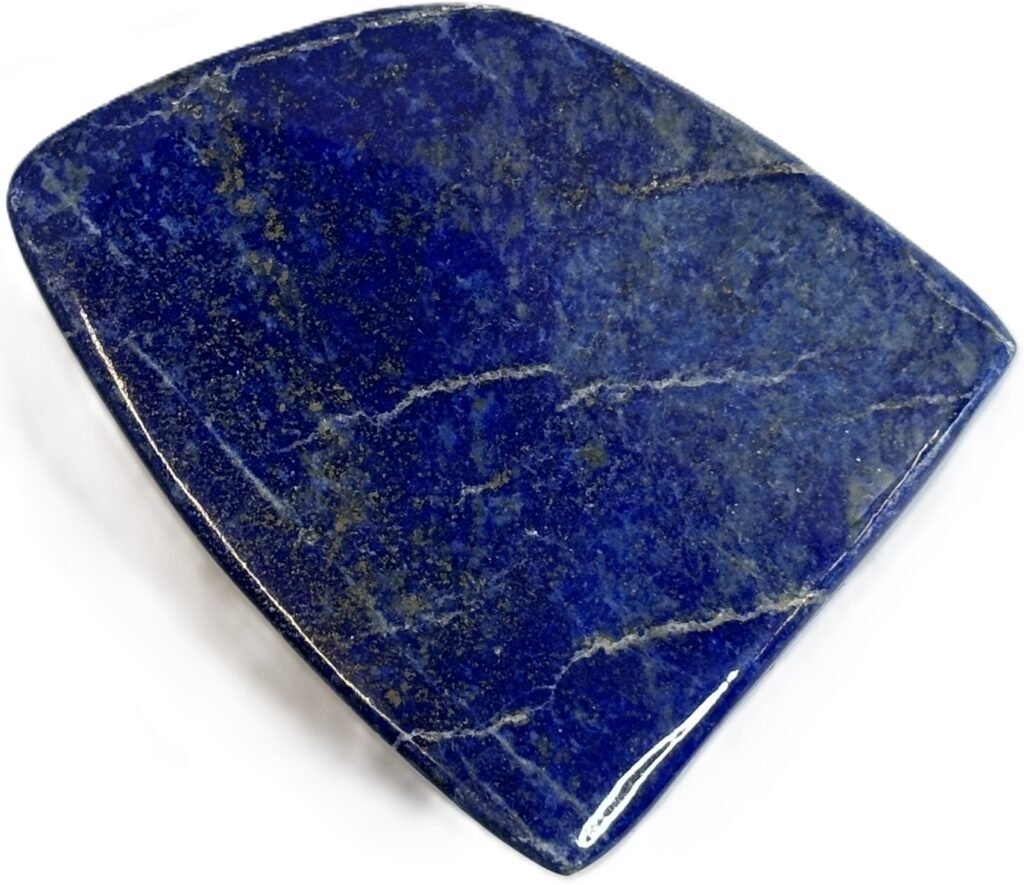
The depth of lapis lazuli history is matched by few other minerals on Earth. Long before it was ground into the costliest pigment of the Italian Renaissance, this celestial blue stone functioned as a sacred token of cosmic authority, sovereign power, and divine medicine. Across five millennia, its journey traced the world’s earliest trade corridors—transported from the precipitous peaks of Badakhshan in modern north-eastern Afghanistan across vast deserts and mountain passes to adorn the royal courts and spiritual sanctuaries of the ancient world.
Rather than serving as mere ornament, the stone carried an innate metaphysical weight across diverse civilisations. To the Sumerians of ancient Mesopotamia, it mirrored the star-strewn vault of the night sky; to the Romanov Tsars of imperial Russia, it represented the pinnacle of decorative luxury; and to Himalayan Buddhist masters, it manifested as the radiant blue light of physical and mental purification.
By exploring these sacred texts, archaeological treasures, and imperial commissions, we uncover how an earthly metamorphic rock became humanity’s enduring symbol of divine truth and sovereign majesty.
The Mesopotamian Epic: Sacred Horns, Inlaid Lyres, and the Royal Graves of Ur
In ancient Sumer and Babylonia, lapis lazuli (uqnû in Akkadian; za-gìn in Sumerian) was regarded not merely as an ornamental luxury, but as the quintessential substance of the celestial sphere. Its deep indigo body, flecked with golden pyrite, was viewed as a physical fragment of the night sky, intimately tied to the dwelling places of the gods.
The Horns of the Bull of Heaven in Gilgamesh
In The Epic of Gilgamesh (Tablet VI), when the goddess Ishtar (Inanna) is spurned by Gilgamesh, she unleashes the celestial Bull of Heaven (Gugalanna) upon Uruk. Following a brutal struggle, Gilgamesh and Enkidu slay the beast. The text describes the anatomical magnificence of the defeated creature:
“Gilgamesh called the craftsmen, the armourers, all of them.
The artisans admired the thickness of its horns:
each was formed of thirty minas of pure lapis lazuli,
two fingers thick was their casing…”
Gilgamesh extracts the hollow lapis horns and dedicates them to his lineage deity, Lugalbanda, hanging them within his royal bedchamber to hold sacred anointing libations. In the Mesopotamian worldview, portraying divine horns in solid lapis lazuli was an explicit literary marker of supreme, otherworldly potency.
The Royal Cemetery of Ur: The Standard and the Golden Lyres
When British archaeologist Sir Leonard Woolley excavated the Royal Cemetery of Ur in the 1920s, he uncovered evidence of how pervasive this trade was by the Early Dynastic III period (c. 2600–2500 BCE).
- The Standard of Ur: A hollow wooden box depicting narrative registers of “War” and “Peace.” The entire visual composition relies on figures carved from marine shell and red limestone set into a dense, solid mosaic background of hand-cut lapis lazuli tesserae, cemented into place using native bitumen.
- The Queen’s Lyre and the Bull Lyres: The famous soundboxes discovered in Royal Tomb PG 800 (Queen Puabi) and PG 1237 (“The Great Death Pit”) feature carved bull heads sculpted from sheet gold and electrum, sporting elaborately waved, bearded ruffs and inlaid horn-tips carved entirely from deep Afghan lapis lazuli.
Because Mesopotamia possessed zero natural stone deposits, every single gram of this material had to traverse more than 1,500 miles of mountain passes and trade routes. To own lapis in Sumer was to possess tangible evidence of divine favour and absolute geopolitical reach.
Imperial Russia: Fabergé Masterpieces and the Palaces of Tsarskoe Selo
Four thousand years after the fall of Ur, lapis lazuli became a dominant decorative medium of the Romanov dynasty. Under the patronage of Catherine the Great, Alexander II, and Nicholas II, Russian hard stone carving reached an architectural and decorative scale unseen anywhere else in the world.
The Catherine Palace and the Lyon Hall
At Tsarskoe Selo outside Saint Petersburg, Catherine the Great and later Empress Maria Alexandrovna directed the creation of monumental stone interiors. The most famous example is the Lyon Hall, designed by Ippolito Monighetti in the 1860s.
Rather than using lapis lazuli merely as small ornamental accents, Russian imperial artisans applied the technique of Russian Mosaic (chameau / stone marquetry):
- Thin veneers (2 to 4 mm thick) of uniform, high-grade lapis lazuli were precisely cut, colour-matched, and adhered onto underlying slate or bronze armatures using mastic.
- The seams were hand-polished until invisible, giving the illusion that massive architectural elements—door portals, baseboards, mirror surrounds, and console tables—were carved from single, colossal monoliths of pure blue stone.
Imperial workshops also made extensive use of native Siberian deposits discovered along the Slyudyanka River near Lake Baikal, which featured a darker, violet-blue colouration with dramatic clouds of calcite and dispersed pyrite.
The House of Fabergé: The Tsarevich Egg (1912)
Peter Carl Fabergé elevated lapis lazuli from monumental architecture to microscopic precision. The pinnacle of this work was the Tsarevich Egg of 1912, presented by Emperor Nicholas II to Empress Alexandra Feodorovna as a gift celebrating their young son, Tsarevich Alexei.
- The exterior shell of the egg was hollowed out from a single, flawless block of dark blue Afghan lapis lazuli.
- It was overlaid with Louis XV-style rococo scroll work, acanthus leaves, and eagles carved from chased gold, set with rose-cut diamonds to conceal the seam where the egg opened.
- Inside, the “surprise” revealed a double-headed Romanov eagle framed in platinum and diamonds, containing a miniature watercolour portrait of the young prince.
Fabergé favoured lapis because its rich opacity created an unmatched visual contrast against high-carat yellow gold and platinum, echoing the royal palette of classical antiquity.
Tibetan Buddhism: Bhaisajyaguru and the Lapis Light of Healing
In Mahayana and Vajrayana Buddhism, lapis lazuli transcends political power entirely, becoming the supreme physical and metaphysical emblem of health, purification, and spiritual awakening.
Vaiduryaprabha: The Radiant Lapis Body
The Medicine Buddha is formally known in Sanskrit as Bhaisajyaguru Vaiduryaprabharaja (“The Medicine Master and King of Lapis Lazuli Radiance”). In traditional Tibetan thangkas and statues:
- He is depicted sitting upon a lotus throne, his skin coloured the pure, glowing, translucent indigo of vaidurya (traditionally translated in Tibetan Buddhist medicine as lapis lazuli).
- His left hand rests in his lap in the dhyana mudra (meditation gesture), holding an iron or lapis lazuli begging bowl containing the nectar of immortality (amrita) and three medicinal myrobalan fruits (Terminalia chebula).
- His right hand rests downward upon his knee in the varada mudra (gesture of granting boons), holding a stem of the blooming arura plant.
The Symbolism of the Blue Light
Why lapis lazuli? Within the Four Medical Tantras (Gyushi) of Tibetan medicine, all physical ailments are understood to stem from mental defilements, specifically the Three Poisons:
- Attachment / Greed (lobha)
- Aversion / Anger (dvesha)
- Delusion / Ignorance (moha)
The radiant blue light of lapis lazuli is believed to penetrate the darkness of human ignorance. Just as lapis is opaque and grounding yet visually reminiscent of infinite space, the Medicine Buddha’s lapis light is said to pacify karmic blockages, cool internal inflammation, and cleanse the mind of the deep-seated conceptual illusions that cause bodily suffering.
When practitioners recite the Medicine Buddha mantra (Tadyatha Om Bhaishajye Bhaishajye Mahabhaishajye…), they are instructed to visualize themselves bathed in a cool, deep lapis blue glow, dissolving sickness, past trauma, and emotional clinging into pure, luminous clear awareness.
Comparative Matrix: Cross-Cultural Meanings of Lapis Lazuli
| Cultural Tradition | Historical Era | Key Artifact or Text | Symbolic Meaning |
| Sumerian / Mesopotamian | 2600–1800 BCE | The Epic of Gilgamesh, Standard of Ur, Queen Puabi’s Lyre | Cosmic majesty, celestial horns of power, royal authority, and fragments of the night sky. |
| Imperial Russian | 1760–1917 CE | Lyon Hall at Tsarskoe Selo, Fabergé Tsarevich Egg (1912) | Aristocratic luxury, architectural mastery via Russian Mosaic, sovereign continuity. |
| Tibetan Buddhist | 8th Century CE – Present | Gyushi (Medical Tantras), Bhaisajyaguru Thangkas | Mental purification, the dissolution of the Three Poisons, spiritual medicine, and primordial clarity. |
Preserving the Legacy
Whether viewed on a Mesopotamian bitumen inlay, polished across the ornate tables of the Romanovs, or visualised as the spiritual medicine of the Himalayas, lapis lazuli has retained its identity as a stone of the higher mind. Its enduring appeal lies in this timeless continuity: an earthly aggregate rock that has, across every major civilisation, been chosen to represent the infinite expanse of the heavens.
