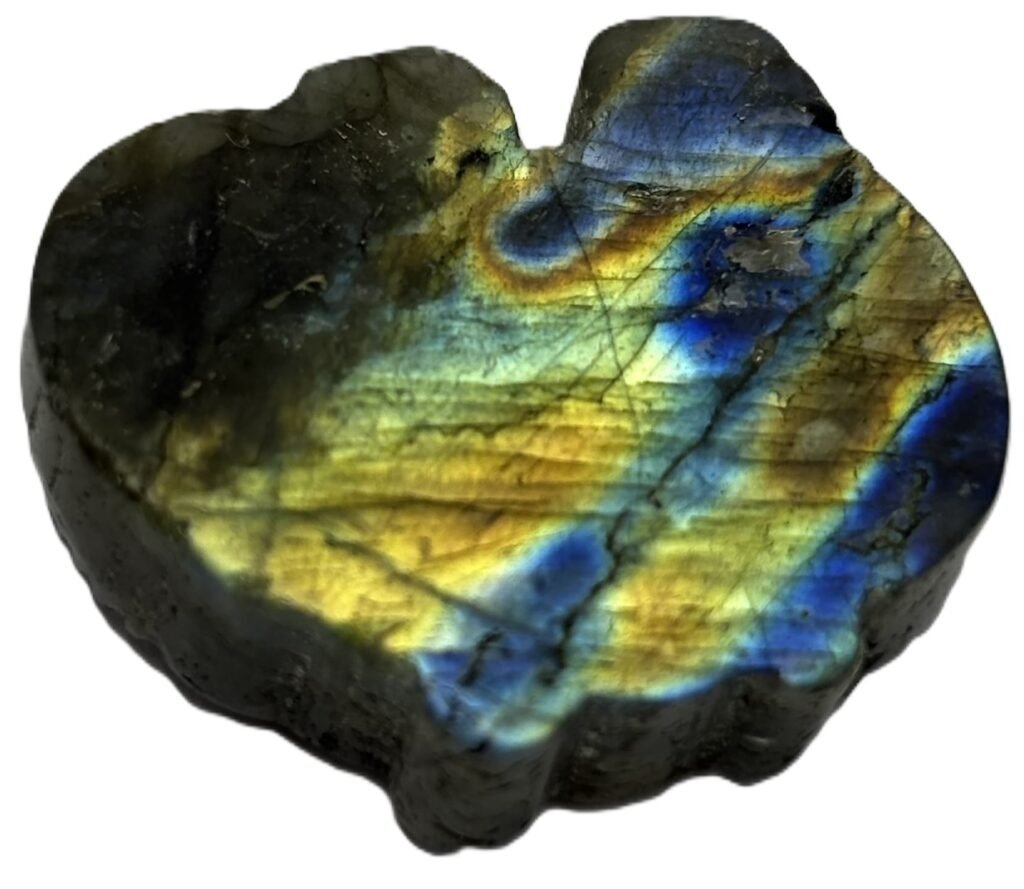
With its shimmering, mystical play of colour, labradorite is easily one of the most beloved gemstones on the planet. But as its popularity has skyrocketed, so has the number of counterfeit, imitation, and treated stones flooding the market. Knowing how to tell the difference between real vs fake labradorite is essential if you want to make sure you are getting the genuine article—especially since clever counterfeits made of glass, plastic, or dyed materials can look surprisingly convincing at first glance.
Fortunately, you don’t need to be a certified geologist to spot a counterfeit. By understanding a few natural characteristics of the genuine stone, you can easily verify any piece in your collection or check a gemstone before you buy it. In this guide, we will break down the simplest, most reliable tests you can do right at home, from analysing the stone’s signature “flash” to checking its weight, temperature, and natural flaws. Let’s make sure your gemstone is the real deal!
Does “Synthetic Labradorite” Actually Exist?
In gemology, the term “synthetic” refers to a laboratory-grown mineral that possesses the identical chemical composition, crystal system, and physical properties as its natural counterpart (such as hydrothermal emeralds or flame-fusion corundum). By this definition, true synthetic gem-quality labradorite is not commercially produced.
The geological conditions required to form gem-grade labradorite cannot be easily or economically replicated in a laboratory:
- Labradorite requires deep, ultra-slow plutonic cooling over millions of years within anorthositic or gabbroic magma chambers.
- This slow cooling allows homogeneous plagioclase feldspar to unmix into alternating calcium-rich and sodium-rich lamellae (Bøggild exsolution) measuring between 120 nm and 400 nm in thickness.
- Replicating these sub-microscopic, crystalline layers in a laboratory setting costs far more than mining the abundant natural material out of the ground.
When a retailer uses the label “synthetic labradorite,” they are almost certainly selling an imitation or simulant—a chemically unrelated material crafted from plastic, polymer resin, glass, or dyed ceramic designed merely to mimic the stone’s superficial appearance.
Common Types of Imitation Labradorite
To recognise a fake, it helps to understand the four primary methods manufacturers use to copy the stone’s optical play:
Polymer Resin & Cellophane Doublets
The most prevalent fake found on mass-market e-commerce platforms consists of a poured epoxy or acrylic resin base.
- The Technique: A crinkled sheet of iridescent dichroic cellophane or metallic Mylar film is laid inside a cabochon mould and submerged in translucent smoky-grey or dark-tinted liquid resin.
- The Appearance: The film mimics an internal flash, but the colours reflect uniformly from all viewing angles rather than shifting directionally along a crystalline cleavage plane. Under magnification, tiny spherical gas bubbles are typically trapped within the liquid resin.
Glass Doublets & Opalite Composites
Glass simulants are constructed by bonding a thin slice of flash-bearing material (or treated holographic glass) beneath a protective dome of clear or grey moulded glass. The seam where the two layers meet is concealed inside a closed-back bezel setting.
Coated or Quench-Crackled Quartz
Low-grade, milky quartz or cheap calcite is heated and quenched in cold liquid dye solutions, creating a network of internal thermal fractures. A thin vapour deposited metallic coating (similar to “aura quartz”) is applied across the base or back to bounce iridescent light through the fractured dome.
Mislabelled Low-Grade Minerals
Occasionally, vendors mislabel other minerals entirely:
- Dyed Gray Agate: Banded chalcedony treated with dark dyes to mimic the base colour of labradorite, but lacking any internal schiller.
- Treated Larvikite: An augite syenite rock from Norway containing ternary feldspars. While naturally related and displaying a silvery-blue schiller, larvikite exhibits scattered silvery patches rather than wide, continuous sheets of spectral labradorescence.
The 6 Diagnostic Tests: How to Spot Fake Labradorite
Distinguishing genuine plagioclase feldspar from an imitation does not require destructive testing or an advanced laboratory. You can verify a specimen using six reliable diagnostic checks.
| Diagnostic Test | Genuine Natural Labradorite | Resin or Glass Imitation |
| 1. Flash Directionality | Directional & Planar: Vanishes completely when tilted off-axis | Omnidirectional / Static: Remains visible at almost every viewing angle |
| 2. Surface Striations | Displays straight, microscopic polysynthetic twinning lines | Smooth, featureless, molded, or curved cooling lines |
| 3. Thermal Sensation | Cold to the touch; draws heat away from skin slowly | Warm/neutral (resin); warms up almost immediately |
| 4. Specific Gravity / Weight | Noticeably dense ($2.68 – 2.72\text{ g/cm}^3$) | Significantly lighter (resin) or uniformly dense without grain |
| 5. Cleavage Fractures | Features internal stepping, mineral veining, and micro-fissures | Flawless clarity, uniform glitter flakes, or trapped air bubbles |
| 6. Mohs Hardness | 6.0 – 6.5: Cannot be scratched by a standard copper coin or iron nail | 2.0 – 3.0 (resin): Readily scratched by an ordinary copper coin or sewing pin |
Step-by-Step Testing Procedures
Test 1: The “Tilt and Disappear” Optical Test
Labradorescence is an internal interference phenomenon tied strictly to the orientation of the stone’s Bøggild lamellae.
- Hold the specimen under a single overhead light source (daylight or a focused desk lamp).
- Slowly rotate and tilt the stone in your hand.
- Natural Stone: As you tilt the stone away from its optimal reflection plane, the electric blue, green, or gold flash shuts off completely, returning the stone to a dull, charcoal, or smoky-grey base colour.
- Resin/Film Fake: The iridescent colours remain visible at almost every angle because the crumpled plastic film scatters light in all directions simultaneously. If you can see the flash from the side, top, and front without shifting the lighting angle, it is almost certainly a fake.
Test 2: The Thermal Touch Test
Plagioclase feldspar is a crystalline silicate with distinct thermal conductivity compared to polymers.
- Place the stone directly against the sensitive skin of your inner wrist or cheek.
- Natural Labradorite will feel icy and take several seconds to warm up against your skin temperature.
- Resin Imitations will feel room-temperature immediately, presenting a lightweight, “plastic” sensation.
Test 3: Microscopic Inspection of Inclusions & Twinning Lines
Examine the face of the cabochon under a 10x jeweller’s loupe:
- Look for Polysynthetic Twinning: Genuine labradorite universally exhibits multiple parallel twin lamellae that appear as razor-straight, hair-fine grooves running across cleavage faces.
- Check for Mineral Inclusions: Natural specimens contain tiny black platelets or needle-like inclusions of ilmenite, magnetite, or rutile, alongside microscopic internal cleavages that step downward at oblique angles.
- Identify Air Bubbles: If you spot perfectly spherical bubbles suspended beneath the surface, the piece is cast resin or moulded glass.
Test 4: The Hardness & Scratch Check
Natural labradorite registers 6.0 to 6.5 on the Mohs scale:
- A piece of plastic or polymer resin (Mohs 2.0 to 3.0) can be scratched easily using the edge of an ordinary copper coin (Mohs 3.0) or an iron sewing needle (Mohs 4.0 to 4.5).
- An authentic labradorite will easily resist a copper coin or needle without leaving a permanent gouge or peeling plastic shavings.
4. Red Flags in Online Listings and Retail Settings
When purchasing loose cabochons, wire-wrapped pendants, or bulk lots online, watch for these common commercial red flags:
- Unrealistically Low Prices for Full-Spectrum Colours: Genuine Finnish spectrolite or rare purple-flash labradorite commands premium prices (£10 to £45+ per gram). If a seller offers deep violet, pink, or full-rainbow cabochons for £2 each, they are either misrepresenting ordinary grey stones using digitally altered photos or selling dyed resin simulants.
- Over saturated Product Photos: Dishonest vendors often photograph specimens underwater or submerged in mineral oil, using extreme contrast filters to make dull, non-flashing stones appear vivid. Always look for dry photos taken in neutral, indirect daylight.
- The “Holographic Glitter” Appearance: Real labradorescence forms a broad, liquid-like, metallic sheen that floods across cleavage domains. If the flash looks like fine, dispersed cosmetic glitter or crushed foil suspended in clear fluid, it is a synthetic craft pour.
- Closed-Back Metal Settings: Be cautious of inexpensive silver or plated jewellery where the back of the setting is entirely sealed with solid metal. While legitimate jewellers occasionally use closed backs, imitation manufacturers use them to hide the foil paper, doublets, or mirror backings glued beneath fake stones.
Summary Checklist for Buyers
Before investing in a high-value labradorite carving, collector rough, or bespoke jewellery piece, verify the following:
- Does the flash vanish when tilted? (Yes = Likely Genuine; No = Likely Fake).
- Are there fine, straight parallel twinning lines and natural fractures? (Yes = Genuine mineral structure).
- Does it feel cold, heavy, and solid in the hand? (Yes = Silicate mineral density).
- Is the stone free of round gas bubbles and artificial foil layers? (Yes = Authentic crystalline formation).
By using these diagnostic criteria, you can verify your collection and ensure that every specimen you acquire is an authentic product of natural geological crystallisation.