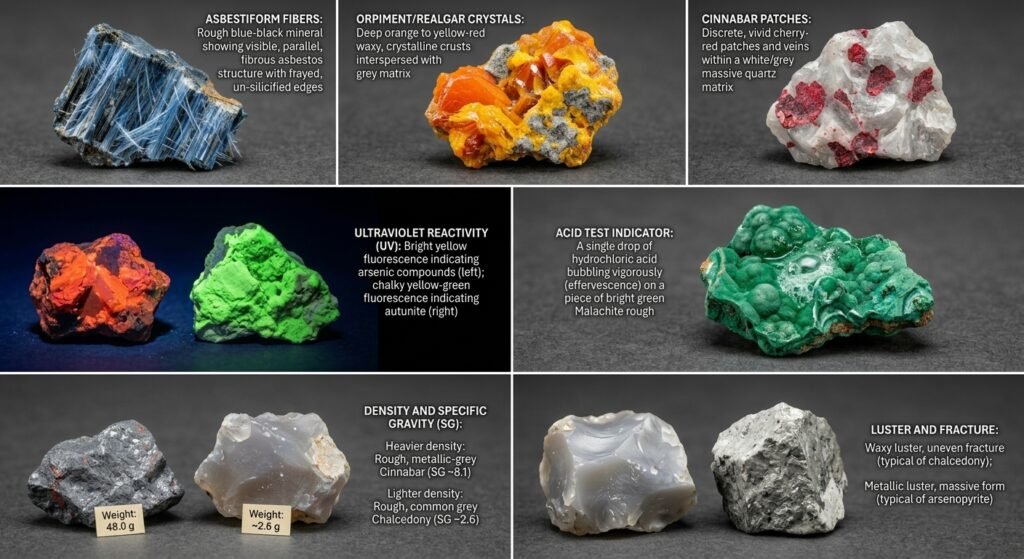
True jasper is a harmless form of microcrystalline quartz, cherished by lapidaries and collectors for centuries. However, the mineral market is flooded with trade names that sell a dangerous illusion. So called toxic jaspers are rarely jaspers at all; instead, they are complex rocks and secondary minerals masquerading under a familiar, benign label.
Stones like “Bumblebee Jasper” or “Dragon’s Blood” often conceal hazardous concentrations of arsenic, lead, or toxic heavy metals. Whether you are cutting rough material in the workshop or handling raw display specimens, understanding what lurks beneath these trade names is vital for safe collecting.
Four Common “Jaspers” with Hidden Dangers
| Trade Name | What It Actually Is | Toxic Element(s) | Primary Risk |
| Bumblebee “Jasper” (Eclipse Stone) | Volcanic carbonate matrix infused with realgar, orpiment, sulphur, and pyrite | Arsenic & Sulphur | Surface powders transfer arsenic to skin; lethal dust risk if dry-cut. |
| Cinnabar “Jasper” (Dragon’s Blood / Cherry Stream) | Chalcedony or quartz speckled with red cinnabar veins | Mercury (mercury sulphide) | Inhaling fine dust or vapours from friction/heat; ingesting red powdery rub-off. |
| Malachite / Chrysocolla “Jasper” (Sonoran Sunrise / Parrot Wing) | Copper carbonates and silicates mixed with chalcedony | Heavy Copper | Cytotoxic dust irritates respiratory tract, lungs, and stomach lining. |
| Tiger’s Eye & Pietersite Roughs (Silk “Jasper”) | Incomplete quartz replacement of amphibole crocidolite | Asbestos fibres | Friable, raw fibrous edges release inhalable asbestiform needles. |
1. Bumblebee “Jasper” (Eclipse Stone)
- The Look: Bright yellow, orange, charcoal, and grey bands that resemble a bumblebee.
- The Reality: It is not a jasper; it is a porous volcanic sediment formed in fumaroles (notably Mount Papandayan in Indonesia). The vibrant yellow and orange colours come directly from orpiment and realgar—both arsenic sulphide minerals—alongside elemental sulphur.
- The Risk: In its rough, unpolished state, chalky yellow dust can rub off directly onto fingers. Inhaling dust from grinding or sanding it creates severe risks of acute or chronic arsenic poisoning.
2. Cinnabar “Jasper” (Cherry Stream / Dragon’s Blood Matrix)
- The Look: White, grey, or cream coloured quartz speckled or veined with deep scarlet red.
- The Reality: Those crimson streaks are cinnabar, the primary ore of mercury ($\text{HgS}$).
- The Risk: While mercury bound in sulphide form is relatively insoluble at room temperature, friction, heat, acidic liquids, or lapidary grinding can liberate mercury dust and toxic vapours. Rough specimens frequently leave red stains that should never come into contact with the mouth.
3. Sonoran Sunrise & Parrot Wing (Copper “Jaspers”)
- The Look: Vivid contrasts of deep reds (cuprite), bright greens (malachite), and electric blues (chrysocolla).
- The Reality: These stones are rich concentrations of secondary copper ores.
- The Risk: Copper dust is heavily cytotoxic. Inhaling dry particles during stone shaping produces an acrid metallic taste, severe throat irritation, nausea, and long-term lung inflammation.
4. Tiger’s Eye, Hawk’s Eye & Pietersite Roughs
- The Look: Shimmering chatoyant bands of gold, brown, blue, or swirled storm-like patterns.
- The Reality: These stones form through a process where silica gradually replaces crocidolite—a fibrous variety of amphibole asbestos.
- The Risk: Fully finished, smooth cabochons are safe because the fibres are locked inside solid silica quartz. However, rough, unworked seams often retain fragile, un-silicified asbestos pockets. Chipping, hammer-breaking, or dry-cutting rough pieces can release airborne asbestos fibres.
Safe Handling for Collectors & Casual Buyers
You do not need to purge your collection of these stones, but you must treat them with informed caution:
- Wash Hands After Handling: Always use warm water and soap after touching rough, powdery, or unpolished mineral specimens.
- Never Make “Gem Elixirs” or Infused Waters: The wellness trend of soaking crystals directly in drinking water is dangerous with trade-name jaspers. Soluble arsenic, sulphur, and heavy metals leach directly into liquids.
- Keep Away from Children and Pets: Porous mineral stones can dissolve small amounts of heavy metals through saliva if chewed or licked.
- Wear Finished Jewellery Mindfully: Polished and sealed cabochons mounted in metal are generally safe. However, avoid wearing raw, unsealed Bumblebee beads directly against sweaty skin, as sweat is mildly acidic and can accelerate mineral breakdown over time.