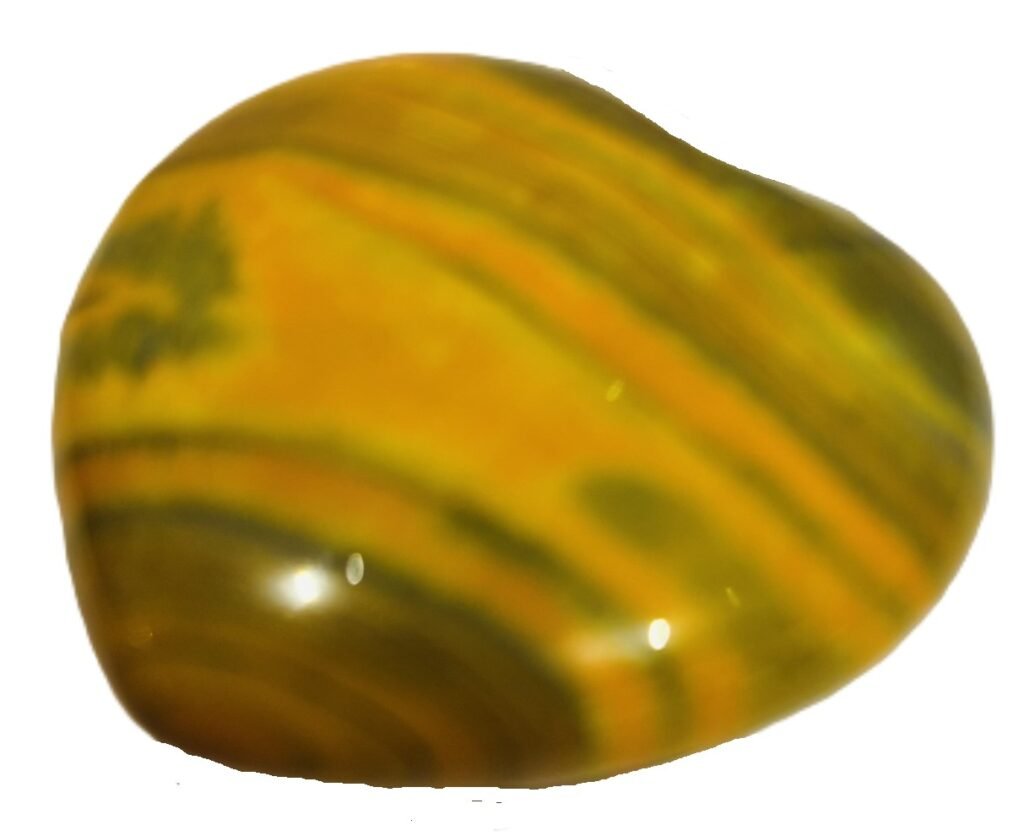
One “Jasper” has an unmistakable, fiery contrast of swirling rings of smoky charcoal, blazing orange, and vibrant neon yellow. Sellers routinely label this striking material as Bumblebee Jasper (occasionally styled as Eclipse Stone or Fimbristylis Stone). Its patterning mimics the fuzzy bands of an insect in flight, making it one of the most commercially sought-after stones in modern lapidary art and jewellery design.
Yet beneath this friendly, trade-friendly name lies one of the biggest misnomers in the mineral world. To most buyers, the label “jasper” implies durability, ease of care, and safety—a tough, everyday quartz stone you can drop in a pocket, tumble in water, or wear on a ring without a second thought.
Geologically, however, Bumblebee Jasper is not jasper at all. It is not an ordinary silicate, nor did it form quietly beneath ancient riverbeds. Instead, it is a volatile cocktail born in the sulphurous vents of an active volcano. Understanding what it actually is—and why that distinction matters—is essential for collectors, jewellery wearers, and lapidary artists alike.
The Origin Story: Mount Papandayan’s Volcanic Breath
True jasper is a dense, non-porous variety of chalcedony—a micro crystalline quartz made of silicon dioxide. It forms over immense stretches of time as silica-rich water slowly precipitates within sedimentary beds or cool fractures in existing rock.
Bumblebee “Jasper” has a radically different genesis. It is found almost exclusively on the steaming, geothermal slopes of Mount Papandayan, an active stratovolcano located in West Java, Indonesia. Rather than forming deep within calm rock formations, it is deposited right at the surface by fumaroles and hydrothermal vents—places where super heated, mineral-choked volcanic steam erupts into the open air and rapidly cools.
As these volcanic gases billow out, they leave behind layered crusts of minerals:
- The White and Cream Matrix (Calcite & Aragonite): Instead of tough quartz, the backbone of this stone is calcium carbonate—the same soft material that forms seashells, limestone, and stalactites.
- The Black and Slate Bands (Ash & Pyrite): The dark rings are literal ribbons of ancient volcanic fallout: ash, volcanic silt, and tiny metallic crystals of marcasite and pyrite (iron sulphide).
- The Fiery Yellows and Oranges (Arsenic Sulphides): That famous neon coloration does not come from harmless iron rust. It comes from inclusions of realgar (ruby-red to fiery orange) and orpiment (vivid golden yellow)—both naturally occurring arsenic sulphide minerals.
Because it is built from soft carbonates and heavy-metal sulphides rather than crystalline quartz, calling this material “jasper” is like calling chalk granite.
Head-to-Head Comparison
| Property | True Jasper | Bumblebee “Jasper” | What It Means for You |
| Primary Chemistry | Silicon dioxide ($\text{SiO}_2$) | Calcium carbonate ($\text{CaCO}_3$) + Sulphides | Bumblebee is chemically active and reactive, not an inert silicate. |
| Mohs Hardness | 6.5 – 7.0 (Hard) | 3.0 – 4.0 (Soft) | A steel pocket knife or copper penny can easily scratch Bumblebee; true jasper resists scratching. |
| Acid Reaction | Completely inert | Effervesces vigorously | Household acids (like lemon juice or vinegar) will dull and dissolve Bumblebee’s surface. |
| Toxicity Profile | Non-toxic | Contains arsenic and sulphur | Requires mindful handling and must never be ingested. |
| Porosity | Impervious and dense | Porous, vuggy, and micro-fractured | Bumblebee readily absorbs liquids, oils, and moisture. |
Everyday Safety: Handling, Display, and Home Use
Because Bumblebee Jasper contains naturally bound arsenic compounds, rumours and panic often circulate online. The reality sits comfortably in the middle: it is not dangerous to own or admire, but it does demand respect.
- Casual Touch: Finished cabochons and tumbled stones coated with a clean polish or resin seal are safe to touch and hold. Intact skin does not absorb solid arsenic minerals. However, washing your hands after handling raw specimens or unsealed stones is good, standard practice.
- Never Make “Crystal Waters” or Elixirs: A common wellness practice involves soaking polished stones in drinking water. Never do this with Bumblebee Jasper. Water leaches out acidic sulphides and soluble arsenic compounds, transforming a harmless decorative stone into toxic liquid.
- Pet and Child Proofing: Because the stone is soft and porous, small fragments can flake off if chewed. Store specimens well out of reach of pets and curious children.
- Beware of Sunlight (The Pararealgar Shift): Realgar is chemically sensitive to light. Prolonged exposure to direct sunlight causes its crystal structure to destabilise, causing the brilliant orange bands to break down into a brittle, powdery, dull yellowish crust known as pararealgar. Keep your display pieces away from sun-drenched windowsills.