
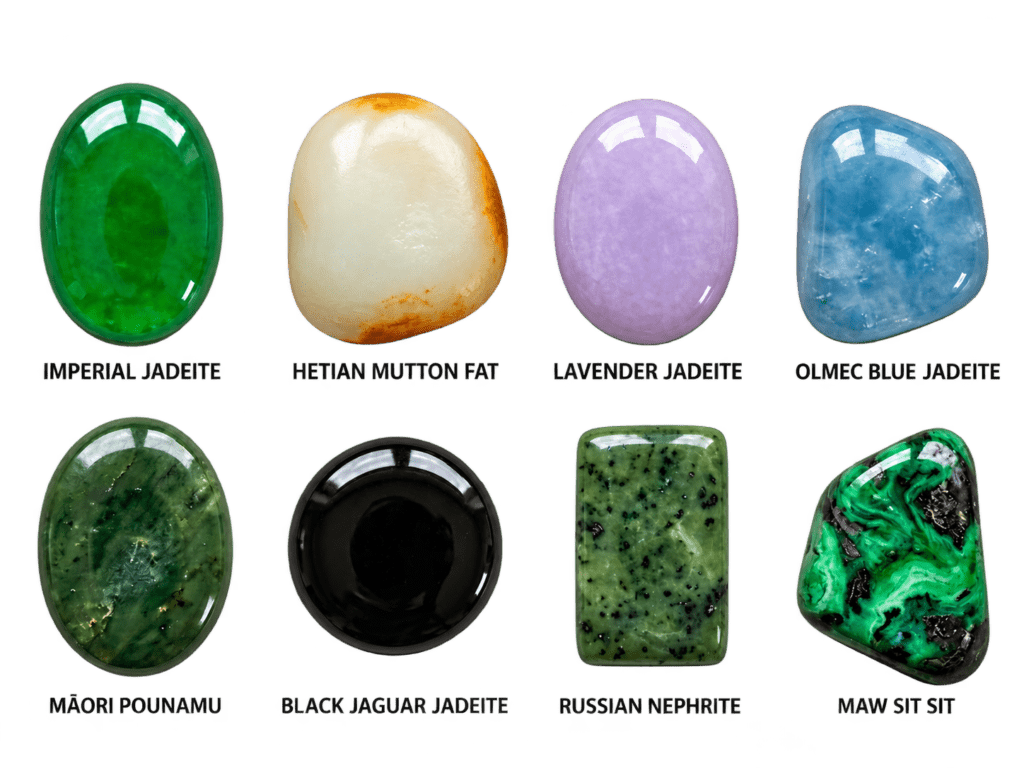
To truly understand jade, one must look beyond the generic green cabochons that flood the commercial market and explore the remarkable geological and cultural tapestry that defines the stone. While gemologists divide true jade into two distinct mineral species pyroxene jadeite and amphibole nephrite the ancient world recognised jade not through modern mineral lattices, but by its physical presence, tactile warmth, and visual poetry. From the high-altitude alluvial gravels of Xinjiang to the subduction zone faults of Guatemala and the sacred riverbeds of New Zealand, regional geologies have yielded an extraordinary spectrum of Jade varieties that shaped empires, religious rituals, and traditional lapidary arts.
Jade Varieties
Each variety tells a story of unique elemental interactions and geographic heritage:
- Geological Diversity: Trace elements like chromium, iron, manganese, and titanium transform the base silicate matrix into an array of colours, from vivid imperial greens and lilac lavenders to luminous watery blues and mirror-like blacks.
- Cultural Reverence: In ancient China, the oily, ivory warmth of “Mutton Fat” nephrite was revered above gold, while Mesoamerican rulers valued vivid translucent greens and deep ceruleans as sacred conduits of life and rain.
- Natural Formation: Whether naturally tumbled in glacial waters to form dense river “seed” jade wrapped in an iron-rich rind, or cut from massive alpine rock faces, the journey from rough boulder to finished masterpiece relies on the stone’s interlocking fibrous structure.
Exploring these regional sub-varieties reveals why jade remains one of the world’s most enduring and spiritually charged materials—a stone whose value is written as much in tectonic history and indigenous tradition as it is in market rarity.
Imperial Jadeite
An intensely saturated, vivid emerald-green pyroxene coloured primarily by trace chromium substituting for aluminium within the crystal matrix. Sourced almost exclusively from the Hpakan-Tawmaw sub-plateau in northern Myanmar, top-tier Imperial jade combines near-transparent clarity with a vibrant glow known as water head (aqueous translucency). It commands the highest per-carat price of any jade variety at auction.
Hetian “Mutton Fat” Nephrite (Hetian Yu)
Prized in China since antiquity, Mutton Fat Jade (Yang Zhi Bai Yu) is a micro crystalline tremolite-rich nephrite sourced from the Kunlun Mountains and Yurungkash (White Jade) River in Xinjiang. Rather than pure stark white, it displays a warm, greasy, yellowish-ivory cast with an oily, waxy lustre. Ancient dynastic lapidaries prized this subtle oily glow above green gemstones.
- Mountain Jade (Shan Yu): Quarried directly from primary alpine rock faces. It forms angular boulders that lack weathering rinds, typically displaying coarser grain and lower translucency.
- Seed Jade (Zi Yu): Alluvial pebbles and cobbles naturally tumbled by glacier-fed rivers over millennia. The tumbling action acts as natural percussion testing, fracturing away weak spots to leave an ultra-dense, silky core.
- The “Pí” (Rind): Secondary iron oxidation forms a thin red, yellow, or russet skin along the exterior of alluvial seed jade. Historic and contemporary carvers utilise this pí for high-relief cameo carvings, leaving the outer skin intact to frame the white interior.
New Zealand Pounamu & The Māori Classifications
Protected legally and spiritually under the guardianship of the indigenous Ngāi Tahu iwi, South Island riverbeds (notably the Arahura and Greenstone rivers) yield alluvial boulders classified into four traditional varieties:
- Kahurangi: The rarest form of pounamu; highly translucent, flaw-free, and displaying a vibrant, vivid apple-green hue. Traditionally reserved for the ceremonial adzes (toki poutangata) of chiefs.
- Inanga: Characterised by an opaque to semi-translucent pearly white or pale celadon grey tone, named after the native freshwater whitebait. It matures to a warm, soft hue with age and handling.
- Kawakawa: The most abundant variety, displaying a rich, dark forest-green body colour frequently sprinkled with dark iron-oxide inclusions, resembling the leaves of the native kawakawa tree.
- Tangiwai: While culturally grouped under pounamu, gemologically it is bowenite (a hard variety of serpentine) rather than nephrite. It is remarkably clear and olive-to-bluish green, deriving its name (“tears of sorrow”) from its watery transparency.
Mesoamerican Jadeite (Motagua Valley, Guatemala)
Rediscovered along tectonic strike-slip fault zones along the Motagua River, Guatemalan deposits supplied ancient Mesoamerican civilisations with unique colour profiles:
- Olmec “Blue” Jadeite: The signature material of the Olmec culture (1500–400 BCE). Semi-translucent with a luminous, watery cerulean tone produced by titanium and iron interacting within an oxygen-reduced pyroxene lattice.
- Maya Emerald Green: Highly prized by Classic Maya royalty (250–900 CE) for funerary masks and royal pectorals, coloured by trace chromium.
- Jaguar Black Jadeite: An opaque, jet-black pyroxene rock rich in omphacite and native iron-titanium oxides, capable of taking a mirror-like vitreous polish for ceremonial mirrors and celts (old name for axe or chisel)
- Lilac/Lavender Jadeite: Exposed by massive landslides following Hurricane Mitch in 1998, this material features soft pastel-purple tones driven by trace manganese and iron.
Siberian Nephrite (Sayan Mountains, Russia)
Sourced from the East Sayan region near Lake Baikal, Russian nephrite occurs both as massive primary lode veins and alluvial boulders. It is known for its intense “spinach-green” colour, high translucency, and diagnostic inclusions: tiny, pepper-like specks of black chromite and graphite scattered throughout the tremolite matrix.
Maw Sit Sit (The Gemological Special Case)
Often sold alongside Burmese jadeite in regional markets, Maw Sit Sit is a metamorphic rock rather than a pure mineral jade. Mined at Maw Sit Sit in Kachin State, Myanmar, it is a complex aggregate composed of kosmochlor (a chromium-rich pyroxene), chromian jadeite, albite, and chlorite. Its signature appearance features an electric, neon-green body mapped with intense, jet-black swirls and dendritic patterns.
Further information on Jade Varieties
For more information of Jade, see my related articles Jade Ultimate Guide: Nephrite v Jadeite Meaning & Properties and also Jade Categories Explained: How to Identify Types A, B, and C Jade

