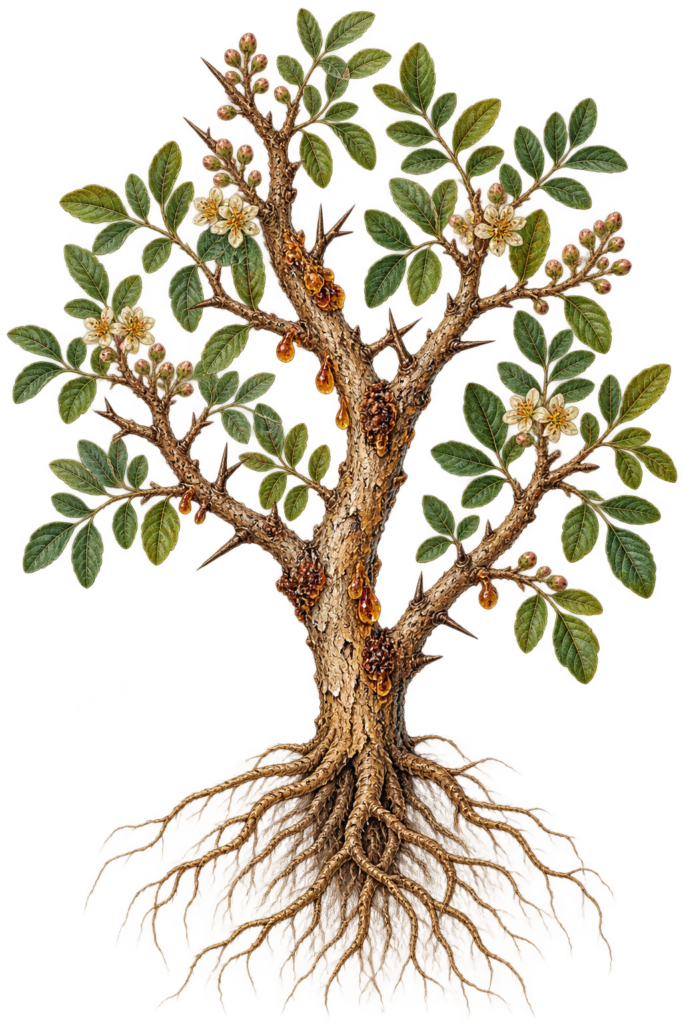
Myrrh is an aromatic natural oleo-gum-resin harvested from small, thorny, scrubby trees of the genus Commiphora, belonging to the Burseraceae (Torchwood or Frankincense) family. These desert-adapted trees thrive in shallow, rocky limestone soils across the Horn of Africa and the southern Arabian Peninsula.
When the bark is wounded or deeply incised, the tree exudes a pale, viscous, yellowish oleo-resin to seal the injury against desert heat and pathogen infiltration. As it dries under the arid sun, this fluid oxidizes into dark, irregular, reddish-brown nodules known as tears.
Key Commiphora Species
| Species | Common Names / Origin | Resin Appearance & Scent Profile | Distinctive Chemistry |
| Commiphora myrrha (syn. C. molmol) | True Myrrh, Herabol Myrrh (Somalia, Ethiopia, Yemen, Oman) | Deep reddish-brown to almost black tears; dusty exterior; bitter, warm, dark balsamic scent. | Rich in furanosesquiterpenes (curzerene, furanoeudesma-1,3-diene, lindestrene). |
| Commiphora guidottii | Opopanax, Scented Myrrh, Bisabol Myrrh (Southern Somalia, Ethiopia) | Golden-brown, brittle, vitreous tears; sweet, fruity, warm-spicy balsamic aroma. | Dominated by (E)-$\beta$-ocimene, $\alpha$-bisabolene, and $\alpha$-santalene; less bitter. |
| Commiphora mukul (syn. C. wightii) | Guggul, Indian Bdellium (India, Pakistan) | Soft, dark brown to greenish paste-like resin; earthy, pungent, balsamic. | High in guggulsterones (E- and Z-isomers); utilized extensively in Ayurveda for lipid balance. |
| Commiphora erythraea | African Opopanax (East Africa, Arabia) | Reddish-amber tears; rich, honeyed, animalic balsamic notes. | Rich in sesquiterpene hydrocarbons; traditional fixative in high perfumery. |
Ancient Origins & Antiquity
Myrrh was one of the most sought-after and costly trade goods of the ancient Mediterranean and Near Eastern worlds, revered for embalming, elite cosmetics, and temple liturgies.
Ancient Egypt & The Afterlife Cult: Known to the Egyptians as ‘abr’ or ‘bal’, Myrrh was purchased through major expeditions to the Land of Punt. It served as a primary agent in royal mummification: after visceral organs were removed, the abdominal cavity was rinsed with palm wine and packed with pure bruised myrrh and cassia to arrest physical decay. It was also compounded into the sacred temple incense Kyphi (Kapet) and burned at dusk to honour underworld transitions.
Mesopotamia & Levant: In the Hebrew Bible, Myrrh (Mor, מָר) is featured prominently. In Exodus 30:23, “pure myrrh” (Mor Deror) is the primary ingredient by weight (500 shekels) in the Holy Anointing Oil. In the Song of Solomon, it serves as an archetype of intimate romance and sacred beauty (“A bundle of myrrh is my well-beloved unto me”).
The Classical World: Greek and Roman physicians, including Hippocrates, Dioscorides, and Galen, listed myrrh extensively in their pharmacopeias for battlefield wound management, dental washes, and surgical antisepsis. Roman funeral rites consumed enormous quantities to mask the odour of cremation pyres.
The Christian Nativity & Passion: In Christian theology, Myrrh acts as the prophetically sombre gift of the Magi (symbolising mortality and burial), was offered mixed with wine on the cross as a narcotic analgesic (Mark 15:23), and was brought by Nicodemus alongside aloes (roughly 100 Roman pounds) to wrap the body of Jesus (John 19:39).
Folklore, Superstition & Cultural Traditions
Across ancient mythologies and regional desert folklore, Myrrh is intrinsically linked with grief, transformative beauty, and physical preservation:
The Myth of Myrrha: In Ovid’s Metamorphoses, Myrrha (mother of Adonis) was transformed by the gods into a weeping Commiphora tree to escape her father’s wrath. Her perpetual tears of sorrow hardened into the aromatic resin, providing the classical mythological origin for the tree’s name and bitter taste.
The Bridal Purification of Esther: In the Book of Esther (2:12), women of the Persian royal court underwent twelve months of intensive beauty preparation before meeting the king—six full months of which were spent exclusively with daily oil-of-myrrh massage to smooth and purify the skin.
Chthonic & Underworld Ward: In Middle Eastern and Levantine folklore, the pungent smoke of burning myrrh was used to keep nocturnal spirits, parasitic astral entities, and the corruption of physical death at bay, acting as an energetic barrier during wakes and burials.
Therapeutic & Medicinal Applications
Modern pharmacology has validated the antimicrobial, analgesic, and tissue-protective properties of Commiphora myrrha.
- Oral Health & Gingivitis: Myrrh tincture remains a gold standard in clinical herbal dentistry. Its astringent sesquiterpene lactones cause the precipitation of surface tissue proteins, tightening inflamed gingival tissue and inhibiting oral pathogens like Streptococcus mutans. It is widely used for aphthous ulcers (canker sores), gingivitis, and sore throats.
- Analgesic Properties (Opioid Modulation): Pharmacological studies show that furanosesquiterpenes in myrrh—specifically furanoeudesma-1,3-diene and curzerene—act on central $\delta$-opioid receptors, explaining its ancient efficacy in relieving headaches, joint pain, and wound trauma.
- Topical Wound Healing & Antimicrobial Action: Applied as a diluted tincture or salved oleoresin, myrrh exerts broad-spectrum antibacterial and antifungal activity, promoting tissue regeneration and protecting slow-healing ulcerations from secondary infection.
- Synergistic Anti-Inflammatory Action: In modern phytotherapy, myrrh is frequently combined with Frankincense (Boswellia), producing a synergistic reduction in pro-inflammatory cytokines that exceeds the efficacy of either resin alone.
Astrological & Mystical Correspondences
Planetary Rulers:
Saturn ($\style{font-family:serif}{\text{♄}}$) [Primary]: Governs endurance, boundaries, physical structures, skeletal preservation, time, bitterness, and the underworld threshold.
The Moon ($\style{font-family:serif}{\text{☽}}$) [Secondary]: Connects to the deep subconscious, ancestral memory, nocturnal incubation, and emotional processing.
Elemental Affinity: Water ($\style{font-family:serif}{\text{🜄}}$) & Earth ($\style{font-family:serif}{\text{🜃}}$). Reflects internal fluid balance, bodily tissue, grounding stillness, and deep introspective depth.
Zodiac Association: Scorpio ($\style{font-family:serif}{\text{♏}}$) (regeneration, death/rebirth cycles, esoteric depth) and Capricorn ($\style{font-family:serif}{\text{♑}}$) (discipline, time, enduring ancient form).
Chakra Resonances:
Root Chakra (Muladhara): Anchors scattered astral energy, establishes psychic grounding, and bolsters physical vitality.
Sacral Chakra (Svadhisthana): Clears stagnant emotional imprints, grief, and energetic trauma stored in the lower abdomen.
Tarot Association: The World (XXI) (completion of cycles, Saturnian boundaries) and The High Priestess (II) (hidden subterranean wisdom, the veil between worlds).
Culinary & Domestic Uses
Digestive Bitters & Tonics: Myrrh’s intense bitterness stimulates bile secretion and digestive enzymes. It is an active bittering agent in traditional European stomachics, elixirs of long life, and certain classic herbal liqueurs (including authentic Fernet preparations).
Natural Linen & Fabric Preservation: Historically, raw tears were placed among woolen blankets, silks, and clothing chests. The resin acts as an effective botanical deterrent against clothes moths (Tineola bisselliella) and silverfish while preventing mustiness.
Traditional Cosmetic Balms: Powdered myrrh infused into olive or almond oil remains a traditional skin-softening balm across Northeast Africa, used to soothe severely chapped hands, cracked heels, and sun-damaged skin.
Spiritual, Energetic & Metaphysical Properties
Where frankincense acts as a radiant solar expander, Myrrh acts as a deep energetic stabilizer and shield:
Psychic Shielding & Grounding: Myrrh creates an impenetrable energetic boundary. It pulls high-strung, anxious, or ungrounded energy back down into the physical body, sealing micro-tears in the auric field caused by shock, trauma, or emotional exhaustion.
Processing Grief & Shadow Work: The bitter-balsamic fragrance eases the pain of bereavement and major transitions. It supports shadow work and inner reflection by allowing difficult emotions to be processed without dissociation.
Clearing Heavy Residual Impressions: When burned alongside frankincense or copal, myrrh binds to low-frequency residual energetic imprints within spaces (such as old buildings or healing rooms) and neutralises them.
Fun Facts
- The Linguistic Root of “Bitter”: The word myrrh comes directly from the Semitic root M-R-R (Aramaic: mūrā, Hebrew: mar, Arabic: murr), which literally translates to “bitter.”
- The “Flowing” Tears: The highest, most expensive biblical grade of myrrh—Mor Deror—referred to the resin that naturally exuded from the tree without artificial bark incisions. These unforced tears were harvested before dust could adhere to them.
- Ancient Anti-Aging Legend: Egyptian women compounded myrrh into a paste with crushed frankincense and cypress wood, calling it a formula to “turn an old man into a youth”—an early precursor to modern anti-aging facial serums.
Frequently Asked Questions
What is the difference between Herabol Myrrh and Bisabol Myrrh (Opopanax)?
Herabol Myrrh (Commiphora myrrha) is the classic bitter resin used for medicine, protection, and astringency; it is dark reddish-brown and pungent. Bisabol Myrrh or Opopanax (Commiphora guidottii) is lighter, golden-amber, significantly sweeter, and fruity-balsamic. It is prized primarily by fine perfumers rather than clinical herbalists.
Why does Myrrh resin scorch and smell harsh when burned?
Unlike frankincense, which melts smoothly due to a high monoterpene and resin acid content, crude myrrh contains up to 60% water-soluble gum. When placed directly onto red-hot charcoal discs, this plant gum scorches rapidly, producing an acrid, burnt-toast smoke. To enjoy its true fragrance:
- Wait until charcoal develops a thick layer of white ash to drop the temperature, or
- Use an indirect, adjustable tea-light burner, or
- Blend powdered myrrh with frankincense or sandalwood powder, which acts as a thermal buffer.
How is a medicinal Myrrh tincture prepared?
Because myrrh contains both water-soluble gums and alcohol-soluble resins, extracting it requires high-proof alcohol (minimum 70–90% ABV, such as pure grain alcohol).
- Use a 1:5 weight-to-volume ratio (1 part coarsely crushed myrrh to 5 parts alcohol).
- Macerate in a sealed glass jar for 4 to 6 weeks, shaking daily.
- The resin will dissolve into a rich amber-red liquid while the white inert gum settles to the bottom. Filter through unbleached cloth.