
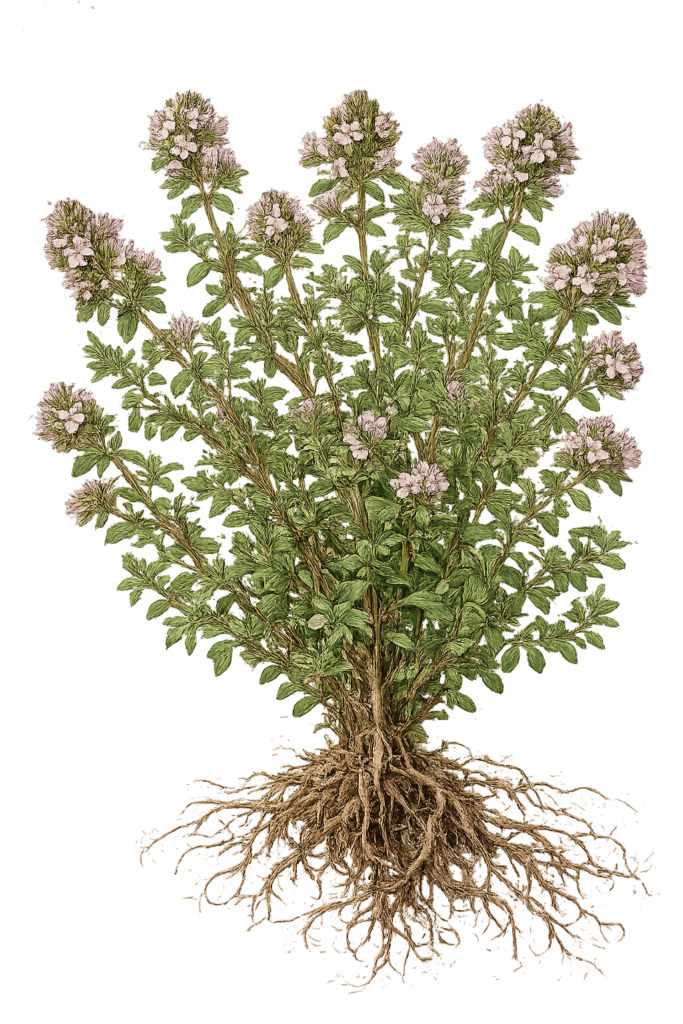
Few plants bridge the realms of kitchen, apothecary, and folklore as effortlessly as common thyme (Thymus vulgaris). Beneath its delicate, wiry stems and tiny, aromatic leaves lies a potent botanical powerhouse with a lineage stretching back thousands of years. From the embalming chambers of ancient Egypt and the sacred hearths of classical Greece to the monastic healing gardens of medieval Europe, thyme has long stood as an enduring symbol of courage, vitality, and renewal.
Today, whether it is simmering in a classic bouquet garni, steeping in an artisanal apothecary syrup, or lending its antimicrobial volatile oils to modern therapeutic preparations, this humble Mediterranean subshrub remains an essential herb in daily life. This guide explores the multifaceted world of Thymus vulgaris—delving into its botanical nuances, rich historical lore, energetic traditions, and timeless practical uses.
Botanical Overview & Key Species
Thymus vulgaris belongs to the mint family, Lamiaceae. Native to the sunny, rocky scrublands of the western Mediterranean basin, it is a hardy, woody-based evergreen perennial subshrub.
- Morphology: Grows 15–30 cm tall, forming dense mounds of wiry, branched square stems that become woody with age. Its leaves are small (4–12 mm long), linear to elliptical, grey-green, slightly recurved along the margins, and dotted with glandular trichomes containing volatile oils.
- Inflorescence: Produces dense whorls (verticillasters) of tiny, two-lipped flowers ranging from pale pink to lilac and white from late spring through mid-summer.
- Chemotypic Diversity: Wild T. vulgaris exhibits marked polymorphism, producing distinct chemical phenotypes (chemotypes) based on microclimate and altitude, most notably thymol (warm, dry lowlands), carvacrol, linalool (cooler uplands), geraniol, and thujanol.
Key Related Species
| Species | Common Name | Distinguishing Traits | Primary Use |
|---|---|---|---|
| Thymus vulgaris | Common / Garden Thyme | Upright, intense thymol aroma, gray-green foliage | Culinary, pharmacopeial standard |
| Thymus serpyllum | Wild / Creeping Thyme (Mother of Thyme) | Low-growing ground cover, purplish blooms, mat-forming | Landscaping, traditional European teas |
| Thymus citriodorus | Lemon Thyme | Bright citrus-forward aroma, rich in geraniol/citral | Culinary (fish, poultry, desserts) |
| Thymus capitatus | Cone head Thyme | Domed inflorescence, aggressive carvacrol content | Mediterranean wild foraging, strong essential oil |
| Thymus herba-barona | Caraway Thyme | Distinct pungent aroma reminiscent of caraway seed | Speciality culinary seasoning |
Ancient Origins & Antiquity
The cultural history of thyme originates from the Mediterranean region:
- Sumerian & Egyptian Embalming: As early as 3000 BCE, Sumerians utilised thyme decoctions as an antiseptic wash. The ancient Egyptians called it tham and made extensive use of its volatile oils alongside myrrh and cedarwood in the mummification process, capitalising on its preservative properties to prevent microbial decay.
- Classical Greece: The name Thymus derives from the Greek root thyein (“to burn sacrifice”) or thymos (“courage”, “spirit”, or “breath of life”). Greeks burned dried thyme bundles as cleansing incense in temples dedicated to Apollo and Aphrodite. Greek athletes massaged their bodies with thyme oil before contests to invigorate their muscles and sharpen their senses.
- Roman Expansion: The Romans expanded the herb’s therapeutic and tactical footprint. Soldiers bathed in thyme-infused waters before battle to instil bravery (thymos). Pliny the Elder documented its utility for respiratory distress, melancholy, and snake venom neutralisation. Roman legions subsequently carried the plant across the Alps, establishing it in Gaul, Britannia, and Germania.
Folklore, Superstition & Cultural Traditions
Throughout the Middle Ages and Renaissance, thyme shifted into European folk magic and chivalric code:
- Emblem of Chivalry: During the Crusades, noblewomen embroidered scarves and tunics with bees hovering around sprigs of flowering thyme to bestow fortitude upon departing knights.
- The Faerie Realm: English and Scottish folklore held that wild thyme was the preferred playground and bedchamber of fairies. The 17th-century herbalist and astrologer Nicholas Culpeper, alongside folkloric grimoires, recorded recipes for “sight waters”—decoctions of wild thyme tops gathered near fairy hills, lady’s mantle, and marigold—to enable mortals to see the “Faerie Folk.”
- Funerary Rites & Restless Spirits: Mourners threw sprigs of thyme into open graves during burials to ensure the safe passage of the deceased’s soul, symbolising resurrection, enduring love, and remembrance.
- Dream Magic: Placing a sprig of thyme beneath a pillow was believed to avert nightmares, induce peaceful sleep, and grant visions of future lovers.
Therapeutic & Medicinal Applications
The pharmacopeial power of thyme rests primarily on its essential oil content, which yields significant amounts of volatile phenols:
- Antimicrobial & Antiseptic Action: Thymol and carvacrol disrupt bacterial cell membranes and inhibit fungal biofilm formation. Thymol remains a standard active ingredient in commercial antiseptic mouthwashes, dental varnishes, and topical wound formulations.
- Respiratory & Spasmolytic Support: Thyme leaf extracts are widely approved (such as by the European Medicines Agency) for relieving wet coughs and bronchial spasms associated with colds, bronchitis, and pertussis. The flavonoids (apigenin, luteolin) relax tracheal smooth muscle, while thymol stimulates secretomotor ciliary action to expel mucus.
- Digestive Stimulation: Bitter principles and volatile terpenes stimulate the secretion of gastric juices, reduce flatulence, and help relieve intestinal cramping.
- Topical Anti-Inflammatory: Diluted thyme infusions and liniments are traditionally applied to soothe arthritic joints, sprains, and cutaneous fungal infections (such as ringworm and athlete’s foot).
Astrological and Mystical Correspondences
In traditional Western occultism, Hermetic botany, and astrological herbalism, thyme is codified with distinct elemental and planetary signatures:
- Planetary Rulers: Venus (associated with beauty, love, harmony, and fairy lore) and Mars (associated with courage, protection, purification, and physical vitality).
- Element: Water (for its emotional soothing, restorative dream qualities, and connection to the fey) or Fire (for its warming, pungent nature and courage-building qualities).
- Zodiac Associations: Taurus (Venusian affinity, connection to early spring earth) and Aries (Martian fiery vigour).
- Polarity: Feminine / Receptive.
- Alchemical Signatures: Warm and Dry in the third degree (according to Galenic humorism).
Culinary & Domestic Uses
Thyme’s resinous, savoury, slightly minty-clove flavour profile makes it one of the foundational culinary herbs globally:
- Classic Spice Blends:
- Bouquet Garni: Tied with bay leaf and parsley to flavour stocks, stews, and braises.
- Herbes de Provence: Combined with rosemary, marjoram, savoury, and oregano.
- Za’atar: Ground wild Mediterranean thyme blended with toasted sesame seeds, sumac, and salt.
- Culinary Pairing: Pairs naturally with roasted meats (poultry, lamb, beef), root vegetables, legumes, tomato sauces, and compound butters.
- Domestic Applications: Dried sprigs placed in linen closets serve as a natural deterrent against clothes moths and silverfish. In traditional households, thyme vinegar was prepared as an all-purpose antimicrobial kitchen cleanser.
Spiritual, Energetic & Metaphysical Properties
In energetic ritual work, thyme serves as a primary purifying and uplifting catalyst:
- Purification & Cleansing: Smudged or brewed into a floor wash, thyme dispels stagnant, heavy, or melancholic energy from domestic spaces.
- Cultivating Courage & Inner Fortitude: Carried in a mojo bag or sachet to bolster confidence during difficult transitions, public speaking, or confrontation.
- Grief & Emotional Release: Used in spiritual baths to support individuals releasing profound sorrow or trauma, assisting the heart centre to recover warmth and buoyancy.
- Psychic Shielding: Planted along garden borders or placed on window sills to deter negative intent and seal energetic boundaries.
Fun Facts
- World War I Antiseptic: Before the widespread synthesis of modern antibiotics, thymol extracted from thyme was used extensively to dress battle wounds and disinfect surgical tools during the First World War.
- Honey of the Gods: Mount Hymettus in Greece has been famous for thousands of years for its thyme honey, revered by ancient poets and modern gourmands alike for its amber color and floral complexity.
- Bee Magnet: The Latin name Thymus was frequently linked by Roman writers to the herb’s magnetic attraction for honeybees, producing clear, medicinal nectar.
- Historical Beer Preservative: Before hops became the standard bittering agent, medieval brewers used thyme along with other aromatic herbs in “gruit” blends to flavor and preserve ale.
Frequently Asked Questions
Can common thyme (Thymus vulgaris) be grown easily in containers?
Yes. Thyme thrives in terracotta pots with sharp drainage. It requires a free-draining sandy/loamy soil mix, at least 6 to 8 hours of direct sunlight daily, and moderate watering (allow the top two inches of soil to dry out between waterings).
What is the difference between fresh and dried thyme in cooking?
Because thyme’s leaves have low moisture content and durable essential oils, dried thyme retains its pungency better than soft herbs like basil or cilantro. Use a ratio of 1 teaspoon of dried thyme to 1 tablespoon (3 teaspoons) of fresh thyme. Add dried thyme early in the cooking process so the heat rehydrates the leaves and releases the oils.
Is thyme essential oil safe to apply directly to the skin?
No. Thyme essential oil—especially thymol-heavy chemotypes—is a potent dermal irritant and “hot” oil. It must always be diluted in a carrier oil (such as jojoba, almond, or olive oil) to a concentration of 1% or less before topical application.
