
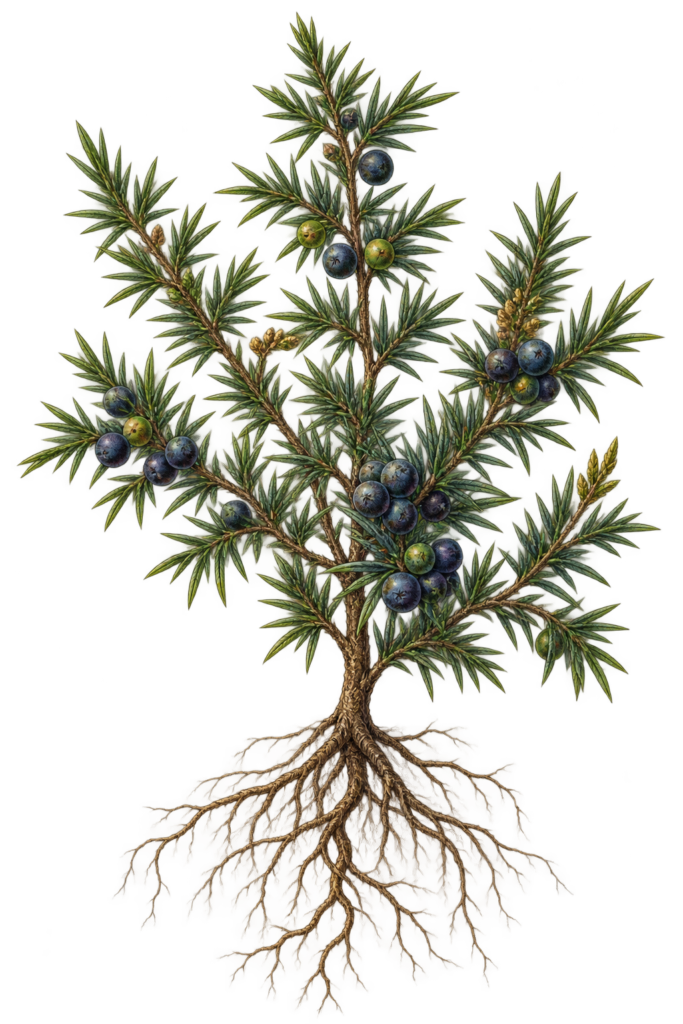
Juniper belongs to the genus Juniperus within the Cupressaceae family. Historically, they comprise roughly fifty to sixty-seven species of evergreen conifers worldwide. The classification places Juniperus firmly within Cupressaceae. This grouping reflects evolutionary relationships among conifers. These features help botanists compare species and track variation. Additionally, Juniper mystical properties are of interest in traditional studies and modern botany.
They range from prostrate alpine shrubs barely hugging rocky terrain to upright trees exceeding 20 metres in height.
Juniper mystical properties have attracted attention from herbalists and researchers worldwide.
Their variety spans environments from cold highs to warmer lowland zones.
These characteristics aid botanists in comparing species and tracking variation.
- Foliage: Needle-like, whorled juvenile leaves or overlapping, scale-like mature foliage depending on the species.
- Seed Cones (“Berries”): Juniper does not produce true botanical berries. The “berries” are modified seed cones with fleshy, coalesced scales, coated in a white, waxy bloom (epicuticular wax) that turns dark blue-black or deep purple upon maturity, taking up to 2–3 years to ripen.
- Key Species:
- Juniperus communis (Common Juniper): Boasts the largest geographic distribution of any woody plant in the world, spanning North America, Europe, and Asia. It is the primary species harvested for culinary and distilling purposes.
- Juniperus virginiana (Eastern Redcedar): Native to eastern North America; historically prized for aromatic, rot-resistant timber and cedarwood essential oil.
- Juniperus sabina (Savin Juniper): Native to central and southern Europe; historically notorious for its toxicity due to high levels of the terpene sabinene and podophyllotoxin.
- Juniperus osteosperma (Utah Juniper) & Juniperus monosperma (Oneseed Juniper): Arid-zone keystone species across the American Southwest, essential to Indigenous foodways and ceremonial customs.
Ancient Origins & Antiquity
Juniper’s relationship with human civilisation dates back thousands of years across Eurasia, North Africa, and the Americas:
- Ancient Egypt (c. 1500 BCE): Juniper berries and cedar/juniper oils were imported from the Levant for mummification rituals, perfume bases, and digestive tonics recorded in the Ebers Papyrus.
- Mesopotamia: Burnt in hearths and brazier offerings to appease the goddess Ishtar and purify living spaces against pestilence.
- Greco-Roman Antiquity: Dioscorides celebrated juniper in De Materia Medica as a warming diuretic and stomachic. The Greeks consumed juniper berries before athletic contests, believing they enhanced physical endurance, while Romans used them as a cheap, locally available substitute for black pepper.
Folklore, Superstition & Cultural Traditions
Throughout European and Indigenous folklore, juniper has served as a guardian against malevolent forces, disease, and spiritual corruption:
- Protective Warding: In Scottish Highlands folklore, burning green juniper branches (saining) inside byres and homes on New Year’s Eve (Hogmanay) was believed to cleanse livestock and families of the evil eye and winter stagnation.
- Threshold Guardian: In Germanic and Scandinavian traditions, hanging juniper boughs above entryways or under eaves prevented witches and thieves from entering; folklore held that spirits could not pass until they counted every needle on the branch.
- Biblical Lore: In Christian apocrypha, a juniper bush opened its branches to hide Mary, Joseph, and the infant Jesus from King Herod’s soldiers during the flight into Egypt, cementing the plant’s reputation as a sanctuary tree.
Therapeutic & Medicinal Applications
The medicinal efficacy of juniper stems mainly relies on its volatile essential oil, rich in terpenes such as alpha-pinene, beta-pinene, terpinen-4-ol, and sabinene.
- Diuretic & Renal Support: Terpinen-4-ol stimulates kidney glomerular filtration, increasing urine volume and flushing mild urinary tract irritations.
- Antimicrobial & Antifungal: Juniper extracts display significant in vitro activity against common bacterial pathogens (Staphylococcus aureus, Escherichia coli) and dermatophytes.
- Digestive Tonic (Carminative): Bitter principles and volatile oils stimulate gastric juices and bile production, alleviating bloating, dyspepsia, and indigestion.
- Topical Counter-Irritant: Diluted juniper berry oil is used in balms to stimulate micro circulation, offering relief for arthritic joints and muscular aches.
Safety Precaution: Due to potential renal stimulation and uterine-contracting properties, therapeutic doses of juniper essential oil are contraindicated during pregnancy.
They are also contraindicated in individuals with chronic kidney disease.
Astrological and Mystical Correspondences
In Western hermetic, astrological, and planetary magic traditions, juniper holds explicit energetic assignments:
| Category | Correspondence | Context / Rationale |
| Planetary Ruler | Jupiter (traditional) / Mars (protective) | Expansion, benevolence, and health (Jupiter); sharp needles and purifying heat (Mars) |
| Element | Fire | Warm, drying nature; aromatic resinous smoke used for purification |
| Zodiac Sign | Sagittarius / Aries | Direct resonance with Jupiter’s rulership and Mars’ fiery vitality |
| Energetic Temperament | Hot $2^\circ$, Dry $2^\circ$ | Classically used to purge cold, phlegmatic, and damp conditions |
| Tarot Correspondence | The Wheel of Fortune or The Sun | Themes of divine luck, vitality, and clearing energetic blockages |
Culinary & Domestic Uses
- Gin & Spirits: The word “gin” derives from the French genièvre and Dutch jenever. European Union regulations require gin to carry a predominant organoleptic flavour of juniper berries (Juniperus communis).
- Game & Charcuterie: Juniper berries possess a piney, peppery, slightly floral profile that cuts through the rich fats of game meats (venison, boar, duck) and serves as an essential seasoning in European charcuterie, sauerkraut, and marinades.
- Woodcraft & Domestic Firewood: Juniper heartwood is dense, rot-resistant, and naturally repels insects, making it historically favoured for fence posts, storage chests, and smoking meats (such as traditional Scandinavian and Alpine smoked fish and bacon).
Spiritual, Energetic & Metaphysical Properties
- Banishing & Space Clearing: Burning dried juniper needles and berries produces an aromatic, resinous smoke that dispels heavy, stagnant energy and cleanses spaces after illness or conflict.
- Psychic Shielding & Grounding: Used in mojo bags, talismans, and ceremonial incenses to reinforce personal boundaries against psychic drain.
- Clarity & Focus: The sharp, coniferous scent cuts through mental exhaustion and confusion, grounding the mind during meditation and ritual work.
Fun Facts
- Oldest Living Conifers: Certain sub-species, like the Rocky Mountain Juniper (Juniperus scopulorum), can live for over 1,500 to 2,000 years in harsh, sub-alpine conditions.
- Bird Distribution Engine: Junipers depend heavily on frugivorous birds—especially the Townsend’s Solitaire, Bohemian Waxwing, and American Robin—which digest the fleshy cones and distribute viable seeds over wide areas.
- Black Death Fumigant: During the bubonic plague outbreaks in medieval Europe, doctors and townspeople burned large heaps of juniper in streets and inside the beaks of plague masks to neutralise “miasma” (foul air).
Frequently Asked Questions
Are all juniper berries edible?
No. Juniperus communis is safe in culinary amounts, but some species, such as Juniperus sabina, have toxic oils. Additionally, they can cause vomiting, kidney damage, and convulsions. Never forage or consume wild juniper without precise botanical verification.
What is the difference between juniper berry spice and fresh berries?
Culinary juniper berries are typically sold dried. Fresh ripe berries are soft, waxy, and resinous, while dried berries darken to a shrivelled, dark purple-blue state with concentrated volatile oils. Lightly crushing them before cooking releases their aromatic flavour.
Can juniper essential oil be applied directly to the skin?
No. Juniper essential oil is potent and can cause skin irritation or sensitisation if applied neat. It should always be diluted in a carrier oil (such as jojoba or almond oil) to a concentration of 1–2% before topical application.
