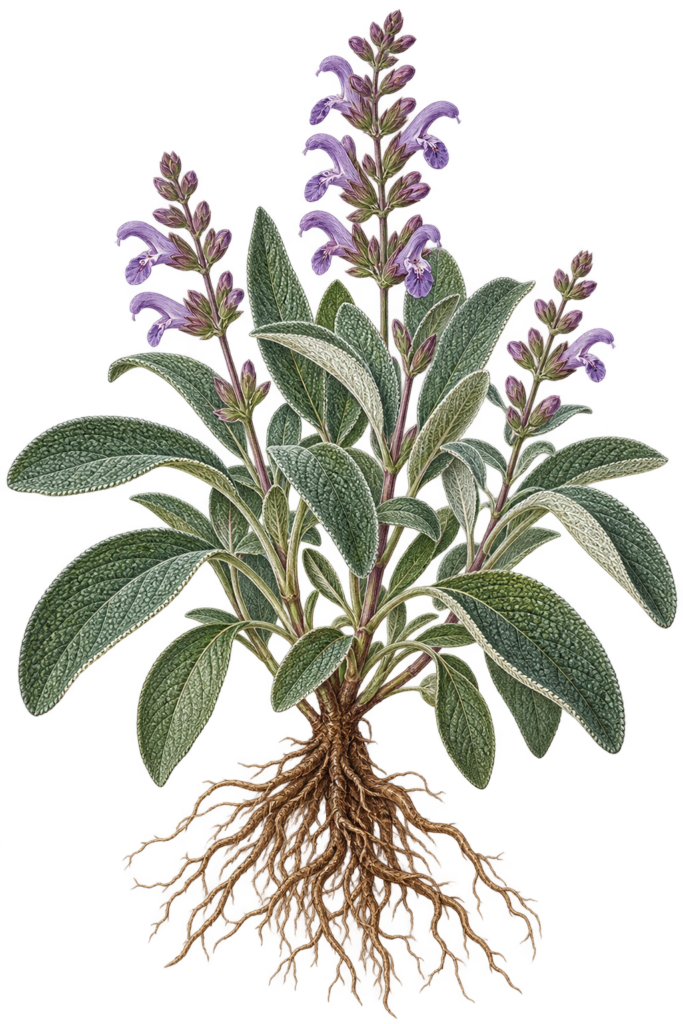
Garden sage (Salvia officinalis) is the familiar culinary staple cultivated across British and European kitchen gardens. While famous for its culinary and herbal heritage, it has become the premier, sustainable workhorse for modern smoke cleansing, sacred resets, and intentional living.
Botanical Profile & Etymology
Belonging to the mint family (Lamiaceae), Salvia officinalis is an evergreen subshrub chara cterised by woody stems, velvety grey-green leaves with a pebbled texture, and spikes of violet-blue flowers.
The botanical name holds deep historical weight:
- Salvia: Derived directly from the Latin salvere, meaning “to feel healthy, to heal, or to save,” reflecting its traditional standing as a herb of salvation and health.
- Officinalis: Indicates its inclusion in the official botanical list of medicinal plants used by monastic apothecaries.
- The “Sage”: Over centuries, the word became synonymous with a person of profound wisdom, sound judgement, and long life.
Garden Sage vs. White Sage (Salvia apiana)
It is essential to distinguish culinary garden sage from North American white sage:
| Feature | Garden Sage (Salvia officinalis) | White Sage (Salvia apiana) |
| Origin | Mediterranean basin & Southern Europe | Southern California & Baja California |
| Cultural Context | European folklore, domestic herbalism, culinary arts | Sacred ceremonial plant of Indigenous nations (Chumash, Kumeyaay) |
| Sustainability | Readily home-grown, non-threatened, abundant | Wild populations face severe pressure from commercial over harvesting |
| Aroma Profile | Earthy, savoury, warm, and sharp | Intensely sharp, pungent, and herbaceous |
For practitioners seeking a grounded, accessible herb, common garden sage avoids commodifying culturally specific ceremonial plants while offering a direct link to local garden traditions.
Traditional Folklore & Historical Uses
Garden sage (Salvia officinalis) was first brought to Britain by the Romans over 2,000 years ago. They introduced the Mediterranean herb for cooking and military field hospitals. Its cultivation expanded during the Middle Ages when monks grew it in monastery physic gardens for its credited healing powers.
Across European folk magic and Mediterranean domestic traditions, sage was held in exceptionally high esteem:
- Protective Wards: Planted near doorways, cottage gates, and garden borders to ward off illness, block negative energy, and invite prosperity.
- Longevity Lore: A classic medieval proverb asked: “Cur moriatur homo cui Salvia crescit in horto?” (“Why should a man die while sage grows in his garden?”).
- Purification Rituals: Monasteries and medieval households burned dried sage boughs during epidemics to disinfect rooms, deter pests, and freshen stale domestic air.
Modern Spiritual Meaning & Energetic Profile
Garden sage carries an energetically brisk, clean, and grounding signature. Unlike heavy woods or dense resins, it breaks up sluggish, static energy without leaving a cold or sterile energetic void.
Core Spiritual Attributes:
- Cleansing & Purification: Scatters accumulated emotional static and environmental heaviness.
- Wisdom & Mental Clarity: Sharpens the intellect, calms scattered thoughts, and supports sound decision-making.
- Protective Shielding: Establishes resilient boundaries around the home, altar, or aura.
- Ritual Readiness: Prepares a space for intention setting, meditation, or divination.
When to Use Garden Sage
Garden sage is uniquely suited as an all-purpose, multi-functional cleanser. Ideal scenarios include:
- Moving into a New Home: Clearing previous occupants’ energetic footprints and establishing a fresh start.
- Resetting After Conflict: Clearing the atmosphere following arguments, stress, or illness.
- Altar & Sacred Space Prep: Cleansing tools, cloths, and statues before seasonal rituals or meditation.
- Crystal & Tool Resets: Safely clearing divination decks, pendulums, and water-sensitive minerals (e.g., Selenite, Calcite).
- Weekly Maintenance: Keeping high-traffic living areas, entryways, and workspaces energetically balanced.
Practical Application: How to Smoke Cleanse with Garden Sage
Methods of Burning:
- Loose Leaf / Heatproof Dish: Place dry, whole sage leaves directly onto a charcoal disc or into a cast iron cauldron/ceramic bowl. Light the leaf edge, let it catch briefly, and blow it out to smoulder.
- Handmade Herbal Bundles: Harvest fresh sprigs (4–6 inches long), bind them tightly with unbleached cotton string, and hang them upside down in a dark, dry space for 2–3 weeks until completely crisp before burning.
Best Practices:
- Ventilation: Always keep a window or door open to allow smoke and displaced static to exit the room.
- Distance: Keep delicate paper card stock and polished crystals 6–8 inches above the rising smoke plume to prevent heat damage or carbon soot.
- Extinguishing: Smother smouldering leaves in natural sand or press the tip firmly into a heat-safe dish until cool.
Frequently Asked Questions
What is garden sage and what is it commonly used for?
Garden sage (Salvia officinalis) is an evergreen subshrub in the mint family, cultivated as a culinary staple and widely used as a sustainable workhorse for modern smoke cleansing, sacred resets, and intentional living.
How does garden sage differ from white sage (Salvia apiana)?
Garden sage originates from the Mediterranean basin and Southern Europe and is associated with European folklore and culinary arts, while white sage comes from Southern California and Baja California and is a sacred ceremonial plant for Indigenous nations; garden sage is readily home-grown and abundant, whereas white sage is increasingly overharvested in wild populations.
What traditional folklore uses are associated with sage?
Sage has been used to protect doorways and garden borders, promote longevity, and purify spaces; it was burned in monasteries and households during epidemics to disinfect rooms, deter pests, and refresh air.
What is the modern spiritual meaning of garden sage?
Garden sage carries a brisk, clean, and grounding energetic profile, offering cleansing and purification, wisdom and mental clarity, protective shielding, and ritual readiness for intention setting or meditation.
How do you perform a smoke cleanse with garden sage?
You can burn loose sage leaves on a heatproof dish or use handmade bundles by drying sprigs until crisp; ensure good ventilation by keeping a window open, hold the smoke about 6–8 inches from objects to protect delicate items, and extinguish by smothering in sand or pressing the tip into a heat-safe dish when finished.