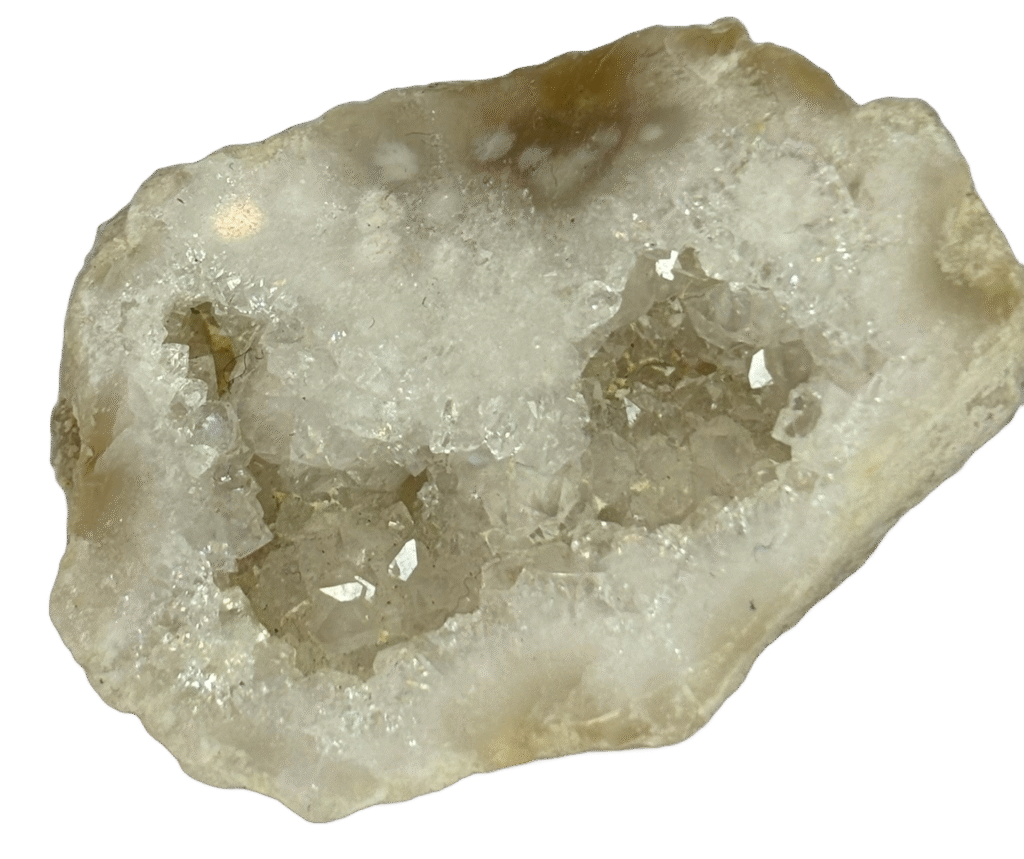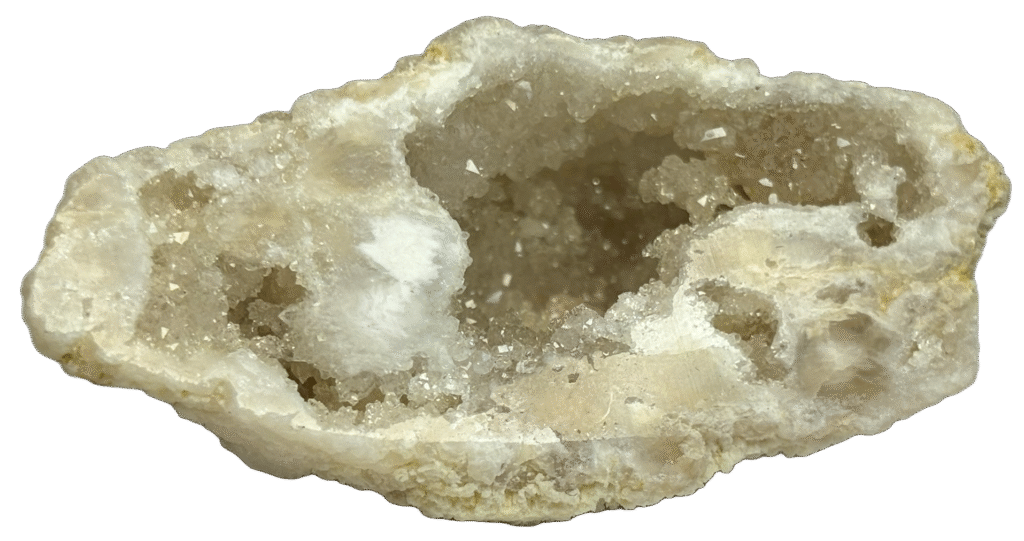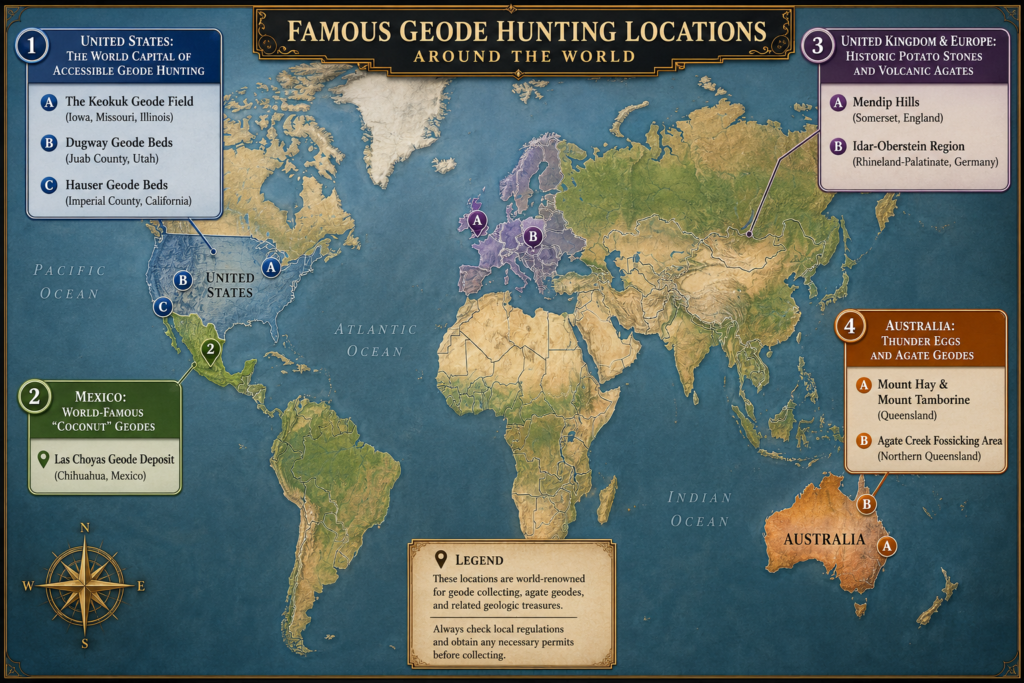
From the ancient basalt lava flows of Rio Grande do Sul in Brazil and Artigas in Uruguay to the sun-baked desert beds of the American Southwest and the subterranean wonders like Spain’s colossal Pulpí Geode, our planet holds extraordinary treasure vaults for collectors, collectors, and travellers alike. Whether you are planning your first field expedition with a rock hammer in hand or simply seeking to marvel at the earth’s greatest geological masterpieces, this guide to geode sites explores the premier geode destinations across the globe, uncovering the unique history, mineralogy, and accessibility of each iconic site.
Beneath the Earth’s weathered crust lies one of geology’s most captivating paradoxes: the geode. To the untrained eye, a geode often resembles nothing more than an ordinary, nondescript boulder or river stone. Yet, split that rough exterior open, and you reveal a hidden hollow lined with sparkling, millions of years old crystal formations ranging from deep violet amethyst and delicate blue chalcedony to radiant selenite and calcite.
1. United States: The World Capital of Accessible Geode Hunting
North America offers the highest concentration of well-documented, publicly accessible geode-hunting grounds in the world.
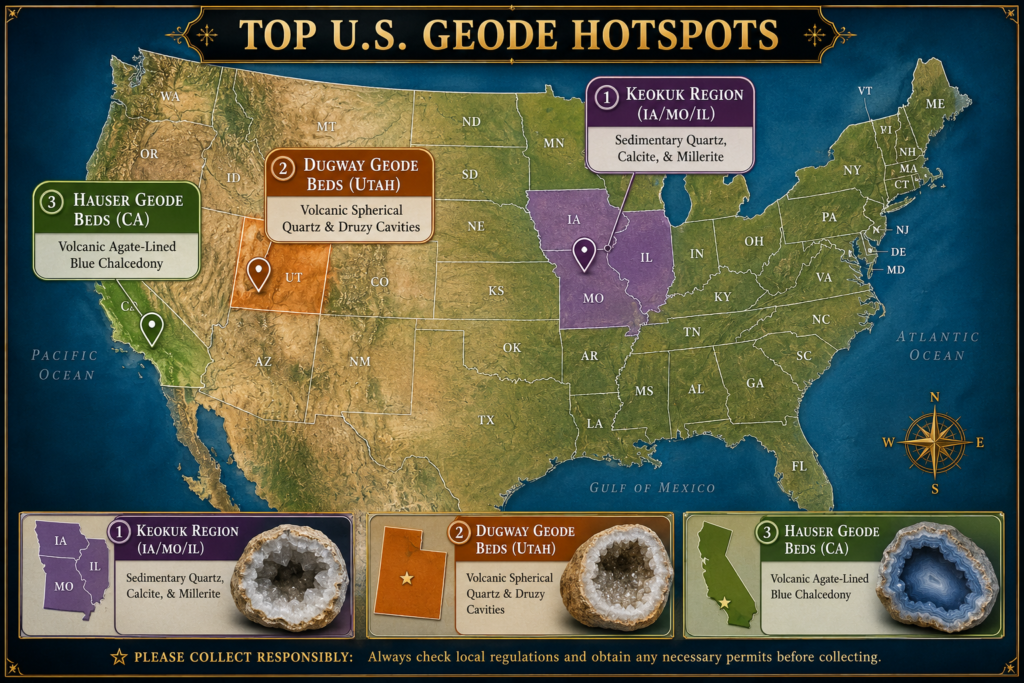
A. The Keokuk Geode Field (Iowa, Missouri, Illinois)
- Geological Origin: Sedimentary (Mississippian-age Warsaw Formation shale and limestone).
- Target Minerals: Quartz points, golden calcite rhombohedrons, chalcedony, dolomite, and rare brassy millerite needles.
- Key Access Sites:
- Sheffler Geode Mine (Wayland, MO): A famous fee-for-dig commercial site where collectors can dig unweathered geodes directly out of soft shale banks.
- Jacobs Geode Gallery & Mine (Keokuk, IA): Offers guided digging access and geode cracking services.
- Public Creek Beds: Publicly accessible gravel bars along the Des Moines and Skunk rivers (always verify local property boundaries).
- Collector Tip: Look for spherical rocks that feel lighter than solid limestone and feature a bumpy, “cauliflower” chalcedony skin.
B. Dugway Geode Beds (Juab County, Utah)
- Geological Origin: Volcanic (Miocene-age rhyolitic tuff beds).
- Target Minerals: Clear and smoky quartz, pale blue chalcedony, and amethyst-tinted druzy points inside hollow spheres.
- Access Status: BLM (Bureau of Land Management) public land. A designated open-collecting area allows free amateur collecting (subject to daily BLM weight limits).
- Field Conditions: Arid desert terrain. Bring ample water, shade, heavy picks, shovels, and sturdy buckets.
C. Hauser Geode Beds (Imperial County, California)
- Geological Origin: Volcanic ash and rhyolite beds in the Wiley Well district of the Colorado Desert.
- Target Minerals: Agate-lined geodes filled with shimmering blue, lavender, and pastel chalcedony cores.
- Access Status: Public BLM land. Accessible via 4WD vehicles along dirt desert roads.
- Field Conditions: Extreme desert heat in summer; collecting is best conducted from late autumn through early spring.
2. Mexico: World-Famous “Coconut” Geodes
Northern Mexico—particularly the state of Chihuahua—is renowned for producing some of the most perfectly symmetrical, hollow geodes on Earth.
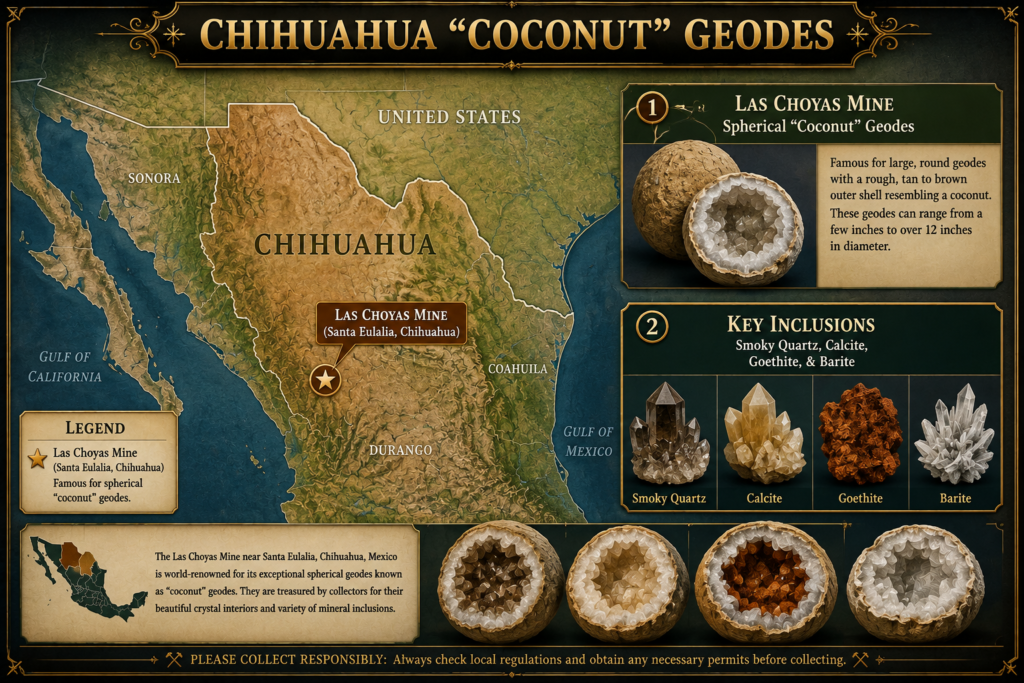
Las Choyas Geode Deposit (Chihuahua, Mexico)
- Geological Origin: Volcanic ash flows (ignimbrites) yielding deeply buried, spherical nodules known colloquially as “Chihuahua Coconuts.”
- Target Minerals: High-clarity quartz, smoky quartz, banded agate, white calcite, and golden goethite inclusions.
- Access & Collecting: Las Choyas is an active commercial underground mining operation. While walk-in public collecting is restricted, local guides and regional tour operators occasionally run field excursions. Unbroken “coconut” geodes from this region are widely exported to gem and mineral shows globally (such as the Tucson Gem & Mineral Show).
3. United Kingdom & Europe: Historic Potato Stones and Volcanic Agates
Europe boasts a rich tradition of geode collecting, with sites dating back to early industrial mining periods.
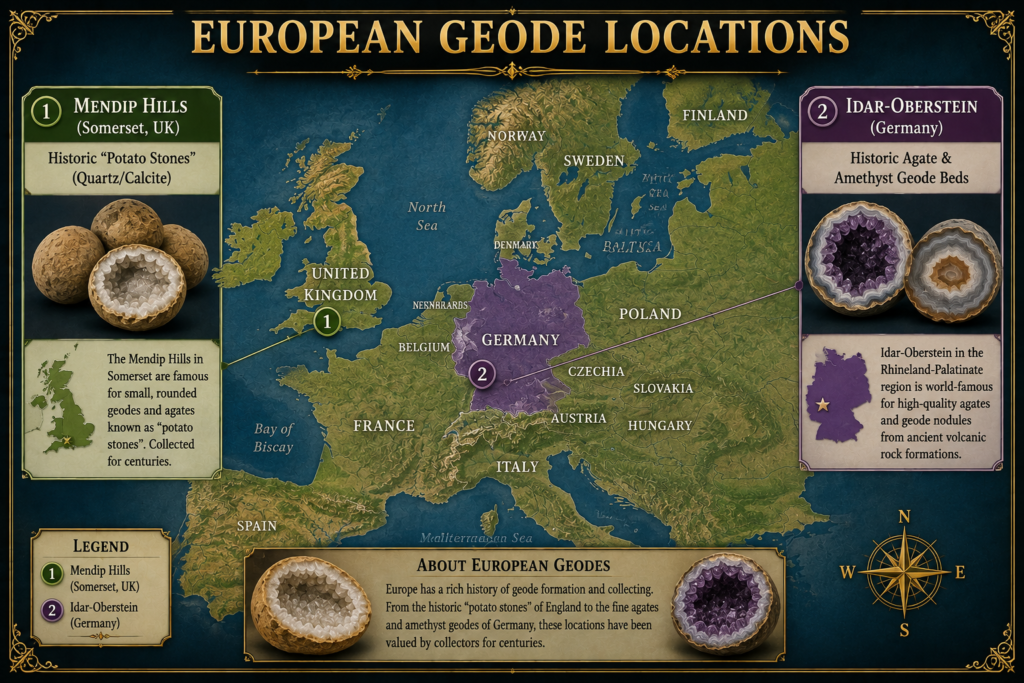
A. Mendip Hills (Somerset, England)
- Geological Origin: Triassic dolomitic conglomerate and limestone strata.
- Target Minerals: Locally known as “Potato Stones,” these rough, potato-shaped geodes contain white to pinkish quartz points, iron-stained calcite, and baryte.
- Key Access Sites: Roadside cuttings, field margins, and historical quarry spoil tips near Dulcote and Wells.
- Access Rule: Most sites lie on private farmland. Always seek explicit permission from local landowners before entering fields or quarries.
B. Idar-Oberstein Region (Rhineland-Palatinate, Germany)
- Geological Origin: Permian volcanic rocks (andesite and tholeiite flows).
- Target Minerals: Banded agate geodes, jasper, and amethyst-lined voids.
- Historical Significance: Idar-Oberstein was Europe’s historical lapidary capital for centuries. While major commercial mining has subsided, local guided field excursions and fee-for-dig quarries (such as the Steinkaulenberg gemstone mine) allow visitors to search for agate and quartz geodes in historic tailings.
4. Australia: Thunder Eggs and Agate Geodes
Australia’s vast volcanic belts offer exceptional opportunities for finding agate-filled thundereggs and hollow quartz geodes.
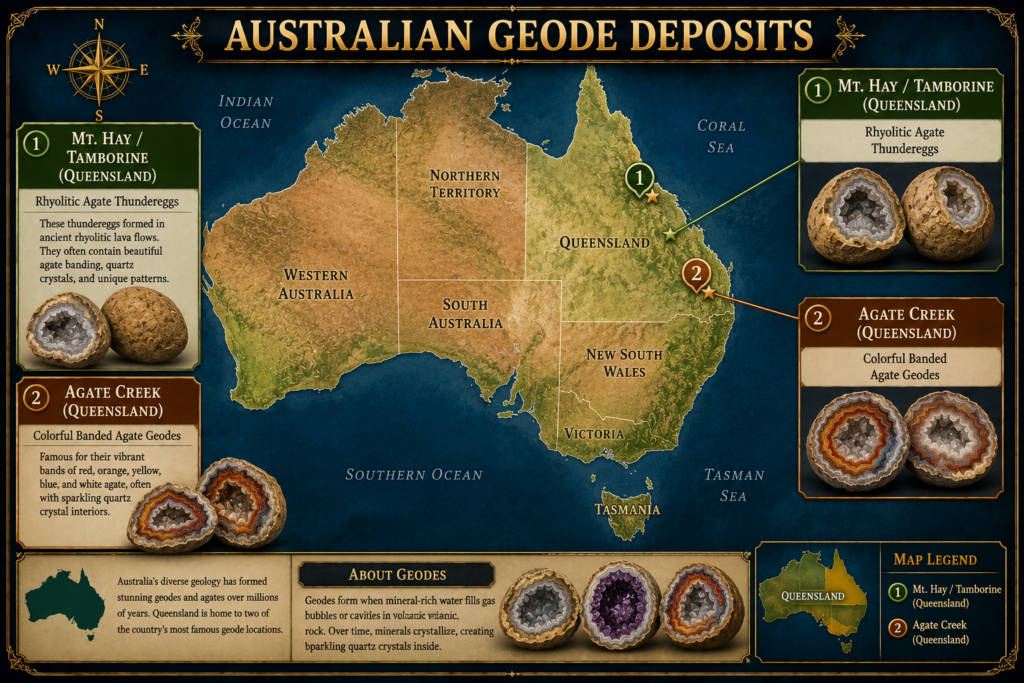
A. Mount Hay & Mount Tamborine (Queensland)
- Geological Origin: Prehistoric volcanic rhyolite flows.
- Target Minerals: Star-shaped thundereggs filled with green, brown, and translucent agate, quartz, and jasper cores.
- Key Access Sites: Commercial fossicking parks (e.g., Mount Hay Gemstone Tourist Park near Rockhampton) offer family-friendly digging areas with equipment rental and cut-and-polish facilities on site.
B. Agate Creek Fossicking Area (Northern Queensland)
- Geological Origin: Permian volcanic basalt beds.
- Target Minerals: World-renowned, intensely coloured agate geodes, moss agates, and quartz-lined nodules.
- Access Status: Designated public fossicking land. A Queensland Fossicking License is required (easily obtained online for a nominal fee).
5. Essential Field Rules and Etiquette
To ensure these public and private sites remain accessible for future generations of collectors, always observe these core field rules:
- Know the Law: Always verify whether a site lies on public land, private property, or protected areas. Never cross fences or collect on private land without explicit permission.
- Pack Safety Gear: Eye protection (goggles) is mandatory when striking rocks with crack hammers. Wear steel toed boots, heavy leather work gloves, and carry adequate hydration in desert terrains.
- Leave No Trace: Fill in any holes you dig, refrain from undermining stable cliff faces or overhangs, and bring back any rubbish,..
- Know Collection Limits: Respect daily personal-use weight limits set by Government agencies.
Summary Checklist for Geode Hunters
- Keokuk (US): Best for abundant quartz and calcite in soft shale; easy digging for families.
- Dugway (Utah): Best for desert collecting of hollow, light volcanic geodes on public land.
- Queensland (Australia): Best for agate thundereggs and designated tourist fossicking parks.
- Field Golden Rule: Check local access permits, carry eye protection, and compare rock weight to spot hollow geodes!
Frequent;y Asked Questions
What are geodes and what can you expect to find inside them?
A geode is a rock that may look like an ordinary stone on the outside but hides a hollow interior lined with crystals such as quartz, chalcedony, calcite, or other minerals. When opened, it reveals sparkling, millions of years old crystal formations ranging from amethyst to selenite and calcite.
Where are the premier geode hunting destinations in the United States?
In the United States, the most notable geode hunting areas include the Keokuk Geode Field spanning Iowa, Missouri, and Illinois; the Dugway Geode Beds in Juab County, Utah; and the Hauser Geode Beds in Imperial County, California, each offering distinct geological origins and target minerals.
What makes Las Choyas in Chihuahua, Mexico significant for geode collectors?
Las Choyas Geode Deposit in Chihuahua is renowned for volcanic ash flow nodules called Chihuahua Coconuts that yield high‑clarity quartz, smoky quartz, banded agate, calcite, and goethite inclusions; public collecting is restricted as it is an active underground mine, with occasional guided field excursions offered by local operators.
What essential field rules should geode hunters follow and why?
Field rules include knowing the law and obtaining permission for private property, wearing protective gear such as eye protection and sturdy boots, practising Leave No Trace by filling holes and removing rubbish, and respecting collection limits set by government agencies to keep sites accessible for future generations.
What minerals and access considerations define the Mendip Hills and Idar-Oberstein geode regions in Europe?
In Mendip Hills, geodes known as Potato Stones typically contain white to pinkish quartz, iron-stained calcite, and baryte, with sites on private farmland requiring permission. In Idar-Oberstein, regional geodes feature banded agate, jasper, and amethyst-lined voids, with guided field excursions and fee-for-dig quarries available in historic tailings.
These are my personally selected and curated geodes