
Top-grade natural turquoise is actually rarer and more valuable than diamonds and quality turquoise is a premium. Hence there is an opportunity to achieve the same look with a substitute stone
White howlite has a naturally webbed matrix (vein pattern) that look remarkably like turquoise, it is frequently dyed blue and sold only as a cheaper imitation often marketed under the trade name Turquenite. However, unscrupulous persons may pass of Turquenite as Turquoise.
To determine whether a stone is authentic natural turquoise or simply dyed howlite, there are several key visual and physical differences..
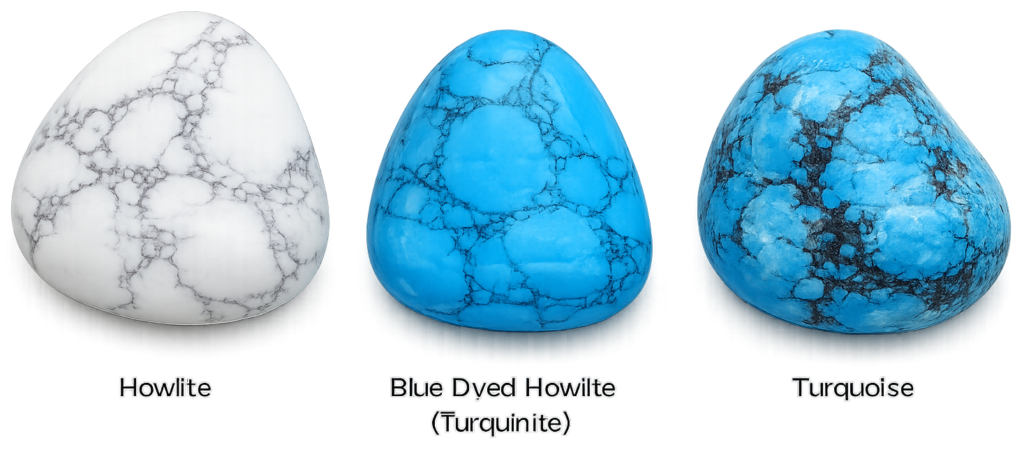
4 Ways to Spot the Difference
1. Inspect the Matrix (The Veins)
- Dyed Howlite: The dark veins on howlite are naturally occurring dark grey, dark brown, or black webs. When the stone is dyed, the blue pigment pools heavily into these recessed cracks, making the veins look artificially dark, sharp, and deeply saturated compared to the rest of the stone.
- Natural Turquoise: The matrix lines are part of the host rock where the turquoise grew. They can be black, brown, yellowish, or even metallic (like copper or pyrite). Crucially, these lines are flush with the stone or slightly uneven, and they do not look like a dye has pooled inside them.
2. The Acetone Test (Dye Check)
Because howlite is highly porous, the blue dye sits primarily on the surface and in the outer layers.
- Dip a cotton swab in pure acetone (nail polish remover) and rub an inconspicuous area of the stone firmly.
- If it is dyed howlite, the blue dye will bleed onto the cotton swab, leaving a faint or white patch on the stone. Natural turquoise will not lose its color.
3. Check for “Bleeding” Around Drill Holes
If you are looking at beads or jewelry:
- Peer closely inside the drilled thread holes or look for deep scratches.
- If you see white flashes or a solid white core inside the hole, the stone is dyed howlite. Natural turquoise is blue all the way through.
4. Hardness and Texture
- Howlite is quite soft (3 on the Mohs scale). It can be easily scratched by a steel knife or copper penny, and it often has a smooth, slightly plastic-like feel once heavily polished and dyed.
- Natural Turquoise is much harder (5 to 6 on the Mohs scale). It cannot be easily scratched by a penny or a standard fingernail, and it feels distinctly cooler and heavier in the hand.
The Price Indicator: If you are looking at large, perfectly uniform turquoise beads or statement rings being sold for an incredibly low price, it is almost certainly dyed howlite. Real, untreated turquoise is relatively rare and priced accordingly.
When navigating the market for turquoise, you will generally run into three distinct tiers of material. natural turquoise, stabilised turquoise, and completely synthetic imitation turquoise Understanding the differences boils down to authenticity, treatment, and structural integrity.
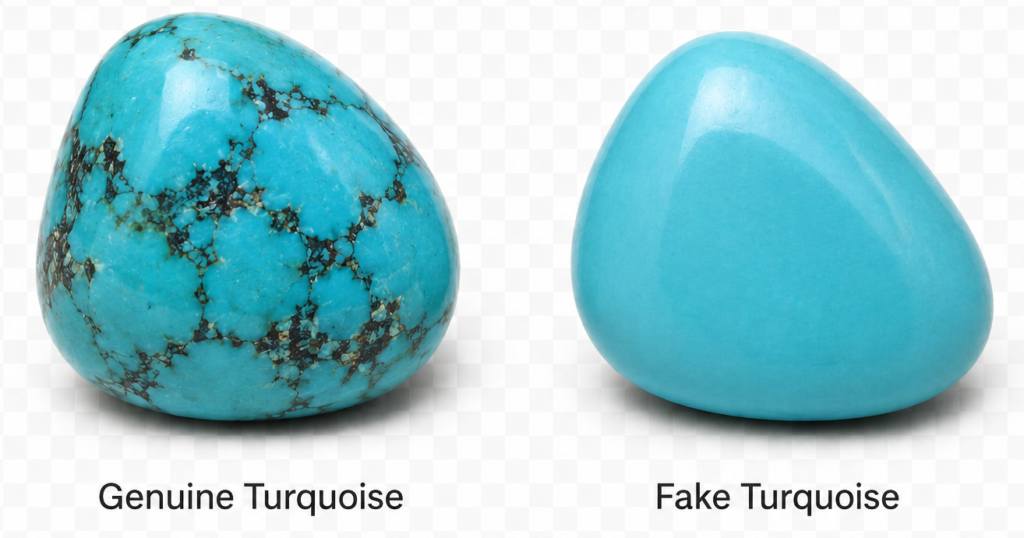
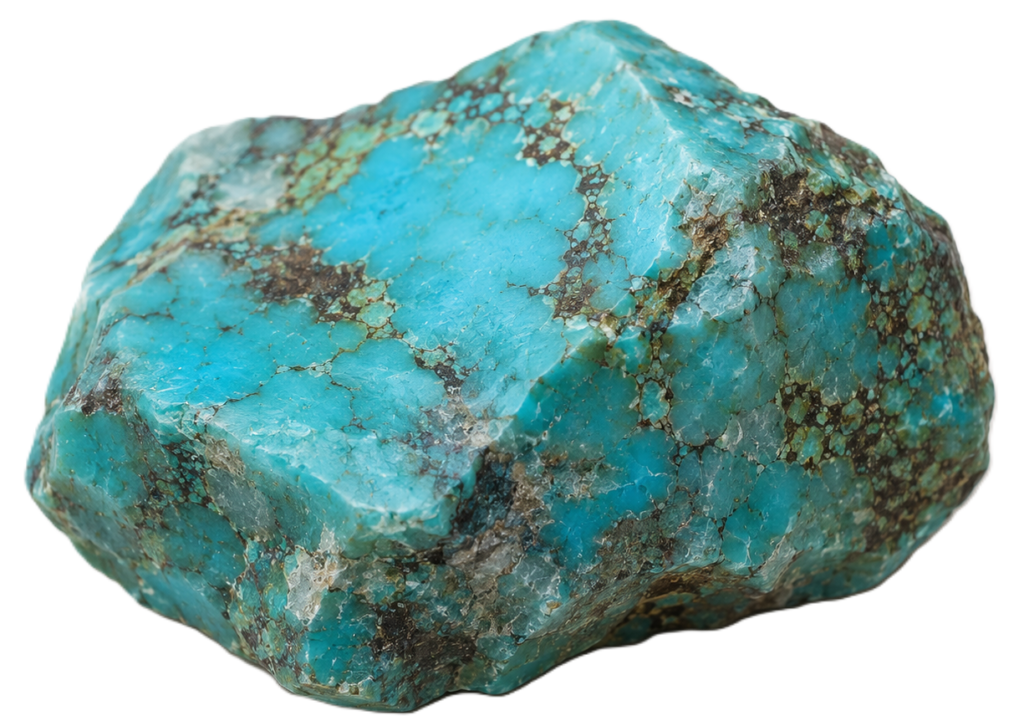
| Attribute | 1. Natural Turquoise | 2. Stabilized Turquoise | 3. Synthetic / Block Turquoise |
|---|---|---|---|
| What It Is | 100% organic, untreated stone cut directly from the mine. | Genuine, low-grade turquoise infused with clear resin. | Completely man-made plastic, epoxy, or resin mixed with dye. |
| Durability | Fragile; absorbs skin oils/perfumes, changing color over time. | Highly durable; waterproof, fade-resistant, and tough to scratch. | Varies, but generally soft, prone to melting under extreme heat. |
| Market Prevalence | Only less than 10% of jewelry market turquoise is completely untreated. | Comprises roughly 80-85% of all genuine turquoise jewelry. | Widely sold in fast-fashion jewelry and cheap souvenir shops. |
| Value | Very expensive; priced by carat weight and specific mine origin. | Moderate and accessible; perfect for everyday wear. | Very inexpensive; sold wholesale by the block or strand. |
A Deeper Look at Each Type
1. Natural Turquoise (Untreated)
This is pure stone just as it came out of the earth. Because it is highly porous, it naturally undergoes a slow transformation over the decades—absorbing natural skin oils, which deepens its color from sky blue to a darker, organic green. Only the highest, hardest grades of turquoise can be cut “natural” without crumbling under a lapidary wheel.
2. Stabilized Turquoise
Stabilization is a universally accepted industry standard, not a scam. Most mined turquoise is too soft and chalky to use in jewelry. To save this beautiful material, miners place the porous stone into a vacuum chamber to draw out air, replacing it with a clear epoxy or plastic resin.
- The Result: The stone keeps its 100% natural color and matrix but becomes hard, glassy, and completely locked in. It will never change color from your skin oils, making it ideal for durable, daily-wear rings and bracelets.
3. Completely Synthetic (Block) Turquoise
This material contains zero genuine turquoise mineral content. It is manufactured in factory laboratories or chemical plants by blending colored plastics, epoxy resins, and dyes into massive structural blocks, which are then sliced into pieces.
- How to spot it: The matrix lines look entirely uniform or painted on. Because it is pure resin, it lacks the cool, heavy temperature of authentic stone. If subjected to a hot-needle test, synthetic block turquoise will emit a distinct chemical, burning-plastic smell and melt slightly.
