For more than a millennium, lapidaries, monarchs, and court jewellers lacked the chemical and crystallographic tools to distinguish between red corundum (ruby) and magnesium aluminium oxide (spinel). Consequently, several of the most famous “rubies” in royal crown jewels are mineralogically red spinels, historically sourced from the ancient Kuh-i-Lal mines in Badakhshan (modern-day Tajikistan and Afghanistan).
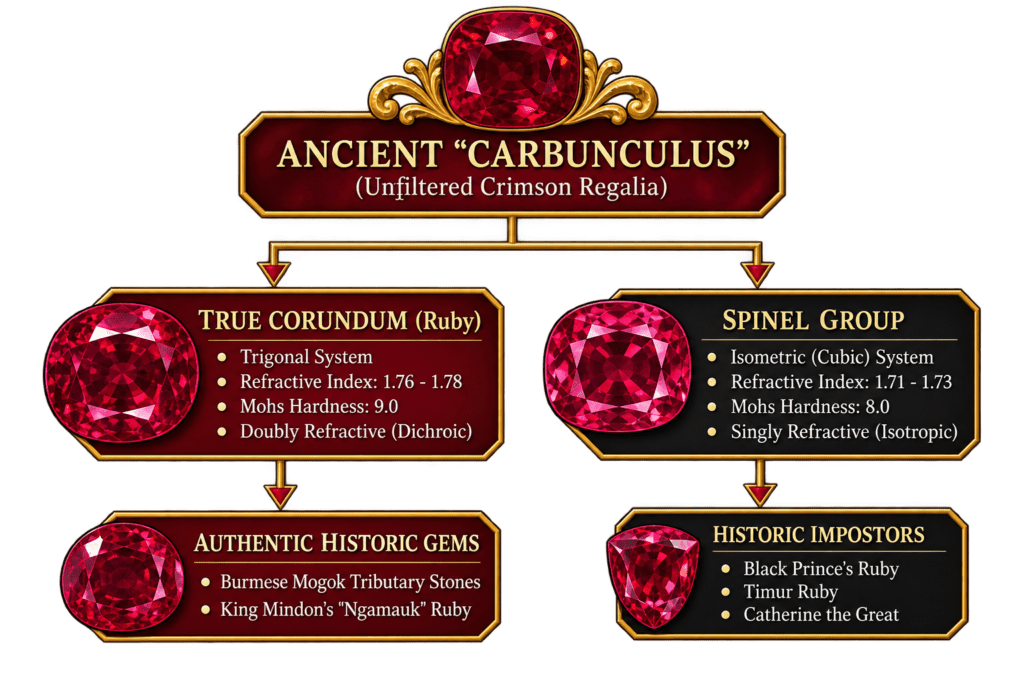
The Black Prince’s Ruby
- Physical Profile: An uncut, roughly pear-shaped red spinel cabochon weighing approximately 170 carats, drilled at one end for use as a pendant and plugged with a small genuine ruby.
- Imperial Placement: Mounted prominently in the front cross pattée of the British Imperial State Crown, directly above the Cullinan II diamond.
- Provenance: Traced to 14th-century Granada, Spain, where it was seized by Don Pedro the Cruel from the Sultan of Granada, Abū Saʿīd. It was subsequently ceded to Edward of Woodstock (the “Black Prince”) in 1367 as payment for military support at the Battle of Nájera. King Henry V famously wore the gem on his battle helmet at Agincourt in 1415.
The Timur Ruby (Khiraj-i-Alam)
- Physical Profile: A 352.5-carat red spinel cabochon inscribed with the names and titles of six historical rulers who held it, including Mughal emperors Jahangir, Shah Jahan, and Aurangzeb.
- Significance: Known as the “Tribute of the World,” this stone travelled through Persia, Afghanistan, and the Sikh Empire before the East India Company claimed it following the annexation of the Punjab in 1849, later presenting it to Queen Victoria in 1851.
The Imperial Crown of Catherine the Great
- Physical Profile: Topped by a colossal 398.72-carat red spinel, crafted by court jeweller Jérémie Pauzié for the empress’s coronation in 1762.
- Classification Shift: Long celebrated as the pinnacle of the Romanov ruby collection, gemological testing confirmed the stone to be an exceptional red spinel acquired via Chinese border trade in the late 17th century.
2. Legendary Modern Gems & Auction Milestones
Natural, untreated rubies exhibiting saturated colour, high clarity, and substantial carat weight command higher per-carat valuations than virtually any other coloured gemstone, frequently rivalling and exceeding fancy coloured diamonds at international auction houses.
The Sunrise Ruby
- Weight & Origin: 25.59 carats; Mogok Valley, Myanmar (Burma).
- Grading Highlights: Certified natural, unheated, with textbook “Pigeon’s Blood” colour, balanced proportion, and exceptional crystal transparency.
- Market Impact: Sold at Sotheby’s Geneva in May 2015 for $30.33 million (over £22 million), establishing the world record for any ruby and any coloured gemstone at roughly $1,185,000 per carat.
Estrela de FURA
- Weight & Origin: 55.22 carats (faceted from a 101-carat rough); Montepuez, Mozambique.
- Grading Highlights: Characterised by vivid saturation, remarkable internal clarity, and rich chromium fluorescence without the extinction typical of iron-bearing African corundum.
- Market Impact: Sold at Sotheby’s New York in June 2023 for $34.8 million, breaking the absolute price record for a polished coloured gem sold at auction and confirming the high-value potential of modern East African deposits.
The Graff Ruby
- Weight & Origin: 8.62 carats; Myanmar (Burma).
- Significance: An unheated cushion-cut ruby demonstrating the classic cushion geometry of Old World Mogok cutting. It crossed the auction block twice, ultimately fetching $8.6 million ($997,000 per carat) at Sotheby’s in 2014, solidifying the market threshold for top-tier unheated Burmese material.
3. The 4 Cs of Coloured Gemstones: Valuation Architecture
Unlike diamonds, which follow standardised geometric cut and linear clarity grading systems, the valuation of ruby is governed predominantly by Colour, followed by geographic origin and treatment history.
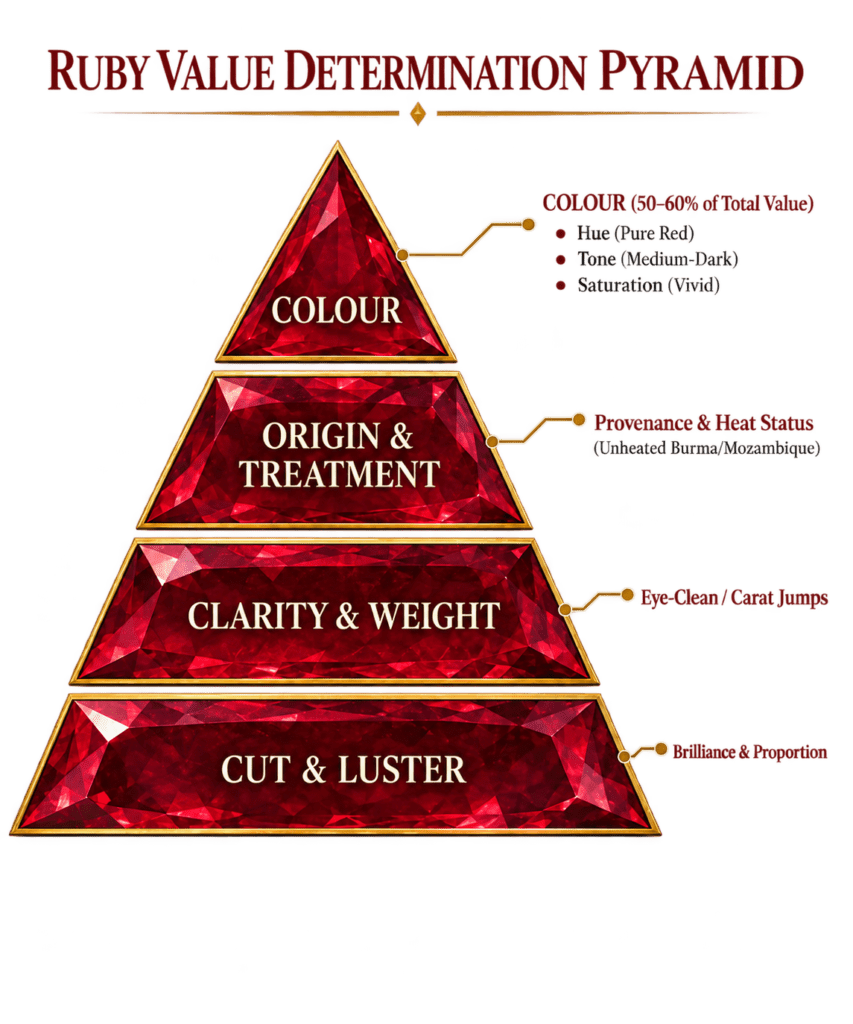
1. Colour (Hue, Tone, Saturation)
Colour accounts for over 50% of a ruby’s total financial valuation:
- Hue: The primary colour must be pure red. Secondary hues of purple or pink are acceptable if minor; secondary hues of orange or brown reduce market value.
- Tone: The depth of darkness or lightness. The global market benchmark targets a medium to medium-dark tone (between 60% and 75%). Stones with tones darker than 80% look black in low light; stones below 50% are categorised as pink sapphire.
- Saturation: The purity or intensity of the hue. Only specimens reaching vivid or intense saturation tiers attain high per-carat pricing.
2. Clarity & Inclusions
- Because rubies grow in turbulent metamorphic environments, completely loupe-clean specimens are geological anomalies.
- Graders look for eye-cleanliness at a normal viewing distance ($25\text{–}30\text{ cm}$).
- Inclusions that compromise structural stability (surface-reaching fissures, deep fractures) lower value significantly.
- Conversely, a delicate dispersal of fine, unheated rutile silk is welcomed by gemologists, as it softens light transmission without creating visible cloudiness, helping confirm that the gem has not undergone thermal alteration.
3. Cut & Lapidary Geometry
- Rough ruby is high-value raw material; lapidaries historically cut for weight retention rather than optical symmetry, frequently resulting in native step cuts, uneven pavilions, or asymmetrical contours.
- Windowing: A pavilion cut too shallow permits light to leak straight through the centre leaving a dead, washed-out area.
- Extinction: A pavilion cut too deep creates dark, dead zones where the stone absorbs light rather than reflecting it back to the viewer.
- High-value rubies are fashioned into balanced ovals, cushions, and rounds with symmetrical faceting that maximises brilliance and dichroic orientation face-up.
4. Carat Weight & Value Jumps
Due to internal stresses caused by chromium ions during crystal formation, rubies rarely form large, transparent crystals. Value scales non-linearly past key weight thresholds:
| Carat Weight Bracket | Rarity Tier | Approximate Value Curve (Unheated, High Colour) |
| 0.50 – 0.99 ct | Commercial to Fine | Baseline market pricing per carat. |
| 1.00 – 1.99 ct | Moderate Rarity | $2\times$ to $3\times$ per-carat price multiplier from baseline. |
| 2.00 – 2.99 ct | High Rarity | Exponential value shift; sharp collector demand. |
| 3.00 – 4.99 ct | Rare Investment Tier | Premium per-carat leaps ($5\times$ to $10\times$ baseline). |
| 5.00+ ct | Exceptional Global Rarity | Handled almost exclusively by major auction houses; per-carat values set independently by competitive bidding. |
4. Modern Milestones: Birthstone Economics and the 40th Anniversary
The July Birthstone Market
Standardised in 1912 by the National Association of Jewellers (now Jewellers of America), ruby is the sole modern birthstone for July.
- Its retail presence peaks in the second quarter of the financial year.
- Retail options range from entry-level treated/composite stones in commercial settings to fine natural unheated gems mounted in platinum or 18-karat yellow gold.
The 40th Wedding Anniversary (“Ruby Jubilee”)
Culturally rooted in Western, Commonwealth, and European traditions, the 40th wedding anniversary is designated the Ruby Anniversary:
- The stone’s durable corundum lattice (Mohs 9) and sustained red colour symbolise four decades of marital endurance, resilience, and undying emotional fire.
- Traditional anniversary pieces favour eternity bands, three-stone rings (flanked by diamonds), and cabochon pendants.
5. Gemological Laboratory Reports & Certification Protocols
In the high-stakes coloured gemstone market, a commercial transaction involving a significant ruby is invalid without third-party laboratory verification. A standard commercial jeweller’s appraisal is insufficient to determine origin, thermal history, or advanced clarity treatments.
The World’s Tier-1 Testing Laboratories
- SSEF (Swiss Gemmological Institute): Global authority for historic provenance and record-setting auction rubies.
- Gübelin Gem Lab (Switzerland): Pioneers of origin determination, maintaining an extensive private reference database of field-collected specimens.
- GIA (Gemological Institute of America): The global standard for domestic and commercial trade grading and origin verification.
- GRS (GemResearch Swisslab): Widely utilised in commercial Asian and European trading hubs; known for establishing colour-descriptor grades such as “GRS-type Pigeon’s Blood.”
Crucial Report Data Points
An authentic laboratory passport for ruby must explicitly disclose:
- Species and Variety: Confirmation of Natural Corundum / Natural Ruby.
- Origin Determination: Country and locality of geological extraction (e.g., Burma, Mozambique, Madagascar, Thailand).
- Treatment Status:
- No indications of heating (NTE): Highest market value.
- Indications of heating (TE): Thermal treatment verified; clarity residues absent or minor.
- Indications of heating with residue: Heated with flux-healed fissures (classified as low-to-moderate value reduction).
- Lead-glass composite / Fracture-filled: Treated with foreign glass; laboratories designate this as manufactured composite corundum rather than natural ruby.