When curating a crystal collection for restorative rest and emotional calm, comparing Lepidolite vs Amethyst is one of the most essential evaluations an energy practitioner or mineral enthusiast can make. While both share an alluring lilac-to-violet palette and a reputation for quelling an overactive mind, their underlying crystal lattices, geological formation, and energetic actions operate through entirely distinct physical and vibrational mechanisms. Understanding these fundamental differences is key to choosing the right mineral for your specific wellness goals.
From a gemological perspective, Amethyst is a tectosilicate—a robust, silicon dioxide quartz with a Mohs hardness of 7 and a rigid trigonal crystal system. Its primary energetic signature works upward through the Third Eye and Crown chakras, transmuting dense psychic static, sharpening intuitive clarity, and protecting the auric boundary. Conversely, Lepidolite is an exceptionally fragile phyllosilicate mica with a delicate Mohs hardness of 2.5 to 3. Its layered sheet structure houses an abundance of trapped lithium ions, giving it a soft, sedative quality that acts directly as a somatic brake for hyperactive nervous systems.
Where Amethyst lifts mental perception into higher, expansive states of spiritual awareness, Lepidolite grounds somatic tension downward, gently absorbing acute fear, circular panic loops, and physical restlessness. Whether you are addressing insomnia caused by vivid cognitive chatter or looking to de-escalate somatic fight-or-flight triggers before bedtime, exploring how each stone directs energy will help you decide when to choose one over the other—or how to harmonise both in a balanced evening ritual.
Quick Reference Comparison
| Diagnostic Property | Lepidolite | Amethyst |
| Mineral Classification | Phyllosilicate (Mica Group) | Tectosilicate (Quartz Group) |
| Chemical Formula | $\text{K(Li,Al)}_3\text{(Al,Si,Rb)}_4\text{O}_{10}\text{(F,OH)}_2$ | $\text{SiO}_2$ with trace $\text{Fe}^{3+}$ |
| Mohs Hardness | 2.5 to 3.5 (Soft, scratch-prone) | 7.0 (Hard, scratch-resistant) |
| Crystal System | Monoclinic (Tabular sheets, scales) | Trigonal (Hexagonal prisms, pyramids) |
| Cleavage | $\{001\}$ Perfect basal (peels in sheets) | None (Conchoidal fracture) |
| Water Safety | Strictly Water-Unsafe (Risk of flaking and degradation) | Water-Safe (Durable for short rinses) |
| Primary Colour Agent | Trivalent manganese ($\text{Mn}^{3+}$) | Natural gamma irradiation of lattice iron ($\text{Fe}^{3+}$) |
| Core Energetic Role | Sedative down-regulation, soothing anxiety | Mental purification, intuitive grounding |
| Nighttime Dynamic | Halts catastrophic overthinking & panic | Dispels nightmares, stimulates lucid recall |
Geological & Mineralogical Distinctions
Lepidolite: The Lithium-Bearing Sheet Silicate
Forming primarily in late-stage, highly evolved granitic pegmatites, lepidolite crystallises where volatile elements such as lithium, fluorine, and rubidium concentrate. Detailed in our Pillar Guide to Lepidolite, its signature purple-to-rose hue is created by trivalent manganese impurities substituting within the octahedral sheets.
Because lepidolite belongs to the mica family, its crystal lattice consists of sandwiched tetrahedral and octahedral sheets bound by weak potassium bonds. This results in perfect basal cleavage: it fractures into thin, flexible scales rather than solid shards. At a delicate Mohs hardness of 2.5 to 3.5, it cannot withstand water immersion, ultrasonic cleansers, or rough handling.
Amethyst: Irradiated Macro-Crystalline Quartz
Amethyst forms inside hydrothermal veins and volcanic gas cavities (geodes). Its chemical baseline is straightforward silicon dioxide ($\text{SiO}_2$). During crystal growth, trace amounts of trivalent iron ($\text{Fe}^{3+}$) replace silicon in the crystal matrix. Natural ambient gamma radiation emitted by surrounding host rocks then knocks an electron free from the iron, producing the $[\text{FeO}_4]^0$ colour centres responsible for its rich purple tone.
Boasting a Mohs hardness of 7.0 with no cleavage planes, amethyst is physically resilient. It resists scratches, withstands damp environments, and maintains structural integrity far better than delicate micas.
Energetic Frequencies: Sedation vs Clarity
The metaphysical divergence between these two violet crystals stems directly from their chemical and physical configurations:
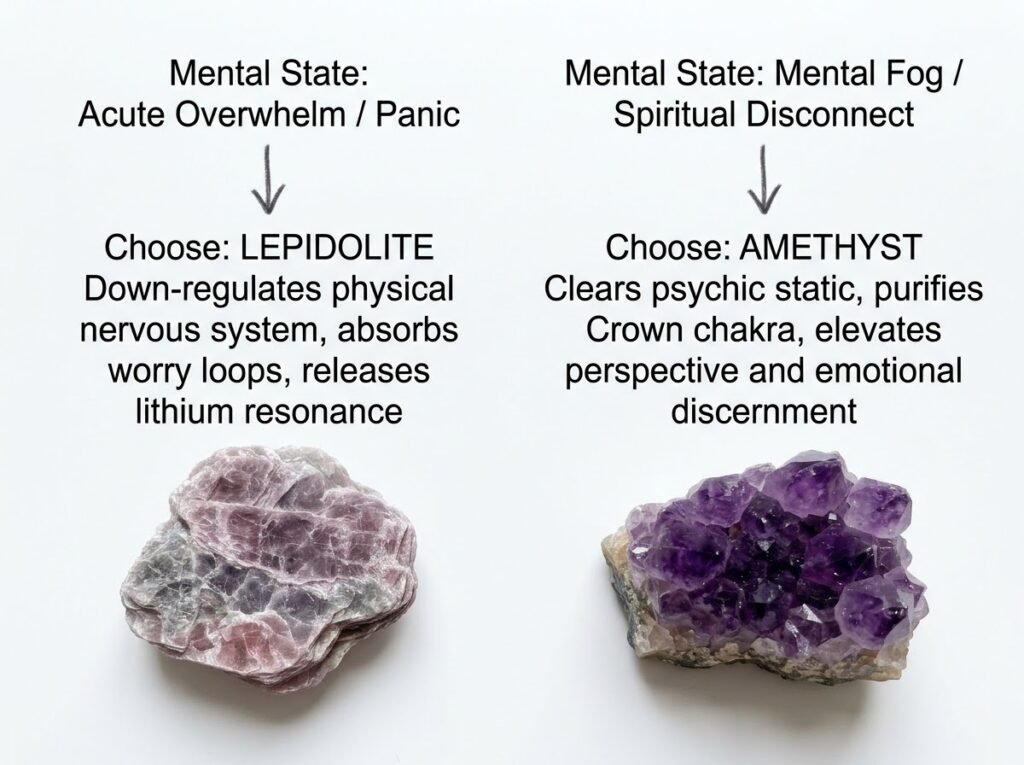
The Energetic Profile of Lepidolite
Lepidolite acts as an emotional sponge and bio-energetic stabiliser. Imbued with natural lithium—the cornerstone of modern clinical mood stabilisers—its resonance directly addresses the parasympathetic nervous system. It interrupts repetitive behavioural patterns, obsessive rumination, and hyperactive stress loops.
- Primary Chakras: Heart (Anahata), Third Eye (Ajna), Crown (Sahasrara).
- Vibrational Signature: Cooling, dense, grounding, and tranquillising.
- Best Used For: Acute panic sensations, burnout, grief recovery, and transitions involving major emotional upheaval.
The Energetic Profile of Amethyst
Amethyst operates as a high-frequency purifier. Rather than dulling an overstimulated system, it transmutes heavy atmospheric vibrations into clear, neutral awareness. It stimulates the intellect and intuition simultaneously, allowing you to examine anxieties with objective detachment rather than emotional reactivity.
- Primary Chakras: Third Eye (Ajna), Crown (Sahasrara), Etheric.
- Vibrational Signature: Crisp, expansive, ascending, and protective.
- Best Used For: Overcoming mental fog, breaking addictive behavioural patterns, spiritual meditation, and clearing energetic debris from your aura.
Bedside Battle: Which Stone Supports Better Sleep?
Both stones feature prominently in sleep practices, but placing the wrong one on your nightstand can inadvertently disrupt your rest.
Choose Lepidolite If: You Cannot Stop Thinking
If insomnia stems from nervous tension, racing thoughts, or reliving workday confrontations, lepidolite is the superior choice. Its calming frequency down-regulates a hyper-vigilant mind, softening physical chest tightness and ushering in deep, dreamless surrender.
- Nightstand Placement: Place a polished palm stone under your pillow or on your bedside table within 30 centimetres of your chest. (Review our safety protocol on Can Lepidolite Go in Water? to ensure you avoid water-based bedroom misters near raw specimens).
Choose Amethyst If: You Suffer from Nightmares or Seek Vivid Dreams
Amethyst excels when nighttime disturbances take the form of psychic static, psychic sponge fatigue, or terrors. However, because amethyst stimulates the Third Eye and Crown centres, highly sensitive individuals occasionally find it too mentally stimulating for sleep, reporting restless, cinematic dreaming.
- Nightstand Placement: Place an amethyst cluster on a dresser a few feet away from your head to establish a protective boundary around the entire bedroom without over-activating your brow chakra.
Can You Combine Lepidolite and Amethyst?
Combining lepidolite and amethyst creates an exceptionally balanced energetic circuit when managed intentionally.
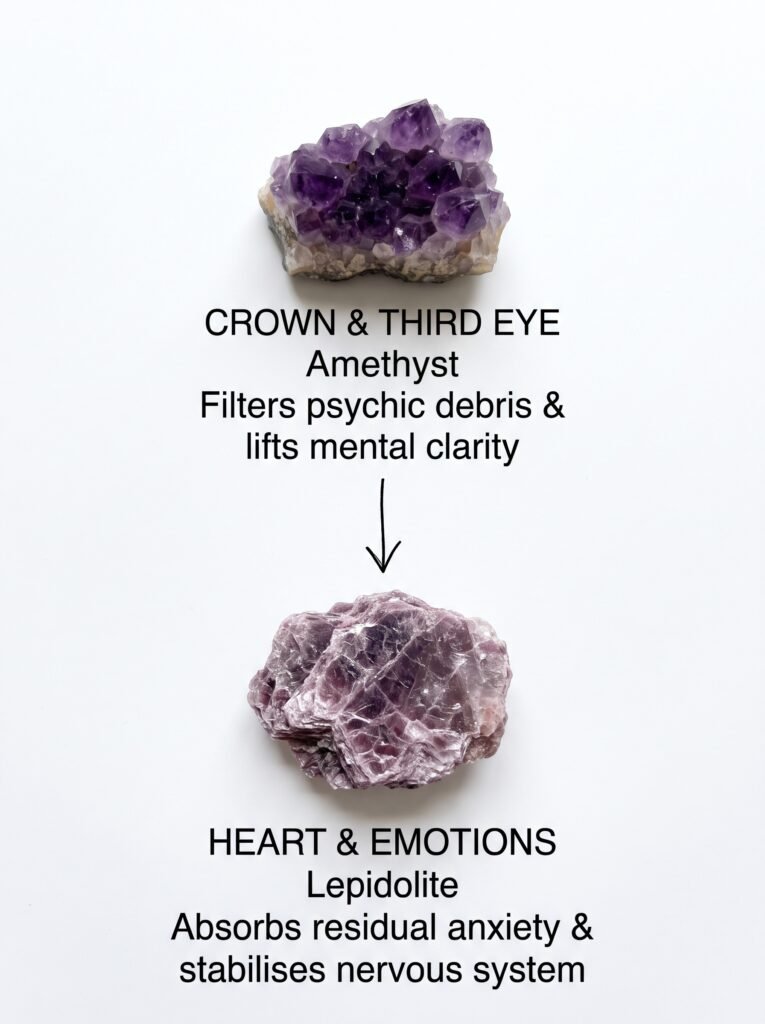
- The Sleep Shield Protocol: Keep a small amethyst geode near the bedroom entrance to maintain spatial energetic boundaries, while resting a lepidolite tumble stone on your nightstand to address immediate physical tension.
- Meditation for Anxiety: Hold lepidolite in your receptive (non-dominant) hand to draw out somatic stress, while placing amethyst directly before you at eye level to invite cognitive clarity.
- Synergistic Pairings: For individuals navigating profound life shifts, pair this duo with Black Tourmaline to ground high-frequency Crown vibrations safely into the physical body.
Cleaning and Physical Care
Proper maintenance protocols differ dramatically due to their hardness and porosity:
- Cleansing Lepidolite: Never submerge in water. Cleanse exclusively via dry methods such as overnight moonlight exposure, sound therapy (432 Hz crystal singing bowls), or resting upon a dry Selenite Charging Plate.
- Cleansing Amethyst: Amethyst safely tolerates brief rinses under lukewarm running water. However, avoid prolonged exposure to direct, harsh sunlight, which fades its purple $[\text{FeO}_4]^0$ colour centres to dull grey or yellow over time.
Related Guides & In-Depth Resources
- The Ultimate Guide to Lepidolite: Geology, Lithium Science & Metaphysical Power
- Can Lepidolite Go in Water? Complete Cleansing, Safety, and Mineral Care Guide
- Pink Tourmaline in Lepidolite: Mineralogy and Heart Healing
- How to Cleanse, Charge, and Maintain Fragile Mica Minerals