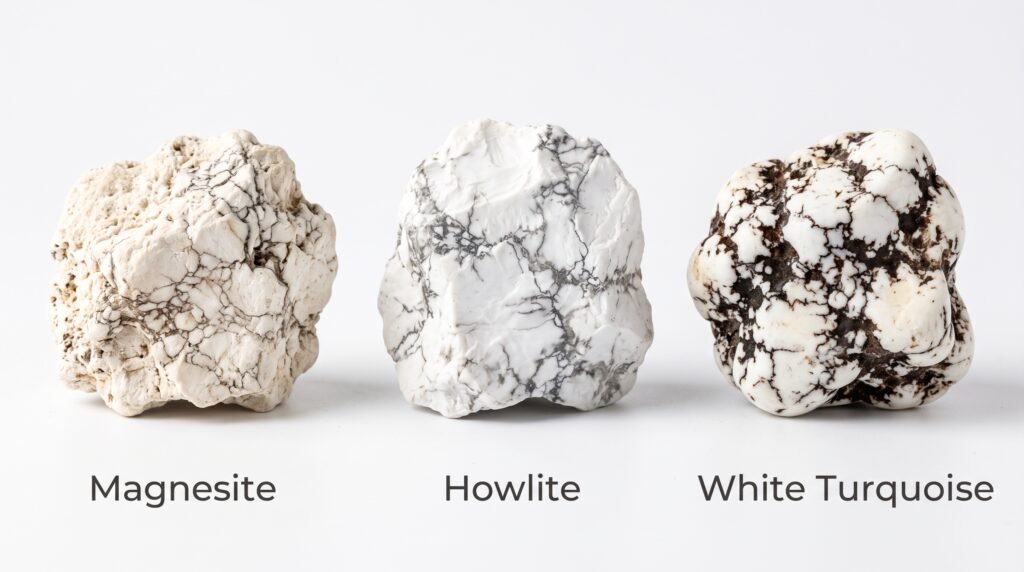
Spotting Dyed Magnesite Sold As Howlite and White Turquoise is one of the most common challenges facing crystal collectors, lapidary artists, and jewellery buyers today. Because natural magnesite ($\text{MgCO}_3$) and true howlite ($\text{Ca}_2\text{B}_5\text{SiO}_9(\text{OH})_5$) both form chalky white, nodular masses criss crossed by dark grey or brown spiderweb veining, the two minerals are routinely confused and frequently mislabelled across the global gem trade.
In its natural, untreated state, white magnesite is so similar in appearance to white howlite that the two are often sold interchangeably under the trade name “white turquoise,” even though neither stone is mineralogically related to true copper-aluminium phosphate turquoise. Worse still, because magnesite is naturally porous and plentiful, commercial manufacturers routinely dye magnesite bright robin’s-egg blue to mimic genuine turquoise or sell unstained, polymer-stabilised magnesite beads and tumbles as authentic borate howlite.
In this practical identification guide, we examine the mineralogical differences behind Dyed Magnesite Sold As Howlite and White Turquoise imitations walking you through non-destructive checks for matrix veining, Mohs hardness, specific gravity, dye pooling, and safe chemical reactions so you can verify your specimens with confidence.
Why Magnesite Is Sold as Howlite and Turquoise
The confusion between Magnesite, Howlite, and Turquoise stems from both geological resemblance and commercial convenience:
- The “White Turquoise” Trade Misnomer: True turquoise ($CuAl_6(PO_4)_4(OH)_8 \cdot 4H_2O$) is a hydrated copper aluminium phosphate. While rare, pale chalky-white or cream turquoise does occasionally occur when copper content is low, the commercial trade term “White Turquoise” was coined decades ago as a marketing euphemism for white, grey-veined Magnesite and Howlite. Scientifically, white turquoise is an oxymoron—without copper, the mineral is no longer true turquoise.
- Global Supply Abundance: Natural gem-grade turquoise deposits in the American Southwest, Iran, and China have become increasingly scarce and expensive. Meanwhile, massive cryptocrystalline Magnesite deposits in Zimbabwe, South Africa, Greece, and China yield thousands of tonnes of dense, porcelain-white nodular stone ideal for tumbling and jewellery carving.
- Superior Dye Absorption: Raw nodular Magnesite has a micro-porous, chalky texture that accepts organic and aniline blue-green dyes far more evenly and deeply than harder silicates. Once stabilised and dyed, veined Magnesite mimics spiderweb Kingman or Sleeping Beauty turquoise closely enough to fool casual buyers.
Chemical & Structural Differences
Although tumbled white Magnesite and white Howlite look nearly identical at a glance, they belong to completely separate mineral classes with distinct crystal systems and physical properties.
| Diagnostic Property | Magnesite | Howlite | Natural Turquoise |
| Chemical Formula | $MgCO_3$ | $Ca_2B_5SiO_9(OH)_5$ | $CuAl_6(PO_4)_4(OH)_8 \cdot 4H_2O$ |
| Mineral Class | Carbonate | Nesosilicate (Borosilicate) | Hydrated Phosphate |
| Crystal System | Trigonal | Monoclinic | Triclinic |
| Mohs Hardness | 3.5 – 4.5 | 3.5 | 5.0 – 6.0 |
| Specific Gravity | 3.00 – 3.12 | 2.53 – 2.59 | 2.60 – 2.90 |
| Natural Colour | Chalk white, cream, pale grey | Porcelaneous white with dark grey/black veining | Sky blue, robin’s-egg blue, blue-green |
| Lustre | Dull earthy to faintly sparkling on fresh breaks | Sub-vitreous to dull porcelain-like | Waxy to sub-vitreous |
| Dilute HCl Acid Reaction | Effervesces (fizzes) when warm | No fizz; slowly dissolves into silica gel | No effervescence; dissolves slowly |
Key Visual Clues
- Magnesite typically displays a slightly softer, warmer cream-white body colour with irregular, branching grey-brown matrix lines. When broken open, fresh surfaces often show a subtle, sugary micro-crystalline sparkle.
- Howlite tends to have a starker, brighter porcelain-white body colour with finer, spiderweb-like black or dark grey veins that appear sharper and more tightly defined. Fresh fractures look completely matte and chalky, like unglazed ceramic.
- Natural Turquoise feels noticeably denser and harder than both substitutes, displaying a rich waxy sheen and matrix veins composed of dark limonite, pyrite, or sandstone rather than soft carbonate clay.
Non-Destructive Home Tests
Before applying any physical test, always perform it on an inconspicuous spot—such as the base of a rough specimen or inside a bead drill hole—to preserve the stone’s appearance.
1. The Specific Gravity (Heft) Test
Specific gravity is the cleanest, completely non-destructive way to separate Magnesite from Howlite:
- How it works: Magnesite has a specific gravity of 3.00 to 3.12, making it roughly 18% heavier than an identical-sized piece of Howlite (2.53 to 2.59).
- Practical check: Hold two tumbled stones of equal volume in your palms, or use a digital pocket scale with a water-displacement cup (hydrostatic weighing). A stone reading close to 3.0 is Magnesite; a stone reading near 2.55 is genuine Howlite.
2. The Acetone Dye-Wipe Test (Spot-Checking Dyed Blue Stones)
If you suspect a bright blue “turquoise” bead or cabochon is actually dyed Magnesite or dyed Howlite:
- Dip a cotton bud into 100% pure acetone (nail polish remover without oils or fragrances).
- Rub firmly against an unobtrusive edge or inside a bead hole for 10 to 15 seconds.
- Result: If blue or green pigment transfers onto the cotton bud, the stone is dyed Magnesite or Howlite. (Note: High-end polymer-stabilised dyed stones may resist brief acetone contact, so inspect bead drill holes under a 10x jeweller’s loupe—dyed stones frequently show concentrated pools of dark blue dye inside the bore hole or an uncoloured white core.)
3. The Mohs Scratch Test
Because natural Turquoise is significantly harder than both substitutes, a simple hardness check separates genuine turquoise from dyed lookalikes:
- Steel Pocket Knife or Masonry Nail (Mohs ~5.5): A steel blade will easily scratch both Magnesite (Mohs 3.5–4.5) and Howlite (Mohs 3.5), leaving a white powdery groove. Genuine, non-chalky Turquoise (Mohs 5.0–6.0) will resist scratching or show only a faint metallic streak from the blade itself.
- Copper Coin (Mohs ~3.5): A copper penny will barely mark Magnesite (especially dense crystalline varieties up to 4.5) but will scratch softer chalky Howlite.
4. The Warm Vinegar / Dilute Acid Effervescence Test
As a carbonate mineral ($MgCO_3$), Magnesite reacts chemically with acids, whereas borosilicate Howlite and phosphate Turquoise do not:
- Place a single drop of warm white household vinegar (acetic acid) or 10% dilute hydrochloric acid on an inconspicuous, unpolished spot.
- Observe through a 10x magnifying loupe.
- Result: Tiny carbon dioxide bubbles will slowly fizz on Magnesite (especially when the stone or acid is slightly warmed). Howlite and Turquoise will produce zero effervescence. Wipe clean immediately with a damp cloth and dry thoroughly.
How to Care for Dyed v Natural Specimens
Because both Magnesite and Howlite sit between 3.5 and 4.5 on the Mohs scale and possess a porous, chalky structure, improper cleaning can permanently dull or discolour them.
- Never Soak in Water or Salt: Prolonged water exposure softens porous carbonate surfaces, washes out surface dyes, and dulls natural polish. Clean with a slightly damp microfibre cloth and dry immediately.
- Keep Away from Cosmetics & Perfumes: Body oils, sunscreens, hairspray, and acidic sweat penetrate porous Magnesite rapidly, turning stark white stones yellow or staining skin blue if the piece is dyed. Always put Magnesite and Howlite jewellery on last.
- Store Separately from Harder Crystals: Keep Magnesite and Howlite in individual soft pouches away from Quartz (Mohs 7), Amethyst, Citrine, and Corundum to prevent surface scuffing.
- Use Dry Energetic Cleansing: Stick to smoke cleansing with dried rosemary or cedar, sound cleansing with a singing bowl, or moonlight exposure rather than water or sea-salt bowls.
Frequently Asked Questions
Is Magnesite a “fake” crystal?
No. Natural Magnesite is an authentic, naturally occurring magnesium carbonate mineral prized in its own right for its calming somatic energy and geological link to elemental magnesium. It only becomes deceptive when dyed blue and sold dishonestly as natural Turquoise, or mislabelled as Howlite
Can you tell Magnesite from Howlite just by looking at a photo?
n most cases, no. Because both minerals form white, grey-veined nodules that are tumbled to an identical finish, visual inspection alone is unreliable without checking specific gravity or testing an unpolished surface.
Does dyed Magnesite still hold metaphysical properties?
In crystal healing traditions, dyed Magnesite retains the underlying calming, grounding frequency of magnesium carbonate ($MgCO_3$), though purists prefer natural, undyed white Magnesite so chemical dyes and acrylic sealants do not interfere with tactile energy work.