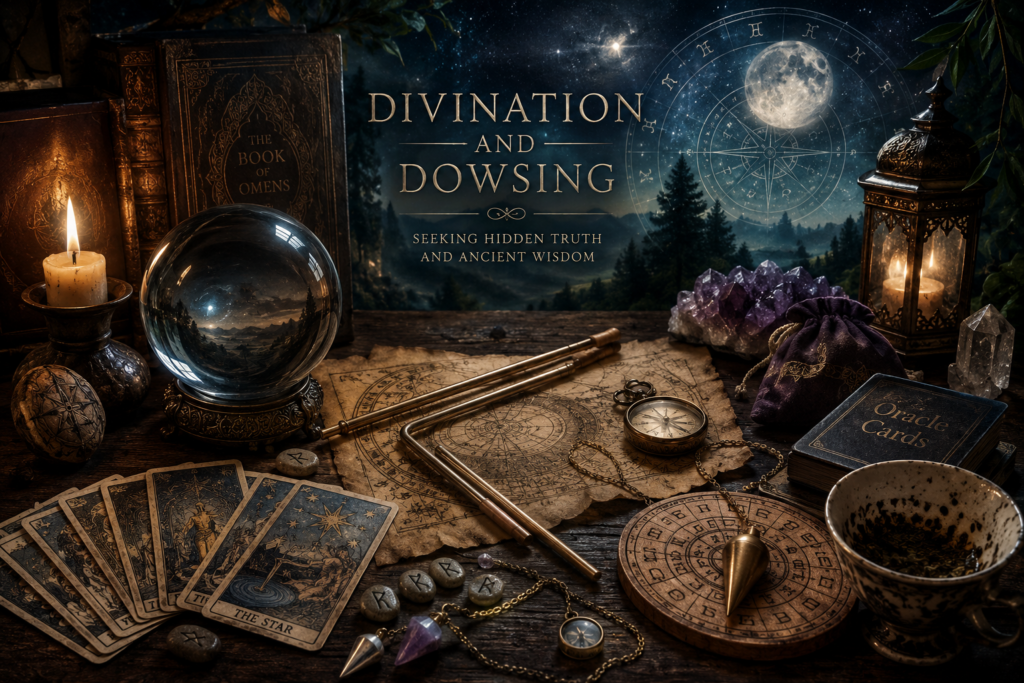
Throughout human history, we have always sought ways to peek behind the veil of the unknown. Whether peering into the future or searching for hidden resources beneath our feet, humanity has relied on intuitive arts to navigate life’s mysteries. Two of the oldest and most widely practised methods are divination and dowsing.
While these terms are occasionally used interchangeably, they are distinct practices with different purposes, history, and tools. Understanding the difference between divination and dowsing can help you choose the right practice for your own intuitive journey.
What is Divination?
Divination is the broad, ancient practice of seeking hidden knowledge, spiritual guidance, or foresight through symbolic interpretation. Rather than looking for physical objects, divination focuses on understanding the past, present, or future by connecting with higher wisdom, universal energies, or the subconscious mind.
The Purpose of Divination
People turn to divination not to find lost keys, but to find direction. It is commonly used to:
- Gain deep personal insight and self-awareness.
- Seek spiritual guidance during difficult transitions.
- Explore potential future outcomes based on current energies.
- Understand complex life situations and relationship dynamics.
Common Divination Methods & Tools
Divination relies heavily on rich, symbolic systems. Some of the most popular types of divination include:
- Tarot & Oracle Cards: Using structured decks to mirror the soul’s journey.
- Astrology & Numerology: Reading the cosmic blueprint of stars, planets, and numbers.
- Rune Casting: Interpreting ancient Germanic symbols carved into stone or wood.
- Scrying: Gazing into crystal balls, mirrors, or water to receive visions.
- Tasseography: Reading the patterns left by tea leaves or coffee grounds.
- I Ching: An ancient Chinese system utilising hexagrams and coins for profound wisdom.
What is Dowsing?
Dowsing is a targeted technique used to locate physical objects, unseen energies, or specific “yes/no” answers using physical tools. Unlike divination, which is highly interpretive and symbolic, dowsing is highly practical and binary.
Dowsers believe that the human body acts as a sensitive antenna. Subconscious awareness, muscle micro-movements (known as the ideomotor response), or subtle environmental energies cause the dowsing tools to move, pointing the way toward the target.
Common Uses for Dowsing
- Finding underground water sources (often called “water witching”).
- Locating minerals, ores, or utility lines.
- Tracking down lost physical objects or missing items.
- Detecting geopathic stress or mapping Earth lines (Ley lines).
- Clearing and balancing energy fields in a space.
Quick Comparison: Divination vs. Dowsing
| Feature | Divination | Dowsing |
| Primary Goal | Seeking wisdom, guidance, and symbolic insight. | Locating physical items, energies, or binary answers. |
| Nature of Output | Deep, metaphorical, and open to interpretation. | Direct, physical movement (pointing, spinning, yes/no). |
| Core Mechanism | Connection to higher consciousness/subconscious archetypes. | Muscle micro-movements responding to energetic fields. |
| Typical Tool | Tarot cards, runes, astrology charts, tea leaves. | L-rods, Y-rods, pendulums, bobbers. |
A Glance into the History & Folklore
The Sacred Origins of Divination
Evidence of divination dates back thousands of years across every major global civilisation:
- Ancient Egypt: Priests interpreted dreams and cosmic movements to commune with the gods.
- Mesopotamia: Babylonian seers meticulously read celestial omens to guide empires.
- Ancient China: Over 3,000 years ago, the I Ching (Book of Changes) was written, remaining one of the oldest operational wisdom systems today.
- Ancient Greece & Rome: The famous Oracle of Delphi channelled Apollo’s prophecies, while Roman augurs read the flight patterns of birds to dictate military strategies.
The Practical Roots of Dowsing
While the origins of dowsing are harder to pinpoint, its history is deeply tied to survival and industry:
- Medieval Europe: By the Middle Ages, German miners heavily relied on forked branches (Y-rods) to discover rich underground ore deposits.
- The “Water Witch”: In British and North American folklore, expert dowsers were dubbed “water witches” for their uncanny ability to find hidden springs, which were often considered sacred or healing wells in Celtic lore.
Essential Tools of the Trade
Divination Toolsets
- Tarot Decks: A structured 78-card system reflecting psychological and spiritual archetypes.
- Oracle Cards: Fluid, theme-based card decks used for daily inspiration and reflection.
- Rune Stones: 24 alphabetic symbols from the Elder Futhark used for direct, concise guidance.
Dowsing Toolsets
- L-Rods: Two L-shaped metal rods (often made of copper or even a bent coat hanger) that cross or swing open to indicate a find.
- Y-Rods: Forked branches traditionally cut from hazel, willow, or fruitwood.
- Bobbers: A flexible wand with a weighted tip used for delicate energy testing.
- Map Dowsing Tools: Using a pendulum over a physical map to pinpoint locations from a distance.
The Overlap Tool: The Pendulum
The pendulum is a unique bridge between both worlds. A weighted object on a string can be used as a dowsing tool to locate energy blocks or get quick “yes/no” answers, but it can also be used as a divination tool alongside lettered charts to spell out messages from the subconscious.
Modern Practice and Perspectives
Today, both divination and dowsing are experiencing a massive modern renaissance. People use them less out of strict historical necessity and more as tools for mindfulness, intuition building, and environmental awareness.
While mainstream science views these practices sceptically—often attributing dowsing to the ideomotor effect and divination to psychological projection—millions of global practitioners continue to find tangible success, comfort, and profound personal clarity through these time-honoured traditions.
Ready to Explore Further?
Enhance your journey into the intuitive arts by checking out my comprehensive guides:
- How to Choose Your First Divination Cards
- Divination Cards: Understanding Tarot, Oracle, and Astrology Decks
- A Beginner’s Guide to Starting in the World of Divination
Frequently Asked Questions
Can anyone learn how to divine or dowse?
Yes! Most modern practitioners believe that intuition is like a muscle. While some people may have a natural aptitude, anyone can learn to use divination tools or dowsing rods with patience, regular practice, and an open mind.
What is the best material for dowsing rods?
Traditionally, hazel, willow, or apple wood Y-rods were favoured in Britain. Today, copper or brass L-rods are highly popular because copper is an excellent conductor of energy. In a pinch, a simple disassembled wire coat hanger works surprisingly well!
Is divination tied to a specific religion?
No. While divination has historically been integrated into many ancient religious practices, modern divination can be approached from a purely secular, psychological, or spiritual perspective. It is a tool for accessing the subconscious mind, regardless of your personal faith. Note that some organized orthodox religions do discourage its practice.
How do I start map dowsing?
Map dowsing involves holding a pendulum over a map or blueprint of a specific area. By systematically moving the pendulum across the grid, the practitioner looks for a change in swing (such as a clockwise circle) to pinpoint where an object or water source might be located before going out into the field.