

When people think of palaeontology, they usually picture towering Tyrannosaurus rex skeletons or massive triceratops skulls. But some of the most valuable clues about prehistoric life are much smaller, rougher, and—admittedly—a bit more unorthodox.
Welcome to the world of coprolites, the scientific term for fossilised poop.
While it might sound like a playground joke, coprolites are highly prized trace fossils. They provide scientists with a literal “gut check” on how ancient creatures lived, ate, and interacted millions of years ago.
Defining Coprolite: More Than Just an Ancient Dropping
The word coprolite comes from the Greek words kopros (meaning dung) and lithos (meaning stone). First named by the pioneering British palaeontologist William Buckland in 1829, a coprolite is classified as a trace fossil. Unlike body fossils (like bones or teeth), trace fossils record the behavioural activity of an animal.
Does coprolite smell?
This is the most common question people ask. The short answer is no. Over millions of years, the original organic matter has been completely replaced by minerals like calcium phosphate and silicates. A coprolite is entirely stone; it smells and feels exactly like a rock.
How Does Poop Become a Fossil?
The odds of a piece of dung surviving long enough to become a fossil are incredibly low. For coprolisation to happen, specific environmental conditions must align perfectly:
- Rapid Burial: The droppings must be covered quickly by sediment (like mud or volcanic ash) before they can decompose, wash away, or be eaten by dung beetles and bacteria.
- The Right Environment: Soft, wet mud flats, lake bottoms, and quiet marine environments are ideal because they lack the oxygen that accelerates decay.
- Mineral Replacement: Over millennia, mineral-rich groundwater seeps through the sediment. Minerals replace the organic structures cell by cell in a process called permineralisation.
Why Scientists Love Studying Coprolites
Bones tell us who an animal was, but coprolites tell us what they did. By cutting a coprolite into ultra-thin slices or scanning it with high-tech 3D imaging, palaeontologists can see exactly what an animal ate for its final meal.
What do scientists find inside coprolites?
- Dietary Habits: Carnivore coprolites often contain crushed bone fragments, teeth, and fish scales. Herbivore specimens contain fossilised seeds, leaves, bark, and pollen.
- Ancient Ecosystems: The pollen grains and plant matter preserved inside can pinpoint exactly what kind of flora grew in a specific region during a specific prehistoric era.
- Parasites: Some specimens preserve the eggs of ancient intestinal worms, offering insights into prehistoric diseases.
Fun Fact: The largest known coprolite left by a carnivorous animal is a massive 2.4-liter specimen believed to have come from a Tyrannosaurus rex. It contains broken bone fragments, proving the T. rex pulverised its prey’s bones before swallowing.
Quick Coprolite Facts & Identification Guide
How do you tell a coprolite apart from a regular backyard rock? Palaeontologists look for several defining characteristics:
| Characteristic | What to Look For | Why it Matters |
| Shape | Spiral, segmented, or elongated structures | Mimics the anatomy of the animal’s intestinal tract. |
| Composition | High concentrations of calcium and phosphate | Organic material leaves behind telltale chemical footprints. |
| Striations | Surface marks, grooves, or gas bubble voids | Shows how the material was extruded and dried before burial. |
Coprolites in Pop Culture and Collecting
Unbelievably, there is a massive global community of coprolite collectors. High-quality specimens are often sliced and polished into beautiful jewellery, revealing striking, multi-coloured mineral patterns inside.
There is even a dedicated museum called the Poozeum (originally founded in the US), which showcases premier specimens of fossilised feces, including the world-record-holding “Barnum” specimen—a massive 26-inch coprolite.
Summary: A Priceless Window into the Past
Coprolites prove that in science, nothing goes to waste. These unique rocks offer an incredibly intimate, unaltered look at the daily lives of dinosaurs, ancient mammals, and prehistoric marine life. The next time you find a strange, grooved rock on a hike, look closely—you might just be holding a piece of history millions of years in the making.
Frequently Asked Questions About Coprolites
How much is coprolite worth?
Small, common coprolites can be bought online for less than $10. However, massive, verified dinosaur specimens with clear bone fragments can fetch thousands of dollars at auction.
Did humans leave coprolites?
Yes. Human fossilised feces are referred to as paleofeces. The Lloyds Bank coprolite is a famous, massive example left by a Viking in the 10th century, which has given historians deep insights into the Viking diet and health.
How do you know if it is genuine Coprolite and not just a stone ?
Firstly, like all fossils and gemstones acquire your specimens from a reputable supplier.
When Palaeontologists look for coprolite specimens, they look at least three things:
Composition Coprolites usually contain a lot of calcium phosphate and were once used as fertiliser. The phosphate was a critical component of the explosives used in munitions during the first world war.
Another identifier is shape, there are several classic coprolite shapes which assist in identification. However, being a natural product there is always the potential for it to be deformed by other animals or the elements.
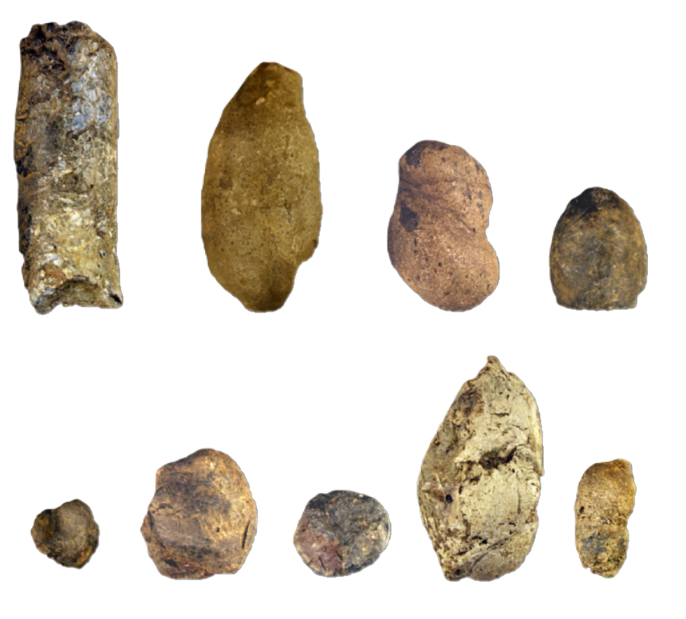
The shapes used to classify coprolites from the top left to right: cylindrical coprolite with constant diameter, cylindrical with pinched ends, bulbous coprolite, two round coprolites, round-bulbous, round-cylindrical, cylindrical-bulbous and cylindrical-bulbous from researchgate.net
Associated fossils other fossils found in the same area, indicate the past presence of organisms and may be clues to what creature originally produced the coprolite. Sometimes, coprolites are found near the fossilised remains of the actual animal itself.
Geological. Fossils are typically preserved under sediments. However, a very dry environment or extreme cold can also preserve it.
The layers of the ground (stratigraphy) where the Coprolite was found also must be the same where the creature that created it lived. For example, you should not be able to find vertebrate coprolite in a Precambrian layer because this was formed before vertebrates were known to exist
By studying (ichnology) the physical composition of coprolites, palaeontologists (or Scatologists) can deduce if the animal that produced it was most likely a carnivore, herbivore or omnivore. Trace particles can show what an animal ingested. Seeds, bones, spores, pollen, wood, grass, leaves, even micro organisms and parasites, can be preserved within coprolite.
Coprolite
A range of Coprolite
