
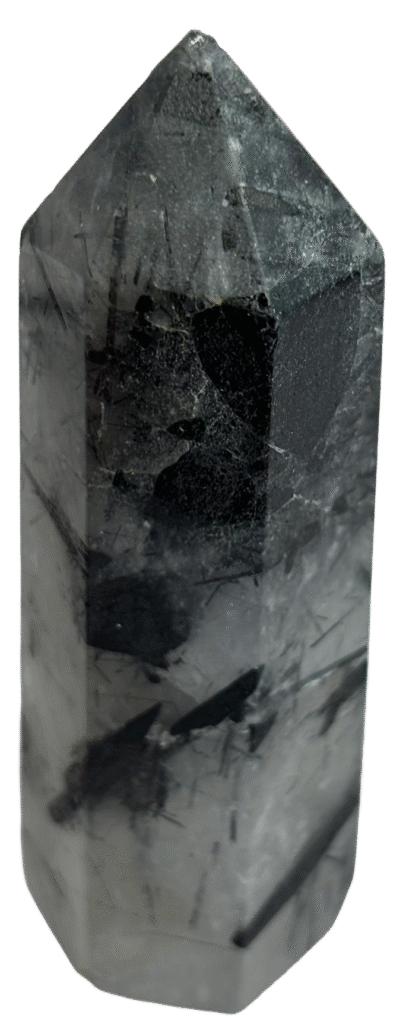
ToThe name Tourmaline in Quartz refers to the natural combination of black tourmaline (schorl) embedded within clear or milky quartz. The term tourmaline originates from the Sinhalese word turmali, meaning “mixed gems,” as early traders often confused tourmaline with other gemstones due to its wide colour range. When the two minerals occur together, the stone is commonly called Tourmalinated Quartz, Black Tourmaline in Quartz, or simply Tourmaline Quartz.
This striking mineral pairing symbolises the union of light and dark, blending quartz’s amplifying energy with tourmaline’s grounding protection.
Composition and Physical Characteristics
Tourmaline in Quartz is a silicate mineral composite made of two distinct minerals:
- Quartz (SiO₂) – a silicon dioxide crystal known for energy amplification and clarity.
- Tourmaline (Na(Fe,Mg)₃Al₆(BO₃)₃Si₆O₁₈(OH)₄) – a boron silicate mineral, typically black (schorl) in this variety.
The black needle-like or rod-shaped inclusions of tourmaline form striking patterns within the translucent to transparent quartz host, creating dramatic visual contrast.
Physical characteristics:
- Hardness: 7–7.5 on the Mohs scale
- Lustre: Vitreous to silky
- Transparency: Transparent to translucent
- Colour: Clear to milky quartz with black or dark grey inclusions
- Crystal system: Hexagonal for quartz, trigonal for tourmaline
- Fracture: Conchoidal
This combination creates a stone of both aesthetic beauty and energetic duality — the clarity of quartz harmonising with the protective nature of black tourmaline.
Varieties
While black tourmaline (schorl) is the most common inclusion, other rare varieties include:
- Green Tourmaline in Quartz: Offers a softer, heart-centred vibration.
- Pink Tourmaline in Quartz: Enhances emotional healing and compassion.
- Rutile-Tourmaline Quartz Mixes: Combine golden rutile needles with dark tourmaline strands for added brilliance.
However, Black Tourmaline in Quartz remains the most widespread and energetically potent form.
Geographical Locations
Tourmaline in Quartz is found in several regions worldwide where hydrothermal and pegmatitic activity allows both minerals to form together. Major sources include:
- Brazil – Minas Gerais and Bahia regions produce some of the finest specimens.
- Madagascar – known for high transparency and well-defined inclusions.
- India – yields milky quartz varieties with dense black inclusions.
- Pakistan and Afghanistan – produce gem-quality crystals.
- United States – especially in California and Maine.
- China and Africa – significant emerging sources for commercial markets.
Archaeological and Significant Finds
While there are no known ancient artefacts specifically featuring Tourmaline in Quartz, both minerals were revered individually in antiquity. Quartz was used in ritual tools and amulets by Egyptians and Romans, while black tourmaline was valued by ancient magicians as a shield against negative forces. Modern gemologists have prized specimens for their optical clarity and intricate needle inclusions, which often form unique natural patterns within the stone.
Historical and Current Usage
Historically, quartz and tourmaline each held spiritual significance — quartz symbolised clarity and divine connection, while tourmaline was a guardian stone of protection. Their natural fusion in Tourmaline in Quartz is now viewed as a harmonious marriage of these two energies.
In modern usage, this stone is highly sought after for:
- Jewellery – polished cabochons, pendants, and beads.
- Energy work – balancing and cleansing negative environments.
- Meditation tools – aiding in grounding while maintaining spiritual awareness.
- Interior décor – adding both visual appeal and protective energy to living spaces.
Interesting Facts
- Tourmaline is pyroelectric and piezoelectric, meaning it can generate an electrical charge through heat or pressure — a property once used in scientific experiments.
- Quartz amplifies any energy or intention directed into it, enhancing tourmaline’s protective qualities.
- Each Tourmaline in Quartz stone has a unique inclusion pattern, making no two specimens alike.
- Known as a stone of “spiritual yin-yang,” it embodies harmony between polar energies — grounding and uplifting simultaneously.
Folklore, Superstition, Legends, and Tales
In ancient folklore, black tourmaline was considered a “stone of protection”, shielding its bearer from dark magic, jealousy, and misfortune. Clear quartz, meanwhile, was the “ice of the gods,” symbolising purity and divine wisdom. When these forces merged naturally in Tourmaline in Quartz, mystics saw it as a union of heaven and earth, representing equilibrium and transformation.
Legends suggest that Tourmaline in Quartz absorbs negative energy and transmutes it into light, serving as a spiritual alchemist for the soul. It was also carried by travellers as a talisman against danger and psychic attack.
Mystical Healing Properties
Tourmaline in Quartz combines the metaphysical powers of both minerals, creating one of the most balanced and synergistic stones in crystal healing.
Emotional Healing:
- Dispels fear, anxiety, and emotional chaos.
- Grounds scattered thoughts while promoting mental clarity.
- Encourages self-acceptance and resilience during difficult transitions.
Spiritual Healing:
- Balances yin and yang energies within the aura.
- Protects against psychic attack and energetic vampirism.
- Aids meditation by grounding spiritual experiences into physical awareness.
Physical Healing (Metaphysical):
- Said to strengthen the immune system and detoxify the body.
- Balances electromagnetic energy and shields against radiation.
- Promotes physical vitality and emotional endurance.
Astrology and the Zodiac
Tourmaline in Quartz resonates strongly with Libra, Capricorn, and Scorpio, as these signs benefit from balance, grounding, and emotional protection. It also harmonises with Gemini, offering focus and inner calm amid mental overstimulation.
Planetary associations include Saturn (for discipline and grounding) and Mercury (for clarity and communication).
The Chakra System
This stone aligns multiple chakras simultaneously, making it a powerful balancing crystal:
- Root Chakra (Muladhara): Provides grounding and stability.
- Crown Chakra (Sahasrara): Opens spiritual awareness and connection.
- Heart Chakra (Anahata): Harmonises emotional energy, especially in pink or green varieties.
The dual energies of light and dark create harmony between the lower and higher energy centres, allowing for balanced personal development.
Use as a Birthstone and for a Wedding Anniversary
Though not an official birthstone, Tourmaline in Quartz is a modern alternative for October, complementing tourmaline’s association with that month.
It also makes a meaningful 8th wedding anniversary gift, symbolising unity, balance, and the strength of partnership through life’s contrasts.
Crystal Combinations: What Works Well and What to Avoid
Crystals that Work Well with Tourmaline in Quartz:
- Clear Quartz: Further amplifies the stone’s energy.
- Smoky Quartz: Enhances grounding and protection.
- Amethyst: Deepens meditation and psychic awareness.
- Selenite: Cleanses and recharges its dual energies.
Crystals to Avoid Combining with Tourmaline in Quartz:
Moldavite: Can overstimulate the aura when used simultaneously with strong grounding stones.ony of opposites and the strength of unity, making it a meaningful choice for couples celebrating enduring love and partnership.
Carnelian or Citrine: Their intense fiery energy may disrupt the stone’s calming balance.
Tourmaline in Quartz
Discover the healing properties of Tourmaline in Quartz. This protective crystal combines the grounding power of black tourmaline with amplifying clear quartz.
