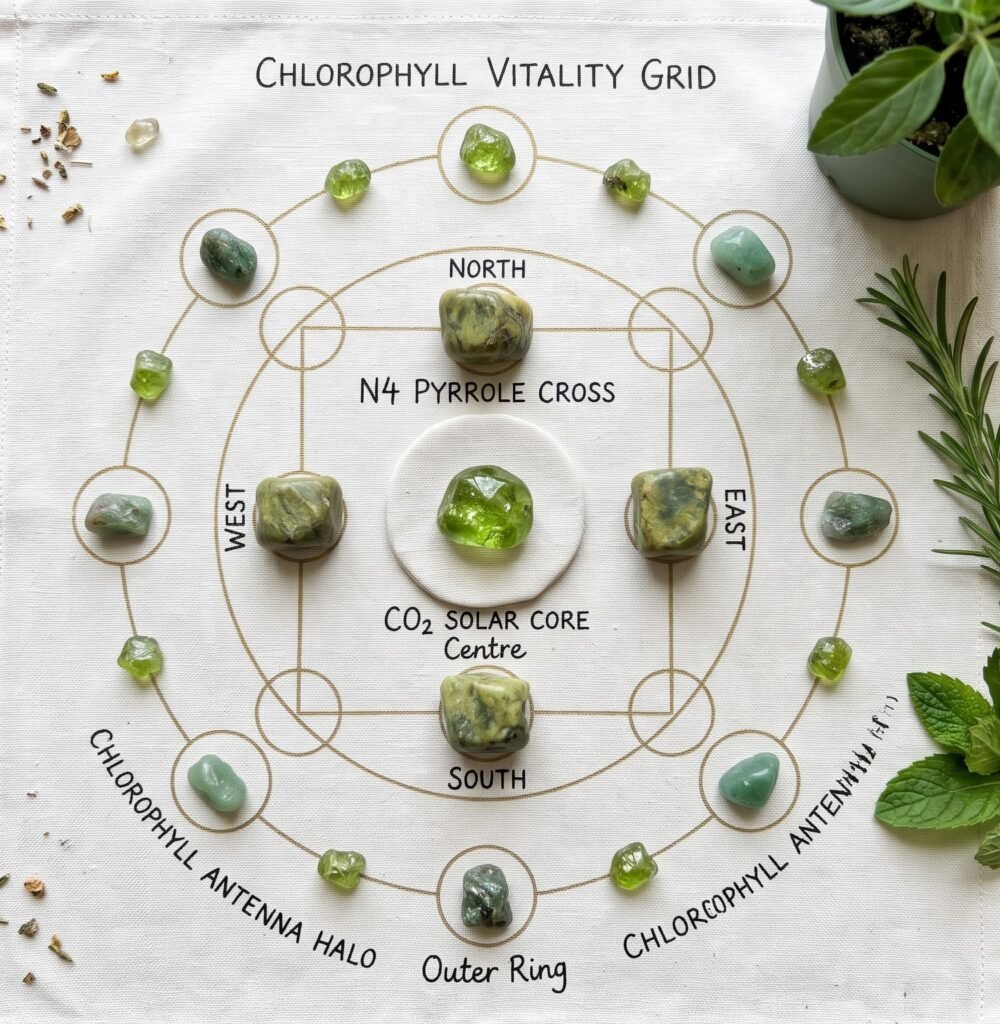
At the exact geometric heart of every green leaf on Earth sits a single, iridescent atom of magnesium. Locked inside the four-pointed nitrogen cross of the chlorophyll-a molecule (C₅₅H₇₂MgN₄O₅), this divalent magnesium ion (Mg²⁺) acts as nature’s ultimate solar antenna—capturing photons of red and blue sunlight at 662 nm and 430 nm and transmuting raw stellar energy into the chemical lifeblood of our biosphere. While mineral collectors and crystal practitioners often celebrate magnesium-bearing stones such as Peridot, Serpentine, and Magnesite for their earthly grounding and soothing cellular resonance, the element’s deepest alchemical secret unfolds silently inside the botanical kingdom.
In this guide, we bridge molecular biochemistry and sacred geometry to explore how the square-planar symmetry of the magnesium porphyrin ring mirrors ancient mandala architecture. You will discover why nature chose magnesium over iron (Fe²⁺) or copper (Cu²⁺) to anchor photosynthesis, how this molecular blueprint translates into living botanical crystal grids, and practical ways to harness the solar vitality of magnesium minerals alongside green plant allies in your own energy work.
Molecular Geometry of Chlorophyll-a
Structurally, chlorophyll-a (C₅₅H₇₂MgN₄O₅) is a molecular masterpiece that combines a light-harvesting geometric “head” with a hydrophobic anchoring “tail”:
| Structural Component | Chemical Composition | Sacred Geometry & Spatial Architecture | Functional Role in Solar Alchemy |
| Central Metal Core | Single Mg²⁺ion | Central focal point (Bindu / solar axis) | Stabilises ring rigidity and tunes electron excitation energy |
| Chlorin (Porphyrin) Head | Four pyrrole rings linked by methine bridges | Planar 4-fold square-planar macrocycle | Absorbs red (662 nm) and blue (430 nm) solar photons |
| Nitrogen Coordination Bonds | Four inward-pointing nitrogen atoms (N₄) | Symmetrical square-planar cross around Mg²⁺ | Holds the magnesium ion securely without magnetic interference |
| Phytol Tail | Long 20 carbon isoprenoid hydrocarbon chain | Linear/helical lipid anchor | Embeds chlorophyll into chloroplast thylakoid membranes |
Why Only Magnesium Can Sit at the Centre
Nature did not choose magnesium at random. If a transition metal such as iron (Fe²⁺) or copper (Cu²⁺) occupies the exact same porphyrin ring, the molecule instantly dissipates absorbed sunlight as wasted heat rather than passing the energy onward. Because magnesium has a closed-shell electronic configuration with zero unpaired electrons, it holds the four surrounding nitrogen rings in a taut, flat geometric plane while keeping captured photon energy suspended long enough (nanoseconds) to trigger electron transfer.
Photosynthesis as Light-to-Matter Alchemy
In esoteric and alchemical tradition, true alchemy is the elevation of dense matter through solar illumination. Inside plant chloroplasts, magnesium-centred chlorophyll performs this exact operation every second of daylight:
- Photon Capture (Solar Reception): Sunlight strikes the flat magnesium-porphyrin ring, exciting a delocalised electron in its conjugated $\pi$-bond network to a higher energy state.
- Resonance Energy Transfer (The Antenna Cascade): Hundreds of surrounding chlorophyll molecules pass that vibrational energy packet inward toward a special pair of chlorophyll-a molecules at the reaction centre with near 99% quantum efficiency.
- Charge Separation & Water Splitting: The excited electron leaps to an acceptor molecule, while enzymes split water into breathable oxygen O2, protons, and replacement electrons.
- Carbon Fixation (Light into Living Matter): Using the chemical energy generated (ATP and NADPH), the Calvin cycle binds atmospheric carbon dioxide CO2 into glucose sugars literally weaving invisible starlight and air into roots, timber, blossoms, and nourishment.
Botanical Crystal Grids Using Green Magnesium Stones
In holistic energy work, green magnesium bearing minerals resonate directly with the botanical solar-to-heart bridge embodied by chlorophyll. Creating a 4 Fold Porphyrin Botanical Grid mirrors the exact square-planar coordination geometry of the chlorophyll molecule to foster physical vitality, seasonal renewal, and heart-centred grounding.
Recommended Stones & Botanical Placements
- Centre Anchor (The CO2 Solar Core): One Peridot tumbled stone, faceted crystal, or a dry-housed Elemental Magnesium sphere placed at the exact centre on a protective linen disc.
- Four Cardinal Points The N4 Pyrrole Cross): Four Serpentine (Bowenite) or Green Dolomite tumble stones placed at North, South, East, and West 90 degree intervals to form the four-fold porphyrin square.
- Outer Ring (The Chlorophyll Antenna Halo): Eight Peridot chips or Green Aventurine pebbles arranged in an outer circle around the square to mirror the light-harvesting antenna complex.
- Living Botanical Accent: Fresh sprigs of rosemary, mint, or a small healthy houseplant positioned beside (never directly atop moisture-sensitive metals) the grid to anchor living chlorophyll resonance.
Step-by-Step Activation Protocol
- Set the Geometric Base: Lay a clean white linen cloth or wooden grid board printed with a four-fold square-within-a-circle template in a bright, indirect daylight spot.
- Place from Centre Outward: Position the central Peridot or dry Magnesium focal stone first, voicing an intention for vitality, clarity, and gentle renewal.
- Build the Four-Fold Cross: Place the four Serpentine stones at the cardinal points, visualising four balanced pillars supporting your central energy.
- Activate with Sunlight & Intention: Trace an invisible clockwise circle linking the outer stones with a Clear Quartz wand, allowing natural morning light to illuminate the grid for 15 to 20 minutes. (Note: Move light-sensitive stones out of direct midday sun afterward, and keep elemental magnesium strictly dry.)
Magnesium & Chlorophyll Frequently Asked Questions
Why are plants green if chlorophyll absorbs sunlight?
The magnesium-porphyrin ring strongly absorbs high-energy blue-violet light and lower-energy red light while reflecting mid-spectrum green wavelengths 500 – 570 nm which is why healthy chlorophyll rich foliage appears vibrantly green to the human eye.
What happens to plants when soil lacks magnesium?
Because magnesium sits at the core of every chlorophyll molecule, magnesium deficiency causes interveinal chlorosis: older leaves turn pale yellow between dark green veins as the plant strips magnesium from older foliage to feed new growth.
Can I place a green magnesium crystal grid inside a plant pot?
You can safely place water-tolerant Peridot or Serpentine on dry decorative pebbles atop houseplant soil, provided you avoid acidic liquid fertilisers. Never place elemental magnesium metal, raw dolomite, or magnesite in damp potting soil, as moisture and soil acids corrode the specimens.