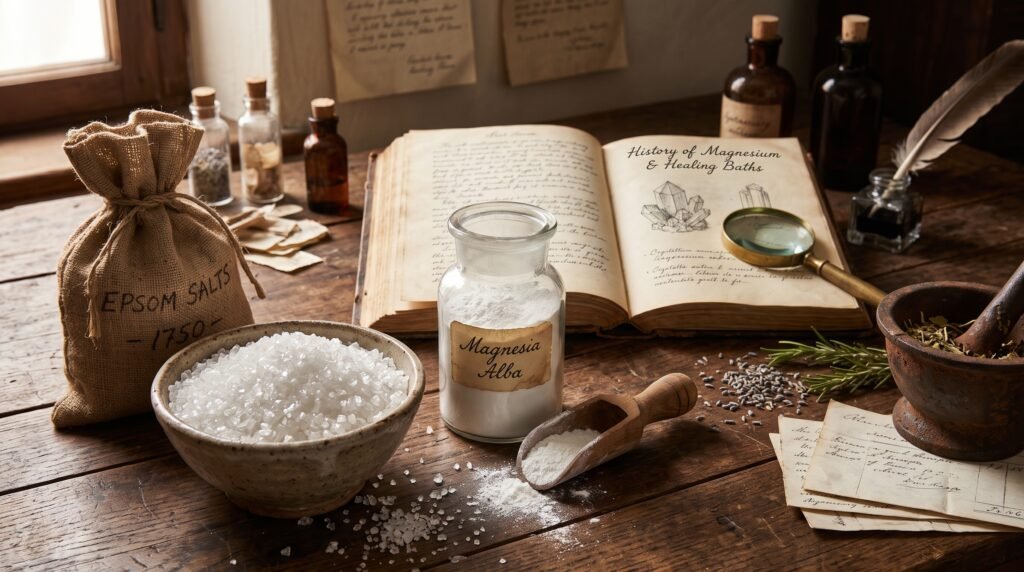
Tracing the story of Epsom Salts And Magnesia uncovers centuries of mineralogical discovery, apothecary lore, and the enduring human reliance on Magnesium For Healing. Long before Sir Humphry Davy isolated elemental magnesium in 1808, ancient Greek physicians in the Thessalian region of Magnesia prized white magnesium rich earths for soothing digestive and inflammatory ailments, while 17th century visitors flocked to the bitter mineral springs of Epsom in Surrey to bathe in and drink waters saturated with natural hydrated magnesium sulphate (epsomite).
Across both classical antiquity and early modern European spa culture, these naturally occurring magnesium compounds bridged the gap between raw geology and restorative wellness. While uncombined metallic magnesium never forms in nature due to its extreme reactivity, water soluble sulphates and gentle magnesium carbonates offered early herbalists, physicians, and bathhouse patrons a reliable, tangible way to ease physical tension and support bodily recovery.
In this historical and mineralogical guide, we explore Epsom Salts And Magnesia from ancient Mediterranean trade routes and 1618 Surrey spring discoveries to modern holistic bathing rituals examining the chemistry, folklore, and enduring legacy of Magnesium For Healing across the ages.
Henry Wicker’s 1618 Discovery in Surrey
The modern story of magnesium in natural wellness begins during a severe summer drought in 1618 on Epsom Common in Surrey, England.
- The Thirsty Cattle Incident: Local farmer and cowherd Henry Wicker noticed a small, water-filled depression on the parched common that remained full despite the dry weather. Hoping to water his herd, he dug out the spring to enlarge the pool only to find that his parched cattle flatly refused to drink from it.
- The Bitter Water Remedy: Tasting the water himself, Wicker discovered it was intensely bitter and salty. However, townsfolk soon noticed that wading through the spring rapidly healed stubborn skin ulcers, grazes, and inflammatory rashes, while drinking small quantities acted as a gentle internal cleanser.
- The Birth of Europe’s Premier Spa Town: Word of the miraculous “Epsom waters” spread rapidly across Stuart London. By the mid 17th century, aristocrats, physicians, and diarist Samuel Pepys (who recorded visiting Epsom Wells in July 1663) flocked to Surrey to “take the waters.”
- From Liquid Spring to Evaporated Crystals: In 1695, English physician and botanist Dr Nehemiah Grew successfully evaporated the spring water to isolate pure, bitter white crystals, securing a royal patent for Sal Mirabile (miraculous salt) forever known worldwide as Epsom salts.
Chemistry of Magnesium Sulphate vs. Magnesium Chloride
Although “magnesium bath salts” are often grouped together in natural wellness, the two primary compounds used in balneotherapy Epsom salts and magnesium chloride flakes have distinct mineralogical origins and chemical behaviours.
| Chemical & Wellness Property | Epsom Salts (Epsomite) | Magnesium Chloride Flakes (Bischofite) | Magnesia Alba (Hydromagnesite) |
| Chemical Formula | MgSO4 · 7H2O | MgCl₂ · 6H₂O | $4\text{MgCO}_3 \cdot \text{Mg(OH)}_2 \cdot 4\text{H}_2\text{O}$ |
| Mineral Name | Epsomite (Heptahydrate) | Bischofite (Hexahydrate) | Hydromagnesite / Magnesite |
| Crystal System | Orthorhombic | Monoclinic | Monoclinic |
| Natural Source | Evaporitic mineral springs & dry lake beds | Ancient subterranean seabeds (e.g., Zechstein Sea) & Dead Sea brines | Altered ultramafic rocks & dolomite veins |
| Hygroscopic Behaviour | Efflorescent (loses water in dry air, stays free-flowing) | Strongly hygroscopic (absorbs moisture from humid air) | Insoluble white powder; absorbs skin oils & sweat |
| Primary Wellness Use | Muscle-soothing baths, foot soaks & botanical scrubs | Deep relaxation soaks, topical “magnesium oil” sprays | Historical antacid, gymnastic/climbing chalk & soothing skin powder |
How Warm Magnesium Baths Work
- Hydrostatic Pressure & Buoyancy: Dissolving $300\text{ g}$ to $500\text{ g}$ of magnesium sulphate or chloride into warm water increases water density, gently offloading mechanical tension from tired joints and tight musculature.
- Thermal Vasodilation & Nervous Calm: Warm water immersion ($37^\circ\text{C} – 39^\circ\text{C}$) dilates peripheral blood vessels and shifts the autonomic nervous system toward parasympathetic “rest-and-digest” dominance—creating an ideal somatic environment for releasing physical restlessness.
- Transdermal Debate vs. Sensory Ritual: While scientific research remains mixed on how much magnesium passes directly through intact outer skin versus hair follicles and sweat glands, warm mineral bathing consistently lowers subjective muscle soreness, softens rough skin through sulphate/chloride osmotic action, and improves sleep readiness.
Historical Balneotherapy & Bath Rituals
Across centuries and cultures, magnesium-rich waters and earths formed the cornerstone of therapeutic bathing traditions:
- Ancient Greek & Roman Magnesia Alba: Classical physicians named the velvety white magnesium carbonate powder gathered near Magnesia in Thessaly magnesia alba (“white magnesia”) to distinguish it from dark magnetic lodestone (magnesia nigra). It was dusted onto chafed skin, mixed into cooling herbal poultices, and taken in spring water to calm digestive acidity.
- The 18th-Century British Spa Circuit: Alongside Bath, Buxton, and Harrogate, Epsom established a structured morning ritual: visitors walked the gravel promenades at dawn, drank measured goblets of warm saline spring water, and soaked in private wooden bathing tubs lined with linen sheets.
- Victorian Apothecary & Botanical Soaks: By the 19th century, British chemists packaged evaporated Epsom crystals in blue glass jars alongside dried English lavender, chamomile flowers, and rosemary sprigs, blending mineral balneotherapy with traditional herbalism.
- Dead Sea & Zechstein Mineral Traditions: In the Levant and Northern Europe, mineral dense brines naturally rich in magnesium chloride ($\text{MgCl}_2$) were prized for soothing dry, reactive skin conditions and restoring vitality after heavy physical labour.
Crafting a Traditional Botanical Magnesium Bath Ritual
To recreate a classic British apothecary soak at home:
- Base Mineral Ratio: Add 2 cups ($450\text{ g}$) of pure pharmaceutical-grade Epsom salts (or magnesium chloride flakes) to a standard warm bath under running water so the crystals dissolve completely.
- Aromatic & Crystal Pairing: Infuse a muslin bag with dried lavender buds and oat straw, and place tumbled Magnesite, Lepidolite, or Amethyst on the bath ledge (never place raw salt sensitive minerals or elemental metals directly inside hot bathwater).
- Soak Window: Rest quietly for 15 to 20 minutes, rinse lightly with lukewarm water afterward, and hydrate with a glass of plain water.
Safety & Contraindications
While magnesium mineral baths are gentle for most healthy adults, responsible apothecary practice requires clear safety boundaries:
- External vs. Internal Use: Modern wellness practices reserve Epsom salts and magnesium chloride strictly for external bathing and foot soaks. Oral ingestion acts as a potent osmotic laxative and should never be undertaken without medical supervision.
- Medical Contraindications: Individuals with severe kidney impairment (reduced ability to clear excess magnesium ions), low blood pressure, open skin wounds, or acute skin infections should consult a GP before taking concentrated mineral baths.
- Pregnancy & Sensitive Skin: Pregnant individuals should keep bath temperatures comfortably warm rather than hot and consult their midwife before using concentrated mineral salts or essential oils. Always patch-test topical magnesium chloride (“magnesium oil”) on the forearm first, as high concentrations can cause temporary tingling on dry skin.
Frequently Asked Questions
Why are Epsom salts called “salts” if they contain no sodium? I
In chemistry, a “salt” is any ionic compound formed by the reaction of an acid and a base. Epsom salt is magnesium sulphate—composed of positively charged magnesium ions ($\text{Mg}^{2+}$) and negatively charged sulphate ions ($\text{SO}_4^{2-}$)—and contains zero sodium chloride (table salt).
Should I choose Epsom salts or magnesium chloride flakes for a bath?
Both create deeply relaxing warm mineral soaks. Epsom salts dissolve briskly, cost less for generous full-body baths, and provide sulphate ions traditionally favoured for post-exercise muscle recovery. Magnesium chloride flakes are harvested from ancient seabeds, feel slightly silkier in the water, and are ideal for sensitive skin or concentrated foot baths.
Can I put crystals directly into my Epsom salt bath?
Only water-safe quartz varieties (such as tumbled Rose Quartz, Amethyst, or Clear Quartz) can safely enter warm bathwater. Never place magnesium-bearing carbonates like Magnesite or Dolomite, porous stones like Howlite, or elemental magnesium metal into bathwater, as heat and dissolved salts dull their polish and trigger surface corrosion.