
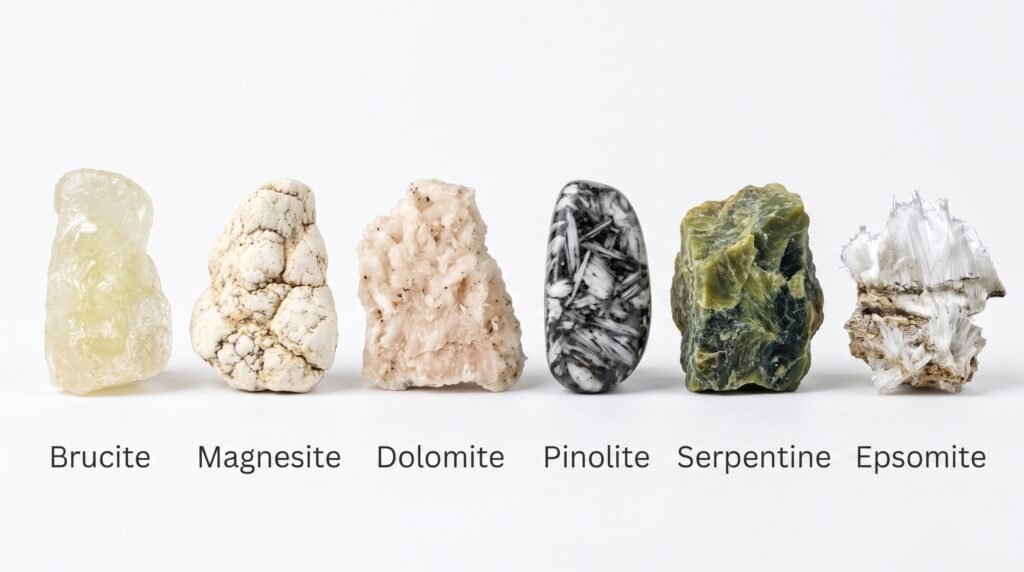
Mastering a safe Magnesium Minerals Cleansing, Charging and storage routine is essential for preserving both natural magnesium-bearing stones and vapour-deposited elemental magnesium clusters. Because the magnesium family spans everything from durable silicate gemstones like peridot (Mohs 6.5–7.0) to porous carbonates like magnesite and dolomite (Mohs 3.5–4.5), water-soluble sulphates like epsomite, and chemically reactive pure magnesium metal (Mohs 2.0–2.5), applying a single universal cleansing ritual can permanently dull, pit, or dissolve sensitive specimens.
While hardy silicates tolerate brief rinsing without issue, porous magnesium carbonates absorb dyes, skin oils, and salt moisture, and pure crystalline magnesium reacts directly with liquid water and chloride ions to form a chalky white crust of magnesium hydroxide. Understanding each specimen’s chemical composition and Mohs hardness ensures you never accidentally scratch a delicate crystal face or strip its natural lustre.
In this practical collector and practitioner handbook, we cover Magnesium Minerals Cleansing, Charging and Storing protocols across every major mineral class—detailing which stones allow brief water contact, which require strictly dry acoustic or selenite charging, and how to store reactive specimens safely for decades.
Understanding the Mohs Hardness Vulnerability of Magnesium Stones
To care properly for magnesium minerals, it helps to understand the three physical vulnerabilities built into their crystal chemistry:
- Low Scratch Resistance (Mohs 2.5–4.5): Everyday household dust contains microscopic grains of airborne quartz (Mohs 7.0), while copper coins sit around 3.5 and steel blades at 5.5. Soft magnesium stones—especially Brucite (2.5–3.0) and chalky Magnesite (3.5–4.5)—can be scratched simply by rubbing against harder crystals or unlined wooden trays.
- Acid & Water Reactivity: Magnesite ($MgCO_3$), Dolomite ($CaMg(CO_3)_2$), and Pinolite are carbonate minerals. Even mildly acidic tap water, rainwater, or skin perspiration slowly dissolves their surface polish, turning a glossy cabochon chalky and dull. Epsomite ($MgSO_4 \cdot 7H_2O$) is completely water-soluble and will disintegrate upon contact with moisture.
- Micro-Porosity & Dye Sensitivity: Cryptocrystalline Magnesite has a naturally porous, unsealed texture that readily absorbs oils, lotions, coloured fabrics, and cleaning detergents—and if the specimen has been dyed blue to mimic turquoise, moisture or alcohol will strip the pigment.
| Magnesium Mineral | Chemical Class | Mohs Hardness | Water & Salt Tolerance | Recommended Care Method |
| Brucite | Hydroxide | 2.5 – 3.0 | Strictly Dry Only | Soft dry brush; smoke or sound cleansing |
| Magnesite | Carbonate | 3.5 – 4.5 | Avoid Soaking (brief damp wipe only) | Smoke, sound, moonlight & Selenite plate |
| Dolomite | Double Carbonate | 3.5 – 4.0 | Avoid Soaking (etches in acids/salt) | Smoke, sound, moonlight & soft cloth |
| Pinolite | Carbonate + Graphite | 3.5 – 4.0 | Strictly Dry Only (graphite smears wet) | Dry microfibre wipe; sound or smoke cleansing |
| Serpentine (Lizardite/Antigorite) | Phyllosilicate | 2.5 – 5.5 | Brief lukewarm rinse (polished only) | Damp cloth wipe; moonlight & Earth contact |
| Epsomite | Hydrated Sulphate | 2.0 – 2.5 | Dissolves Instantly in Water | Sealed dry display case; sound cleansing only |
Safe Smoke, Sound & Moonlight Cleansing Methods
Because moisture and salt damage soft magnesium carbonates and hydroxides, dry energetic cleansing is always the safest and most effective approach.
1. Botanical Smoke Cleansing (Smudging)
- Best for: Magnesite, Dolomite, Pinolite, Brucite, and Serpentine.
- How to do it: Light a bundle of dried rosemary, cedar, mugwort, or a stick of ethically sourced palo santo or frankincense resin in a fireproof dish. Pass each magnesium specimen through the rising smoke for 30 to 60 seconds while setting a clear intention to release stagnant energy.
- Why it works: Smoke leaves zero moisture residue on porous surfaces and does not interact chemically with carbonate minerals.
2. Acoustic Sound Cleansing
- Best for: Delicate raw clusters such as botryoidal yellow Brucite, saddle-shaped Dolomite crystals, and fibrous or powdery specimens.
- How to do it: Place your magnesium stones beside a brass singing bowl, crystal singing bowl, or tuning fork (432 Hz or 528 Hz) and strike the instrument cleanly, letting the harmonic vibrations wash over the minerals for one to two minutes.
- Why it works: Sound waves clear stagnant energetic buildup non-invasively without physical contact, abrasion, or humidity.
3. Full Moonlight & Selenite Charging
- Best for: Recharging all magnesium minerals overnight.
- How to do it: Place your stones on an indoor windowsill bathed in full moonlight overnight (avoiding outdoor dew or rain), or rest them atop a flat Selenite charging slab for four to six hours.
- Care tip: Set soft Magnesite or Brucite gently onto a Selenite plate rather than sliding them across the surface, as Selenite’s directional cleavage edges can scuff softer minerals.
Why Salt Water, Ultrasonic Cleaners & Harsh Sunlight Cause Damage
Avoid these four common crystal-care mistakes when handling magnesium minerals:
- Never Use Sea-Salt Bowls or Salt Water: Salt crystals (Halite, Mohs 2.5) leave abrasive microscopic grit inside porous Magnesite and Dolomite, while saline solutions accelerate chemical etching and dull surface lustre.
- Never Put in Ultrasonic or Steam Cleaners: High-frequency ultrasonic vibrations and pressurised steam will fracture natural cleavage planes in Dolomite and Magnesite and strip polymer stabilisers or dyes.
- Avoid Prolonged Direct Sunlight: While white Magnesite will not fade like Amethyst, intense UV radiation and heat can dehydrate hydrous minerals like Brucite and Serpentine, fade cobalt-tinted Pink Dolomite, and bleach dyed blue Magnesite.
- Keep Away from Essential Oils & Perfumes: Porous Magnesite acts like an aromatherapy diffuser bead—applying essential oils directly onto raw or tumbled Magnesite permanently stains the stone yellow or brown and can soften the surface binder.
Step-by-Step Physical Cleaning & Storage Protocol
Follow this simple four-step routine to keep your magnesium minerals pristine and scratch-free:
- Dust Gently with a Soft Dry Brush: For raw crystal clusters like saddle-shaped Dolomite or delicate yellow Brucite, use a clean, dry camel-hair artist’s brush or makeup brush to lift dust from crevices without applying pressure.
- Wipe Polished Stones with a Dry Microfibre Cloth: To remove skin oils from tumbled Magnesite, Pinolite, or polished Serpentine, buff lightly with a dry, lint-free microfibre jewellery cloth. If needed, barely dampen the corner of the cloth with distilled water, wipe quickly, and buff dry immediately.
- Wrap Individually in Soft Pouches: Never toss magnesium stones loose into a bowl alongside Quartz, Amethyst, Citrine, or Garnet (Mohs 7.0–7.5). Store each specimen in its own velvet, suede, or organic cotton drawstring pouch.
- Use Foam-Lined Compartments in a Dry Environment: Arrange pouches or raw specimens inside a compartmented collector’s box lined with acid-free foam or felt. Keep storage boxes away from steamy bathrooms or damp windowsills, especially if your collection includes Pinolite (whose graphite matrix can smudge if damp) or Epsomite.
Frequently Asked Questions
Can I cleanse Magnesite or Dolomite with running tap water?
It is best avoided. While a brief 5-second rinse under lukewarm water will not ruin solid tumbled Magnesite, tap water often contains chlorine, dissolved minerals, and slight acidity that gradually dull carbonate polish over repeated washes. Stick to dry smoke, sound, or moonlight cleansing instead.
How do I clean dyed blue Magnesite (“White Turquoise”) without removing the colour?
Never use alcohol, acetone, soap, or water on dyed Magnesite. Simply buff the surface with a dry microfibre cloth and store it away from direct sunlight and skin lotions.
Is Selenite safe to use for charging Brucite and Magnesite
Yes, Selenite is completely dry and energetically compatible for charging, provided you place soft stones like Brucite (Mohs 2.5–3.0) and Magnesite (Mohs 3.5–4.5) gently onto the Selenite slab without dragging them across sharp crystal ridges.
